Winnipeg on track to reject managed encampment pilot
Front-line agencies disappointed; report estimates program would cost up to $1.39 million
Wednesday, Apr. 15, 2026
 MIKE DEAL / FREE PRESS
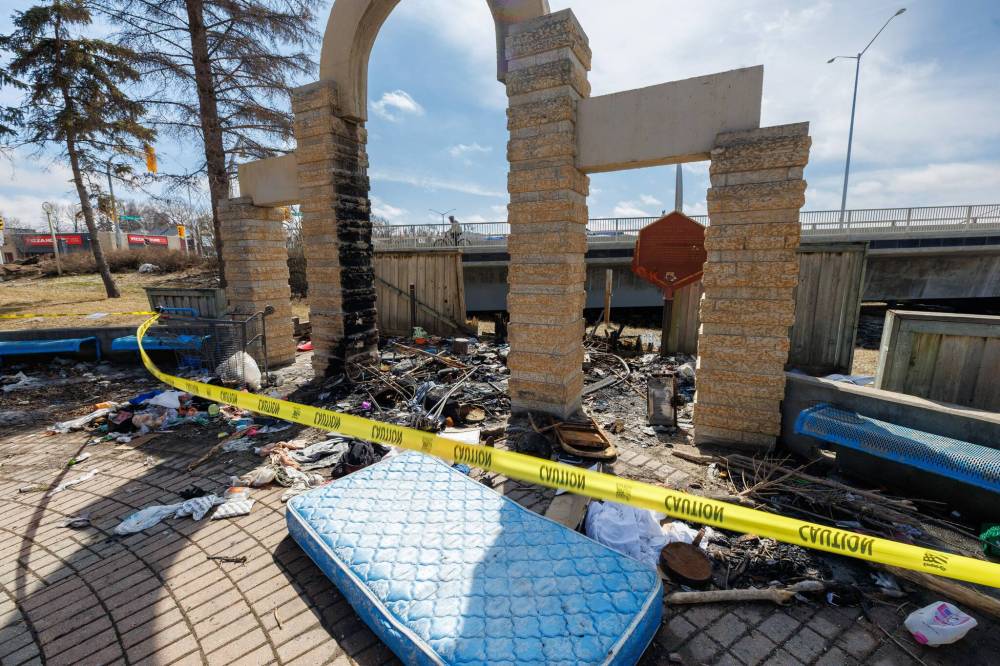
The burned out remains of an encampment at the Joseph Royal Park off of Tache Avenue next to the Provencher Bridge.
In a small park nestled against the Provencher Bridge, the burned-out remnants of a new encampment are blocked off by caution tape.
The Joseph Royal Park camp has been deserted — or taken down by city bylaw officers — but on Wednesday, the acrid smell of smoke hung in the air. Charred items are scattered on the ground, proof that people once called the St. Boniface park home: food and drink containers, clothing, bicycle parts, naloxone kits, a mattress.
A sign that warns loitering isn’t allowed remained upright — one of the steps in the city’s encampment response protocol — and a laminated note attached to the caution tape says the Winnipeg Fire Paramedic Service has deemed the site vacant and officers would make arrangements to clean the space if no one returned.
As the weather warms up and more people pitch tents and hang tarps in public areas, city council has been advised to abandon the idea of a “managed encampment” pilot project owing to time constraints and high operational costs.
In December, city council requested a report to determine the feasibility of running a temporary managed encampment this spring and summer. It could include portable washrooms, garbage bins and on-site service providers to offer resources to the homeless.
The public service recommends the city drop the idea. Its report is on the agenda at council’s executive policy committee meeting on April 21.
“Given the time constraints to operationalize a managed encampment site before spring, the significant operational costs, the current work of the province, which limits its ability to support this pilot, and the need to engage the community related to site selection, design and operations, the public service is not recommending that the pilot move forward at this time,” the report reads.
“To proceed, further analysis is needed, including community engagement related to site selection, a comprehensive legal review on the project, and a more detailed cost evaluation.”
The report suggests the site, which could host 24 to 60 people, based on size and the number of staff needed, could cost from $707,168 to $1.39 million to operate from April to August. The estimates don’t include security, wrap-around supports or other on-site staff.
Coun. Cindy Gilroy put forward the motion to open up an immediate safe place for people who haven’t yet accepted housing or had gone back to the streets. She called it a “revolving door” situation that has happened to some people in her Daniel McIntyre ward.
“It’s upsetting that we’re not trying to find some kind of solution over the summertime. I’m starting to see people that have been housed that are coming back out,” Gilroy said.
“As the weather warms up, some people are coming back out, and I’m also really starting to understand how difficult it is to house some of the people that are experiencing a lot of trauma, addictions and mental health (issues).”
This is the first spring since the city implemented its encampment policy in November, which bans tents in a number of public spaces and includes steps the city must take to contact people in encampments and offer housing and other supports.
Gilroy said the policy doesn’t affect everyone in need and she expects a “really high volume of homelessness this summer.”
Some Canadian cities have versions of managed camps that offer amenities ranging from basic washroom and water facilities to tiny homes, laundry and internet.
Organizations that help the homeless in Winnipeg have different opinions about the managed encampment model.
Investing in a managed camp often means cutting services in other areas, and works against one of the ways vulnerable people are able to keep themselves safe — being able to pick up and move when a situation becomes dangerous, said Kate Sjoberg, the executive director of Resource Assistance for Youth.
“In this policy environment, people are already pressuring folks who are in places where they’re allowed to be, to move away from those places. So the moment that a managed encampment exists, the very existence of that encampment increases the pressure that campers feel in other areas to get out of the spaces they’re in,” she said.
“In other words, it curtails people’s ability to move to the places where they feel safest.”
East of the Red River, Marion Willis leads St. Boniface Street Links, whose staff have counted 11 new camps in their area since the weather started warming up.
Willis said she supported the managed encampment pilot idea and is frustrated with the city’s handling of the homeless file.
“The managed encampment-to-housing site would have really supported that, that would have been the game changer here in Winnipeg. But the city is not interested, in my view, in doing much of anything,” she said.
“They put it all on the province, and think it’s their responsibility … it’s a very uninformed, unintelligent approach to ending homelessness on this side of the city, quote me on that.”
Street Links currently doesn’t receive funding from the City of Winnipeg, Willis said.
Main Street Project is Winnipeg’s sole provider for 24-7 homeless outreach. Without support, Willis said she expects the summer to be dire in her community.
“Normally it’s not like this, and I’m expecting one of the worst encampment seasons that we’ve ever seen over here.”
Mayor Scott Gillingham said he plans to support the recommendation to axe the managed encampment pilot at the EPC meeting, adding the city would continue to partner with the province on its Your Way Home strategy for people who are chronically homeless.
Council asked city staff to consult with the province about funding options for a managed encampment, but the report said the government responded by saying it wouldn’t boost funding or divert existing services this summer.
The province suggested supporting a pilot project would force it to reduce resources on the Your Way Home strategy and its “navigation centre” on the Disreali Freeway, which it said would offer many of the supports suggested in the managed camp proposal.
Sjoberg said her concerns about managed encampments apply to the navigation centre.
“There’s a lot of wisdom, benefit, and frankly, best practice to ensuring that the services that people who are living unsheltered need are available in a multiplicity of spaces throughout the city,” she said.
The city’s encampment policy co-ordination team is ramping up inspections in line with the warmer weather, and has cleared 20 sites since the policy was approved in November.
— With files from Scott Billeck and Nicole Buffie
 MIKE DEAL / FREE PRESS
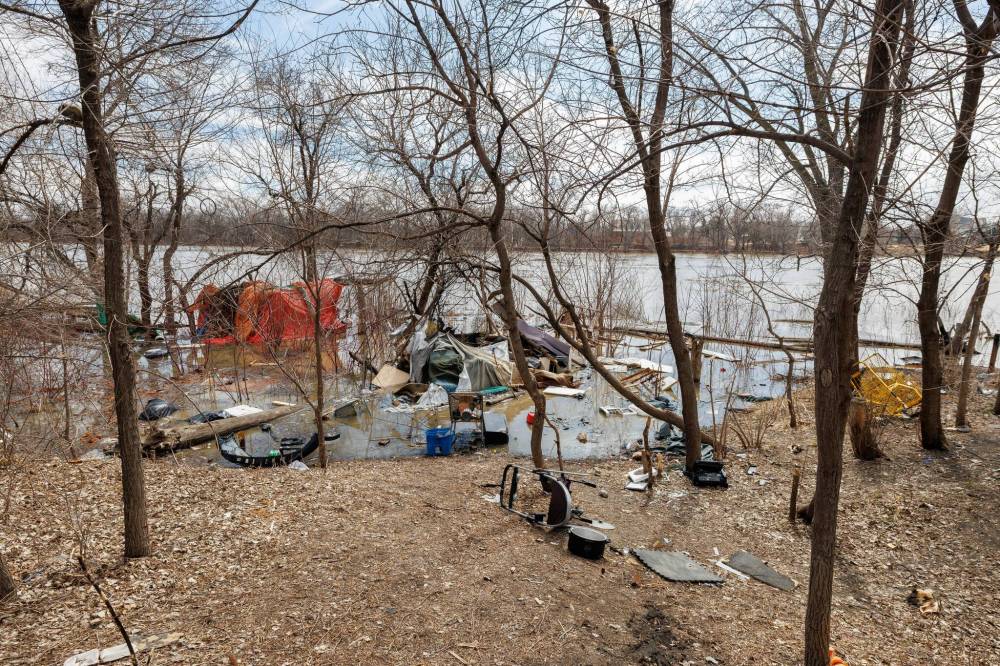
Trash is all that remains of an encampment on the Red River along Waterfront Drive.
Winnipeg Free Press





 Prev
Prev





 Linear Mode
