HomeDiagramsDatabaseMapsForum About
     

Go Back   SkyscraperPage Forum > Regional Sections > Canada


Reply

 
Thread Tools Display Modes
     
     
  #3081  
Old Posted Feb 14, 2026, 12:31 AM
Changing City's Avatar
Changing City Changing City is online now
Registered User
 
Join Date: Nov 2016
Posts: 7,646
Quote:
Originally Posted by whatnext View Post
Hmmm, now how could it be possible that home prices are so out of whack with reported local incomes.....?
Duh. It's Chinese money laundering. Last year in Vancouver almost 24,000 homes were sold, and all of them were bought with cash by people with non-anglicized surnames. Happy now?
__________________
Contemporary Vancouver development blog, https://changingcitybook.wordpress.com/ Then and now Vancouver blog https://changingvancouver.wordpress.com/
Reply With Quote
     
     
  #3082  
Old Posted Feb 14, 2026, 12:40 AM
whatnext whatnext is online now
Registered User
 
Join Date: Feb 2009
Location: Vancouver
Posts: 26,728
Quote:
Originally Posted by Changing City View Post
Duh. It's Chinese money laundering. Last year in Vancouver almost 24,000 homes were sold, and all of them were bought with cash by people with non-anglicized surnames. Happy now?
Again, why the kneejerk response? What's the explanation for two markets that shared interest rates with all those other North American cities having such huge increases unsupported by local incomes? Why is Vancouver's home price/income ratio so far out of line with every other city on the list? It isn't like bankers in Vancouver were particularly lax or generous handing out mortgages.

It's one thing to say "Vancouver's so beautiful it will always be expensive" but then what about Toronto?
Reply With Quote
     
     
  #3083  
Old Posted Feb 14, 2026, 1:05 AM
casper's Avatar
casper casper is offline
Registered User
 
Join Date: Nov 2011
Location: Victoria
Posts: 12,217
Quote:
Originally Posted by whatnext View Post
Again, why the kneejerk response? What's the explanation for two markets that shared interest rates with all those other North American cities having such huge increases unsupported by local incomes? Why is Vancouver's home price/income ratio so far out of line with every other city on the list? It isn't like bankers in Vancouver were particularly lax or generous handing out mortgages.

It's one thing to say "Vancouver's so beautiful it will always be expensive" but then what about Toronto?
There is mountains blocking growth to the north. There is the US blocking growth to the south. There water blocking growth to the west. There agricultural land reserves blocks growth in other parts.

Did I mention the puddle on a post and chandelier under the bridge. Developers are required to spent money on making it an interesting place to live.

We don't want to talk about view cones.

The reality is its not Calgary or Saskatoon where there is open field that can be turned into urban sprawl.
Reply With Quote
     
     
  #3084  
Old Posted Feb 14, 2026, 1:14 AM
someone123's Avatar
someone123 someone123 is online now
hähnchenbrüstfiletstüc
 
Join Date: Nov 2001
Location: Vancouver
Posts: 35,304
That argument by itself doesn't fully explain why multi-unit highrises are expensive. Sure, take it as a given that the land is valuable and a land cost of $1.5M makes a house prohibitively expensive for most. If you allow 10 units on it the per-unit land cost of $150,000 is more manageable.

The other part of the puzzle (most of the puzzle) is that the unit counts are capped, construction itself is expensive, and then there are very high development fees tacked on top. That is how you make shoeboxes in mid neighbourhoods unaffordable.
Reply With Quote
     
     
  #3085  
Old Posted Feb 14, 2026, 2:30 AM
Changing City's Avatar
Changing City Changing City is online now
Registered User
 
Join Date: Nov 2016
Posts: 7,646
Quote:
Originally Posted by someone123 View Post
That argument by itself doesn't fully explain why multi-unit highrises are expensive. Sure, take it as a given that the land is valuable and a land cost of $1.5M makes a house prohibitively expensive for most. If you allow 10 units on it the per-unit land cost of $150,000 is more manageable.

The other part of the puzzle (most of the puzzle) is that the unit counts are capped, construction itself is expensive, and then there are very high development fees tacked on top. That is how you make shoeboxes in mid neighbourhoods unaffordable.
You're looking at the economics of new construction, which is presumably what the thread was initially discussing, but the house price to income ratio is based on the value of homes sold, compared to the median household income. That's mostly about the existing stock of buildings, not just new ones.

On a world basis, Canadian cities are quite a bit down the list of expensive cities. That probably means it's not as straightforward as looking at home price and income and jumping to a conclusion that a few factors explain everything.

One factor is obviously that once a household has secured equity in the ownership market, many can leverage that equity to continue to trade up to bigger or more valuable properties over many years. In that situation, income isn't as important (or relevant) to explain what they can afford.

I think Canadian cities are very attractive to live in, and so people are willing to pay more to live here, because they're Canadian cities. Which is why most US cities are 'more affordable' than some Canadian cities.

Another factor in both Vancouver and Toronto is that property is favoured as an investment, by many ordinary people (compared to having investments in the stock market, for example). I've known a surprising number of neighbours, and colleagues, who have owned investment properties that they rent. Often they're apartments Downtown, or in other municipal centres. Sometimes they're the 'spare' apartment that results from them getting married, or partnered up. That becomes a feedback loop because they have an asset that (historically) has increased in value, while also paying for itself as it was bought when prices were lower, and rents have steadily increased to cover the mortgage, if there still is one. That situation no longer holds true, and it's presumably why sales in Vancouver and even more in Toronto have fallen off a cliff in the past couple of years. Prices are falling slowly, because there's still enough buyers to sustain some sort of market, and potential sellers are generally not desperate enough to sell at any price. That means the price to income ratio is falling, slowly, as well.
__________________
Contemporary Vancouver development blog, https://changingcitybook.wordpress.com/ Then and now Vancouver blog https://changingvancouver.wordpress.com/
Reply With Quote
     
     
  #3086  
Old Posted Feb 14, 2026, 8:31 PM
someone123's Avatar
someone123 someone123 is online now
hähnchenbrüstfiletstüc
 
Join Date: Nov 2001
Location: Vancouver
Posts: 35,304
I think new construction is very important because for most people it's going to put a ceiling on what they'll pay for housing. If brand new decent condos are available for $200k, units in crumbling 80s buildings will not sell for $600k. The condo investment aspect is secondary as well; it relies on a lack of supply gradually driving up prices and generating a return. Houses and condos are almost always depreciating assets. Without the artificial economy of over-regulated building and high taxes, there wouldn't be an investor market for used condos.
Reply With Quote
     
     
  #3087  
Old Posted Feb 14, 2026, 8:41 PM
casper's Avatar
casper casper is offline
Registered User
 
Join Date: Nov 2011
Location: Victoria
Posts: 12,217
Quote:
Originally Posted by someone123 View Post
I was just proposing we add more to the very simply model I replied to, which states that Vancouver housing must be expensive because of the short supply of land.

I think new construction is very important because for most people it's going to put a floor on what they'll pay for housing. If brand new decent condos are available for $200k, units in crumbling 80s buildings will not sell for $600k. The condo investment aspect is secondary as well; it relies on a lack of supply gradually driving up prices and generating a return. Houses and condos are almost always depreciating assets.
The issue becomes how to add more capacity in the market.

The current market conditions are driving "investors" out of condos. That may be a good thing, that results in more condos available for people to buy that actually intend to live in them. The problem has been a lot of the new additions were designed for airbnb so not idea as new built condos but in 10-20 years those units will likely be seen as great "low cost" buys for someone starting out.

The government providing loan guarantees for those wanting to build purpose built rentals should add a lot more units and those units will be designs for people to live in them instead of being hotel rooms with closet kitchens.

The provincial government stepping in an overriding zoning around mass-transit stations is probably going to result in some creative projects.
Reply With Quote
     
     
  #3088  
Old Posted Feb 14, 2026, 8:50 PM
someone123's Avatar
someone123 someone123 is online now
hähnchenbrüstfiletstüc
 
Join Date: Nov 2001
Location: Vancouver
Posts: 35,304
It's not that complicated. Canadian cities used to have highrise zoned areas like the West End of Vancouver or large areas of Toronto etc. and the CMHC used to build or fund housing construction. A lot of that stock remains today's affordable housing.

It is more along the lines of the old Upton Sinclair quote: "It is difficult to get a man to understand something when his salary depends on his not understanding it". Politicians have taken steps to make house prices go up because that benefits them, and are terrified of losing their jobs and net worth from falling prices.
Reply With Quote
     
     
  #3089  
Old Posted Feb 14, 2026, 11:33 PM
Changing City's Avatar
Changing City Changing City is online now
Registered User
 
Join Date: Nov 2016
Posts: 7,646
Quote:
Originally Posted by someone123 View Post
It's not that complicated. Canadian cities used to have highrise zoned areas like the West End of Vancouver or large areas of Toronto etc. and the CMHC used to build or fund housing construction. A lot of that stock remains today's affordable housing.

It is more along the lines of the old Upton Sinclair quote: "It is difficult to get a man to understand something when his salary depends on his not understanding it". Politicians have taken steps to make house prices go up because that benefits them, and are terrified of losing their jobs and net worth from falling prices.
I'd separate those two factors. Canadian cities introduced zoning for higher buildings from the mid 1950s. The Canadian Architect looked at how that was viewed in an article in 2020. There were critical opinions about high rise living then, just as there are today. Federally funded affordable towers were only introduced in the 1970s (at least, that was when they were developed in the West End of Vancouver).

There was something of a reversal in some places in the 1970s. The West End was downzoned in 1973. The population of the West End was almost the same in 1991 as it was in 1971. More recent policy changes allow redevelopment to higher densities in some areas, and the population has increased. However, many more new areas were identified for densification in the 1980s and 90s, almost all of them former industrial locations. In Vancouver higher density zoning for housing in some places followed the introduction of SkyTrain, both in the city, and in the other municipalities. In Metro Vancouver, for at least the past decade, there have been well over 100,000 high rise apartments - both rental and market - that have been approved for development in a variety of centres, and along arterials with frequent bus service, but they aren't developed all at once - housing starts are pretty steady (except when interupted briefly by circumstances like the 2008 financial hiccup, or COVID in 2020). There are many, many more that have developers owning a site that can be developed at higher densities than in the past (almost all of them higher density than the West End was built to in the 1960s and 70s). Insufficient 'Housing capacity' in terms of zoning for apartments is a myth, and has been for many years.

CMHC funded 60,000 homes from the 1950s to the early 1990s, so not a massive number, but very significant in some locations. That all stopped in 1993, but in 2008, the Government of Canada committed more than $1.9 billion over five years to improve and build new affordable housing and to help the homeless. By the late 2000s, in Vancouver they were providing funds (with the Province and City as partners) to build non-market affordable housing buildings. That's continued to today. They returned to funding co-ops in 2017, so those are starting to get added to the affordable stock as well. And recently they have been making low interest loans to developers building market and below market rental buildings.

The break in providing funding from 1993 certainly had an impact, although in Vancouver the province, under both the BC Liberals and the NDP, stepped up to build non-market buildings across the city, with the City of Vancouver providing the land. However, many other municipalities (notably Burnaby) refused to allow any 'social housing' and didn't have any protections for affordable housing, or tenants who were 'renovicted', but that's changed in the past decade.

__________________
Contemporary Vancouver development blog, https://changingcitybook.wordpress.com/ Then and now Vancouver blog https://changingvancouver.wordpress.com/

Last edited by Changing City; Feb 15, 2026 at 6:32 AM.
Reply With Quote
     
     
  #3090  
Old Posted Feb 15, 2026, 2:47 AM
MonkeyRonin's Avatar
MonkeyRonin MonkeyRonin is offline
¥ ¥ ¥
 
Join Date: Sep 2006
Location: Vancouver
Posts: 10,544
Quote:
Originally Posted by someone123 View Post
Analyzing the table requires at least econ 101 level theory. If you have new housing supply you can have population growth with flat housing prices (sunbelt). If you have no supply and no population growth you can have flat prices (Japan). If you have population growth and no supply, prices spike (Canada).

The consideration that the worst affordability change in the US has been in some Sunbelt cities and low-growth/low-construction cities like Detroit and Philadelphia would suggest that there is more to it than that.

One of the bigger factors is that despite population growth or supply levels, incomes have kept pace with housing costs in much of the US.
__________________
Reply With Quote
     
     
  #3091  
Old Posted Feb 15, 2026, 3:36 AM
Changing City's Avatar
Changing City Changing City is online now
Registered User
 
Join Date: Nov 2016
Posts: 7,646
Quote:
Originally Posted by MonkeyRonin View Post
The consideration that the worst affordability change in the US has been in some Sunbelt cities and low-growth/low-construction cities like Detroit and Philadelphia would suggest that there is more to it than that.

One of the bigger factors is that despite population growth or supply levels, incomes have kept pace with housing costs in much of the US.
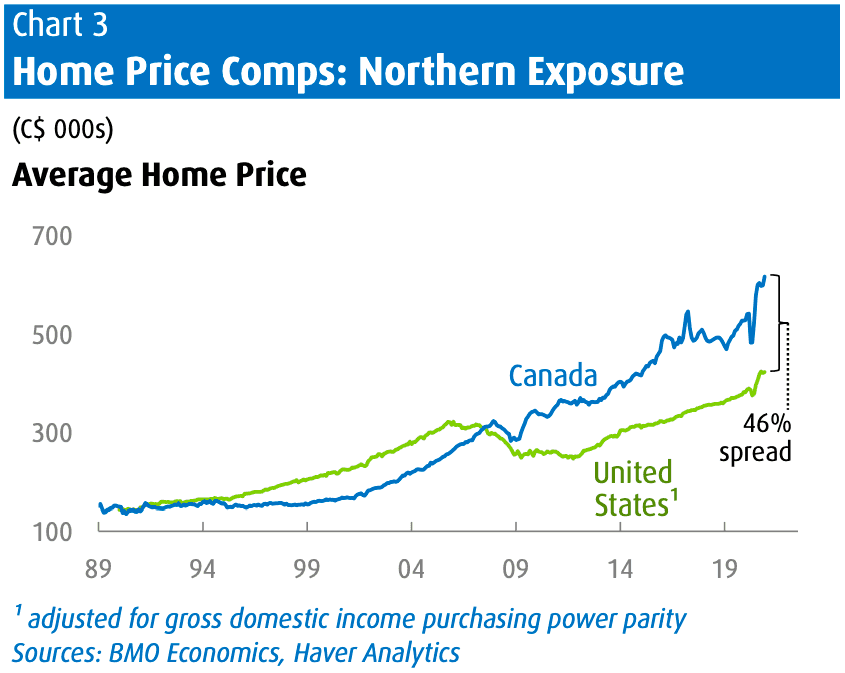
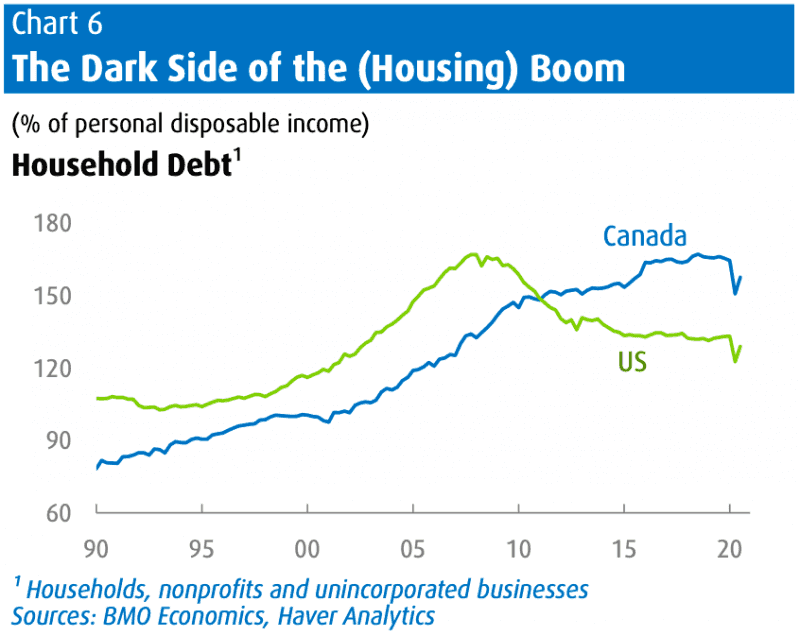
That's presumably because we didn't have the collapse of the housing market that the US experienced in the late 2000s? As a result Canadian house prices are now much higher on average than US house prices. And that means Canadian household debt is much greater, (and also that households who own property have greater household wealth). Storeys had an excellent piece of analysis, including these charts.


__________________
Contemporary Vancouver development blog, https://changingcitybook.wordpress.com/ Then and now Vancouver blog https://changingvancouver.wordpress.com/

Last edited by Changing City; Feb 15, 2026 at 6:27 AM.
Reply With Quote
     
     
  #3092  
Old Posted Feb 15, 2026, 12:54 PM
suburbanite's Avatar
suburbanite suburbanite is offline
Registered User
 
Join Date: Apr 2011
Location: Toronto & NYC
Posts: 5,606
The U.S. had overbuilt so much leading up to 2008 that many markets had sufficient supply for 5+ years worth of regular (non sub-prime fueled) absorption.

One other major difference between the two markets that isn't often talked about is the nature of developers/homebuilders and how they operate. Canada doesn't have a single publicly-listed homebuilder (apart from maybe Brookfield Residential but it's buried within BAM). Residential development in Canada is dominated by private family-held businesses, while almost all of the top-10 developers in the U.S. are publicly traded behemoths.

When you have private ownership in a market with significant structural imbalances, you create a misaligned incentive structure where the speculative returns created by significantly drawn out entitlement processes and fundamental supply/demand constraints are more favourable than the margin earned on homebuilding. A public company that answers to shareholders doesn't have the luxury of tying up capital for 10 years in land banking exercises and waiting out a soft market. You take your licks on a project that was purchased at peak prices and move on to the next at a price that works in the current environment. They behave more like manufacturing business where land is just an input and less like an investor holding on to a commodity waiting for a market correction.

Mattamy is really the only builder that I'm aware of that operates with that mindset in the GTA at least. Now you see them taking fairly drastic action like providing rebates to homebuyers if the price drops before they close. They are willing to forego the speculative return to keep their capital churning and clip the 10-14% return on homebuilding.
__________________
Discontented suburbanite since 1994

Last edited by suburbanite; Feb 15, 2026 at 1:09 PM.
Reply With Quote
     
     
  #3093  
Old Posted Feb 15, 2026, 4:28 PM
whatnext whatnext is online now
Registered User
 
Join Date: Feb 2009
Location: Vancouver
Posts: 26,728
Very interesting point suburbanite. I wonder why it evolved that way in Canada?
Reply With Quote
     
     
  #3094  
Old Posted Feb 15, 2026, 6:01 PM
Changing City's Avatar
Changing City Changing City is online now
Registered User
 
Join Date: Nov 2016
Posts: 7,646
Quote:
Originally Posted by whatnext View Post
Very interesting point suburbanite. I wonder why it evolved that way in Canada?
There is no obvious reason for house builders, or major construction companies in Canada to go public, if they can raise the development capital they need. As most multifamily projects that are sold are funded by banks or similar financial institutions, based on presales, the house builders only need to cover the land purchase (and as we see when some get into financial difficulties, even that is often mortgaged).

Anthem Properties were founded in Vancouver in 1991, and expanded across Canada and into the US. In 1998 they went public on the Toronto Stock Exchange, but In 2004, they became a private company again. On the company website they say "Financial strategy shifted from partnering on individual projects to relying on a public shareholder base. This proved not to be in the best interests of the company, given the vagaries and uncertainties of the stock market."
__________________
Contemporary Vancouver development blog, https://changingcitybook.wordpress.com/ Then and now Vancouver blog https://changingvancouver.wordpress.com/
Reply With Quote
     
     
  #3095  
Old Posted Feb 15, 2026, 11:43 PM
ssiguy ssiguy is offline
Registered User
 
Join Date: Mar 2006
Location: White Rock BC
Posts: 11,779
The stats for Toronto and especially Vancouver, are MUCH worse than those figures relay.

Remember, a "house" is a very loose word. It can be anything from Buckingham Palace to a 1960s Vancouver Special to a 2020 Toronto microsuite. Canadians are more likely to live in condos than Americans and especially in Van/Tor because they can't afford a real house so they are not only spending a lot more on their homes but they are also getting a lot less of a house in a much worse area of the city.
Reply With Quote
     
     
  #3096  
Old Posted Feb 16, 2026, 12:08 AM
logan5's Avatar
logan5 logan5 is offline
Registered User
 
Join Date: Feb 2011
Location: Mt.Pleasant - The New Downtown South
Posts: 8,065
Quote:
Originally Posted by whatnext View Post
Hmmm, now how could it be possible that home prices are so out of whack with reported local incomes.....?
Same reason rents are so out of whack with local incomes?
Reply With Quote
     
     
  #3097  
Old Posted Feb 16, 2026, 1:06 AM
Innsertnamehere's Avatar
Innsertnamehere Innsertnamehere is offline
Registered User
 
Join Date: Jan 2010
Location: Hamilton
Posts: 12,733
Lots of REITs in housing these days answering to shareholders. They are primarily in apartments though not low rise product.
Reply With Quote
     
     
  #3098  
Old Posted Feb 17, 2026, 12:58 AM
suburbanite's Avatar
suburbanite suburbanite is offline
Registered User
 
Join Date: Apr 2011
Location: Toronto & NYC
Posts: 5,606
Quote:
Originally Posted by Innsertnamehere View Post
Lots of REITs in housing these days answering to shareholders. They are primarily in apartments though not low rise product.
I assumed we were talking about delivering product to homebuyers. REITs make up an insignificant fraction of non-rental deliveries in Canada. I don't even know if there any any aside from Riocan Living that develop or invest capital in condos.

I would say the fact that the REITs are among the few actively investing capital right now speaks to my original point. However, it's not really a fair comparison since rental economics are so different from homebuilding. If interest rates dropped to 2% tomorrow they would be priced out of most the acquisition opportunities again just like they were 5 years ago.
__________________
Discontented suburbanite since 1994
Reply With Quote
     
     
  #3099  
Old Posted Feb 17, 2026, 2:53 AM
whatnext whatnext is online now
Registered User
 
Join Date: Feb 2009
Location: Vancouver
Posts: 26,728
Quote:
Originally Posted by Changing City View Post
There is no obvious reason for house builders, or major construction companies in Canada to go public, if they can raise the development capital they need. As most multifamily projects that are sold are funded by banks or similar financial institutions, based on presales, the house builders only need to cover the land purchase (and as we see when some get into financial difficulties, even that is often mortgaged).

Anthem Properties were founded in Vancouver in 1991, and expanded across Canada and into the US. In 1998 they went public on the Toronto Stock Exchange, but In 2004, they became a private company again. On the company website they say "Financial strategy shifted from partnering on individual projects to relying on a public shareholder base. This proved not to be in the best interests of the company, given the vagaries and uncertainties of the stock market."
It seems a bit disingenuous of Anthem to talk of the “vagaries of the stock market” when businesses in every other field operate that way. But this goes back to having to use the poor presale model. Funders (aka banks) minimize their risk by forcing the developer to sell a lot of the product in advance. As a result the product is skewed away from the end user to investors.
Reply With Quote
     
     
  #3100  
Old Posted Feb 20, 2026, 2:58 PM
jonny24 jonny24 is offline
Registered User
 
Join Date: Aug 2017
Location: Caledonia, often in Hamilton and Norfolk
Posts: 1,669
Quote:
Originally Posted by casper View Post
Income to Home price ratio may be high but not out of the norm for a major city in North America. Vancouver and Toronto are the problems.
Having a high absolute number for income-to-price isn't out the norm.

It's the massive increase in that ratio, specifically over a 20 year period, that isn't.
__________________
Mods: Don't delete my posts without explaining why. I broke no rules. I wasn't inappropriate.

Don't ruin what is a good forum.
Reply With Quote
     
     
This discussion thread continues

Use the page links to the lower-right to go to the next page for additional posts
 
 
Reply

Go Back   SkyscraperPage Forum > Regional Sections > Canada
Forum Jump


Forum Jump


All times are GMT. The time now is 10:23 PM.

     
SkyscraperPage.com - Privacy Statement - Top

Powered by vBulletin® Version 3.8.7
Copyright ©2000 - 2026, vBulletin Solutions, Inc.