HomeDiagramsDatabaseMapsForum About
     

Go Back   SkyscraperPage Forum > Discussion Forums > Engineering


Reply

 
Thread Tools Display Modes
     
     
  #1  
Old Posted May 11, 2024, 1:50 AM
DCReid DCReid is offline
Registered User
 
Join Date: Jun 2012
Posts: 1,507
Mass timber buildings - Durability and safety

This is a general question as I don't know how these buildings are constructed. I just saw this article about Houston but I know other cities are building mass timber office buildings. Are these building reinforced with metal and concrete? How durable could they be? Would you feel safe if you worked in one?

https://www.msn.com/en-us/news/us/first-...s-ground/ar-BB1maOEz?ocid=BingNewsSearch
Reply With Quote
     
     
  #2  
Old Posted May 14, 2024, 10:29 PM
Alpha Alpha is offline
Registered User
 
Join Date: Jun 2005
Posts: 4,805
On the summit of Feldberg mountain, northwest of Frankfurt am Main, there is since 1950 a 69.1 metres tall highrise-like telecommunication tower, whose upper floors are made of wood without metal elements ( https://skyscraperpage.com/cities/?buildingID=41551 ). The fact that this tower still stands in spite of its exposed location shows that it is in principle possible to build such objects durable.
Reply With Quote
     
     
  #3  
Old Posted May 15, 2024, 3:27 PM
dchan's Avatar
dchan dchan is offline
No grabbing my banana!
 
Join Date: Dec 2007
Location: 10021
Posts: 2,670
There's been a big movement in the energy-efficient and carbon-neutral design sector in recent years.

The initial primary design target has been to reduce operational energy usage (electricity, HVAC) because it was such a low-hanging fruit. The typical building constructed in the 20th century (and even 21st century) is pure crap in terms of energy efficiency. Their roofs and walls are leaky and lack insulation, and their windows leak tons of heat and air. So just making a building airtight, adding plenty of roof insulation & reflective roof material, and installing energy-efficient windows has done wonders in reducing HVAC needs.

Reducing carbon-usage beyond reducing operational energy usage is more difficult. The next major step is through reducing embodied carbon. Embodied carbon is the amount of carbon expended during the construction of the building, including methods and materials used. Both steel and cement manufacturing releases an exorbitant amount of CO2 into the atmosphere, some of the worst in any industry. So reducing the amount of steel and cement used in a building would drastically cut down on embodied carbon emissions.

This is where mass timber comes into play. Trees act as a carbon sink (up to a certain age). By using lumber instead of steel & cement, you are drastically reducing the initial embodied carbon in new construction.

Unlike modern wood-frame construction, mass timbers come in beam & column sections that are much, much thicker than a typical 2x4 or 2x8. This not only increases the inherent strength of the structural sections, but also makes it more fire resistant. When a fire occurs, the outside section of the mass timber chars, which helps protect the inner sections and helps maintain the strength of the mass timber.

Mass timbers are no longer a single solid piece of wood from a tree trunk. Old growth forests are protected, and newer lumber forests are still too young to produce such thick lumber. Instead, most mass timber consists of Cross-Laminated Timbers (CLTs), which are essentially made from several 2x4s glued & pressed into a single thick structural section.

You can read more about CLTs here:

https://www.naturallywood.com/products/cross-laminated-timber/

__________________
I take the high road because it's the only route on my GPS nowadays. #selfsatisfied
Reply With Quote
     
     
  #4  
Old Posted May 16, 2024, 3:32 PM
woodrow woodrow is offline
Registered User
 
Join Date: Oct 2002
Location: Chicago to London
Posts: 1,104
Walmart is building a huge new campus in Bentonville. The office buildings are using mass timber construction. 2.9 million square feet - https://corporate.walmart.com/about/newhomeoffice/our-approach/mass-timber
Reply With Quote
     
     
  #5  
Old Posted May 16, 2024, 6:29 PM
muertecaza muertecaza is offline
Registered User
 
Join Date: Oct 2015
Posts: 2,455
Reply With Quote
     
     
  #6  
Old Posted May 23, 2024, 12:21 PM
scalziand's Avatar
scalziand scalziand is offline
Mortaaaaaaaaar!
 
Join Date: Aug 2007
Location: Naugatuck, CT/Worcester,MA
Posts: 3,504
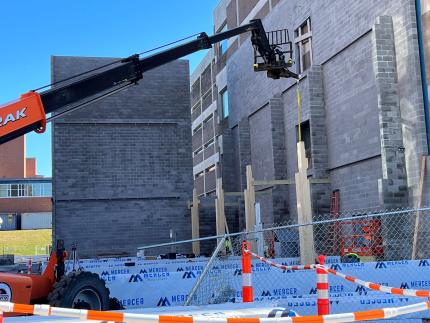
The Burritt Library expansion at Central Connecticut State University is being built with mass timber.

https://www.ccsu.edu/facilitiesmanagement/major-facilities-projects
Reply With Quote
     
     
  #7  
Old Posted Jun 13, 2024, 9:16 PM
Changing City's Avatar
Changing City Changing City is online now
Registered User
 
Join Date: Nov 2016
Posts: 7,963
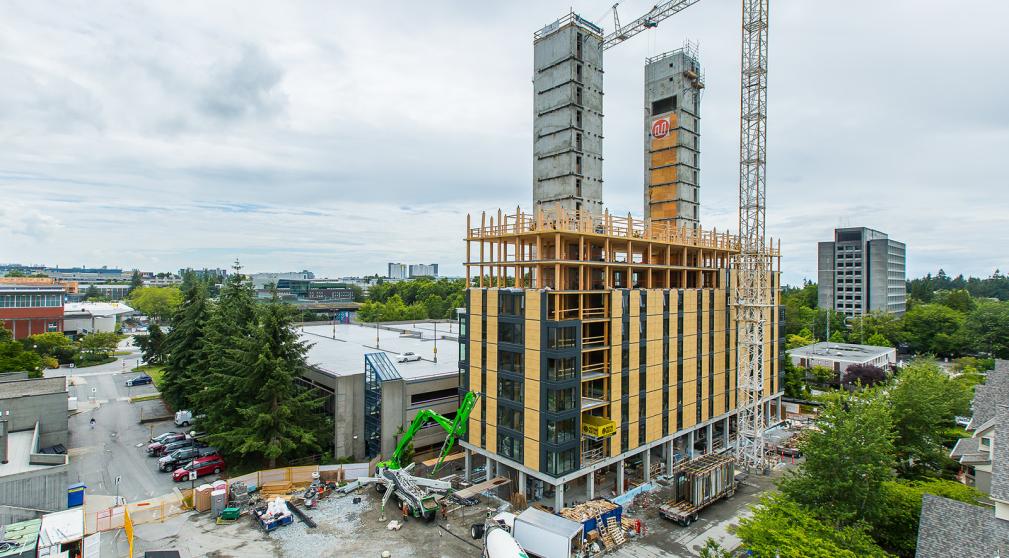
The University of British Columbia has an 18 storey wood frame hall of residence called Tallwood House. It has concrete core elevator shafts (Vancouver is in an earthquake zone) for seismic stability, but the rest of the building is built with CLT floor panels supported on glue-laminated timber and parallel strand lumber columns.


[UBC]

There's a 17 storey social housing building and community centre under construction Downtown, with the same construction technique, and an 8-storey non-market housing building under construction in Grandview in Vancouver


[City of Vancouver]

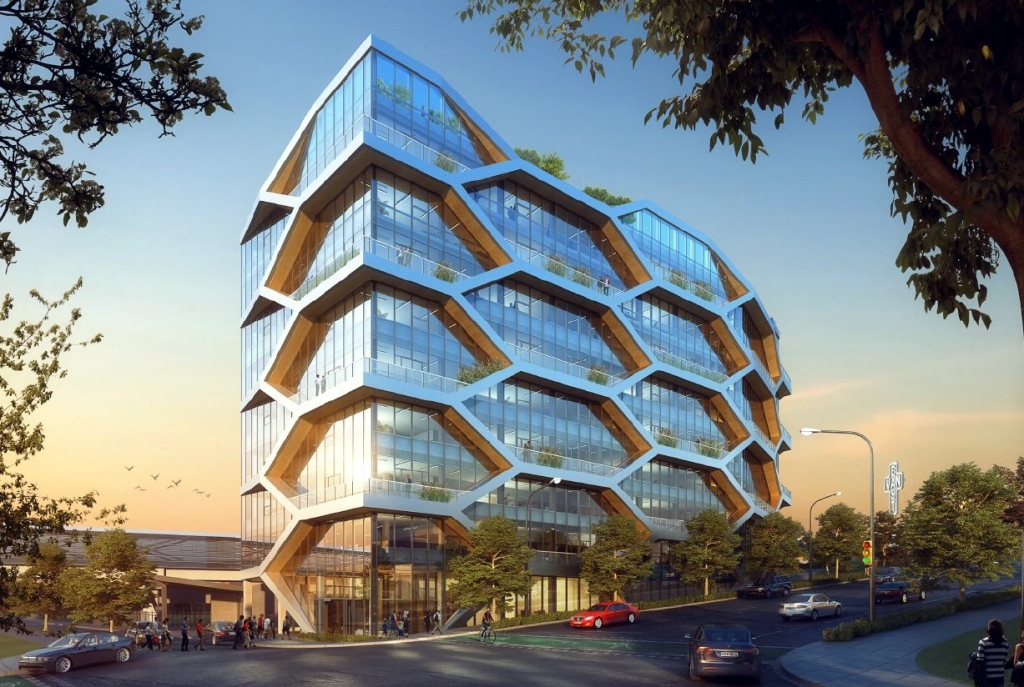
There are several woodframe office buildings proposed in the city, and the first to get built is next to a SkyTrain station in East Vancouver (now confirmed as the new HQ for provincial insurer ICBC). It doesn't have a concrete core: "The honey-combed-shaped timber frame is a perimeter-braced seismic structure that connects with four internal cross-laminated timber (CLT) shearwalls. This structural exoskeleton will be the tallest timber-braced frame in North America."


[Changing City blog]
__________________
Contemporary Vancouver development blog, https://changingcitybook.wordpress.com/ Then and now Vancouver blog https://changingvancouver.wordpress.com/

Last edited by Changing City; Jun 13, 2024 at 10:39 PM.
Reply With Quote
     
     
  #8  
Old Posted Sep 18, 2024, 11:33 PM
pdxtex's Avatar
pdxtex pdxtex is offline
Registered User
 
Join Date: Jan 2004
Location: Portland, OR
Posts: 3,210
Considering most 5 over 1's appear to be framed with pine 2x4's, mass timber seems oodles better.
__________________
Portland!! Where young people formerly went to retire.

Last edited by pdxtex; Sep 20, 2024 at 11:54 PM.
Reply With Quote
     
     
  #9  
Old Posted Mar 20, 2025, 8:49 AM
SwiftGamer's Avatar
SwiftGamer SwiftGamer is offline
Usagi KV
 
Join Date: Nov 2023
Location: Kohtla-Järve, Ida-Virumaa
Posts: 124
Example from my region that is UC would be Fahle Terrasses it is by architecture firm LUMIA & with Tallinn University of Technology and ETH Zurich. Building will host insurance company If... and is the first timber-framed (CLT) high-rise building in Estonia. 8 floor 33m the core with lift Shafts and stairwell.


Source of pictures is official website for project: FAHLE
Reply With Quote
     
     
  #10  
Old Posted Apr 18, 2025, 5:54 PM
muertecaza muertecaza is offline
Registered User
 
Join Date: Oct 2015
Posts: 2,455
https://woodcentral.com.au/why-milwaukee-the-midwest-sparks-new-wave-of-timber-skyscrapers/

Why Milwaukee? The Midwest Sparks New Wave of Timber Skyscrapers

Reply With Quote
     
     
  #11  
Old Posted May 17, 2025, 2:26 PM
mrnyc mrnyc is offline
cle/west village/shaolin
 
Join Date: Jul 2006
Posts: 15,154
^ very interesting.

yes, list us the problems with mass timber buildings too when you get a chance.
Reply With Quote
     
     
  #12  
Old Posted Jun 27, 2025, 9:01 PM
EnvisionSaintJohn's Avatar
EnvisionSaintJohn EnvisionSaintJohn is online now
New Brunswick, Canada ⛵️
 
Join Date: Apr 2023
Location: Canada's first City 🍁🌊
Posts: 3,785
Anyone have some insight or theories on how mass timber manufacturing could become more scalable and cost efficient? Or why it's seemingly taking so long for the cost to come down?

For such an impressive building material, with huge upsides in terms of sustainability and carbon emissions, the huge downside seems to remain the high price.

In the most simplest terms, mass timber is manufactured by glueing and laminating pieces of wood together, to create larger, and stronger "pieces" of wood. I'm certainly no engineer, or economist, so I'm just curious as to why mass timber remains to be considered such an expensive building material and construction method.
__________________
Peace and Athabasca and Coppermine and Slave, And Yukon and Mackenzie—the highroads of the brave. Saskatchewan, Assiniboine, the Bow and the Qu'Appelle, And many a prairie river whose name is like a spell. They rumor through the twilight at the edge of the unknown, "There's a message waiting for you, and a kingdom all your own. — Bliss Carman
Reply With Quote
     
     
  #13  
Old Posted Jul 28, 2025, 6:00 PM
lajthabalazs lajthabalazs is offline
Registered User
 
Join Date: Jul 2025
Posts: 3
Quote:
Originally Posted by EnvisionSaintJohn View Post
Anyone have some insight or theories on how mass timber manufacturing could become more scalable and cost efficient? Or why it's seemingly taking so long for the cost to come down?

For such an impressive building material, with huge upsides in terms of sustainability and carbon emissions, the huge downside seems to remain the high price.

In the most simplest terms, mass timber is manufactured by glueing and laminating pieces of wood together, to create larger, and stronger "pieces" of wood. I'm certainly no engineer, or economist, so I'm just curious as to why mass timber remains to be considered such an expensive building material and construction method.
My theory is that it's the market setting the price. And because it's a substitute for a widely used product (concrete beams) there's a latent demand. If price of engineered wood drops below concrete, demand increases as builders shift to wood. And that pulls the price back up.
Reply With Quote
     
     
  #14  
Old Posted Aug 1, 2025, 9:07 AM
EnvisionSaintJohn's Avatar
EnvisionSaintJohn EnvisionSaintJohn is online now
New Brunswick, Canada ⛵️
 
Join Date: Apr 2023
Location: Canada's first City 🍁🌊
Posts: 3,785
Quote:
Originally Posted by lajthabalazs View Post
My theory is that it's the market setting the price. And because it's a substitute for a widely used product (concrete beams) there's a latent demand. If price of engineered wood drops below concrete, demand increases as builders shift to wood. And that pulls the price back up.
Interesting theory. I'll have to quote your post here in the NB mass timber thread... I wonder how if an opportunity exists for mass timber manufacturing and/or warehousing at the Lorneville industrial park.
__________________
Peace and Athabasca and Coppermine and Slave, And Yukon and Mackenzie—the highroads of the brave. Saskatchewan, Assiniboine, the Bow and the Qu'Appelle, And many a prairie river whose name is like a spell. They rumor through the twilight at the edge of the unknown, "There's a message waiting for you, and a kingdom all your own. — Bliss Carman
Reply With Quote
     
     
  #15  
Old Posted Aug 29, 2025, 2:15 PM
Notonfoodstamps Notonfoodstamps is offline
Registered User
 
Join Date: Dec 2022
Posts: 248
201 Pratt Street in Baltimore will be mass timber as is Under Armor’s new HQ

Reply With Quote
     
     
  #16  
Old Posted Sep 7, 2025, 5:51 PM
Glow Fun City's Avatar
Glow Fun City Glow Fun City is offline
deadhead raver Jew
 
Join Date: Jul 2025
Location: Vancouver
Posts: 264
All of the main timber arches have now been installed for the roof of Vancouver's new PNE Amphitheatre ("Freedom Mobile Arch"), CLT roof deck installation is in progress. Still lots of work left to go before FIFA World Cup next June!


Photos by me during PNE Fair, Aug 30th 2025
__________________
Don’t tell me this town ain’t got no heart
You just gotta poke around…
Reply With Quote
     
     
  #17  
Old Posted Sep 16, 2025, 10:13 AM
LeonUk LeonUk is offline
Registered User
 
Join Date: Sep 2025
Posts: 4
I was talking to a friend recently who recommended charred wood/shou sugi ban (something like this https://timbersol.co.uk/product/anthracite-grey-larch-cladding/ ) for my upcoming project, and I thought it could be an interesting material for larger buildings, especially high-rises. I know it’s mainly used in low-rise residential or small-scale projects, but I’m wondering why it’s not more commonly seen in high-rise facades.

My friend mentioned how durable and low-maintenance charred wood is, and I’ve started to think about its potential in skyscrapers. It definitely offers a unique aesthetic and fire-resistant properties. A few things I’m wondering:

Has anyone seen charred wood used on the facades of high-rise buildings?
Why do you think it hasn’t gained more popularity for urban skyscrapers?
Reply With Quote
     
     
  #18  
Old Posted Oct 2, 2025, 3:39 PM
202_Cyclist's Avatar
202_Cyclist 202_Cyclist is offline
Registered User
 
Join Date: Feb 2009
Posts: 6,428
Another consequence of Trump’s beautiful tariffs.

https://www.dezeen.com/2025/10/01/edison-skyscraper-neutral-milwaukee-tariffs/
__________________
RELEASE THE FILES. NO CHILD RAPISTS IN THE WHITE HOUSE!
Reply With Quote
     
     
  #19  
Old Posted Oct 7, 2025, 9:28 PM
Alpha Alpha is offline
Registered User
 
Join Date: Jun 2005
Posts: 4,805
We should not forget the airship hangars built by the US Navy in 1942/1943. From the 17 hangars built, 5 are still existing. One of them in Tillamook, Oregon houses today an aircraft museum ( https://www.tillamookair.com/hangar-b ).
Reply With Quote
     
     
End
 
 
Reply

Go Back   SkyscraperPage Forum > Discussion Forums > Engineering
Forum Jump


Forum Jump


All times are GMT. The time now is 6:00 PM.

     
SkyscraperPage.com - Privacy Statement - Top

Powered by vBulletin® Version 3.8.7
Copyright ©2000 - 2026, vBulletin Solutions, Inc.