https://journalnow.com/article_8b76f3c5-1753-5921-bf09-d73d3906659d.html
RICHARD CRAVER
Staff Reporter
CHARLOTTE — The wait-and-see stage has arrived for Wake Forest University School of Medicine's transformative two-campus experiment.
With the high-profile June 2 debut of the 14-story medical school building on a 20-acre tract in midtown Charlotte, the ability to make comparisons and contrasts with the vaunted Winston-Salem facility founded in 1941 shifted from concept to towering reality.
The Pearl healthcare campus debuted as a $1.5 billion capital investment.
At least $400 million was raised from Charlotte-area private donors as Atrium Health officials, led by chief executive Eugene Woods, pitched shedding the label of being the nation's largest city without a four-year medical school.
Even since Wake Forest Baptist Medical Center and Atrium disclosed in April 2019 they had signed an open-ended memorandum of understanding "to create a next-generation academic health-care system," there have been local concerns about the future of the local medical school.
Those concerns were amplified when the systems announced in October 2020 that Atrium had acquired all of Baptist with an offer anchored by a $3.4 billion local capital investment commitment over 10 years.
When asked how will resources be divided and how will medical students be placed on the two campuses, officials from both systems have repeated the phrase "two campuses, one medical school" enough for it to evolve into a mantra.
Dr. Julie Ann Freischlag, chief executive of Atrium Health Wake Forest Baptist and medical school dean for 5½ years before stepping down in January 2023, emphasized during her June 2 speech that even with the inaugural four-year class of 48 medical students in Charlotte, there still will be a four-year class of 143 medical students in Winston-Salem.
The goal is expanding to at least 100 Charlotte medical students in the near term.
Freischlag said during the June 2 presentation that the Charlotte medical school "builds on a long-standing legacy of academic excellence that Wake Forest University School of Medicine has upheld in Winston-Salem for more than 80 years."
"We have expanded our footprint to take medical education to the next level of excellence together. We're reimagining education at Wake Forest University School of Medicine for the next generation of medical professionals."
Freischlag said the second medical school campus offers "an extraordinary opportunity to make discoveries of the future right here in Charlotte and spark real-world innovation that improves lives and strengthens communities."
"The Pearl fosters an environment where learning extends far beyond the classroom."
Paused IQ Phase II
IQ officials unveiled in July 2021 plans for expanding the North District that would feature as many as 10 buildings and up to 2.7 million square feet of medical and mixed-use development on a 28-acre site, up to 450 residential units.
IQ officials acknowledge, however, that Phase II represents a much different development challenge given that the 28 acres do not contain buildings that qualify for historic rehabilitation tax credits.
Those tax credits attracted outside investors, such as Blue Cross Blue Shield of N.C. and US Bancorp, which helped to offset up to 40% of the renovation costs of the historic buildings.
"Unfortunately, we are all out of old buildings that we could reuse because we really like that work. Those days are over, sadly," Graydon Pleasants, the retired head of development for IQ, acknowledged with the unveiling of the expansion plans.
Four years later, as The Pearl's anchor buildings rose as new parts of the Charlotte skyline, Phase II remains unfulfilled outside landscaping preparations.
The medical school's Eye Institute — the planned Phase II anchor — was shifted to occupy the former Inmar Intelligence headquarters in an existing Phase I building.
However, IQ official Jason Kaplan said to think of this moment of Phase II "as the pause before the next push — quiet, but anything but stagnant."
"While we're not yet ready to share any public-facing news about Phase II construction, there's a lot happening behind the scenes that's laying the foundation for what's next," said Kaplan, associate vice president of IQ Operations and Wake Forest School of Medicine Academic Resources.
Kaplan said horizontal infrastructure work has been completed across the full 28-acre Phase II footprint, including fiber, streetscapes and the Long Branch Trail extension.
"That work — now largely invisible but essential — sets the stage for vertical construction" Kaplan said.
In regard to the existing IQ footprint, Kaplan said the Sparq Labs at One Technology Place "continues to see strong demand, with occupancy nearing 90% and additional leases in progress. "
Sparq, located on the second floor of the renovated Bailey Power Plant, serves healthcare business startups that qualify to participate in IQ Labs, which includes IQ Healthtech Lab and IQ Community Lab.
"It's become a real hub for regenerative medicine and life sciences startups, many of which are eyeing expansion space within the district," Kaplan said.
Kaplan said the medical school and IQ officials view The Pearl and IRCAD facilities as "reflecting growing regional energy that has Innovation Quarter as a vital part of that story.
"Our regenerative medicine cluster is simultaneously positioning Winston-Salem as an international destination for translational life sciences."
Why not in Winston-Salem?
For those in Winston-Salem, Freischlag's "reimagining education" comments may stir questions of "why not here?' for new medical research and training breakthroughs.
Particularly given the nearly $1 billion invested over the past decade in downtown Winston-Salem's Innovation Quarter that is operated by the medical school.
Yet, it's undeniable that Charlotte, as the nation's 14th largest city, is a socioeconomic magnet with much more oldand newmoney private wealth than in Winston-Salem.
It's also abundantly clear that the projected $1.5 billion capital investment into The Pearl could not/would not have happened in Winston-Salem.
The Charlotte medical school building features the Howard Levine Center for Education and the Carolinas College of Health Sciences, a public non-profit college owned by Atrium. Neither were considered for Winston-Salem.
IRCAD, the highly acclaimed French-based research and training institute for surgeons, committed in March 2022 to locating its North American headquarters in the 10-story research building on The Pearl campus. Its programs will commence in September.
IRCAD's presence has led to major healthcare commitments to the campus from Siemens Healthineers, Boston Scientific, Stryker Corp. and Medtronic.
"Here's the thing: they would not have come to Charlotte to invest millions of dollars but for The Pearl, but for the vision of Advocate Health and but for the support of this community," Woods said.
Woods said those tenants "are not just coming here to open shop."
"They're coming here to co-create the future with us, and they'll innovate side-by-side with our clinicians, engineers, students and start-ups."
The Charlotte campus offers "an extraordinary opportunity to make discoveries of the future right here in Charlotte and spark real-world innovation that improves lives and strengthens communities," Freischlag said.
"The Pearl fosters an environment where learning extends far beyond the classroom."
Dr. Ebony Boulware, the medical school's dean, was not in attendance at the June 2 presentation.
Boulware provided a statement that read in part "as our world is changing, especially with technology advances, we are challenged to rethink everything — how we teach, how students learn and how we prepare the next generation of physicians to lead.
"This challenge became an opportunity, and our new school of medicine at The Pearl is our answer."
Balancing act
Wexford Science + Technology, developer of downtown Winston-Salem's Innovation Quarter and The Pearl, has said it will make presentations on behalf of both districts to potential tenants to help them decide where they want to locate.
"There is for the first time in North America a common university and school of medicine partner ... a common clinical partner ...common programming, common entrepreneurial resources in two cities," said Thomas Osha, executive vice president for Wexford.
That collaboration "can allow research to go to scale in Charlotte and in Winston-Salem, acting as a super corridor of activity and engagement," Osha said.
"We believe there will be a complementary set of companies in Charlotte to what is happening in Winston-Salem."
Dennis Miller, Wexford's senior vice president and market executive for The Pearl, shared during the presentation that the 10-story, 220,000-square-foot IRCAD building's space is nearly filled with tenant commitments.
He said Wexford already was developing designs for the next research facility phase of The Pearl.
When Woods referred to IQ facilities — many of which came online well before Atrium ownership of Baptist — he said "just look at what we've built in Winston-Salem through Wake Forest."
Woods mentioned the innovative research of Dr. Anthony Atala, director of Wake Forest Institute for Regenerative Medicine, and his team "for redefining regenerative medicine in this world."
"He is part of our research team."
Preferred choice?
Given the pitches about The Pearl being made by Freischlag and Woods, it's not hard to envision the Charlotte campus becoming the preferred training location for medical students.
Woods said that while the Charlotte medical school initially would feature faculty from Winston-Salem, it will recruit from throughout the Atrium and Advocate systems, including from Chicago and Milwaukee.
Atrium and Baptist officials have said local speculation that Charlotte's metropolitan appeal could eventually lure the full medical school from Winston-Salem is not based in fact.
Tony Plath, a retired finance professor at UNC Charlotte, said that there is one risk that would cause Wake's medical school to relocate from Winston-Salem to Charlotte — student demand for the program.
The potential consolidation of the two campuses into Charlotte down the line "is a valid concern," said Michael Walden, a retired economics professor at N.C. State University.
"Still, the reputation and gravitas of Wake Forest University can't easily be replicated."
That includes touting an established medical school faculty and the lower cost of living in Winston-Salem and the Triad compared with Charlotte, particularly for medical students not wanting to plant roots in either metro area.
"Winston-Salem should strongly play this card," Walden said.
Woods said The Pearl campus will help elevate the socioeconomic influence of healthcare in a Charlotte metro known for financial services, banking and Fortune 500 corporate headquarters.
"We believe this city and this region has had the potential to do more" with healthcare, Woods said.
"We couldn't keep watching talented students leave for opportunities elsewhere, so we built The Pearl to change that — to bet on our talent, to shape the future of medicine. Not to catch up, but to lead."
"It wasn't that Charlotte couldn't support a four-year medical school. It just was because we hadn't built one."





 Prev
Prev


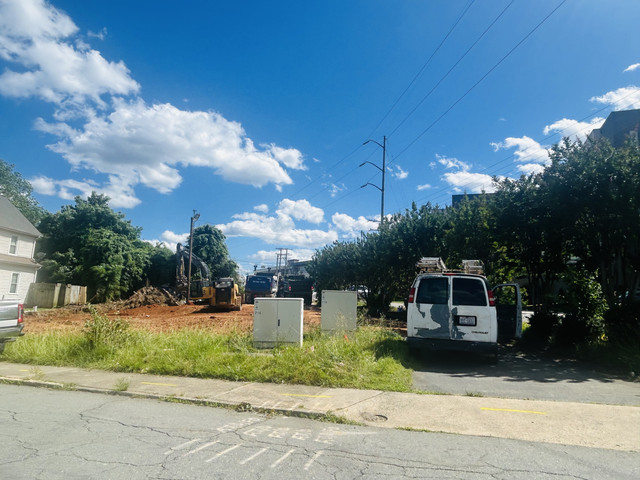


 This week, we say goodbye to a few projects we've discussed for a long time. They have reached completion. However, there are always new projects to take their place on our updates! Lets get updated!
 4th and Green Apartments & Retail: Built!


 D1 Training Center:


 Your City


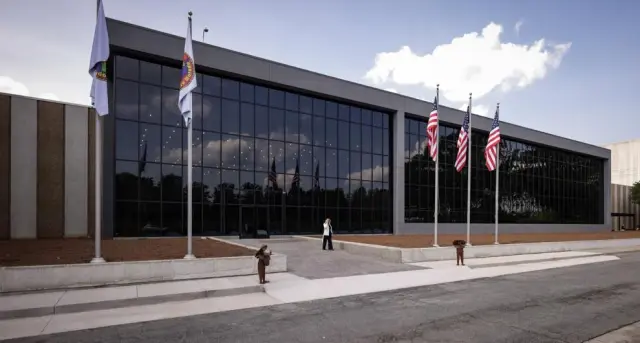 photo from Winston-Salem Journal’s Allison Lee


 Linear Mode
