Quote:
Originally Posted by RocketSurgeon

They really are 
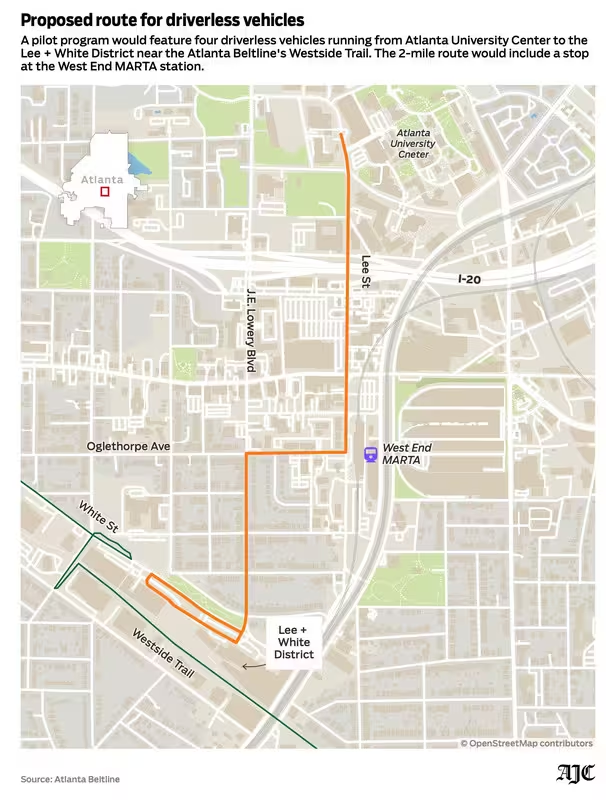
I think he's right in this case, though. There's no regulation I know of that requires drivers. The company is just using them for liability/testing reasons. And more to the point, $3 million would buy a few hundred feet of light rail at most. That's nothing in public budget terms.
I do agree with you that this is pointless though--not because of the drivers or the cost, but because it will be operating in a relatively desolate corner of the city, and like the streetcar, it has such a short route that it would be faster to walk instead. I doubt it will have much ridership. |
More insufferable but prudent info:
This tiny 2.2-mile extension of the streetcar will cost over $200 million and have already spent OVER $11 million just designing it. It will serve almost no one and will barely go anywhere in Atlanta. The privileged residents there are now NIMBYs, making the costs even higher and making the timeline much longer.
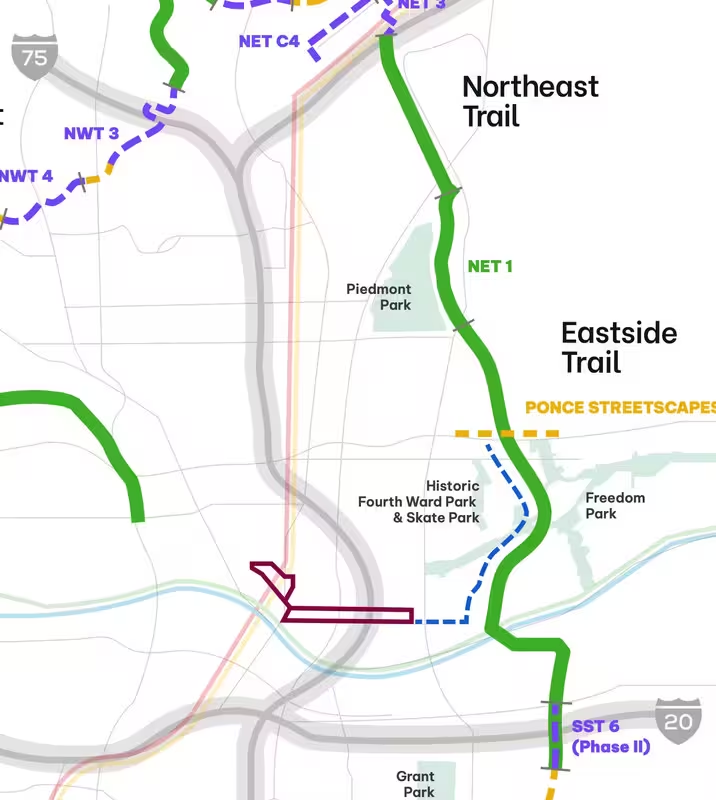
I understand that many people are captivated by the romantic allure of streetcars. However, it’s important to acknowledge that Atlanta, or any other major city, is unlikely to ever have a comprehensive streetcar system. The cost of such a project would exceed $10 billion, likely approaching $100 billion, and it would involve numerous decades of endless litigation and construction delays.
Right now we are in a radical transition with AI. Here is an Perplexity summery of the future of metro travel:
The future of metro transportation is undergoing a profound transformation as AI-controlled shuttles emerge as a central component of urban mobility systems. These autonomous shuttles, operating under concepts like Autonomous Shuttle-as-a-Service (ASaaS), are designed to provide sustainable, proximity-based mobility with minimal need for new infrastructure, significantly reducing both noise and pollution in densely populated areas[1]. Leveraging advanced artificial intelligence, these vehicles can dynamically plan routes, adapt in real time to traffic conditions, and coordinate with intelligent traffic management systems to alleviate congestion and optimize flow across the city[2][5].
AI-driven shuttles are not only capable of analyzing vast streams of data from sensors, cameras, and urban networks, but also of predicting passenger demand and adjusting services accordingly, offering a flexible and responsive transit experience[2][5]. This adaptability enhances connectivity, making public transportation more accessible and inclusive, especially for underserved communities and those with mobility challenges[1][3]. Furthermore, the integration of AI and federated learning in these systems introduces new opportunities for responsible, privacy-preserving data sharing, though it also raises important questions about security, transparency, and ethical deployment[4].
As these technologies mature, metro transportation will become increasingly characterized by seamless multimodal integration, environmental sustainability through electric fleets, and a passenger-centric approach that prioritizes safety, efficiency, and user experience. While challenges remain-such as ensuring the generalizability and safety of AI models, managing regulatory frameworks, and addressing social implications-the shift toward AI-controlled shuttles represents a pivotal step toward the realization of intelligent, resilient, and future-ready urban transit networks[1][2][4][5].
Sources
[1] Autonomous Shuttle-as-a-Service (ASaaS): Challenges, Opportunities, and
Social Implications
https://arxiv.org/pdf/2001.09763.pdf
[2] AI-Driven Scenarios for Urban Mobility: Quantifying the Role of ODE
Models and Scenario Planning in Reducing Traffic Congestion
https://arxiv.org/abs/2410.19915
[3] MetaUrban: An Embodied AI Simulation Platform for Urban Micromobility
https://arxiv.org/html/2407.08725v2
[4] Responsible Federated Learning in Smart Transportation: Outlooks and
Challenges
http://arxiv.org/pdf/2404.06777.pdf
[5] Futuristic Intelligent Transportation System
https://arxiv.org/pdf/2105.09493.pdf
[6] Artificial Intelligence in Traffic Systems
https://arxiv.org/pdf/2412.12046.pdf
[7] Generative AI-enabled Vehicular Networks: Fundamentals, Framework, and
Case Study
https://arxiv.org/pdf/2304.11098.pdf
[8] Autonomous buses in public transport, a driverless future ahead?
https://www.sustainable-bus.com/its/autonomous-bus-public-transport-driverless-driverless/
[9] The Future of the Driverless Shuttle Bus Industry in the United States
https://www.metropolitanshuttle.com/the-...uttle-bus-industry-in-the-united-states/
[10] AI-assisted Public Transport Systems: Revolutionizing Urban Mobility
https://uppcsmagazine.com/ai-assisted-public-transport-systems-revolutionizing-urban-mobility/
[11] AI in transportation: Redefining metro systems - Ultralytics
https://www.ultralytics.com/blog/ai-in-transportation-redefining-metro-systems
[12] Next-Gen Autonomous Public Transport: AI-Piloted Buses and ...
https://www.thefuturelist.com/next-gen-a...nd-shuttles-transforming-urban-mobility/
[13] Artificial Intelligence: Transforming Public Sector Transit Services
https://www.cogentinfo.com/resources/art...nsforming-public-sector-transit-services
[14] AI for Autonomous Public Transportation - Redefining Urban Mobility
https://fpgainsights.com/artificial-intelligence/ai-for-autonomous-public-transportation/
[15] AI in Public Transit: Enhancing Safety & Efficiency - Newo.ai
https://newo.ai/insights/revolutionizing...ith-ai-safety-and-schedule-optimization/
[16] 7 ways AI technology can boost sustainable logistics - Maersk
https://www.maersk.com/insights/sustaina...chnology-can-boost-sustainable-logistics
[17] AI and Machine Learning Are Shaping the Future of Public Transit
https://www.urban.org/urban-wire/ai-and-machine-learning-are-shaping-future-public-transit
[18] A Neural-Evolutionary Algorithm for Autonomous Transit Network Design
http://arxiv.org/pdf/2403.07917.pdf
[19] Real-Time Bus Departure Prediction Using Neural Networks for Smart IoT
Public Bus Transit
https://arxiv.org/html/2501.10514v1
[20] The 5th AI City Challenge
https://arxiv.org/pdf/2104.12233.pdf





 Prev
Prev






 Linear Mode
