| |
 Posted Jan 20, 2025, 6:44 PM
|
|
|
|
Join Date: Dec 2015
Posts: 15,849
|
|
Quote:
Originally Posted by LowerLonsdaleMike

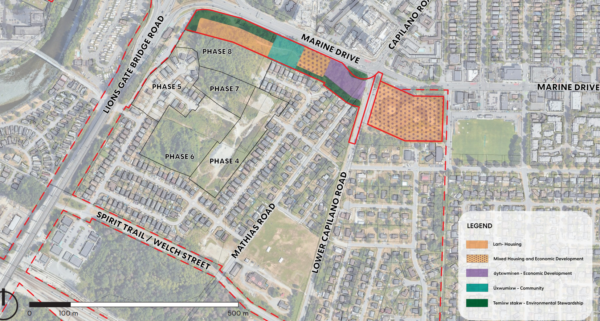
It's interesting how nobody is talking about the Squamish Nation waterfront land immediately east of the Lions Gate Bridge that has been levelled and remediated. I'm certain that something big is on the horizon for that whole area.
|
They were just doing remediation on the land before it gets transferred back.
You assume a new Low Level Road from Park Royal connecting over to the new Sewage Plant road is the basis of any development down there.. so maybe 20 years down the line.
Quote:
|
Public Works and Government Services Canada (PWGSC) released their annual tender for the Remedial Excavation Program at the Pacific Environment Centre (PEC) Site remediation, this year, in a two-pronged format to firstly pre-qualify suitable vendors and later issue an invitation to tender to the down selected contractors. KBL was among eight (8) organizations invited to Phase 2 of the highly competitive bid process. The scope of work included the transportation and disposal of 28,500 tonnes of previously excavated contaminated soil, and the excavation, transport, and disposal of 53,700m3 of contaminated soil. Additional optional work for which our pricing was accepted involves excavation 23,700 m3 of soil, and transport and disposal of 47,400 tonnes of contaminated soil.SCOPE OF WORK
|
https://kbl.ca/projects/pacific-environment-center-site-remediation/
2007
Quote:
Ending a toxic nightmare
The waterfront lands that lie at the north end of Lions Gate Bridge, directly across from Stanley Park, have for decades been a toxic nightmare for the federal government, which leases the property for $6-million a year, but can't use it because of pollution.
For years, Ottawa has struggled to come up with a way to decontaminate the property and negotiate an end to a 71-year-lease it signed, in 1974, when there were grand plans to build a new Pacific Environment Centre and coast guard base on the site.
Those plans fell through after the local MP, Jack Davis, who was the project's champion and the Liberal minister of environment, was defeated in the 1974 federal election. Then the pollution was discovered -- and the land became known as a toxic site where rocks and seashells turned bright green from zinc and copper percolating through the groundwater.
Deposits of heavy metals and layers of sulphur were found throughout the 22-hectare site, penetrating deep into the ground, where they created acid rock drainage that flowed into Burrard Inlet, killing fish.
The contaminants came from ore concentrate that had spilled from thousands of passing train cars, turning the scenic waterfront property into one of the most hazardous sites in the country. Eventually, the land was put behind a chain link fence, watched over by video cameras, and people in haz-mat suits digging test pits replaced the beachcombers who once walked the shoreline.
Now, the government has given the green light to a bold plan by Peter Krahn, an Environment Canada engineer and manager of the so-called PEC lands, that will launch a massive recovery program to restore the property -- and, it is estimated, cost millions of dollars less than earlier forecasts.
And fittingly enough, given the history of the site, there is a political aspect to the latest plan for the PEC lands. Mr. Krahn is hoping the success of the restoration project will help launch his campaign to become the Conservative candidate for North Vancouver. He was expected to file his nomination papers this week.
"I've been getting up at 4:30 to work on the campaign, and then at 7:30 I go in to work on the site," said Mr. Krahn, who has helped Environment Canada prosecute some of the worst polluters in the province.
Mr. Krahn said that when the final pieces began to fall into place this year on the PEC project, he started to think about entering politics "and doing something to help the environment on a larger scale."
The PEC lands, however, didn't help Mr. Davis, an early environmental crusader who lost despite his promise to turn the site into a thriving government centre.
Mr. Krahn (who if he wins the nomination will likely face popular Liberal incumbent Don Bell) says he is hoping voters will be more favourable to his plan.
"Essentially, we're going to mine the site," said Mr. Krahn, who has arranged for empty ore trucks offloading at a nearby bulk port facility to detour to the PEC lands and take tens of thousands of tonnes of contaminated soil back with them to a mine in the British Columbia Interior.
This spring, in a full-scale test, 18,000 tonnes of toxic soil will be loaded onto those trucks and taken to the mine, "halfway to Prince George," where copper will be extracted. At the same time, sulphur recovered on the PEC site will be trucked to the mine for use in a heap-leaching process that will extract copper from ore bodies at the mine.
Copper oxide ore will be mixed with water and soil containing sulphur from the PEC site, which Mr. Krahn said will create a reaction "like Alka-Seltzer placed in vinegar." The process consumes the acid created while releasing copper metal, which can be recovered at 99-per-cent purity.
Result: The government gets rid of toxic soils, the mine gets copper and sulphur.
"Just on this test alone, each party will save $1-million, and that's a small per cent of what is going to be involved eventually," said Mr. Krahn, who couldn't immediately name the mining company because of contractual obligations.
"It's likely to save tens of millions of dollars by the time we are done," he said. "It's designed to be profitable on both sides. Environment Canada profits by saving money [on the reclamation work]and the mining company saves by not paying to have the trucks come back empty. Plus they get a supply of sulphur and they can recover copper."
In 2005, it was estimated that it would cost $500-million to clean up the site.
The plan then was to have a fleet of big trucks haul the contaminants to a hazardous-materials dump, which would have solved one problem but created another.
Mr. Krahn said he doesn't know what the final cost will be under the new plan, but that it will be substantially less.
Once the site has been cleaned, a process that will take several years, the government can end the lease and return the property to the owners, the Squamish First Nation, which has long-term plans for residential and retail developments.
The government has spent an estimated $100-million on the lease so far -- without getting anything in return except a big pollution problem.
|
https://www.theglobeandmail.com/news/national/ending-a-toxic-nightmare/article17991327/

|
|
|





 Prev
Prev




 Linear Mode
