HomeDiagramsDatabaseMapsForum About
     

Go Back   SkyscraperPage Forum > Regional Sections > Canada


Reply

 
Thread Tools Display Modes
     
     
  #1561  
Old Posted Dec 27, 2024, 6:16 PM
Build.It Build.It is offline
BANNED
 
Join Date: Dec 2023
Posts: 1,394
You are correct, I said this in 2022 and 2023. I am early, but that doesn't make me wrong. You are also correct I was using employment data from the US because there wasn't a similar stat available for the Canadian employment market. Our economies are intertwined enough though that I can only assume a similar pattern up here. If anything, we are probably further ahead than them.

That being said, here is Canada's unemployment data:
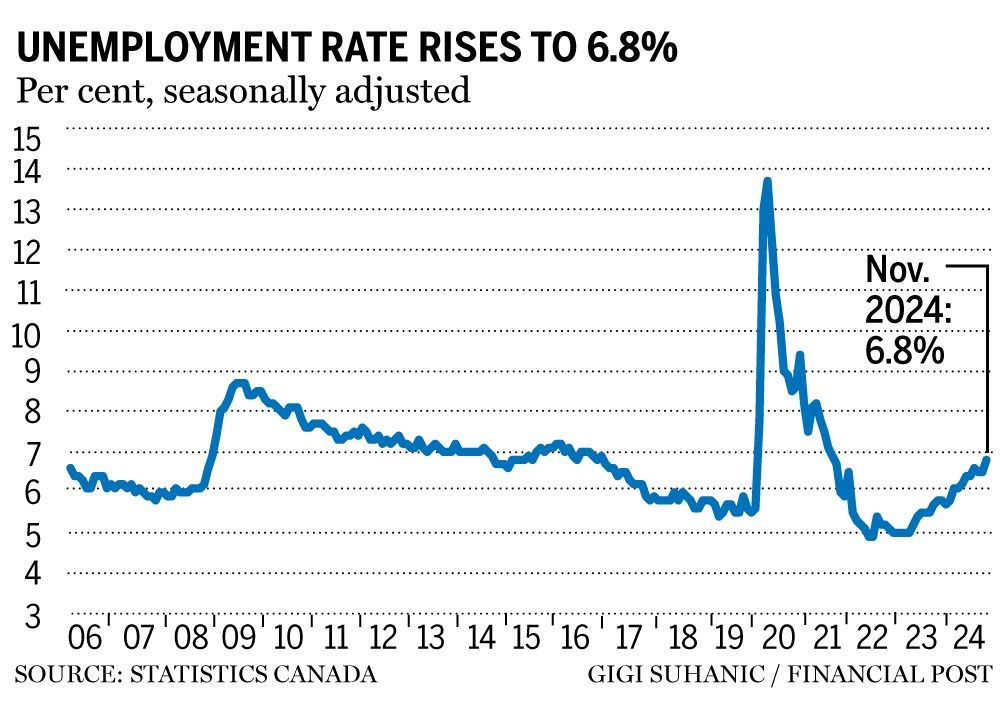


It has been trending higher for months. This trend began long before Trump won the presidency.

And before people blame this all on unemployed migrants skewing the data, EI claims are also way up:
- in February 2022 there 391,700 EI claimants
- in October 2024 there were 484,600 EI claimants
https://www150.statcan.gc.ca/t1/tbl1/en/...024&referencePeriods=20220601%2C20241001

As we all know, you have to pay into EI to receive EI, so TFWs wouldn't be included in that data.

I have spent quite some time researching this, and I don't see how we get out of this economic climate without a major recession.

1. We had largest increase in interest rates since the 80s. There has never been a time in history where a rapid rise in interest rates didn't pish an economy into recession.

2. Interest rates have been cut around the world now for almost a year. This always gets done before the recession starts.

3. The yield curve was inverted for 2 years. Going back 100 years, the length of the yield curve inversion typically precurses a recession of an equal length. The recession rypically follows the yield curve 6-18 months after it uninverts. This places us in mid-2025 for a recession start date.

4. Layoffs are the last cost-cutting measure businesses take after all other measures have already been exhausted. First is a slow down in purchases, then a hiring freeze, then layoffs.

5. Across the western world, government spending typically accounts for 30-50% of GDP. Western countries are also almost in unison electing fiscally conservative governments with a mandate to cut government spending. Most notably will be the US, but Canada is going to do the same, as will Germany and France. Argentina did it last year. There will probably be more to follow.

I don't see how all these factors don't push the world into a major global recession. Honestly the only reason I can think of that a recession will be avoided is that all this data is piblicly available, so it's possible more widespread anticipation of a recession means it will be avoided.

However I'm not betting the farm on that. I think the fact that so many people can see a recession coming this time means that when it does arrive it will probably be much worse than anyone in our lifetime has ever experienced. I've done what I can to position myself for it, but I don't expect to come out of it unscathed. I'm quite nervous about it actually. If I can ride it out I know there are going to be some great deals and opportunities to get market share, but to do that I have to remain solvent, which is never guaranteed.

Reply With Quote
     
     
  #1562  
Old Posted Dec 27, 2024, 6:40 PM
WarrenC12's Avatar
WarrenC12 WarrenC12 is offline
Registered User
 
Join Date: May 2007
Location: East OV!
Posts: 24,558
Quote:
Originally Posted by Build.It View Post
If you want to place blame somewhere, make sure tou place it in the right place. More than a decade of deficit spending capped off by an overdrive QE during COVID caused 2022's inflation, which resulted in high interest rates, which we are only now feeling the effects from.
Most of the deficit is from Trump's tax cuts on the super rich last time he was in office.
Reply With Quote
     
     
  #1563  
Old Posted Dec 27, 2024, 7:15 PM
Changing City's Avatar
Changing City Changing City is offline
Registered User
 
Join Date: Nov 2016
Posts: 8,080
Quote:
Originally Posted by Build.It View Post
You are correct, I said this in 2022 and 2023. I am early, but that doesn't make me wrong. You are also correct I was using employment data from the US because there wasn't a similar stat available for the Canadian employment market. Our economies are intertwined enough though that I can only assume a similar pattern up here. If anything, we are probably further ahead than them.

That being said, here is Canada's unemployment data:

It has been trending higher for months. This trend began long before Trump won the presidency.

And before people blame this all on unemployed migrants skewing the data, EI claims are also way up:
- in February 2022 there 391,700 EI claimants
- in October 2024 there were 484,600 EI claimants
https://www150.statcan.gc.ca/t1/tbl1/en/...024&referencePeriods=20220601%2C20241001

As we all know, you have to pay into EI to receive EI, so TFWs wouldn't be included in that data.
Again, is anybody arguing that we aren't likely to see a recession coming? US Government policy under Trump pretty much guarantees it. Whether it was a foregone conclusion with a different US election result would be pure speculation.

Businesses aren't (yet) laying people off. "The unemployment rate rose from 5% at the start of 2023 to 6.5% in September 2024. This increase primarily reflects a rising share of the existing unemployed continuing to be unable to find work. The rise in the unemployment rate is also due to a growing share of new workers joining the labour force without a job. Layoffs, in contrast, have not contributed much to the rise in unemployment". [ source: Bank of Canada]

TFWs are very much related to the higher enemployment rate - hence the criticisms of Canadian government policy on bringing so many TFWs and students (allowed to work 40 hours for a while) into the country. If you add a significant number of younger workers looking for jobs in the gig economy, or for relatively unskilled work, you are likely to see the existing workforce less able (or willing) to compete. "The rise in the unemployment rate largely reflects the challenges faced by newcomers and youths, who have had a harder time finding work than others in the labour force" According to StatCan there were 30 per cent fewer vacancies than last year in jobs requiring high school education or less, accounting for 70 per cent of the overall decline in vacancies.

The total employed workforce hasn't fallen (yet), but job vacancies have, so unemployment has risen. In other words, the economy isn't growing much - partly because of the higher interest we had for a while, to tame inflation.

There wasn't a recession so far, and it wasn't guaranteed that there would be next year, here, if changed policy on immigration had the desired effect. Now we won't know because the massive economic tsunami of change coming from the south is likely to do damage here, and we're also going to see policy change here that may be disruptive.
__________________
Contemporary Vancouver development blog, https://changingcitybook.wordpress.com/ Then and now Vancouver blog https://changingvancouver.wordpress.com/
Reply With Quote
     
     
  #1564  
Old Posted Dec 27, 2024, 9:59 PM
Build.It Build.It is offline
BANNED
 
Join Date: Dec 2023
Posts: 1,394
So we're in agreement then on the outcome for the most part but differ on what we believe to be good/bad policy.
Reply With Quote
     
     
  #1565  
Old Posted Dec 27, 2024, 10:07 PM
Build.It Build.It is offline
BANNED
 
Join Date: Dec 2023
Posts: 1,394
Quote:
Originally Posted by WarrenC12 View Post
Most of the deficit is from Trump's tax cuts on the super rich last time he was in office.
Trump wasn't exactly prudent when he served, but the national debt grew by just as much if not more under Obama and Biden.

Reply With Quote
     
     
  #1566  
Old Posted Dec 27, 2024, 10:22 PM
Build.It Build.It is offline
BANNED
 
Join Date: Dec 2023
Posts: 1,394
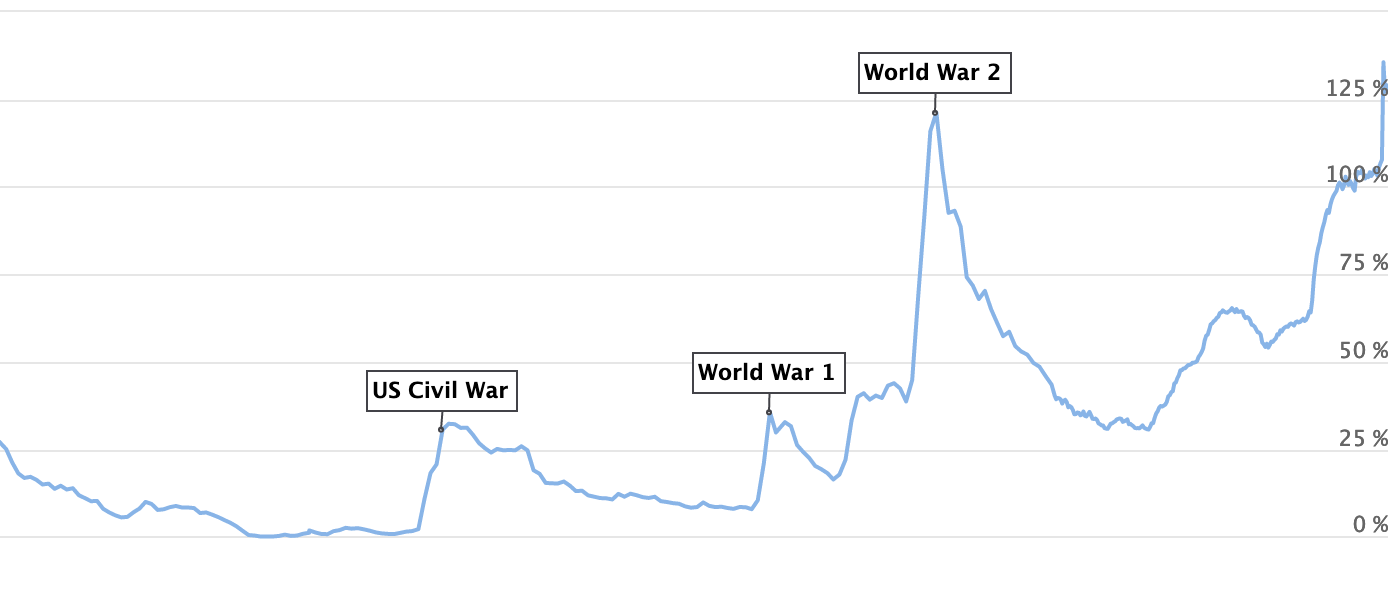
This is also for the US, but it tells an interesting story. There are some who think Japan is the future (eg. Where debt debt doesn't matter and grows continuously into perpetuity), however I think these things are cyclical. What goes up must come down.

Reply With Quote
     
     
  #1567  
Old Posted Dec 27, 2024, 10:54 PM
WarrenC12's Avatar
WarrenC12 WarrenC12 is offline
Registered User
 
Join Date: May 2007
Location: East OV!
Posts: 24,558
Quote:
Originally Posted by Build.It View Post
Trump wasn't exactly prudent when he served, but the national debt grew by just as much if not more under Obama and Biden.
Why don't you go to the real numbers instead of graphs with little context or reference:

https://www.investopedia.com/us-debt-by-president-dollar-and-percentage-7371225

Republican presidents are by far the worst. Trump is significantly worse than Biden.
Reply With Quote
     
     
  #1568  
Old Posted Jan 4, 2025, 2:57 PM
Build.It Build.It is offline
BANNED
 
Join Date: Dec 2023
Posts: 1,394
Here are some more reliable recession indicators.

The Chicago PMI Business Barometer is a survey sent to Chicago manufacturers. Above 50 means they are expanding, and below means they are contracting. Every time the barometer has fallen below 40 there was a recession. It just fell below 40 last month.


Another indicator is the Sahm rule: The Sahm rule is a recession indicator that signals a recession when the three-month moving average of the unemployment rate increases by at least 0.5 percentage points from the lowest three-month average in the previous year.

The Sahm rule was triggered in July when it crossed 50 basis points. It has since gone down a bit but the trend is still upwards.


And of course, this is accompanied by the 10-year-minus-3-month yield curve uninversion, which happened late December (I've already talked about this before, but here is the updated chart).


These are probably the 3 most reliable recessionnleading indicators we have. When you couple that with the rising unemployment, everything is flashing red.

I'm not trying to scare you guys, just warning you so that you have time to get your shit together. There are going to be layoffs and asset prices are going to fall. Make sure you get your shit together before the ball drops so you're not exposed by the time the rest of the market catches on.

Pay off any high interest debt, make sure you have enough cash to weather a possible job loss, and be proactive with your networking. Most people will probably be okay, but there's going to be a shock to the system and it's best to be prepared.
Reply With Quote
     
     
  #1569  
Old Posted Jan 4, 2025, 3:06 PM
Truenorth00 Truenorth00 is offline
Registered User
 
Join Date: May 2017
Posts: 28,836
Quote:
Originally Posted by Build.It View Post

Another indicator is the Sahm rule: The Sahm rule is a recession indicator that signals a recession when the three-month moving average of the unemployment rate increases by at least 0.5 percentage points from the lowest three-month average in the previous year.

The Sahm rule was triggered in July when it crossed 50 basis points. It has since gone down a bit but the trend is still upwards.
The irony of you quoting the Sahm rule while railing against deficits is obviously lost on you cause you are clueless about her work.

I read Claudia Sahm's substack. The whole reason she came up with the rule was to argue that looser fiscal spending when her threshold was breached would prevent recessions. She argued that it would create a bit more inflation, but that it was preferable to high unemployment. She argued that inflation was easier to tame than unemployment and underemployment.
What you see with COVID response and stimulus is literally the Sahm doctrine at work. She's bragged about it. She acknowledged that this might be politically unpopular but she argued the American rebound after COVID proved her right. She has argued that austerity is bad policy during economic slowdowns.

If you agree with Sahm, then you should actually support doubling the deficit in Canada.
Reply With Quote
     
     
  #1570  
Old Posted Jan 4, 2025, 4:42 PM
Build.It Build.It is offline
BANNED
 
Join Date: Dec 2023
Posts: 1,394
Eh don't say I didn't warn you.

But for the record, the COVID response (and prior QE) is what caused the upcoming recession.

If the governments allowed businesses to fail in the GFC and didn't force people to shut their businesses down during COVID we wouldn't be as deeply indebted right now and income inequality wouldn't be as severe.

Last edited by Build.It; Jan 4, 2025 at 5:52 PM.
Reply With Quote
     
     
  #1571  
Old Posted Jan 4, 2025, 5:06 PM
Build.It Build.It is offline
BANNED
 
Join Date: Dec 2023
Posts: 1,394
What I suspect is going to happen is the following:

1. For the first time in 80 years, longterm yields are going up despite central banks cutting rates. This has already started happening. This means that governmwnts can no longer keep refinancing their debt at lower rates.

2. This means there will be mass layoffs in the government and massive decrease in government spending on social programs.

3. Certain private banks are going to go bust, but unlike the GFC banks aren't going to get bailed out this time. Instead the central banks are going to print money to make the account holders whole. This is what happened when Silicon Valley Bank failed, and seems to be their new solution.

4. The money printing is going to cause inflation, but instead of asset inflation it's going to cause commodity inflation. This will eventually flow into asset prices, but much more lagged than during COVID.

5. Governments around the world aren't going to be able to repay their debt, as they are going to have to borrow at higher rates to repay maturing loans. When this happens, governments are going to rewrite their central bank acts so that they can take control of the currency. Whatever debt is held by the central bank will be wiped out. All other maturing debt is going to be paid off using printed money.

6. After this process has taken place we will be left with leaner governments, and newly balanced budgets, and a bad wave of inflation to pay for all this.

7. We will only have to go through this once in our lifetime thankfully as this won't happen again for 80-100 years.

This is literally what happens at the end of every debt cycle. Ray Dalio, Neil Howe and Joe Brown (Heresy Financial) absolutely nailed it.
Reply With Quote
     
     
  #1572  
Old Posted Jan 4, 2025, 5:36 PM
Build.It Build.It is offline
BANNED
 
Join Date: Dec 2023
Posts: 1,394
Further to my last post, here is the Bank of Canada's 2-year and 10-year yields (this is the interest rate they pay for new debt).

I put a pin on June 5 which is when we had the first rate cut.


As you can see, the short term interest rates went down substantially (this is the rate that the central bank has some control over), however the long-term rate (which is driven by the market) has been going up again and is now at the same level as it was when they first started cutting rates.

The next chart is the 10-year yield over the past 13 years. As you can see, any debt that matured since 2022 had to be refinanced at a higher rate. Further more, unless longterm yields start going down substantially (unlikely), all debt maturing over the next 5 years are going to have to be refinanced at a higher rate as well.


This is similar to using a credit card to pay your mortgage.

So basically the government has a choice to make. They can either:

1. Keep refinancing the debt at ever increasing interest rates until they can longer afford to repay the debt.

Or,

2. They can cut spending by rooting out all inefficiency from the government, run surpluses for a few years, and use that (plus printed money) to repay the debt.

Both of these situations are going to involve money printing and inflation, the only question is how much. I firmly expect that the "no more money printing" promise is going to be broken, but it still won't be nearly as bad as if Trudeau/Singh stayed in power. However once this process is over the government's finances will be in much better shape and there will be about 40 good productive years.

Last edited by Build.It; Jan 4, 2025 at 5:52 PM.
Reply With Quote
     
     
  #1573  
Old Posted Jan 4, 2025, 5:38 PM
acottawa acottawa is offline
Registered User
 
Join Date: Aug 2009
Posts: 18,825
Quote:
Originally Posted by Build.It View Post
What I suspect is going to happen is the following:

1. For the first time in 80 years, longterm yields are going up despite central banks cutting rates. This has already started happening. This means that governmwnts can no longer keep refinancing their debt at lower rates.

2. This means there will be mass layoffs in the government and massive decrease in government spending on social programs.

3. Certain private banks are going to go bust, but unlike the GFC banks aren't going to get bailed out this time. Instead the central banks are going to print money to make the account holders whole. This is what happened when Silicon Valley Bank failed, and seems to be their new solution.

4. The money printing is going to cause inflation, but instead of asset inflation it's going to cause commodity inflation. This will eventually flow into asset prices, but much more lagged than during COVID.

5. Governments around the world aren't going to be able to repay their debt, as they are going to have to borrow at higher rates to repay maturing loans. When this happens, governments are going to rewrite their central bank acts so that they can take control of the currency. Whatever debt is held by the central bank will be wiped out. All other maturing debt is going to be paid off using printed money.

6. After this process has taken place we will be left with leaner governments, and newly balanced budgets, and a bad wave of inflation to pay for all this.

7. We will only have to go through this once in our lifetime thankfully as this won't happen again for 80-100 years.

This is literally what happens at the end of every debt cycle. Ray Dalio, Neil Howe and Joe Brown (Heresy Financial) absolutely nailed it.
This reads like crypto bro fan fiction.

Bond yields are pretty stable, and more or less in line with inflation.
https://www.marketwatch.com/investing/bond/tmbmkca-30y?countrycode=bx

To balance the budget would only be about a 10% cut in spending. This would not obviously lead to the massive economic crisis you are suggesting.

There is no reason to expect banks to go bust. Canadian banks have been making provisions for mortgage foreclosures, etc. and are fairly tightly regulated.
Reply With Quote
     
     
  #1574  
Old Posted Jan 4, 2025, 6:07 PM
Build.It Build.It is offline
BANNED
 
Join Date: Dec 2023
Posts: 1,394
The economic crisis I'm talking about is going to get triggered by the US whose government finances are in far worse shape. The bank failures are also going to be US banks, not Canadian ones.

The Fed has cut interest rates by a full percentage point since Sept 19th, and since that time 10-year yields have gone up by a full percentage point.

All current new debt the US takes out is at a higher interest rate than anything since 2007.


Reply With Quote
     
     
  #1575  
Old Posted Jan 4, 2025, 6:20 PM
Build.It Build.It is offline
BANNED
 
Join Date: Dec 2023
Posts: 1,394
A quick comparison of Canada and the US:

CANADA:

The government projects that public debt charges will amount to $54.1 billion, or 12% of total federal spending. This is just the interest portion of the debt not the principle. It is also equal to the entire amount of revenue the government collects from the Goods and Services Tax (GST).

USA:

In July 2023, the annualized cost of servicing the debt was $726 billion, which was 14% of total federal spending. (It has gone up even more since then I just don't have all the data)

NOTES:

Both countries run deficits each year, so if there is no cut in government spending both countries are going to have refinance these debts at much higher rates. This means that while the interest payments are manageable at the moment, that won't be the case if longterm yields keep going up. If they don't at the very least balance the budget, debt servicing costs could balloon dramatically since they will have to refinance at higher rates.

It is crucial for both countries, but especially for the US, that government spending be cut dramatically so that this debt doesn't have to get refinanced at higher rates.
Reply With Quote
     
     
  #1576  
Old Posted Jan 4, 2025, 6:39 PM
GreaterMontréal's Avatar
GreaterMontréal GreaterMontréal is offline
Registered User
 
Join Date: Dec 2013
Posts: 4,628
Quote:
This will eventually flow into asset prices, but much more lagged than during COVID
This worse than the COVID rapid inflation. Here in Quebec most government employees got a pretty good raise (15-25%) mainly because of the COVID inflation. I expect the real estate market in Quebec to be a lot more expensive in 2030.
Reply With Quote
     
     
  #1577  
Old Posted Jan 4, 2025, 6:53 PM
suburbanite's Avatar
suburbanite suburbanite is offline
Registered User
 
Join Date: Apr 2011
Location: Toronto & NYC
Posts: 5,645
Quote:
Originally Posted by Build.It View Post
A quick comparison of Canada and the US:

CANADA:

The government projects that public debt charges will amount to $54.1 billion, or 12% of total federal spending. This is just the interest portion of the debt not the principle. It is also equal to the entire amount of revenue the government collects from the Goods and Services Tax (GST).

USA:

In July 2023, the annualized cost of servicing the debt was $726 billion, which was 14% of total federal spending. (It has gone up even more since then I just don't have all the data)

NOTES:

Both countries run deficits each year, so if there is no cut in government spending both countries are going to have refinance these debts at much higher rates. This means that while the interest payments are manageable at the moment, that won't be the case if longterm yields keep going up. If they don't at the very least balance the budget, debt servicing costs could balloon dramatically since they will have to refinance at higher rates.

It is crucial for both countries, but especially for the US, that government spending be cut dramatically so that this debt doesn't have to get refinanced at higher rates.
A balanced budget isn't going to result in a reduction of the existing debt. Unless either country somehow generates a substantial surplus through unprecedented austerity, the debt is going to be refinanced at higher rates if long-term yields rise.
__________________
Discontented suburbanite since 1994
Reply With Quote
     
     
  #1578  
Old Posted Jan 4, 2025, 7:00 PM
GreaterMontréal's Avatar
GreaterMontréal GreaterMontréal is offline
Registered User
 
Join Date: Dec 2013
Posts: 4,628
Quote:
Originally Posted by Build.It View Post
A quick comparison of Canada and the US:

CANADA:

The government projects that public debt charges will amount to $54.1 billion, or 12% of total federal spending. This is just the interest portion of the debt not the principle. It is also equal to the entire amount of revenue the government collects from the Goods and Services Tax (GST).

USA:

In July 2023, the annualized cost of servicing the debt was $726 billion, which was 14% of total federal spending. (It has gone up even more since then I just don't have all the data)

NOTES:

Both countries run deficits each year, so if there is no cut in government spending both countries are going to have refinance these debts at much higher rates. This means that while the interest payments are manageable at the moment, that won't be the case if longterm yields keep going up. If they don't at the very least balance the budget, debt servicing costs could balloon dramatically since they will have to refinance at higher rates.

It is crucial for both countries, but especially for the US, that government spending be cut dramatically so that this debt doesn't have to get refinanced at higher rates.
MMT allows to print to infinity to pay the debt. In the long term, there is a higher chance to see a government giving people free money just to exist, to keep the economy rolling, than to have a government that does nothing resulting in a catastrophic outcome for most people.
Reply With Quote
     
     
  #1579  
Old Posted Jan 4, 2025, 7:11 PM
Build.It Build.It is offline
BANNED
 
Join Date: Dec 2023
Posts: 1,394
Were you not around in 2020-2022 when the government did MMT and we got massive inflation as a result?

If you give people money, they work less. If they work less then fewer products and services come to market.

If you have fewer products and services on the market, and more money, what do you get?
Reply With Quote
     
     
  #1580  
Old Posted Jan 4, 2025, 7:17 PM
GreaterMontréal's Avatar
GreaterMontréal GreaterMontréal is offline
Registered User
 
Join Date: Dec 2013
Posts: 4,628
Quote:
Originally Posted by Build.It View Post
Were you not around in 2020-2022 when the government did MMT and we got massive inflation as a result?

If you give people money, they work less. If they work less then fewer products and services come to market.

If you have fewer products and services on the market, and more money, what do you get?
The inflation was not created because they gave people free money. The inflation was caused because the supply chain stopped suddenly and people had money to buy things all at the same time. This resulted in a rarity in almost everything.
Reply With Quote
     
     
This discussion thread continues

Use the page links to the lower-right to go to the next page for additional posts
 
 
Reply

Go Back   SkyscraperPage Forum > Regional Sections > Canada
Forum Jump


Forum Jump


All times are GMT. The time now is 10:38 PM.

     
SkyscraperPage.com - Privacy Statement - Top

Powered by vBulletin® Version 3.8.7
Copyright ©2000 - 2026, vBulletin Solutions, Inc.