HomeDiagramsDatabaseMapsForum About
     

Go Back   SkyscraperPage Forum > Discussion Forums > Transportation


Reply

 
Thread Tools Display Modes
     
     
  #1  
Old Posted Nov 12, 2024, 6:15 PM
Mad_Nick Mad_Nick is offline
Registered User
 
Join Date: Oct 2003
Posts: 1,950
Largest metro systems in the world

Metro system rankings have changed quite a bit in the past number of years as China has been building metros like crazy. Truly fascinating stuff. I thought a list of metros ranked by length would be in order. What can we learn in order to catch up and start once again properly expanding our transit systems?
  1. Beijing 🇨🇳
    • Stations: 381
    • Length: 507.0 mi / 816 km
    • Annual ridership: 3,445.7 million
    • Lines: 27
  2. Shanghai 🇨🇳
    • Stations: 408
    • Length: 497.5 mi / 796 km
    • Annual ridership: 3,647.6 million
    • Lines: 19
  3. Guangzhou 🇨🇳
    • Stations: 265
    • Length: 403.1 mi / 645 km
    • Annual ridership: 3,128.9 million
    • Lines: 15
  4. Chengdu 🇨🇳
    • Stations: 296
    • Length: 373.1 mi / 597 km
    • Annual ridership: 2,109.2 million
    • Lines: 13
  5. Shenzhen 🇨🇳
    • Stations: 307
    • Length: 345.1 mi / 555 km
    • Annual ridership: 2,705.3 million
    • Lines: 16
  6. Chongqing 🇨🇳
    • Stations: 256
    • Length: 325.4 mi / 524 km
    • Annual ridership: 1,325.8 million
    • Lines: 11
  7. Nanjing 🇨🇳
    • Stations: 212
    • Length: 324.0 mi / 521 km
    • Annual ridership: 1,010.0 million
    • Lines: 14
  8. Moscow 🇷🇺
    • Stations: 233
    • Length: 322.7 mi / 519 km
    • Annual ridership: 2,288.5 million
    • Lines: 16
  9. Hangzhou 🇨🇳
    • Stations: 254
    • Length: 320.8 mi / 516 km
    • Annual ridership: 1,383.6 million
    • Lines: 12
  10. Wuhan 🇨🇳
    • Stations: 265
    • Length: 311.0 mi 501 km
    • Annual ridership: 1,342.9 million
    • Lines: 12
  11. London 🇬🇧
    • Stations: 272
    • Length: 250.0 mi / 402 km
    • Annual ridership: 1,181.0 million
    • Lines: 11
  12. New York City 🇺🇸
    • Stations: 423
    • Length: 248.0 mi / 399 km
    • Annual ridership: 2,027.3 million
    • Lines: 28
  13. Xi'an 🇨🇳
    • Stations: 211
    • Length: 235.6 mi / 379 km
    • Annual ridership: 1,294.3 million
    • Lines: 12
  14. Seoul 🇰🇷
    • Stations: 337
    • Length: 222.7 mi / 358 km
    • Annual ridership: 2,403.0 million
    • Lines: 11
  15. Delhi 🇮🇳
    • Stations: 231
    • Length: 217.7 mi / 350 km
    • Annual ridership: 2,032.0 million
    • Lines: 10
  16. Qingdao 🇨🇳
    • Stations: 169
    • Length: 216.8 mi / 349 km
    • Annual ridership: 470.0 million
    • Lines: 8
  17. Zhengzhou 🇨🇳
    • Stations: 187
    • Length: 213.9 mi / 344 km
    • Annual ridership: 583.2 million
    • Lines: 11
  18. Suzhou 🇨🇳
    • Stations: 204
    • Length: 200.3 mi / 322 km
    • Annual ridership: 523.8 million
    • Lines: 7
  19. Tianjin 🇨🇳
    • Stations: 193
    • Length: 195.5 mi / 315 km
    • Annual ridership: 571.3 million
    • Lines: 10
  20. Madrid 🇪🇸
    • Stations: 242
    • Length: 182.6 mi / 294 km
    • Annual ridership: 662.3 million
    • Lines: 13
  21. Paris 🇫🇷
    • Stations: 320
    • Length: 152.6 mi / 246 km
    • Annual ridership: 1,411.5 million
    • Lines: 16
  22. Istanbul 🇹🇷
    • Stations: 147
    • Length: 151.2 mi / 243 km
    • Annual ridership: 831.4 million
    • Lines: 11
  23. Singapore 🇸🇬
    • Stations: 141
    • Length: 150.0 mi / 241 km
    • Annual ridership: 1,183.7 million
    • Lines: 6
  24. Dalian 🇨🇳
    • Stations: 100
    • Length: 147.7 mi / 238 km
    • Annual ridership: 252.0 million
    • Lines: 6
  25. Tehran 🇮🇷
    • Stations: 131
    • Length: 139.6 mi / 225 km
    • Annual ridership: 820.0 million
    • Lines: 6
  26. Changsha 🇨🇳
    • Stations: 140
    • Length: 135.3 mi / 218 km
    • Annual ridership: 943.9 million
    • Lines: 6
  27. Hefei 🇨🇳
    • Stations: 161
    • Length: 134.0 mi / 216 km
    • Annual ridership: 411.0 million
    • Lines: 5
  28. Washington, D.C. 🇺🇸
    • Stations: 98
    • Length: 129.0 mi / 208 km
    • Annual ridership: 136.3 million
    • Lines: 6
  29. Kuala Lumpur 🇲🇾
    • Stations: 138
    • Length: 127.3 mi / 205 km
    • Annual ridership: 238.5 million
    • Lines: 6
  30. Mexico City 🇲🇽
    • Stations: 163
    • Length: 124.8 mi / 201 km
    • Annual ridership: 1,115.2 million
    • Lines: 12

Last edited by Mad_Nick; Nov 13, 2024 at 8:52 PM.
Reply With Quote
     
     
  #2  
Old Posted Nov 12, 2024, 11:08 PM
Cirrus's Avatar
Cirrus Cirrus is offline
cities|transit|croissants
 
Join Date: Jul 2001
Location: Washington, DC
Posts: 18,718
I think you forgot Tokyo.

Anyway, interesting stuff.

>> What can we learn in order to catch up and start once again properly expanding our transit systems?

Basically in the US we have a perfect storm of political, fiscal, regulatory, labor, and planning hurdles that make it unnecessarily hard & expensive to deliver mega projects, and transit in particular, compared to other highly developed countries. There is no single answer, and it is definitely not an issue of US labor simply being more expensive (although that is part of the answer). The most serious work to date on this comes from Alon Levy's Transit Costs Project, which everyone interested in US transit should at least be aware of.
__________________
writing | twitter | bluesky | flickr | instagram | ssp photo threads
Reply With Quote
     
     
  #3  
Old Posted Nov 12, 2024, 11:17 PM
Minato Ku's Avatar
Minato Ku Minato Ku is offline
Tokyo and Paris fan
 
Join Date: Jul 2006
Location: Paris, Montrouge
Posts: 4,305
Quote:
Originally Posted by Mad_Nick View Post
Metro system rankings have changed quite a bit in the past number of years as China has been building metros like crazy. Truly fascinating stuff. I thought a list of metros ranked by length would be in order. What can we learn in order to catch up and start once again properly expanding our transit systems?
  1. New York City 🇺🇸
    • Stations: 423
    • Length: 248.0 mi
    • Annual ridership: 2,027.3 million
    • Lines: 28
When New York subway had an annual ridership of 2,027.3 million ?
Last annual ridership in 2023 was 1,151.9 million.

Did you use unlinked passenger trips data for New York City instead of annual ridership ?
Reply With Quote
     
     
  #4  
Old Posted Nov 13, 2024, 12:13 AM
caligrad's Avatar
caligrad caligrad is offline
Registered User
 
Join Date: Nov 2013
Location: Long Beach
Posts: 1,842
Quote:
Originally Posted by Cirrus View Post
I think you forgot Tokyo.

Anyway, interesting stuff.

>> What can we learn in order to catch up and start once again properly expanding our transit systems?

Basically in the US we have a perfect storm of political, fiscal, regulatory, labor, and planning hurdles that make it unnecessarily hard & expensive to deliver mega projects, and transit in particular, compared to other highly developed countries. There is no single answer, and it is definitely not an issue of US labor simply being more expensive (although that is part of the answer). The most serious work to date on this comes from Alon Levy's Transit Costs Project, which everyone interested in US transit should at least be aware of.
Funding. Los Angeles for instance. LA could quadruple the size of its network with about 20 billion dollars. But unfortunately for us, METRO isn't as bullish nor is it funded enough to get those lines even the consideration, they deserve to be built.
Reply With Quote
     
     
  #5  
Old Posted Nov 13, 2024, 12:29 AM
TWAK's Avatar
TWAK TWAK is offline
Resu Deretsiger
 
Join Date: Feb 2004
Location: Clearlake, CA Micropolitan Statistical Area
Posts: 17,151
Quote:
Originally Posted by caligrad View Post
Funding. Los Angeles for instance. LA could quadruple the size of its network with about 20 billion dollars. But unfortunately for us, METRO isn't as bullish nor is it funded enough to get those lines even the consideration, they deserve to be built.
Political will, ROW, technology are things as well...but the number one will be cost. It just costs more in dense urban areas to build stuff!
BART has eBART which is not Metro and a different gauge , but is part of the metro system. Similar to that, Caltrain will be running as frequent as a metro system and sort of will be treated as such.


The roll of the eyes is for the original BART system being a different type of gauge.
__________________
#ruralurbanist
Reply With Quote
     
     
  #6  
Old Posted Nov 13, 2024, 2:38 AM
Nouvellecosse's Avatar
Nouvellecosse Nouvellecosse is online now
Volatile Pacivist
 
Join Date: Aug 2005
Location: Nova Scotia
Posts: 11,217
Very interesting list! The only improvement needed is for the distances to be listed in km since most of those systems operate in metric regions and the thread is in the international section of a Canada based forum. With miles obviously it's clear how they compare in a relative sense, but for many of us the actual distance doesn't mean anything in miles.
__________________
"The reasonable man adapts himself to the world; the unreasonable one persists in trying to adapt the world to himself. Therefore all progress depends on the unreasonable man." - George Bernard Shaw
Don't ask people not to debate a topic. Just stop making debatable assertions. Problem solved.
Reply With Quote
     
     
  #7  
Old Posted Nov 13, 2024, 3:39 AM
Busy Bee's Avatar
Busy Bee Busy Bee is online now
Closeted Normie
 
Join Date: Feb 2006
Location: on the artistic spectrum
Posts: 12,978
Quote:
Originally Posted by Minato Ku View Post
When New York subway had an annual ridership of 2,027.3 million ?
Last annual ridership in 2023 was 1,151.9 million.

Did you use unlinked passenger trips data for New York City instead of annual ridership ?
Not sure where that 2.03 billion number came from but 2015 I believe got the closest to the 1946 record of 2 billion annual rides. 2015 saw a daily record of 6.2 million.
__________________
Everything new is old again

Sic semper tyrannis
Reply With Quote
     
     
  #8  
Old Posted Nov 13, 2024, 11:16 AM
Mad_Nick Mad_Nick is offline
Registered User
 
Join Date: Oct 2003
Posts: 1,950
Quote:
Originally Posted by Minato Ku View Post
When New York subway had an annual ridership of 2,027.3 million ?
Last annual ridership in 2023 was 1,151.9 million.

Did you use unlinked passenger trips data for New York City instead of annual ridership ?
Wikipedia which in turn got it from https://www.apta.com/wp-content/uploads/2023-Q4-Ridership-APTA-Update-1.pdf

Yes it appears to be unlinked. Comparisons can be difficult when everyone counts differently.
Reply With Quote
     
     
  #9  
Old Posted Nov 13, 2024, 5:05 PM
MolsonExport's Avatar
MolsonExport MolsonExport is offline
Touching grass everyday.
 
Join Date: Oct 2003
Location: Otisburgh
Posts: 51,141
For Canada

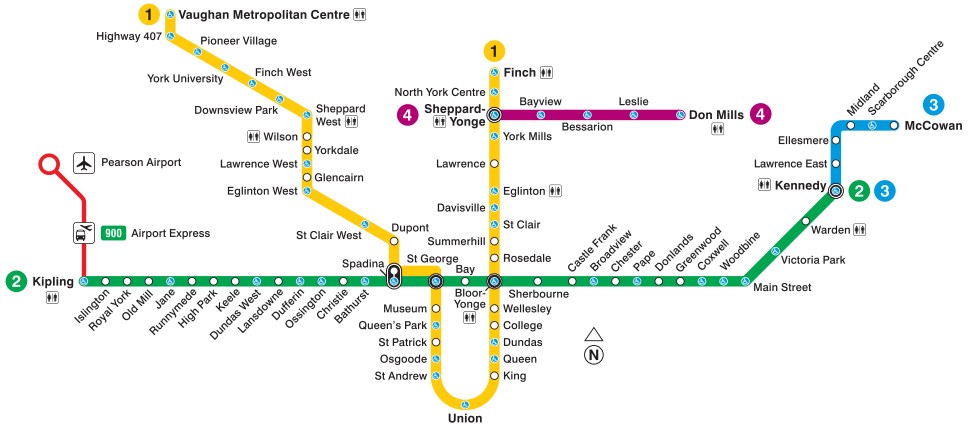
Toronto Subway: 70.1 km (43.6 mi), with an additional 63.2km (39.3 mi) under construction. 70 stations, with an additional 60 under construction. Annual ridership (2023): 302,527,000


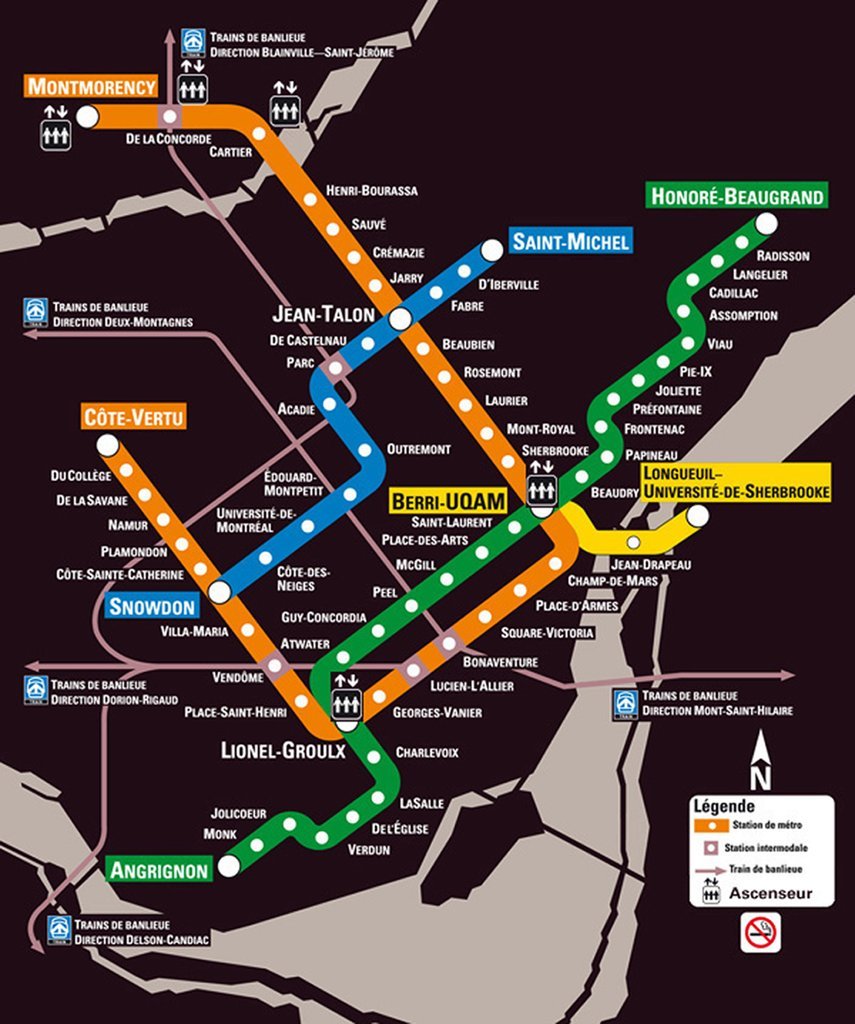
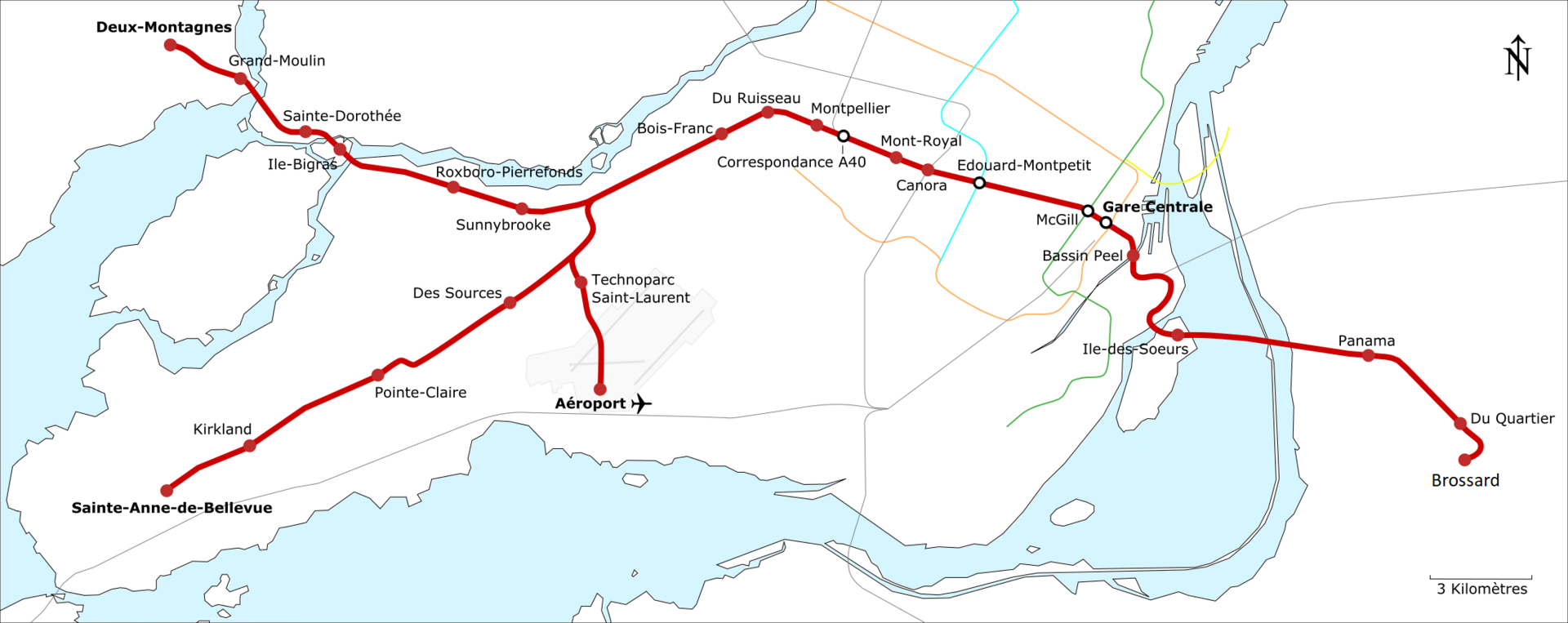
Montreal Metro: 69.2km (43.0 mi). 68 stations (with another 5 under construction). Annual ridership (2023): 303,969,500. These figures do not include what is essentially a second metro system for Montreal, the REM, which covers 67km (42 mi) and is currently being opened in stages (with 25 stations in total).


__________________
The whole problem with the world is that fools and fanatics are always so certain of themselves, and wiser people so full of doubts. (Bertrand Russell). Sweet Loretta fart thought she was a cleaner, but she was a frying pan. (John Lennon)
Reply With Quote
     
     
  #10  
Old Posted Nov 13, 2024, 6:35 PM
JMBasquiat JMBasquiat is offline
Registered User
 
Join Date: Feb 2023
Posts: 33
Reply With Quote
     
     
  #11  
Old Posted Nov 13, 2024, 7:27 PM
Nouvellecosse's Avatar
Nouvellecosse Nouvellecosse is online now
Volatile Pacivist
 
Join Date: Aug 2005
Location: Nova Scotia
Posts: 11,217
Track length is quite different from how metro systems are usually measured which tends to go by route length. Track length not only counts all double tracked sections twice, but also counts non-revenue track such as sections used only to transport trains to maintenance/storage facilities or between routes.
__________________
"The reasonable man adapts himself to the world; the unreasonable one persists in trying to adapt the world to himself. Therefore all progress depends on the unreasonable man." - George Bernard Shaw
Don't ask people not to debate a topic. Just stop making debatable assertions. Problem solved.
Reply With Quote
     
     
  #12  
Old Posted Nov 13, 2024, 8:04 PM
Mad_Nick Mad_Nick is offline
Registered User
 
Join Date: Oct 2003
Posts: 1,950
Quote:
Originally Posted by TWAK View Post
Political will, ROW, technology are things as well...but the number one will be cost. It just costs more in dense urban areas to build stuff!
BART has eBART which is not Metro and a different gauge , but is part of the metro system. Similar to that, Caltrain will be running as frequent as a metro system and sort of will be treated as such.


The roll of the eyes is for the original BART system being a different type of gauge.
Something China has done which is very interesting is standardize almost all aspects of metro building. It makes the process much simpler, you analyze the need for capacity and the geography, you choose from a pre-determined list, and you build. Standardized equipment, standardized signalling, technology, tracks. It becomes much cheaper and they have built expertise over time so when one metro system is done, you can use the same engineers to build the next one of the same type.

Could something similar ever be done in the west? Sure, it may result in systems that are in many ways very similar which may not be so fun for us transit enthusiasts, but it gets built and it gets built fast!

RM Transit has a video on it:
Video Link
Reply With Quote
     
     
  #13  
Old Posted Nov 13, 2024, 8:06 PM
Mad_Nick Mad_Nick is offline
Registered User
 
Join Date: Oct 2003
Posts: 1,950
Quote:
Originally Posted by Nouvellecosse View Post
Very interesting list! The only improvement needed is for the distances to be listed in km since most of those systems operate in metric regions and the thread is in the international section of a Canada based forum. With miles obviously it's clear how they compare in a relative sense, but for many of us the actual distance doesn't mean anything in miles.
Of course you're right, a much more rational system as well! I added km. Unfortunately it screwed up the flags for some reason.
Reply With Quote
     
     
  #14  
Old Posted Nov 13, 2024, 10:07 PM
Busy Bee's Avatar
Busy Bee Busy Bee is online now
Closeted Normie
 
Join Date: Feb 2006
Location: on the artistic spectrum
Posts: 12,978
Quote:
Originally Posted by Mad_Nick View Post
Something China has done which is very interesting is standardize almost all aspects of metro building. It makes the process much simpler, you analyze the need for capacity and the geography, you choose from a pre-determined list, and you build. Standardized equipment, standardized signalling, technology, tracks. It becomes much cheaper and they have built expertise over time so when one metro system is done, you can use the same engineers to build the next one of the same type.

Could something similar ever be done in the west? Sure, it may result in systems that are in many ways very similar which may not be so fun for us transit enthusiasts, but it gets built and it gets built fast!

RM Transit has a video on it:

That makes sense when you have a dozen cities in line to more or less all get metro networks at the same time. But also, that's not totally unlike some of the efforts we saw from the USDOT and FTA in the 60s and 70s when rolling stock standardization was being pursued for the new heavily fed funded metro programs (DC, Atlanta) and existing subway systems (SOAC). Even the Boeing-Vertol articluated trolley (Muni, MBTA) I believe was an FTA initiative. Another example of a federal standardization program was DOT's Transbus program which birthed the RTS bus.
__________________
Everything new is old again

Sic semper tyrannis
Reply With Quote
     
     
  #15  
Old Posted Nov 13, 2024, 10:11 PM
craigs's Avatar
craigs craigs is offline
Registered User
 
Join Date: May 2019
Location: Los Angeles
Posts: 10,794
Quote:
Originally Posted by Busy Bee View Post
That makes sense when you have a dozen cities in line to more or less all get metro networks at the same time. Also, that's not totally unlike some of the efforts we saw from the USDOT and FTA in the 60s and 70s when rolling stock standardization was being pursued new and existing subway systems. Even the Boeing-Vertol articluated trolley (Muni, MBTA) I believe was an FTA initiative.
I rode those Boeing LRVs in both cities and man, did they suck. Always breaking down, doors that wouldn't open, etc.
Reply With Quote
     
     
  #16  
Old Posted Nov 13, 2024, 10:18 PM
Busy Bee's Avatar
Busy Bee Busy Bee is online now
Closeted Normie
 
Join Date: Feb 2006
Location: on the artistic spectrum
Posts: 12,978
Quote:
Originally Posted by craigs View Post
I rode those Boeing LRVs in both cities and man, did they suck. Always breaking down, doors that wouldn't open, etc.
Yeah, they looked pretty cool with their period styling, but yes they had a ton of problems. Might have had something to do with an aeronautical corp trying to build trains, though I think the Cta L cars they built had much better luck.
__________________
Everything new is old again

Sic semper tyrannis
Reply With Quote
     
     
  #17  
Old Posted Nov 15, 2024, 8:04 PM
ssiguy ssiguy is online now
Registered User
 
Join Date: Mar 2006
Location: White Rock BC
Posts: 11,910
Very much appreciate the info/stats Mad_Nick.

The problem with these figures, however, is that what qualifies as a "Metro" is not clearly defined. Montreal's new REM system is completely grade separated and automated and will span 65km when complete in by 2026 but use light rail vehicles so it may not be included.

Also there are many regional/suburban rail systems that act as effective Metros and are not included in these stats yet may have Metro level frequencies, have completely integrated fares with the other transit systems, and be nearly or completely grade separated. In fact many regional/suburban ridership numbers are higher than the Metros themselves. This is the case in Paris, Berlin, Sydney, and even Tokyo and the systems can be significantly larger than the largest Metro system, Beijing. For most riders they are viewed as just Metro systems with a different name and different rolling stock but "technically" don't qualify as a Metro.
Reply With Quote
     
     
  #18  
Old Posted Nov 15, 2024, 9:14 PM
wanderer34 wanderer34 is offline
Registered User
 
Join Date: Jan 2006
Location: Miami/somewhere in paradise
Posts: 1,705
I think this thread name should be changed from the largest metro systems in the world to the longest metro systems in the world. Beijing looks like it has the longest metro system when it comes to distance, as well as one of the highest ridership in the world due to having one of the highest city populations in the world. When it comes to having the most stations, NYC wins hands down. However, it looks like China (and Russia) make up the world's longest metro systems.
Reply With Quote
     
     
  #19  
Old Posted Nov 15, 2024, 9:50 PM
Cirrus's Avatar
Cirrus Cirrus is offline
cities|transit|croissants
 
Join Date: Jul 2001
Location: Washington, DC
Posts: 18,718
Quote:
Originally Posted by caligrad View Post
Funding. Los Angeles for instance. LA could quadruple the size of its network with about 20 billion dollars. But unfortunately for us, METRO isn't as bullish nor is it funded enough to get those lines even the consideration, they deserve to be built.
Too simple. Funding does matter but the US actually spends a lot of money on new transit. A huge part of our problem is that a billion dollars in the US doesn't buy nearly as much (or as good) transit as a billion dollars does in Western Europe (never mind China).

For example, it costs Los Angeles about $500 million to build one mile of subway, and Los Angeles is typical for the US. It costs Spaid--a first world Western European economy--about $150 million to do the same. These numbers are a few years old but the point is we are not getting the value for our spending that we should be getting. And that's because of all that other stuff I listed, in addition to "fiscal."
__________________
writing | twitter | bluesky | flickr | instagram | ssp photo threads
Reply With Quote
     
     
  #20  
Old Posted Nov 16, 2024, 12:20 AM
Busy Bee's Avatar
Busy Bee Busy Bee is online now
Closeted Normie
 
Join Date: Feb 2006
Location: on the artistic spectrum
Posts: 12,978
That tends to happen when four men are hired to do a job that could be done by three. That and the fact US agencies have virtually no internal institutional knowledge on how to actually design and build anything and spend hundreds of millions of dollars on outside consultants.
__________________
Everything new is old again

Sic semper tyrannis
Reply With Quote
     
     
This discussion thread continues

Use the page links to the lower-right to go to the next page for additional posts
 
 
Reply

Go Back   SkyscraperPage Forum > Discussion Forums > Transportation
Forum Jump


Forum Jump


All times are GMT. The time now is 3:23 PM.

     
SkyscraperPage.com - Privacy Statement - Top

Powered by vBulletin® Version 3.8.7
Copyright ©2000 - 2026, vBulletin Solutions, Inc.