| |
 Posted Nov 29, 2024, 1:00 PM
|
 |
Registered User
|
|
Join Date: Aug 2006
Location: Downtown Los Angeles
Posts: 20,749
|
|
Central Metro East - Park City - High Valley Transit on track to open new headquarters in early 2025
Construction progresses on transit district’s new $46 million campus, paving the way for improved services across the Wasatch Back
Toria Barnhart for the Park Record - Full Article @ https://www.parkrecord.com/2024/11/26/hi...-to-open-new-headquarters-in-early-2025/
November 26, 2024 - High Valley Transit was launched in January 2021 as a special service district of Summit County designed to bring transportation services, and solutions, to the Wasatch Back. Since then, staff have been focused on building the transit district from the ground up — providing 3.5 million rides in three years. But now that High Valley has reached cruising speed, it’s considering the best ways to sustain its success, build permanence, and ensure the long-term vitality of the organization...
...An occupation date has been set for February or March 2025, marking what’s expected to be the start of improved and expanded services.
June 2024
High Valley Transit’s new headquarters, along U.S. 40 near Home Depot, was under construction in June. Credit: Park Record file photo by David Jackson

“Launching a transit district is no small task. It’s a huge effort to get a hold of buses and mechanics and drivers and space and put together routes,” said Chief Development Officer Gabriel Shields. “To date, the lion’s share of the effort was focused on operations, and then the other side of our agency really has kind of focused on capital.”
Shields started with High Valley Transit in February after working as a transportation engineer for Park City Municipal for two years. His job is to deliver a $150 million capital program, including the S.R. 224 Bus Rapid Transit project and the new headquarters as well as the purchase of new buses or other assets to improve rider comfort.
High Valley Transit’s new headquarters will support its mission of moving the Wasatch Back forward with sustainability and innovation by creating a 17,000-square-foot shop with space for maintenance work such as tires, parts, fluid storage and a bush wash facility, an 18,000-square-foot administrative building with the second floor dedicated as employee housing and a 31,000-square-foot garage with enough room for 24 buses...The scope of the project also changed to include nine apartments for High Valley Transit drivers and electric vehicle charging capabilities, pushing the total price tag to about $46 million...
November 2024
Machinery and piles of gravel sit at the construction site for the new High Valley Transit headquarters. Credit: Clayton Steward/Park Record

...High Valley received around $8 million in state and federal funds to help construct the new headquarters as well as a discretionary grant for several low- and no-emission vehicles. The Board of Trustees previously approved borrowing up to $18 million against sales tax revenue bonds to pay for the project on its own, if necessary...
...GSB architects designed the facility, while Big D Construction handled the groundwork. Once the ground was flat, work started on the eastern portion of the parcel where a tilt panel building resembling a warehouse sits. That will be the bus storage facility, which is nearly finished. There’s minimal activity in the building as crews put on the finishing touches such as painting and installing light bulbs...
...Shields said the final component of the project is making site improvements such as installing utilities, parking canopies, trash enclosures and fencing as well as moving dirt. He estimated that 70 to 80 people are working on the job site now, but there were around 150 in the peak of the summer...
The maintenance building, which is concrete masonry, sits in the middle of the new High Valley Transit campus. Construction crews are still finishing work on the building but expect it to be occupied by early next year. The steel-framed administrative and driver housing...is in the earliest stages of construction with a flurry of activity. Crews recently finished hanging drywall to close in the employee housing. The one-bedroom apartments have a living room and bathroom, plus a shared common area outside of the unit. Credit: Clayton Steward/Park Record
 Credit: Park Record file photo by David Jackson
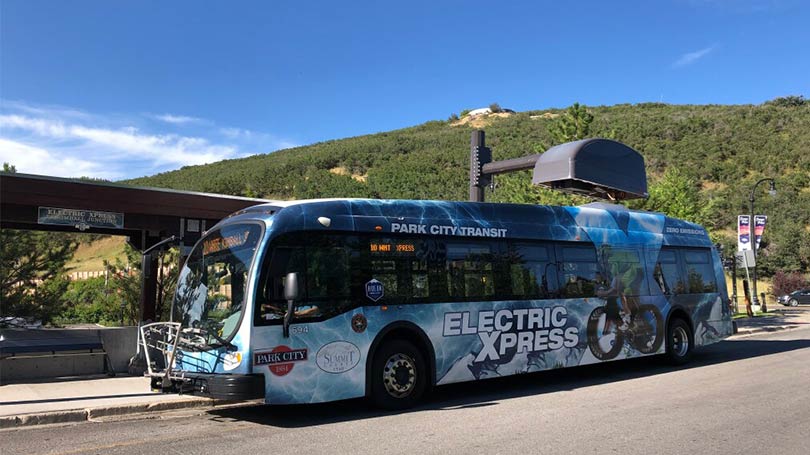
 Central Metro East - Park City - High Valley Transit adds two more electric buses to its fleet
2023: Park City Transit gained two more battery-electric bus chargers, in addition to starting the Bus Stop Improvement Project. This project is funded through $7.4 million in federal, state, and county grants, and will transform 72 bus stops in Park City. The goal is to enhance the transit experience through improved accessibility, comfort, and new amenities.
These newest electric vehicles are the first of their specific kind for the transit district, which is slated to receive additional buses as part of the agreement...Half of the total of eight new vehicles will be 40-foot, rapid transit-style buses, while the other four will be branded High Valley Transit commuter buses that are similar to what’s utilized on the Park City-Salt Lake City Connect route currently, according to High Valley Transit Executive Director Caroline Rodriguez.
...The new buses represent a huge shift in how the transit district will operate in the future. “We can reasonably say that the Summit County Council, the Park City Council, and most stakeholders in the greater Park City area have committed to clean, renewable energy,” she said. “High Valley Transit is following in their footsteps. We have always envisioned clean vehicles and moving to a greener technology.”
The High Valley Transit District recently received two new electric buses. The transit district is slated to receive six other green vehicles that will help transition to a more sustainable fleet.
Overhead conductive charging, also known as pantograph charging, requires physical contact with flow of current between an overhead charger and the onboard battery. Transit buses can be recharged in 5 – 20 minutes at a higher power level (165 – 600 kW).
.

|
|
|





 Prev
Prev












 Linear Mode
