HomeDiagramsDatabaseMapsForum About
     

Go Back   SkyscraperPage Forum > Discussion Forums > City Discussions


Reply

 
Thread Tools Display Modes
     
     
  #621  
Old Posted Jan 26, 2024, 11:21 PM
Yuri's Avatar
Yuri Yuri is offline
Registered User
 
Join Date: Sep 2008
Posts: 6,142
Quote:
Originally Posted by mhays View Post
LA is dense, yes. Unfortunately it might also have the highest density of cars in the world.
Sadly, São Paulo is probably the biggest offender here. Its footprint is half of Los Angeles+Inland, whereas it has just a slightly smaller number of cars.
__________________
London - São Paulo - Rio de Janeiro - Londrina - Frankfurt
Reply With Quote
     
     
  #622  
Old Posted Jan 26, 2024, 11:27 PM
Yuri's Avatar
Yuri Yuri is offline
Registered User
 
Join Date: Sep 2008
Posts: 6,142
Quote:
Originally Posted by Steely Dan View Post
Impressive.

How many other US cities put over 1.5M people on less than 100 contiguous sq. miles of land?

NYC obviously.

probably Chicago.

Who else?
How accurate are those numbers? When I was making my Downtown lists, I found 479,985 people within 66 km2 (25sqm) on Central Los Angeles (Downtown, Chinatown, Echo Park, Silver Lake, Los Feliz, East Hollywood, Westlake, Koreatown, Pico-Union)

Maybe I'm mistaken, but I wouldn't think this (high) density keeps up for an area four times larger.
__________________
London - São Paulo - Rio de Janeiro - Londrina - Frankfurt
Reply With Quote
     
     
  #623  
Old Posted Jan 27, 2024, 12:47 AM
Klippenstein's Avatar
Klippenstein Klippenstein is offline
Rust Belt Motherland
 
Join Date: Apr 2021
Location: Chicago, IL
Posts: 871
^I don't think they're contiguous. I think it's adding up all the densest neighborhoods in LA, but I could be wrong.

Quote:
Originally Posted by Steely Dan View Post
Nice.

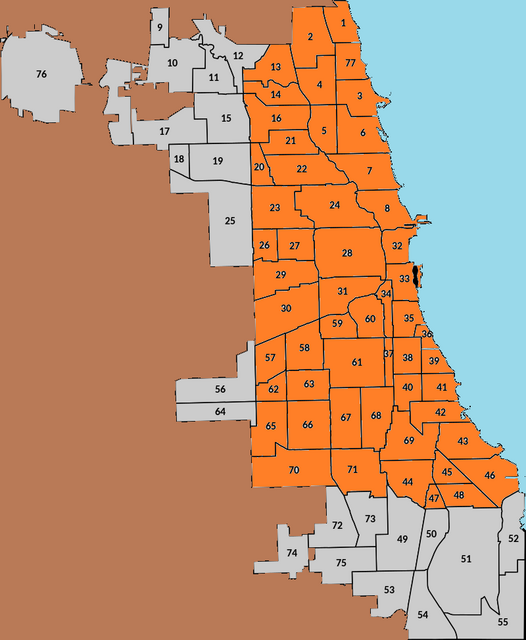
Here's a 135 sq. mile, non-cherry-picked, version of Chicago.

It's basically all of the community areas east of Cicero Ave. and north of 95th Street.

2020 population of the orange CAs was 2,072,413


This is cool. Any idea what the smallest contiguous area you could fit a million people in?
Reply With Quote
     
     
  #624  
Old Posted Jan 27, 2024, 1:54 AM
Quixote's Avatar
Quixote Quixote is offline
Inveterate Angeleno
 
Join Date: Apr 2006
Location: Los Angeles
Posts: 7,652
Quote:
Originally Posted by iheartthed View Post
There are 14 million people in LA metro. I don't think finding 2 million people in 150 square miles should be all that hard. Detroit had that way back in 1950 when it was barely a 3 million person metro.
This makes no sense. Atlanta is a metro of 7 million. So it follows that one should be able to find 1 million people in 75 square miles? lol

The city of Atlanta is 500K across 135 square miles, for reference.
__________________
“To tell a story is inescapably to take a moral stance.”

— Jerome Bruner
Reply With Quote
     
     
  #625  
Old Posted Jan 27, 2024, 2:48 AM
LA21st LA21st is offline
Registered User
 
Join Date: Jul 2002
Posts: 8,029
Quote:
Originally Posted by iheartthed View Post
Thanks for doing that. However, I don't think this changes the narrative that much. Los Angeles's weighted density is roughly the same ratio to NYC's weighted as its average density is to NYC, with or without the SFV:

Selected cities by weighted density, % of weighted density compared to NYC's
  1. New York: 65,299 -> 100%
  2. Jersey City: 36,846 -> 56%
  3. San Francisco: 33,572 -> 51%
  4. Boston: 27,437 -> 42%
  5. Newark: 24,478 -> 37%
  6. Miami: 22,014 -> 34%
  7. Philadelphia: 21,935 -> 34%
  8. Chicago: 21,235 -> 33%
  9. Washington: 20,642 -> 32%
  10. Los Angeles w/o SFV: 20,315 -> 31%
  11. Los Angeles: 17,294 -> 26%
  12. Seattle: 15,249 -> 23%

Selected cities by average density, % of average density compared to NYC's
  1. New York: 29,302 -> 100%
  2. Jersey City: 19,835 -> 68%
  3. San Francisco: 18,634 -> 64%
  4. Boston: 13,976 -> 48%
  5. Newark: 12,903 -> 44%
  6. Miami: 12,284 -> 42%
  7. Philadelphia: 11,936 ->41%
  8. Chicago: 12,059 -> 41%
  9. Washington: 11,280 -> 38%
  10. Los Angeles w/o SFV: 8,802 -> 30%
  11. Seattle: 8,775 -> 30%
  12. Los Angeles: 8,304 -> 28%

My two takeaways:
  • If any city really deserves to be in the "big urban" conversation based off of density numbers, it's Miami.
  • Staten Island is a bigger drag on NYC's density numbers than the mountains are on L.A.'s.
source of weighted densities: https://skyscraperpage.com/forum/showpost.php?p=9391840&postcount=3182
Uhh, thats still including the giant mountain range of LA. And LA 42 sq miles in the core is easily denser than Miami, which most of it looks like the San Fernando Valley. Litltle Havana (probably Miamis biggest neighborhood) wouldnt stand out in LA for any standard. Looks like Van Nuys at best. Although Van Nuys looks like it has a better/larger concentration of retail/restaurants/amenties. And I wouldnt put Van Nuys in the top 20 areas of LA
c
Reply With Quote
     
     
  #626  
Old Posted Jan 27, 2024, 6:04 PM
iheartthed iheartthed is offline
Registered User
 
Join Date: Oct 2009
Location: New York
Posts: 11,837
Quote:
Originally Posted by Quixote View Post
This makes no sense. Atlanta is a metro of 7 million. So it follows that one should be able to find 1 million people in 75 square miles? lol

The city of Atlanta is 500K across 135 square miles, for reference.
No one is arguing that Atlanta is a "big urban" city.
Reply With Quote
     
     
  #627  
Old Posted Jan 27, 2024, 6:10 PM
iheartthed iheartthed is offline
Registered User
 
Join Date: Oct 2009
Location: New York
Posts: 11,837
Quote:
Originally Posted by Yuri View Post
Sadly, São Paulo is probably the biggest offender here. Its footprint is half of Los Angeles+Inland, whereas it has just a slightly smaller number of cars.
Los Angeles and São Paulo are the two most car centric mega cities that I've visited, but L.A. is far more car centric than SP.
Reply With Quote
     
     
  #628  
Old Posted Jan 27, 2024, 6:33 PM
Yuri's Avatar
Yuri Yuri is offline
Registered User
 
Join Date: Sep 2008
Posts: 6,142
Quote:
Originally Posted by iheartthed View Post
Los Angeles and São Paulo are the two most car centric mega cities that I've visited, but L.A. is far more car centric than SP.
Yes, LA is definitely more car-centric. São Paulo subway/railway systems carry 8 million passengers daily. Buses another 8 million. LA comes nowhere close to it. However those big numbers disguise how car-centric SP is. It's actually a cultural thing and fortunately younger generations are turning back to cars.

But back to the number of cars, São Paulo state (44.4 million people) has 33.26 million registered vehicles (Dec/2023) of which 6.77 million are motorbikes. 26.5 million cars. I don't want to do the math for the 38 municipalities comprising metro area, but I'd guess 12.5 million or so are registered on the metro area (20.7 million people).

Los Angeles CSA still has more cars than São Paulo metro area. How many cars there? 14-15 million? Of course LA CSA is a way too generous definition for LA metro area.
__________________
London - São Paulo - Rio de Janeiro - Londrina - Frankfurt
Reply With Quote
     
     
  #629  
Old Posted Jan 27, 2024, 6:37 PM
Quixote's Avatar
Quixote Quixote is offline
Inveterate Angeleno
 
Join Date: Apr 2006
Location: Los Angeles
Posts: 7,652
Quote:
Originally Posted by iheartthed View Post
No one is arguing that Atlanta is a "big urban" city.
But people are in LA’s case. So then why do you even respond, let alone readily discount, 2,065,000 across 250 contiguous square miles when your (erroneous) claim all along has been that LA without the SFV increases from a population density of 8,300 to 8,800?

You after being discredited: “Yeah, well, LA *should* have 2,065,000 people in 150 square miles because its metro population is 14 million.” How does that crow taste?
__________________
“To tell a story is inescapably to take a moral stance.”

— Jerome Bruner
Reply With Quote
     
     
  #630  
Old Posted Jan 27, 2024, 6:42 PM
Quixote's Avatar
Quixote Quixote is offline
Inveterate Angeleno
 
Join Date: Apr 2006
Location: Los Angeles
Posts: 7,652
Quote:
Originally Posted by Yuri View Post
Los Angeles CSA still has more cars than São Paulo metro area. How many cars there? 14-15 million? Of course LA CSA is a way too generous definition for LA metro area.
Why is that a way too generous definition?
__________________
“To tell a story is inescapably to take a moral stance.”

— Jerome Bruner
Reply With Quote
     
     
  #631  
Old Posted Jan 27, 2024, 6:43 PM
iheartthed iheartthed is offline
Registered User
 
Join Date: Oct 2009
Location: New York
Posts: 11,837
Quote:
Originally Posted by Quixote View Post
But people are in LA’s case. So then why do you even respond, let alone readily discount, 2,065,000 across 250 contiguous square miles when your (erroneous) claim all along has been that LA without the SFV increases from a population density of 8,300 to 8,800?

You after being discredited: “Yeah, well, LA *should* have 2,065,000 people in 150 square miles because its metro population is 14 million.” How does that crow taste?
No, my point is that having that many people in 150 square miles isn't impressive when you have 14 million people in a region. Atlanta isn't impressive either. Being better than Atlanta is an extremely low bar and doesn't automatically qualify your city as a "big urban" place lol.
Reply With Quote
     
     
  #632  
Old Posted Jan 27, 2024, 6:56 PM
Quixote's Avatar
Quixote Quixote is offline
Inveterate Angeleno
 
Join Date: Apr 2006
Location: Los Angeles
Posts: 7,652
Quote:
Originally Posted by iheartthed View Post
No, my point is that having that many people in 150 square miles isn't impressive when you have 14 million people in a region. Atlanta isn't impressive either. Being better than Atlanta is an extremely low bar and doesn't automatically qualify your city as a "big urban" place lol.
DC metro is home to 6.3 million, or 45% of LA MSA.

DC is 690K across 61 square miles. Can you find another 239K across 14 contiguous square miles immediately outside the District boundaries?

(Spoiler: You can’t)

And I’m being nice by not using Miami instead, which you think has a stronger argument for being a “big urban city.”
__________________
“To tell a story is inescapably to take a moral stance.”

— Jerome Bruner
Reply With Quote
     
     
  #633  
Old Posted Jan 27, 2024, 7:27 PM
Yuri's Avatar
Yuri Yuri is offline
Registered User
 
Join Date: Sep 2008
Posts: 6,142
Quote:
Originally Posted by Quixote View Post
Why is that a way too generous definition?
I meant for a direct comparison with São Paulo metro area (7,945 km²), then Los Angeles CSA (87,940 km²) is a bit excessive. Cities like Ventura (109 km away from DTLA), Lancaster (111 km) or Palm Springs (171 km) are all inside the CSA, whereas in São Paulo, Jundiaí (800k inh., 56 km) or Santos (1.8 million inh., 80 km) or Campinas (3 million inh., 97 km) are out of São Paulo metro area. In fact, São Paulo Macrometropolitan Area (33.6 million people) covers a smaller area (58,128 km²) than LA CSA.

It's always hard to compare metro area definitions between distinct countries.
__________________
London - São Paulo - Rio de Janeiro - Londrina - Frankfurt
Reply With Quote
     
     
  #634  
Old Posted Jan 27, 2024, 8:01 PM
Steely Dan's Avatar
Steely Dan Steely Dan is online now
devout Pizzatarian
 
Join Date: Jul 2001
Location: Lincoln Square, Chicago
Posts: 30,205
Quote:
Originally Posted by Quixote View Post
readily discount, 2,065,000 across 150 contiguous square miles
And if that doesn't qualify LA for "big city" density, then we're also gonna have to discount Chicago.

And San Francisco.

And Philly.

And Boston.

And DC.


As has been reiterated many, many times now in this thread, LA brings the population density to hang with the "big 6"; many traditional urbanists just don't care for the form it has largely taken. which is fine, but that's a different discussion than straight population density.
__________________
"Missing middle" housing can be a marvelous middle ground for many middle class families.
Reply With Quote
     
     
  #635  
Old Posted Jan 27, 2024, 8:08 PM
Docere Docere is offline
Registered User
 
Join Date: Jul 2014
Posts: 8,607
Quote:
Originally Posted by Yuri View Post
I meant for a direct comparison with São Paulo metro area (7,945 km²), then Los Angeles CSA (87,940 km²) is a bit excessive. Cities like Ventura (109 km away from DTLA), Lancaster (111 km) or Palm Springs (171 km) are all inside the CSA, whereas in São Paulo, Jundiaí (800k inh., 56 km) or Santos (1.8 million inh., 80 km) or Campinas (3 million inh., 97 km) are out of São Paulo metro area. In fact, São Paulo Macrometropolitan Area (33.6 million people) covers a smaller area (58,128 km²) than LA CSA.

It's always hard to compare metro area definitions between distinct countries.
I'm generally a CSA "skeptic" myself. Though in some cases MSAs are too narrow.
Reply With Quote
     
     
  #636  
Old Posted Jan 27, 2024, 10:49 PM
craigs's Avatar
craigs craigs is offline
Registered User
 
Join Date: May 2019
Location: Los Angeles
Posts: 10,689
Quote:
Originally Posted by Steely Dan View Post
And if that doesn't qualify LA for "big city" density, then we're also gonna have to discount Chicago.

And San Francisco.

And Philly.

And Boston.

And DC.

As has been reiterated many, many times now in this thread, LA brings the population density to hang with the "big 6"; many traditional urbanists just don't care for the form it has largely taken. which is fine, but that's a different discussion than straight population density.
Thank you.
__________________
Chaos upon my enemies, chaos upon my enemies, chaos upon my enemies.
Reply With Quote
     
     
  #637  
Old Posted Jan 28, 2024, 1:20 AM
Klippenstein's Avatar
Klippenstein Klippenstein is offline
Rust Belt Motherland
 
Join Date: Apr 2021
Location: Chicago, IL
Posts: 871
Quote:
Originally Posted by Steely Dan View Post
And if that doesn't qualify LA for "big city" density, then we're also gonna have to discount Chicago.

And San Francisco.

And Philly.

And Boston.

And DC.
I'm really confused because you "quoted" a post, but changed the text. This was the actual text (my bolding):

Quote:
Originally Posted by Quixote View Post
But people are in LA’s case. So then why do you even respond, let alone readily discount, 2,065,000 across 250 contiguous square miles when your (erroneous) claim all along has been that LA without the SFV increases from a population density of 8,300 to 8,800?

You after being discredited: “Yeah, well, LA *should* have 2,065,000 people in 150 square miles because its metro population is 14 million.” How does that crow taste?
Your quote:

Quote:
Originally Posted by Quixote View Post
readily discount, 2,065,000 across 150 contiguous square miles
The original post that Quixote made counted about 1.5 million people in 100 square miles, BUT it wasn't clear if those were contiguous.

I'm just trying to clarify the data here.
Reply With Quote
     
     
  #638  
Old Posted Jan 28, 2024, 1:23 AM
Steely Dan's Avatar
Steely Dan Steely Dan is online now
devout Pizzatarian
 
Join Date: Jul 2001
Location: Lincoln Square, Chicago
Posts: 30,205
^ I knew he had made a typo on the the "250", so I edited it to the correct "150" in my post.
__________________
"Missing middle" housing can be a marvelous middle ground for many middle class families.
Reply With Quote
     
     
  #639  
Old Posted Jan 28, 2024, 5:04 AM
Segun's Avatar
Segun Segun is offline
Ikenga: Igbo God of Power
 
Join Date: Aug 2001
Posts: 5,948
"Suburban" Bungalow neighborhoods with entire apartment complexes taking up what used to be backyards.
Reply With Quote
     
     
  #640  
Old Posted Jan 28, 2024, 6:08 AM
Nouvellecosse's Avatar
Nouvellecosse Nouvellecosse is offline
Volatile Pacivist
 
Join Date: Aug 2005
Location: Nova Scotia
Posts: 11,088
The original thread premise claimed that NYC, SF, Chicago, Boston, Philly, and DC, a list of very different cities in terms of size, population, and built form belong to a single group that can be called "big urban cities". I personally can't see any plausible argument why these all can be included in a single group while LA can't. Boston and DC are not Philly with its huge expanse of rowhouses, and none of them are anywhere near NY with its huge quantity of... basically everything. A good half or more of these metro areas are suburban in nature other than maybe NYC. But even it has more people in suburban areas than most of the other listed cities have in their entire metros.

The "proportion" of urban vs suburban would be relevant if just measuring and comparing overall "urban-ness." But for inclusion in a list of "big urban cities" this seems to be a pass/fail in terms of the sheer quantity of urban development. After all, the "big" takes precedence over the "urban". If you added another say, 10 million people in the form of suburban sprawl to the NYC metro area while keeping the urban part as is, the urban part would still be big and urban. And if you trimmed away say, 7 million people's worth of metro LA's most suburban development while keeping the 7ish million of the most urban areas, wouldn't the part that remained be similarly urban as metro DC or Boston? Pretty sure it would given both of the latter metro areas have huge volumes of suburbs. So while population density is far from the only criterion for what counts as urban, that's not really the most relevant aspect here.

Quote:
Originally Posted by Steely Dan View Post
As has been reiterated many, many times now in this thread, LA brings the population density to hang with the "big 6"; many traditional urbanists just don't care for the form it has largely taken. which is fine, but that's a different discussion than straight population density.
After following the thread without having a particularly strong opinion one way or the other, I think this raises some important questions including:

- Is population density on its own enough to qualify a place as being similarly or equally "urban" as places with comparable population density but with additional urban features?
- Is urban vs not urban a simple pass/fail concept where if a place meets a minimum set of criteria it's urban and if it doesn't it's not? Or is it more of a gradient?
- And if it's a gradient, how close do places need to be on the spectrum to be considered part of the same subgroup?

For the first question I'd answer no. Population density is just part of what makes a place urban. A place with additional urban features like greater walkability/less car usage, more buildings built to street with fewer lawns and setbacks, more transit usage, etc. is more urban than a place with fewer of these things even if it has equal population density. So for the second question, yes urban-ness is very much a gradient. But for the 3rd question, that would be answered by the response up top. If places as different as the listed "big urban 6" can be grouped, then whatever the criteria are they're loose enough to also include others.

__________________
"The reasonable man adapts himself to the world; the unreasonable one persists in trying to adapt the world to himself. Therefore all progress depends on the unreasonable man." - George Bernard Shaw
Don't ask people not to debate a topic. Just stop making debatable assertions. Problem solved.
Reply With Quote
     
     
This discussion thread continues

Use the page links to the lower-right to go to the next page for additional posts
 
 
Reply

Go Back   SkyscraperPage Forum > Discussion Forums > City Discussions
Forum Jump


Forum Jump


All times are GMT. The time now is 10:47 AM.

     
SkyscraperPage.com - Privacy Statement - Top

Powered by vBulletin® Version 3.8.7
Copyright ©2000 - 2026, vBulletin Solutions, Inc.