HomeDiagramsDatabaseMapsForum About
     

Go Back   SkyscraperPage Forum > Regional Sections > Canada


Reply

 
Thread Tools Display Modes
     
     
  #621  
Old Posted Jan 5, 2024, 6:32 PM
Nite's Avatar
Nite Nite is offline
Registered User
 
Join Date: Dec 2007
Location: Toronto
Posts: 3,332
Quote:
Originally Posted by suburbanite View Post
So interest rates are the biggest determinant of prices, and Americans could previously lock in 2% rates. Chicago also has higher median incomes than Toronto. In theory we should be able to go back and see Chicagoans bidding up all the supply in Chicago and actually reaching real prices in excess of what Toronto saw during 2020-2022. All that matters is that they basically had the ability to lock in free money for the entirety of their 30 year mortgage right?

I'd love to see the graph for that. Or maybe, just maybe, Chicago actually has a relatively healthy balance of supply and demand and so people don't unnecessarily bid up assets and overindebt themselves when there isn't the level of competition to necessitate it.

My argument is about impact of interest rates in the Canadian market only. Unlike in the US, where interest rates only affect a small fraction of homebuyers, in Canada, these rates have a more immediate and significant effect on house prices. This is evident in the current scenario where, despite an increase in rates in the US, house prices have risen by 6.3 percent year-on-year in Chicago, even amidst a declining population. In contrast, prices are falling in Toronto, a city experiencing high population growth.

https://www.fhfa.gov/AboutUs/Reports...October%202023.

In the US, the fixed 30-year mortgages, which were recently low for most people, coupled with the current high rates, discourages homeowners from selling. They would have to buy a new house with much higher interest rates. This reluctance to sell reduces supply or inventory, leading to an increase in house prices. In Canada, whether homeowners sell or not, they are still affected by higher rates. Consequently, people continue to list properties, increasing supply and causing prices to fall, as seen in Toronto.

Therefore, the dynamics between interest rates in Canada and the US are much different. In Canada, interest rates have a more substantial effect than factors like immigration or population growth.
So prices rise and fall faster in Canada than the US based on high or low interest rate.


Last edited by Nite; Jan 5, 2024 at 7:04 PM.
Reply With Quote
     
     
  #622  
Old Posted Jan 5, 2024, 7:03 PM
suburbanite's Avatar
suburbanite suburbanite is offline
Registered User
 
Join Date: Apr 2011
Location: Toronto & NYC
Posts: 5,607
Quote:
Originally Posted by Nite View Post
My point was about interest rates is about the Canadian market because rates have a more immediate effect on Canadian house prices which is not the dynamic in the US where American rate only effect a small amount of people. That why although rates have increased in the US prices are still up 6.3 percent YoY Chicago despite a falling population while prices are falling in Toronto despite a booming population.

https://www.fhfa.gov/AboutUs/Reports...October%202023.

in the US they have fixed 30 year mortgages, which were low for most people recently and high current rates so no one wants to sell (and move to a new house with newer high interest rates) and few want to build because of higher interest rates. This is making house prices go up because supply is much lower than demand. In Canada if you sell or don't sell you will still be affected by higher rates so people are still listing properties which is increasing supply and causing prices to fall in Toronto for example.

Therefore the dynamic between interest rates in Canada and the US are much different. Interest rates have a bigger effect in Canada than immigration or population growth than in the US
I agree, interest rate changes are more acutely felt in Canada. However you're ignoring the fact that the underlying base price in Canada was already heavily distorted compared to our peers before interest rates changed. Interest rates are one variable that acts like an additional layer added on top of the existing supply and demand curves. If your supply and demand is settled an equilibrium, increasing interest rates just directly shifts the equilibrium price downwards. It absolutely does not tell you that the relationship between the supply and demand curves is not the main driver of the underlying equilibrium point.
__________________
Discontented suburbanite since 1994
Reply With Quote
     
     
  #623  
Old Posted Jan 5, 2024, 7:09 PM
Nite's Avatar
Nite Nite is offline
Registered User
 
Join Date: Dec 2007
Location: Toronto
Posts: 3,332
Quote:
Originally Posted by suburbanite View Post
I agree, interest rate changes are more acutely felt in Canada. However you're ignoring the fact that the underlying base price in Canada was already heavily distorted compared to our peers before interest rates changed. Interest rates are one variable that acts like an additional layer added on top of the existing supply and demand curves. If your supply and demand is settled an equilibrium, increasing interest rates just directly shifts the equilibrium price downwards. It absolutely does not tell you that the relationship between the supply and demand curves is not the main driver of the underlying equilibrium point.
Since interest rates have a more profound impact in Canada than the US, low interest rates for a long time will cause house prices to rise much faster in Canada than in the US. This was the situation for a decade up to 2 years ago. So what you are calling the base price was the price of a low interest rate environment in Canada which we have agreed will increase prices faster in Canada than the US because of the 30-year fixed mortgage in the US.

We saw prices increase much faster in Canada than the US for the last decade now we are seeing prices fall faster in Canada than the US for the same reasons.
This is why interest rate determine prices in Canada and not so much in the US

Last edited by Nite; Jan 5, 2024 at 7:25 PM.
Reply With Quote
     
     
  #624  
Old Posted Jan 5, 2024, 7:27 PM
Harrison's Avatar
Harrison Harrison is online now
A Better Place
 
Join Date: Jan 2007
Location: Edmonton
Posts: 3,053
Quote:
Originally Posted by Innsertnamehere View Post
I'd be advising people to buy right now to be honest - I think prices are pretty close to bottom. Once interest rates start falling in the spring the bleeding will stop.

Buy now and grab a variable mortgage or a short-term fixed rate. Shoulder the high interest costs for a few months until rates start falling.
That's what I did a month ago, possession late March so we may get an even lower mortgage rate if the BOC drops the rate by then. I am worried that the wild Calgary RE market trends will make it's way to Edmonton, but we were also looking to move into a new place anyways so it seemed like a good time while prices are low.
__________________
Bingo bango bongo
Reply With Quote
     
     
  #625  
Old Posted Jan 5, 2024, 8:12 PM
suburbanite's Avatar
suburbanite suburbanite is offline
Registered User
 
Join Date: Apr 2011
Location: Toronto & NYC
Posts: 5,607
Quote:
Originally Posted by Nite View Post
Since interest rates have a more profound impact in Canada than the US, low interest rates for a long time will cause house prices to rise much faster in Canada than in the US. This was the situation for a decade up to 2 years ago. So what you are calling the base price was the price of a low interest rate environment in Canada which we have agreed will increase prices faster in Canada than the US because of the 30-year fixed mortgage in the US.

We saw prices increase much faster in Canada than the US for the last decade now we are seeing prices fall faster in Canada than the US for the same reasons.
This is why interest rate determine prices in Canada and not so much in the US
You're distorting the message again. "Interest rates having a more profound impact in Canada than the US" is only true in terms of relative change. Interest rates in both countries were steady for a decade prior to 2020 and one market saw disproportionately higher increases than pretty much any other in the Western world. We also know that a lot of Canadians don't have very much foresight and budgeted their previous purchases as if they were locking into a 30-year rate. Relative to incomes, Canadian housing affordability has deteriorated in steady interest rate environments, declining interest rate environments, and now even in a rising environment in many cases.
__________________
Discontented suburbanite since 1994
Reply With Quote
     
     
  #626  
Old Posted Jan 5, 2024, 8:37 PM
urbandreamer's Avatar
urbandreamer urbandreamer is offline
recession proof
 
Join Date: Apr 2007
Posts: 4,656
And now you see Govt making stuff up with oh, we added 100 jobs in December. It's brutal out there looking for work. For the first time in my life, I'm considering becoming a realtor or trying some other sales jobs, even though I'm an introvert.

Last edited by urbandreamer; Jan 5, 2024 at 9:03 PM.
Reply With Quote
     
     
  #627  
Old Posted Jan 5, 2024, 9:07 PM
someone123's Avatar
someone123 someone123 is offline
hähnchenbrüstfiletstüc
 
Join Date: Nov 2001
Location: Vancouver
Posts: 35,312
Quote:
Originally Posted by Changing City View Post
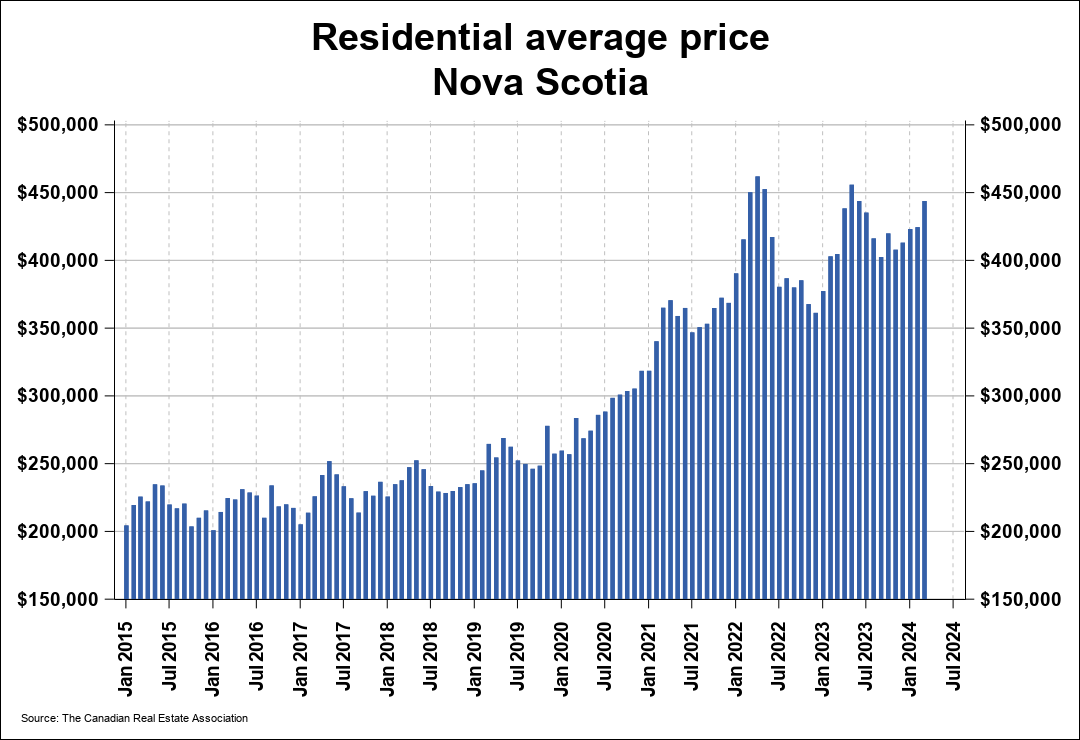
If you aren't in Ontario, there is no 'housing crash', just a slight drop in a few places. From the CREA last month; "While price declines remain mainly an Ontario phenomenon, home prices are also now starting to soften in the Fraser Valley, Winnipeg, and Halifax.
Here's NS as an example. This is the base price, and then due to rates increasing the mortgage interest costs have risen. The typical mortgage payment on a new house after the latest house price dip is still probably something like 2-2.5x what it would have been in 2019.


https://creastats.crea.ca/board/nsar
Reply With Quote
     
     
  #628  
Old Posted Jan 5, 2024, 9:19 PM
WarrenC12's Avatar
WarrenC12 WarrenC12 is offline
Registered User
 
Join Date: May 2007
Location: East OV!
Posts: 24,345
Quote:
Originally Posted by urbandreamer View Post
And now you see Govt making stuff up with oh, we added 100 jobs in December. It's brutal out there looking for work. For the first time in my life, I'm considering becoming a realtor or trying some other sales jobs, even though I'm an introvert.
Making stuff up? It's StatCan, they are reputable. The differences are regional too, Ontario lost 48k jobs while most other provinces gained.
Reply With Quote
     
     
  #629  
Old Posted Jan 5, 2024, 9:21 PM
Truenorth00 Truenorth00 is offline
Registered User
 
Join Date: May 2017
Posts: 28,370
Quote:
Originally Posted by theman23 View Post
You’re hardly an authority figure with a great track record. What are you basing this prediction on?
Quote:
Originally Posted by suburbanite View Post
It's easy to make unscrupulous claims like this when you know the powers that be will not go down this path.
Is he wrong though? Who can afford current prices at 4% rates? In theory those rates should take us back to 2019 prices.
Reply With Quote
     
     
  #630  
Old Posted Jan 5, 2024, 9:28 PM
Nite's Avatar
Nite Nite is offline
Registered User
 
Join Date: Dec 2007
Location: Toronto
Posts: 3,332
Quote:
Originally Posted by suburbanite View Post
You're distorting the message again. "Interest rates having a more profound impact in Canada than the US" is only true in terms of relative change. Interest rates in both countries were steady for a decade prior to 2020 and one market saw disproportionately higher increases than pretty much any other in the Western world. We also know that a lot of Canadians don't have very much foresight and budgeted their previous purchases as if they were locking into a 30-year rate. Relative to incomes, Canadian housing affordability has deteriorated in steady interest rate environments, declining interest rate environments, and now even in a rising environment in many cases.
An interest change lasting 5 years will effect 100% of Canadian homeowner/buyers. in the US with the popularity of a 30 year fix mortgage it could effect as few as 1/6 (16%) of homeowners/buyers.
In practice if the Canadian takes out a home equity loan when interest rates are low they can buy a 2nd property and not worry about the interest rate, the American might have a much higher interest rate to content with than the current low interest rates dissuading them from property investment.

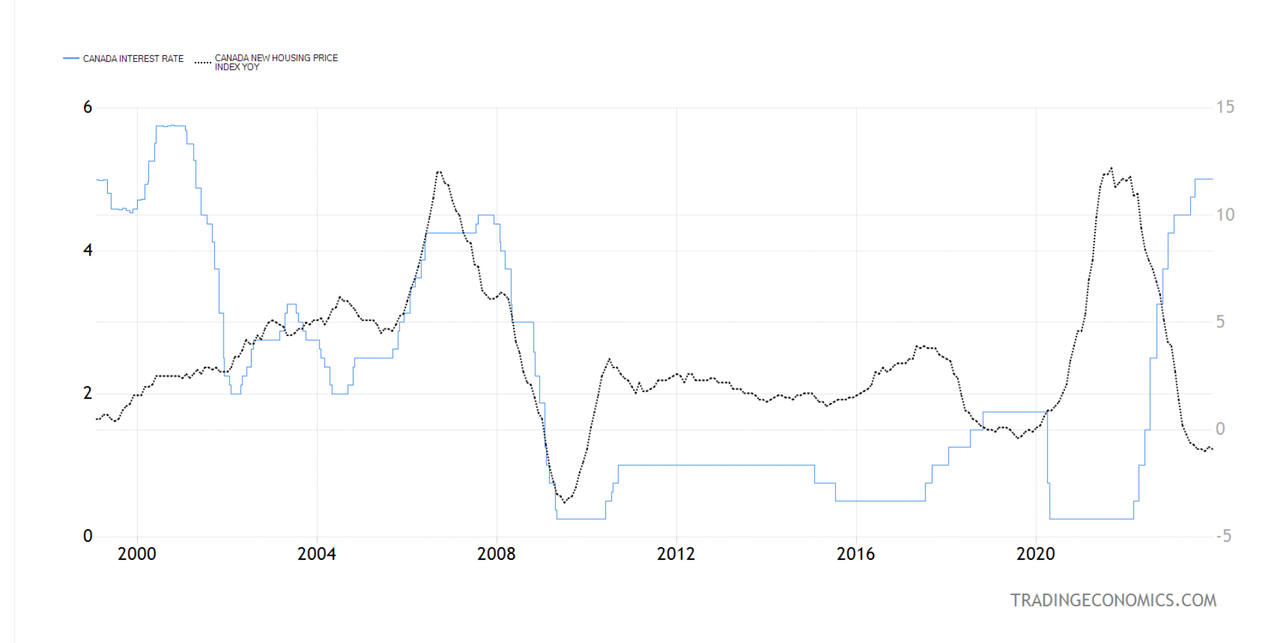
here is a graph showing interest rate and new house prices index
It seems pretty evident to me when interest go up house prices come down and when interest rate come down house prices go up


https://tradingeconomics.com/canada/interest-rate

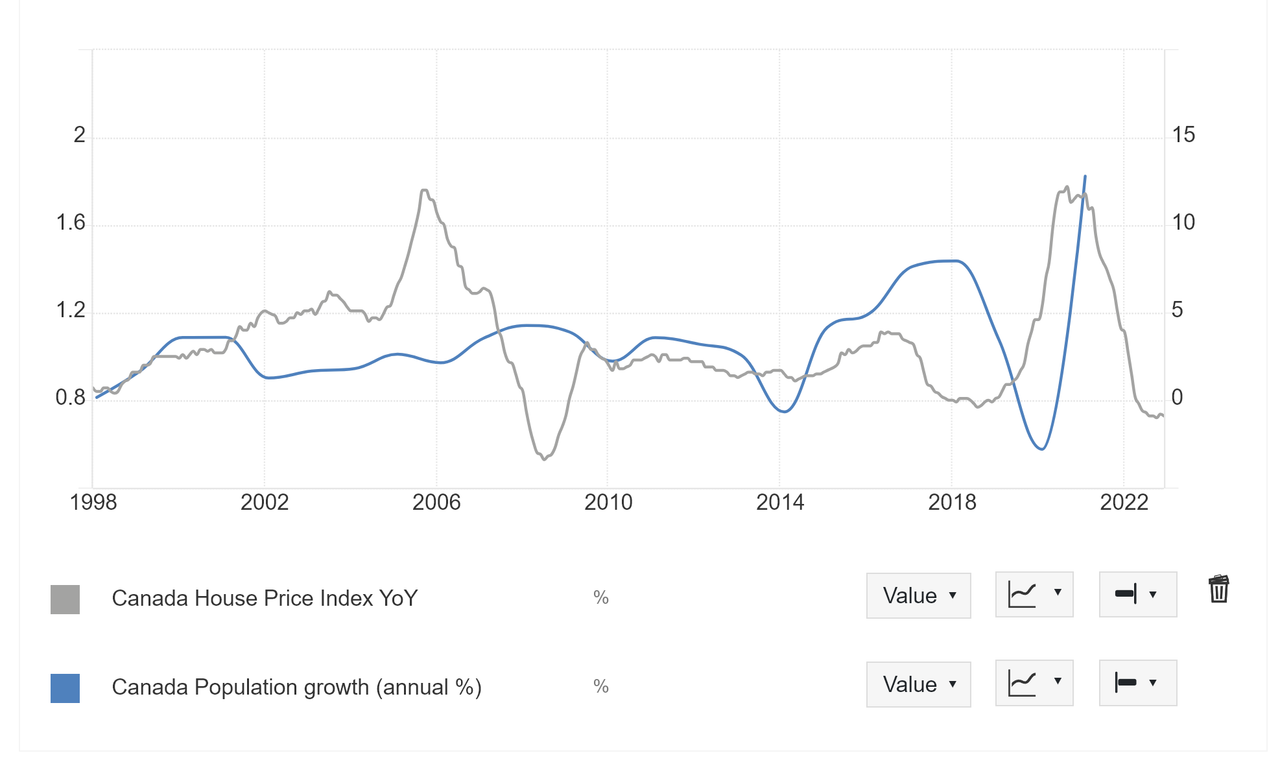
and here is house prices index and population growth, if anything it appears house prices growth is negatively correlating to price growth


https://tradingeconomics.com/canada/...t-wb-data.html

Last edited by Nite; Jan 5, 2024 at 9:53 PM.
Reply With Quote
     
     
  #631  
Old Posted Jan 5, 2024, 9:42 PM
suburbanite's Avatar
suburbanite suburbanite is offline
Registered User
 
Join Date: Apr 2011
Location: Toronto & NYC
Posts: 5,607
Quote:
Originally Posted by Truenorth00 View Post
Is he wrong though? Who can afford current prices at 4% rates? In theory those rates should take us back to 2019 prices.
All else being equal, rates should decrease prices, and they have had that immediate affect. The specific point being made though was that at 4% rates, prices would keep dropping. That only holds true if there aren't a sufficient number of buyers relative to supply that create a very difficult floor to break through when it comes to asset prices. There are a ton of people creeping around new developments in Toronto putting in offers at 5-10% below asking prices, just waiting for someone to get desperate. I'm still seeing groups of 8+ people on a vendor financed mortgage for a SFH in Brampton or Milton who still come to the table with cash at closing. People still want houses at rates/prices that will severely financially burden them, they just want to feel like their getting somewhat of a good deal.

In reality the argument about what proportion of price is based on interest rates is pointless because the whole argument is based around some convoluted idea that asset prices themselves are what's actually important. As I said in my previous post, housing affordability was getting really bad at steady rates, it was terrible at low rates, and it's not any better at new higher rates. Canadians will spend 50% of their take home pay on housing costs when prices are high and rates are low, and they will spend 50% on housing costs when prices are lower and rates are high. The point is that you're not getting an accurate picture when only talking about monetary policy.
__________________
Discontented suburbanite since 1994
Reply With Quote
     
     
  #632  
Old Posted Jan 5, 2024, 9:47 PM
someone123's Avatar
someone123 someone123 is offline
hähnchenbrüstfiletstüc
 
Join Date: Nov 2001
Location: Vancouver
Posts: 35,312
Quote:
Originally Posted by suburbanite View Post
People still want houses at rates/prices that will severely financially burden them, they just want to feel like their getting somewhat of a good deal.
There's some circularity to the market in that real estate wealth can be used to secure financing for more real estate (new investor properties, properties for relatives, or moving up the ladder and keeping the old place). Rates increased carrying costs for landlords but spiking rents offset that to some degree.
Reply With Quote
     
     
  #633  
Old Posted Jan 5, 2024, 9:48 PM
suburbanite's Avatar
suburbanite suburbanite is offline
Registered User
 
Join Date: Apr 2011
Location: Toronto & NYC
Posts: 5,607
Quote:
Originally Posted by Nite View Post

here is a graph showing interest rate and new house prices index
It seems pretty evident to me when interest go up house prices come down and when interest rate come down house prices go up
Mind blown.
__________________
Discontented suburbanite since 1994
Reply With Quote
     
     
  #634  
Old Posted Jan 5, 2024, 9:49 PM
theman23's Avatar
theman23 theman23 is offline
Registered User
 
Join Date: Apr 2007
Location: Ville de Québec
Posts: 6,279
Quote:
Originally Posted by Truenorth00 View Post
Is he wrong though? Who can afford current prices at 4% rates? In theory those rates should take us back to 2019 prices.
Early 2023. The last time fixed rage mortgages fell even slightly, prices begin to return to all time highs. There is no plan to curb demand and the government seems determined to do all it can to buoy the housing market with affordability solutions that amount to lip service. The sentiment still is that rates will go down eventually and that housing prices will always go up, so I’d imagine that there will be a flurry of activity this spring with people trying to get in with what they see is a temporary reduction in prices.
__________________
For entertainment purposes only. Not financial advice.
Reply With Quote
     
     
  #635  
Old Posted Jan 5, 2024, 9:49 PM
Nite's Avatar
Nite Nite is offline
Registered User
 
Join Date: Dec 2007
Location: Toronto
Posts: 3,332
Quote:
Originally Posted by suburbanite View Post
Mind blown.
I added a second graph with population growth to illustrate my point more strongly


which of the two do you think is more closely correlated, population growth of interest rates in relation to house prices
Reply With Quote
     
     
  #636  
Old Posted Jan 5, 2024, 9:56 PM
suburbanite's Avatar
suburbanite suburbanite is offline
Registered User
 
Join Date: Apr 2011
Location: Toronto & NYC
Posts: 5,607
Quote:
Originally Posted by Nite View Post
I added a second graph with population growth to illustrate my point more strongly


which of the two do you think is more closely correlated, population growth of interest rates in relation to house prices
At the end of the day, if you want to go about thinking that a market where demand outpaces supply by several factors is only unaffordable because of current interest rates, I'm not going to change your mind.
__________________
Discontented suburbanite since 1994
Reply With Quote
     
     
  #637  
Old Posted Jan 5, 2024, 9:58 PM
Nite's Avatar
Nite Nite is offline
Registered User
 
Join Date: Dec 2007
Location: Toronto
Posts: 3,332
Quote:
Originally Posted by suburbanite View Post
At the end of the day, if you want to go about thinking that a market where demand outpaces supply by several factors is only unaffordable because of current interest rates, I'm not going to change your mind.
i don't see how you can look at the graph i posted and not see that interest rate are by far determine housing prices than population growth.
Reply With Quote
     
     
  #638  
Old Posted Jan 5, 2024, 10:06 PM
suburbanite's Avatar
suburbanite suburbanite is offline
Registered User
 
Join Date: Apr 2011
Location: Toronto & NYC
Posts: 5,607
Quote:
Originally Posted by Nite View Post
i don't see how you can look at the graph i posted and not see that interest rate are by far determine housing prices than population growth.
We're talking past each other at this point when you continue to fixate on prices. I don't care about prices, and I'm not going to beat my head against the wall on a Friday.

My position is ultimately that Canada is more unaffordable than pretty much every developed nation in the world because we have the biggest mismatch between supply and demand. Canada will continue to be unaffordable at 4% rates, 3% rates, 2% rates, 10% rates, etc. unless that changes. If you don't agree than let's not waste any more time.
__________________
Discontented suburbanite since 1994
Reply With Quote
     
     
  #639  
Old Posted Jan 5, 2024, 10:09 PM
someone123's Avatar
someone123 someone123 is offline
hähnchenbrüstfiletstüc
 
Join Date: Nov 2001
Location: Vancouver
Posts: 35,312
Deciding there is a causal relationship between two variables because you eyeball a chart and they look similar is not going to be very reliable.
Reply With Quote
     
     
  #640  
Old Posted Jan 5, 2024, 10:19 PM
Nite's Avatar
Nite Nite is offline
Registered User
 
Join Date: Dec 2007
Location: Toronto
Posts: 3,332
Quote:
Originally Posted by someone123 View Post
Deciding there is a causal relationship between two variables because you eyeball a chart and they look similar is not going to be very reliable.
Fine don't trust my eyes trust you own and tell me what can you conclude from the charts i posted, or bring some other type of evidence to refute my conclusion that interest rates are the strongest determinate of house prices than population growth is
Reply With Quote
     
     
This discussion thread continues

Use the page links to the lower-right to go to the next page for additional posts
 
 
Reply

Go Back   SkyscraperPage Forum > Regional Sections > Canada
Forum Jump


Forum Jump


All times are GMT. The time now is 6:48 PM.

     
SkyscraperPage.com - Privacy Statement - Top

Powered by vBulletin® Version 3.8.7
Copyright ©2000 - 2026, vBulletin Solutions, Inc.