Quote:
Originally Posted by lio45

Man, that's really epically facepalmy (to consider that the government will brag about "successfully adjusting people's welfare checks to inflation!" when the official inflation figure -- the one that drives all adjustments -- is strongly pushed towards the low side by the (relatively) cheap(er) prices of intercontinental plane travel, brand new iPhones, and brand new Teslas!)
Marie-Nite-Antoinette will tell homeless people whose local food bank has run out of supply that at least flying to the French Riviera is cheaper, as is a new Tesla Model 3 (you can live in that thing, you know that!) so that contrary to what they may think, they're officially better off now than before!
|
the CPI uses the average cost of phones and cars bought, so saying brand new iphone or tesla is irrelevant since they are mixed with cheaper cars bought as well
so are you saying poor Canadian don't buy plane tickets, phones or cars and they only spend their money on food and shelter???
the CPI is a basket of goods that represent what the average of entire Canadian population spend their money on.
Some components will always be inflating faster than another, but since the average Canadian spend their money on all the components, then higher inflation in one components is compensated by lower inflation in another area. higher housing and food cost effect poorer canadian more but also the fall in gas and transportation cost, clothing also effects them more than wealthier Canadians.
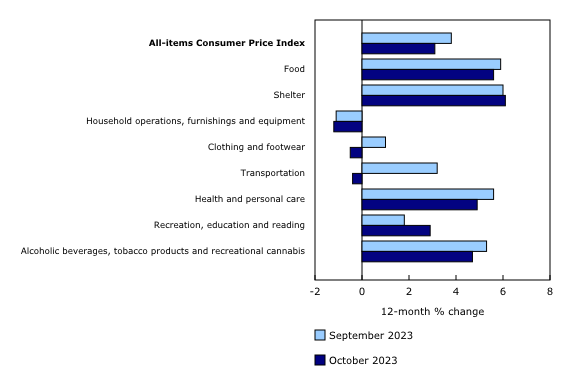 https://www150.statcan.gc.ca/n1/daily-quotidien/231121/cg-a002-eng.htm
Going back to my New Brunswicker on Minimum wage, assuming NB inflation rates are close to the national average
This is how things compare from a year ago
They saw a wage
increase of 7.3%
Shelter cost
increase of 6.1%
Food cost
increase of 5.6%
Transportation cost
decrease of -0.4%
Clothing and footwear cost
decrease of -1.2%





 Prev
Prev


 Linear Mode
