According to the CTVnews article, the restraining rails are checked weekly:
Quote:
"OC Transpo, RTG and Alstom continue to closely monitor and inspect the track and trains to ensure ongoing safe operations for our customers and employees," Morgan said.
"Inspections of restraining rails are done weekly in order to identify if additional adjustments are necessary."
|
[From:
https://ottawa.ctvnews.ca/o-train-resume...r-emergency-track-adjustments-1.6523522]
WEEKLY! So, the last time that they would have been checked was last Thursday, when the restraining rails were initially being moved and tested? And, presumably, all locations, including this curve, were tested at that time to ensure that the wheels did not make contact with the restraining rails – under the usual conditions of the test train’s movement.
From what I am reading, they started the train service on Monday, based on the contact tests coming back clear. Then, several days later, they perform the weekly check to see if any of the paint has been polished off of the restraining rails. (It is an assumption on my part that the rails were painted so that maintenance crews could quickly spot areas where the paint had been rubbed off from wheel contact.) Lo-and-behold, a shiny spot is found on Thursday’s check. Stop the trains from using that track IMMEDIATELY!
Why was this an emergency repair? The restraining rails are only checked weekly. It is possible that the wheel had been rubbing for days.
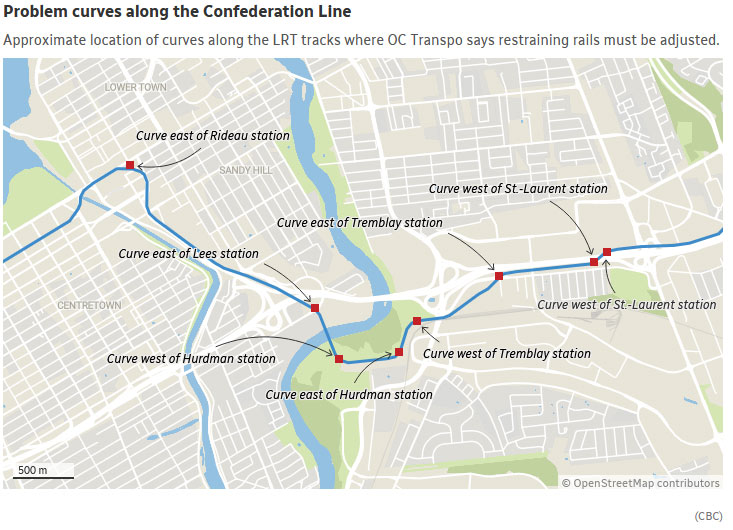
OC Transpo should have continued to run their already limited service on both tracks, at least until after 18:00. Then, they could have moved to one-track running, if it was estimated that RTM needed more than the usual over-night period to readjust that one rail. (What is going to happen when the restraining rails are finally reinstalled on the curve east of Rideau? Will that require another service interruption, too?)
But this craziness does bring up some other questions:
- How thorough was the initial testing for contact? We were assured that all of the restraining rail adjustments had been “completed”, and tested to ensure that there was no contact between the wheels and those rails. Was that testing flawed?
- Have the restraining rails moved in some way? Was the adjustment and testing done at a higher temperature and now that it is cooler the restraining rail has shrunk and tightened around the curve, or vice versa? Were the mounting bolts not sufficiently torqued?
- Was the initial movement of “1-2 millimetres” insufficient? Has wear of the high rail and wheel flanges already caused more than that distance of additional sideways movement on curves? Will this continued additional wear cause further need to adjust the restraining rails? (Until they have been moved at least the 10 mm, or so of permitted wear.)
- Was the test bogie representative of a worse-case? The gage of every wheelset will vary slightly from ideal. That is why tolerances are specified. Is there a train with a pair of wheels that has a slightly narrower gauge than the test bogie?
- Did the restraining rail actually perform its function and restrain a bogie from moving too far? If there was flange-climb on the high side of the curve, the low-side wheel would have been caught by the restraining rail, preventing a derailment. But this would have scraped off the paint.





 Prev
Prev










 Linear Mode
