You are correct that the state doles out money based on incorporated city size for counties, but it has nothing to do with property tax and the unincorporated percentage in Pima County is about 66%, not 50%. But, this is still way too large a percentage and we do lose money, and lots of it.Half the population of Tucson lives on unincorporated county land (the wealthier half of the population for the most part) Their property taxes go to fixing potholes in Phoenix. Tucson is handling the traffic of a million people with half the tax base.

You are using an out of date browser. It may not display this or other websites correctly.
You should upgrade or use an alternative browser.
You should upgrade or use an alternative browser.
Tucson Development Thread
- Thread starter oliveurban
- Start date
These bonds were from Pima County, but the city of Tucson did do a good job with their recent $100 Million bond to fix roads. So far they are coming in under budget and quicker than expected. The roads are getting better (Grant and 22nd St. look and drive so much better and Kolb is much improved too - it just wasn't as bad to start with) and they think they may be able to get an extra $5 Million or so out of the bond due to being under budget.As a property owner (owner of several properties) I am always weary of how Government spends money during a normal basis. Tucson and to a lesser extent Pima County has been less than stellar in transparency. I mean driving thru most streets in Tucson is like driving thru Bedrock. I assume that the voters don't want to spend more in property taxes if they feel the Government is not giving them a bang for the buck. I would do the same here in Maricopa.
More redevelopment on the Broadway corridor. A new supermarket just got rezoning approval by the city on the southwest corner of Rosemont and Broadway.

farmerk
New member
Here's more explanation why pima county bonds failed previous election , https://www.youtube.com/watch?v=jADVQAqoWjw .
They mentioned that pima county bonds rarely fail.
more here, http://www.tucsonweekly.com/TheRang...t-and-digging-into-the-school-funding-package .
Just like most if not all of the folks in this thread, I'm very disappointed.
They mentioned that pima county bonds rarely fail.
more here, http://www.tucsonweekly.com/TheRang...t-and-digging-into-the-school-funding-package .
Just like most if not all of the folks in this thread, I'm very disappointed.
InTheBurbs
New member
Tucson ranked 4th best city for confrences
In related news...
Site selectors conference chooses Tucson
Luis F. Carrasco/Arizona Daily Star
The top site selector consultants, who help companies throughout the world relocate or expand, have chosen Tucson as the site of their 2017 conference.
It’s an opportunity local economic development officials hope will mean more businesses moving to the region.
The group considered about 10 locations throughout Arizona as part of a statewide pitch, said Phil Schneider, chairman of the Site Selectors Guild.
“We had good alternatives in Arizona but it’s the combination of the team and the facilities and the timing,” he said. “Everything came together extraordinarily well for Tucson.”
The guild’s combined membership manages projects valued at more than $30 billion in capital expenditures and thousands of new jobs every year, officials said.
Guild members have been involved in many large projects that have come to Tucson, including the expansions at Ventana Medical Systems and Bombardier Aerospace, and the HomeGoods distribution center.
...
Although the conference is not meant to spotlight the host city, it is still considered a chance to promote the region.
Aerospace and defense, transportation and logistics, alternative energy and natural resources, bioscience and diagnostics are all areas the region is competitive in, said Sun Corridor’s Welsh, and conference attendees will not leave Tucson without knowing about them.
Here's more explanation why pima county bonds failed previous election , https://www.youtube.com/watch?v=jADVQAqoWjw .
more here, http://www.tucsonweekly.com/TheRang...t-and-digging-into-the-school-funding-package .
Just like most if not all of the folks in this thread, I'm very disappointed.
Not to beat a dead horse, but the defeat of all seven bond measures on Tuesday was a disheartening setback for Tucson and Pima County--not only for the economic boost they would have provided, but also for the region's image and ability to attract more companies with higher-paying jobs. As previously mentioned, there were numerous factors that converged to sink the bond proposals:
1. Timing Voter turnout for off-year elections is generally very low, plus the fact that property owners had just received a higher tax bill in the mail at the same time they were being asked to approve yet another tax hike by voting for the bonds.
2. Misinformation Plenty of voters are distrustful of local government bodies to manage the financial resources at their disposal, as mentioned by the numerous call-ins on Friday's Buckmaster show: http://www.buckmastershow.com/. This image problem continues to persist, in spite of a recent state audit that found the county's financial management of bonds to be exemplary, as well as the city of Tucson's transparency and accountability in handling the recent bond monies for road repair. Many residents also don't understand that, while their county property taxes are very high, the total tax burden for Pima County and Maricopa County residents is approximately the same.
3. Packaging As noted by Daily Star columnist Tim Steller, the bond propositions had a rather "grab-bag" approach, with many important projects mixed in with others that were seen as unnecessary. So even with all the years of hard work by the bond committee, their grouping of the projects didn't resonate with voters, and ultimately served to derail funding for any of them. http://tucson.com/news/local/column...cle_afaa0bb4-9fb8-5b61-ab9e-fd37fd7d90cb.html
Needless to say, the majority of those larger but worthwhile projects will now languish until other funding sources can be identified. Mayor Rothschild believes it will now be up to each municipality to fund their own projects in the future. As for the half a million Pima County residents living in unincorporated areas? Maybe it's time to dust off those incorporation papers.
http://www.tucsonsentinel.com/opini...lex_op/varney-whats-plan-b-after-bond-defeat/
Last edited:
Chicago Music Store is changing hands. I think Dabdoub is doing the Arizona Hotel work, too. It will be interesting to see some plans...
http://m.tucson.com/business/local/...5adc-9efa-77f90272ce4f.html?mobile_touch=true
http://m.tucson.com/business/local/...5adc-9efa-77f90272ce4f.html?mobile_touch=true
Chicago Music Store is changing hands. I think Dabdoub is doing the Arizona Hotel work, too. It will be interesting to see some plans...
http://m.tucson.com/business/local/...5adc-9efa-77f90272ce4f.html?mobile_touch=true
This sounds promising to me. There's room for Chicago Store downtown, but they probably don't need that big of a footprint individually and the building as a whole needs significant interior work from what I've heard.
farmerk
New member
Nice photo from KVOA. Probably much nicer if the photo took the vehicles out of the picture.

Vail, Marana, Oro Valley and eastern/southern edges of Tucson torpedoed county $200M bond road plan. Central Tucson said yes.
Vail, Marana, Oro Valley and eastern/southern edges of Tucson torpedoed county $200M bond road plan. Central Tucson said yes.
http://m.tucson.com/business/local/...5b07-9e5c-f8da6170ca76.html?mobile_touch=true
Dabdoub has been busy! Good for him
Dabdoub has been busy! Good for him
InTheBurbs
New member


southtucsonboy77
New member
Discussion of/action on the Ronstadt Transit Center RFP is scheduled for the 11/17 city council meeting.
Today is the big day...I know both submittals were able to make some revisions, so I'm anxious to see/hear what turns up from this meeting.
Discussion of/action on the Ronstadt Transit Center RFP is scheduled for the 11/17 city council meeting.
Peach it is. Hopefully they can secure funding...
farmerk
New member
Peach it is. Hopefully they can secure funding...
Give it 20 years for Peach to build a big empty hole at this location.
Financing could obviously be a problem for Peach, but let's hope the city puts hard deadlines into the development agreement.
Here's one of the new renderings.
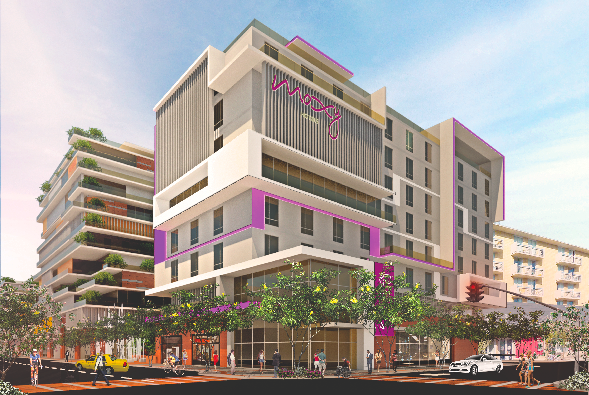
https://twitter.com/BeckyPallack/status/666781094142808064
Moxy is a new Marriott concept. It looks like there's a place in Tempe called Hotel1333 that is being rebranded as a Moxy. Otherwise, most of the locations in development are in Europe.
Normally, I'd figure this was just a placeholder but FORS, which is involved with Peach's proposal, designed the AC so . . .
Also, FORS isn't so great with perspective in their renderings. This appears to be the corner of 6th and Congress looking northeast.
Here's one of the new renderings.
https://twitter.com/BeckyPallack/status/666781094142808064
Moxy is a new Marriott concept. It looks like there's a place in Tempe called Hotel1333 that is being rebranded as a Moxy. Otherwise, most of the locations in development are in Europe.
Normally, I'd figure this was just a placeholder but FORS, which is involved with Peach's proposal, designed the AC so . . .
Also, FORS isn't so great with perspective in their renderings. This appears to be the corner of 6th and Congress looking northeast.

southtucsonboy77
New member
Condos, hotel proposed as neighbor to Tucson's tallest building
From the Star:
An adjacent tower to Tucson’s tallest building could become a combination of condominiums, luxury apartments and hotel space.
And, while developers say it will be integrated to match the existing structure known by its address, One South Church, it likely won’t be a twin tower.
“The new building won’t be a twin sister . . . maybe a cousin,” owner and developer Roger Karber told members of the Pima Country Real Estate Council Thursday morning. “It’s very rare to be involved with a project that is so unique. We are still exploring options.”
One South Church and its adjoining lot was bought by local investors last month for $32 million.
Karber, managing member of Aerie Development LLC, then bought the1/2-acre lot for $3.5 million, as Aerie is looking toward developing more urban projects.
The company has several luxury apartment complexes in Arizona.
Owners and investors are “crunching the numbers daily” to conceive a successful plan, Karber said.
The top four to six floors could become private condominiums , with luxury rental units in the middle floors and hotel rooms on the bottom floors along with some retail, he told the council.
In response to questions, Karber said he’d like to build about 30 condominiums.
The elevators shaft, which reaches three floors underground and one above was engineered to sustain 23 stories, gives developers an advantage, he said.
“All we have to do is go vertical,” Karber said. “We hope to occupy by mid-2018.”
He envisions the neighboring plaza as a hangout for residents on the south end of downtown, citing the success of places further north, such as The Cup at Hotel Congress on Toole Avenue and La Cocina on Court Avenue.
“That will be key,” Karber said.
He also committed to preserving the Ben’s Bells mural that is wrapped around the exposed elevator shaft of the never-built twin tower.
One of the four panels may remain at the site and the others are “transportable and meaningful,” he told members of the council and asked for ideas on where the other panels could be placed in the community.
Meanwhile, the existing tower, built in 1986, is getting a makeover and already has a new tenant.
Northern Bank of Arizona has signed a lease for space on the first floor, said Matt Thrasher, of Thrasher Law Offices PLLC, one of the new owners.
The building was 30 percent vacant when purchased.
He said upgrades to the offices will be done with an eye toward attracting younger tenants.
Co-owner Zachary Fenton said the building is the same as it was when built 29 years ago and plans are to remove things that “scream 1980s.”
On some floors, the ceilings are being removed to expose the beams and florescent lighting is being replaced with track lighting, he said.
“It’s a great building,” Fenton said, “but it needs some refreshment.”
The 240,811 square-foot tower has 23 stories. It was designed by Curtis W. Fentress of Fentress Architects and built by Sundt Corp.
One South Church was first known as the United Bank Tower, then Citibank Tower, Norwest Tower and UniSource Tower until 2011.
The new owners have not decided whether to change the name.
farmerk
New member
Regents to consider $163M UA health-sciences building
A $163 million high-tech facility for health-sciences students at the University of Arizona could add to what’s turning into a local medical construction boom.
The Arizona Board of Regents is scheduled today to consider a 220,000-square-foot “Simulation, Inter-Professional Healthcare Education and Research (SIPHER) Building” to go up on what’s now a parking lot near the UA colleges of medicine, pharmacy, nursing, and public health, as well as the Medical Research Building and the BIO5 Institute.
....
The SIPHER building would also be in close proximity to the planned $107.5 million BioScience Research Laboratories building, scheduled for construction beginning next month and going through November 2017.
....
The SIPHER building location east of Cherry Avenue between East Drachman and East Mabel streets is appropriate, UA officials say, since the building would not belong to any one particular health-science school. Rather, it would be a place for nursing, medicine, pharmacy, other health-science faculty, students, businesses and the community at large to collaborate, they say.
The exact height of the SIPHER building has not yet been decided, but a height of 10 or 11 stories has been discussed, UA Health Sciences spokesman George Humphrey said. The SIPHER height would be similar to that of a new tower expected to be constructed at nearby Banner-University Medical Center Tucson.
The timeline on the project, according to materials accompanying the Board of Regents agenda, is for construction to begin in 2017.
The goal would be to have the building ready for students in the fall semester of 2018.
....
Arizona universities push for 61,000 more students by 2025
Looks like Tucson may need some more student housing in the next decade if the Regents decide in favor of this unprecedented expansion. This could be huge for downtown Tucson!
From the Arizona Daily Star:
Looks like Tucson may need some more student housing in the next decade if the Regents decide in favor of this unprecedented expansion. This could be huge for downtown Tucson!
From the Arizona Daily Star:
PHOENIX — Arizona's state university system is looking to aggressively grow its student population over the next decade, with hopes of adding 61,000 more students across the three schools.
From the Arizona Daily Star:
The Arizona Republic reports that the Arizona Board of Regents on Thursday set a goal for enrollment at Arizona State University, University of Arizona and Northern Arizona University to expand to about 224,000 students by 2025.
UA would increase 52 percent to 64,250 students, with 12,000 more online students. NAU enrollment would increase 27 percent to 34,090 students, with a focus on undergraduate education.
ASU is already the nation's largest public research university with 91,000 students. The Regents goal would see that enrollment balloon to 125,000 students, with 35,000 of those students enrolled online.
Regents President Eileen Klein acknowledged that some are concerned the university system is already too large.