The Wave


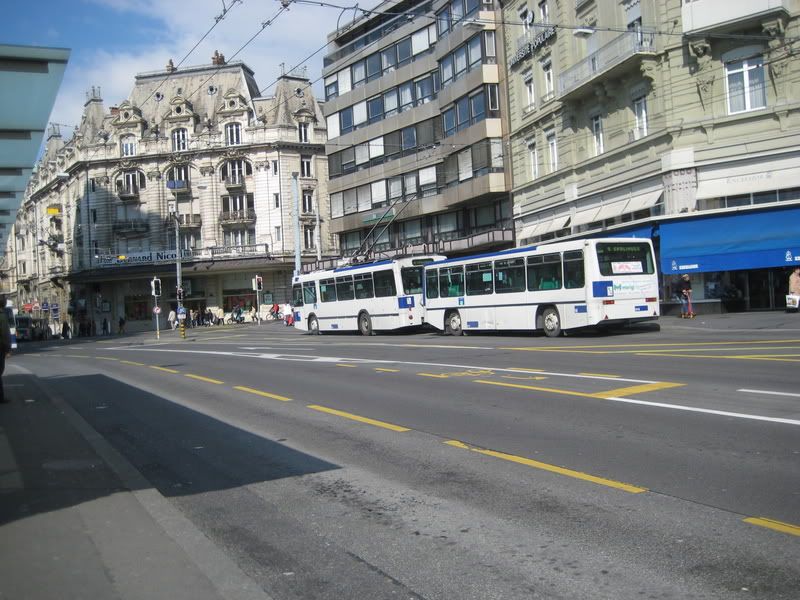
I've never quite understood the advantage of street car over bus.

#1: Buses belch diesel fumes for all to breathe. They do nothing to help reduce greenhouse gases other than concentrate them into fewer vehicles per capita.

#2: Buses are not expandable like trams. You can just add cars onto the back of a tram. Doing so on a bus requires disassembly of the vehicles, which is more expensive and invasive. This is typically why buses on popular routes are more crowded than comparable trams.

#3: Buses get into more accidents (by far) per capita than trams. THis is partially because of their smaller size (motorist are less careful and cautious around buses), but also because buses don't have their own right-of-way as do most trams.

#4: Buses are less efficient. They can carry an average of 70 people per mile, per hour. Cars are less efficient, admittedly, at 40 per hour-mile. But Trams can carry upwards of 200 people per hour-mile.

#5: Buses are more difficult to adapt for handicap accessibility. There are now tram designs that have almost no rise whatsoever and can be accessed by wheelchair-bound citizens in exactly the same manner as everyone else. Buses often require a special add on ramp that is tedious, time consuming, and slightly embarrassing to use.

#6: Buses are less attractive. They produce noxious fumes, wear out road surfaces with their huge tires, produce more noise with their internal combustion engines, and in general detract from the street space. Trams can be more easily integrated into street space because they take up less width and make much less noise.
 
http://www.sun-sentinel.com/news/local/broward/sfl-flbtransit0319sbmar19,0,5436366.story

Streetcar transit still a possibility in downtown Lauderdale
County stands by promise for Lauderdale

By Brittany Wallman and Scott Wyman | South Florida Sun-Sentinel
March 19, 2008

FORT LAUDERDALE - Broward County commissioners indicated Tuesday they will stand by a promise made in more flush times to operate a light-rail system downtown, if it indeed is built in the coming few years.

At a county transit workshop, commissioners said they don't want to renege on a commitment they made several years ago to own and operate a streetcar transit loop downtown, if project supporters succeed in getting the $150 million system built.

The Downtown Development Authority in Fort Lauderdale has been working for seven years and spent several million dollars planning a proposal for what they now call "The Wave," a system of streetcars powered by overhead wires that would loop around downtown, from six blocks north of Broward Boulevard on Andrews Avenue, to 17 blocks south of Broward Boulevard, near Broward General Medical Center.


The exact route hasn't been selected, but the downtown group of power brokers faces a deadline to get city, county and regional funding commitments to keep the project alive. An application will be made later this year to get half the $150 million from the federal government.

Tuesday's signal of support was crucial; the county voted on the concept several years ago, before property tax reform and a sluggish economy.

"This is very heartening," Downtown Development Authority Chairman Jack Loos said.

Commissioners took no vote, and several said they want the city of Fort Lauderdale to make official its financial backing of the project. The city will be asked April 1 to vote on a route, and on a possible financial or land contribution. The city also will be asked to endorse the idea of a special assessment to collect most of the $37.5 million needed locally over 30 years from downtown property owners in the immediate area of the streetcar path.

County Transportation Director Chris Walton said the estimated operating cost when county commissioners agreed to it about five years ago was $1.8 million per year. The new estimate is $2.2 million a year. He said his staff will evaluate the estimate; county commissioners did not commit to any dollar figure.

Only Commissioner Suzanne Gunzburger voiced concern. She questioned paying for light-rail while the county is cutting bus routes. The county next month will consider ending four routes because of low ridership — a cost-cutting move in response to state requirements that local governments lower property taxes.

"When we are cutting our own buses because we do not have sufficient riders and cutting routes for people who are unable to get to see their spouses in the hospital or nursing homes or go to Publix and Target to do their shopping, and instead are putting our money into downtown Fort Lauderdale, I'm really concerned about this," she said.

The county and the city of Fort Lauderdale also have historically had a rough relationship, even though now a county commissioner, John Rodstrom, is married to a city commissioner, Charlotte Rodstrom.


Brittany Wallman can be reached at [email protected] or 954-356-4541.
 
I've never quite understood the advantage of street car over bus.

Could you do this with a bus?

modern-12.jpg
 
I'm surprised the cost per mile is so high - normally streetcars average around $10-$30 million a mile.

But kudos to you guys, these systems really help to change people's perceptions of an area, more than anything else. And people love to ride them... almost too much, actually. I sometimes see people wait for them here in Portland just to go one block! :P
 
It could be that it's a new system; needing a maintenance facility, purchasing the cars, etc., and possibly traveling over water is what is driving up the cost per mile?
 
An update on what's going on...

Fort Lauderdale commits $37.5 million for downtown streetcars
By Brittany Wallman | South Florida Sun-Sentinel
April 2, 2008

FORT LAUDERDALE - In a pivotal decision for a proposed streetcar system downtown, the city on Tuesday agreed to come up with 25 percent of the cost of the proposed $150 million light rail loop to be built on the streets of the urban core.

Part of the $37.5 million local contribution would be borne by the city from yet-to-be-determined funds, and could include a contribution of land. Part would come from property owners downtown, who would pay a special assessment every year for 30 years.

Both expenditures will require public hearings, but the vote Tuesday was crucial to move the streetcar proposal forward.

Even in tight budget times for local governments, city officials agreed to come up with the money that downtown businessmen said would ignite investment along its route and inspire light rail expansions countywide.

"This is a beginning," developer Jack Loos told commissioners. Loos is chairman of the Downtown Development Authority.

Proponents of the rail say the permanent nature of the system would attract more private investment along the route, and more riders, than a rubber-wheel vehicle route like a trolley.

The city's vote was unanimous to endorse the financial contributions, and to select a preferred route for the system, though county elected officials also will weigh in on the route.

A no vote or a delay would have dealt a blow to the proposal, which is on a tight deadline to apply for federal funds.

The system, dubbed The Wave, would cover a 2.7-mile loop that would take riders from as far south as Broward General Medical Center off Andrews Avenue and Southeast 17th Street, to as far north as Sixth Street six blocks north of Broward Boulevard.

Six vehicles would run on rails and would be powered by overhead electrical wire, between Andrews and Third avenues. The streetcar would travel over the Third Avenue bridge that spans the New River.

The city's Downtown Development Authority has been working seven years on the proposal and by October will have expended $4.1 million to bring The Wave to fruition. The downtown group hopes to get $75 million from the federal government, and $37.5 million from the state. When the project is complete, the county has agreed to own and operate it at an estimated cost of $2.2 million a year.

The project needs county approval next month and then would be submitted for federal funds, which downtown officials acknowledge could prove difficult to get. If all goes well, construction would begin in 2010, with service starting in 2013.

The commitment from city coffers is $600,000 every year for 30 years. City officials said they might propose giving some money and some land, and will come up with that plan soon.

The special assessment for property owners in the downtown amounts to about $99 every year for 30 years for a residential condo, and 12 cents per square foot for commercial.

Even Commissioner Carlton Moore voted in favor of the system, though he wanted the streetcar to run down Sistrunk Boulevard and was critical of the private consultants who said doing so would cost more than $30 million. He said the whole system seems too costly, but he didn't want to say no.
 
The Fort Lauderdale Downtown Development Authority has updated their website site: http://www.ddaftl.org/dtc.asp with information on this project. They have even posted a a link of animation of the street car running along Andrew's Ave.

http://www.ddaftl.org/streetcarhp.jpg
streetcarhp.jpg


http://www.ddaftl.org/streetcarwhite.jpg
streetcarwhite.jpg


The Wave FAQ's
http://www.ddaftl.org/dtcFAQs.asp

Q: What is The Wave?

A: The Wave is an environmentally friendly (electric) streetcar system that will move people in and around Downtown Fort Lauderdale.

Q: What makes The Wave environmentally friendly?

The Wave is environmentally sound in many ways. The streetcar is powered by electricity, which when compared to gasoline, significantly reduces emissions and harmful air pollutants. It also provides a quiet ride, unlike the bus that operates on a noisy combustion engine. Additionally, the streetcar glides on steel wheels while the bus uses rubber tires that are not environmentally sound and is difficult to dispose of.

Q: Where will The Wave go?

A: Analysis is still being done on the final route. Each of the 4 remaining routes cover from Sistrunk at the North, 17 th Street at the South, Andrews at the West, and 3rd Avenue at the East. View the Important Decisions page to see the 4 remaining routes.

Q: Why do we need The Wave when we have the Sun Trolley?

A: The Sun Trolley provides trolley services to various areas beyond the downtown. In order to support the urban center and its growth, we need to provide permanent infrastructure.

Fixed rail streetcar systems promote an economic development benefit that rubber-wheel vehicles do not. By knowing that a route will remain the same forever, it allows investment to occur. Streetcars are more convenient, more reliable, more efficient, and more environmentally friendly than rubber wheel operations.

Q: What will happen to the Sun Trolley when The Wave is operational?

A: The Sun Trolley will serve the surrounding neighborhoods and provide connections feeding into the Wave system and help to build a regional system.

Q: When can I start riding The Wave?

A: Construction is anticipated to begin in 2010 so we hope to have it operational by 2012, which is right around the corner!

Q: How much will the Wave cost to construct and who is paying for it?

A: The total capital cost in 2010 dollars (year of expenditure dollars) is $150 million

The federal government will pay 50% of the total cost = $75 million
The state government will pay 25% of the total cost = $37.5 million
The local community will pay 25% of the total cost = $37.5 million
The local share of $37.5 million is anticipated to come from a variety of contributors that will benefit from the system to include government, the hospital district, and the residential and commercial/business community.

It is important to note that historically, South Florida has been a donor State to Federal and State transit projects. Our tax dollars have been used for projects like Portland’s streetcar, Seattle’s Light Rail, and many more. We have an opportunity to see our dollars come back.

Q: How much will the Wave cost to ride?

A: Broward County passed a resolution in 2004 committing to operate the Wave for 20 years. As the owners and operators of the system, they will make the final decision regarding fares. Ultimately, a free system is what the Downtown Development Authority (DDA) will endorse, however, if that is not financially possible, options will be explored that gives the residential and commercial owners a discount given their help with funding the capital.

Q: Will the Wave have a dedicated lane in traffic or can I drive in the same lane?

A: The Wave will function just like a vehicle does. It will abide by traffic signals and the rules of the road. Vehicular traffic and the streetcar will share the same lane of traffic.

Q: How often will the Wave pick up passengers at any given stop and what time will it run?

A: The Wave will run at peak hours in the morning, afternoon, and evening. It is anticipated that initial ridership counts will help to determine necessary hours beyond those evening peak times. A person should expect to wait no longer than 7.5 minutes at any given stop. Intelligent transportation systems (ITS) will be part of the system that will display route information and real time traffic information at the stops which will tell the rider when the next vehicle should arrive (down to the second). In addition, to help maintain the 7.5 minute headways, Broward County traffic engineering will be using what is called traffic prioritization. This means as the streetcar vehicle is approaching a green light, the light will stay green 20 seconds longer so the vehicle can get through the intersection. If it arrives at a red light, it will change the light to green 20 seconds earlier. This will help not only the streetcar vehicle, it will also help move vehicular traffic as well.

Q: What are the mechanics of The Wave?

The streetcar is equipped with a pole that connects to an overhead wire called a catenary. The electricity is transmitted through the wire by substations. The streetcar is stopped by a friction braking system, where a pad or brake shoe is applied to the tread of the wheel to stop. The streetcar is operated by one person referred to as a motormen or operator. The operator responsibility includes regulating speed, control of the doors, and safe operation of the streetcar.
 
#1: Buses belch diesel fumes for all to breathe. They do nothing to help reduce greenhouse gases other than concentrate them into fewer vehicles per capita.

#2: Buses are not expandable like trams. You can just add cars onto the back of a tram. Doing so on a bus requires disassembly of the vehicles, which is more expensive and invasive. This is typically why buses on popular routes are more crowded than comparable trams.


#4: Buses are less efficient. They can carry an average of 70 people per mile, per hour. Cars are less efficient, admittedly, at 40 per hour-mile. But Trams can carry upwards of 200 people per hour-mile.

Problem solved
IMG_2780.jpg
 
Portland, Ore., showed the way for Fort Lauderdale's streetcar plan
April 27, 2008
Sun-Sentinel

The Portland, Ore., streetcar system is the model for Fort Lauderdale's plan.


Portland, Ore.
Route: Four miles, double-tracked, with stops every three or four blocks.

Opening date: 2001.

Frequency: Streetcars run about every 12 minutes during most of the day Monday through Saturday and less often in the early morning, evenings and Sundays.

Fares: Outside a "fareless zone" it costs $1.75 for two hours for adults, $1.40 for youths. An annual pass costs $100.

Time between initial planning and start of service: 11 years.

Links: Suburbs are linked to downtown Portland by a regional light rail system.

Expansion: The system is undergoing another expansion.

Economic development: $2.2 billion in private development, including 7,248 new housing units and 4.6 million square feet of office space, was built within two blocks of the rail line starting in 1997, when the route was identified. The development was denser than what was built before the rail plans.

Cost per track mile: $12.9 million.

Ridership: 9,000 riders a day by the fall of 2005.

Operating cost: $4.9 million a year.

For more information: www.portlandstreetcar.org


Fort Lauderdale
Route: None selected, but the preferred proposal would cover 2.7 miles, with 10 stations and six vehicles.

Opening date: projected to be sometime in2013.

Frequency: Every 7 1/2 minutes.

Fares: The Downtown Development Authority wants rides to be free; county officials would decide.

Time between initial planning and start of service: Estimated at 11 years.

Links: Could link with proposed east-west bus rapid transit on Broward Boulevard, county bus system and Sun Trolley system.

Cost per track mile: estimated at$49.3 million.

Ridership: estimated at 8,000 a day.

Operating cost: estimated at $2.24 million.

Who would pay: Owners of the thousands of new downtown condos would be expected to pay $99 a year for 30 years if city commissioners pass the assessment. Commercial owners would pay 12 cents a square foot, or $1,200 for 10,000 square feet. Owners citywide would see their property taxes used toward a $10.5 million city contribution. Broward County would pick up costs when the project is built. The yearly operation cost is estimated at $2 million. The state would contribute $37.5 million, and the federal government $75 million.

For more information: Downtown Development Authority, www.ddaftl.org
.
 
http://www.sun-sentinel.com/news/local/broward/sfl-flbmayocol0501sbmay01,0,1775526.column

Fort Lauderdale's transit 'Wave' looks like a wipeout
Michael Mayo | News Columnist
May 1, 2008
As boondoggles go, I love this proposed light-rail transit system for downtown Fort Lauderdale being pushed by the Downtown Development Authority.

It sounds great: Electric streetcars going almost nowhere being ridden by virtually no one. A perfect way for all those phantom residents of downtown condo high-rises to not commute to jobs they don't have.

But that's OK, proponents of The Wave say, because developers will still flock to build things near the fixed rail lines.

Uh, does this sound backward or what?


I'm all for mass transit, especially in these eco-conscious, $4-a-gallon times.

But a $150 million, 2.7-mile project such as this should be the last piece in our sprawling region's mass transit puzzle, not one of the first.

Here's what Broward residents need sooner: Rail transit routes going east-west along the Interstate 595 corridor and north-south on the Florida East Coast railway tracks along Dixie Highway.

If linked properly, those projects could actually help get transit-averse South Floridians out of their cars. Both are in the early planning stages.

A transit system on the FEC tracks also could make Fort Lauderdale's proposed Wave streetcars redundant, since the two systems would run parallel and be separated by mere blocks for much of the route.

That hasn't stopped the Downtown Development Authority, a special taxing district with a pro-development mission, from pushing this half-baked mistake into the oven.

Over the past seven years, the DDA has spent almost $4.1 million on planning, consulting and other fees associated with the project.

After all that, you think the DDA board or its latest consultant would say, "Sorry, this pig won't fly?"

Instead, we get self-serving projections and rosy optimism.

The board's consultant, Parsons Brinckerhoff, estimates the Wave could attract 8,000 riders a day.

That seems irrationally exuberant, considering the regional Tri-Rail system, which spans Miami to West Palm Beach, is still hard-pressed to break 15,000 riders a day after almost two decades.

And it also seems overly optimistic when you consider that the free downtown light-rail in Portland, Ore., has an excellent feeder system from suburban commuter lines and still gets only 9,000 riders a day.

Then there are the sobering numbers from the current Sun Trolley system that's meandered along a similar downtown Fort Lauderdale route.

When it was free, it snagged less than 200 passengers a day. When there was a 50-cent fare (it reverts to free service today), the Sun Trolley attracted less than 100 daily riders.

Less than 100 a day, in a city of 175,000 and county of 1.7 million!

No problem, say board members such as developers Jack Loos and Alan Hooper. Just lay tracks below, hang electric wires above and charge nothing and people will clamor to ride The Wave.

How would this get built? A combination of federal and state transit funds, and local money that would come from a special 30-year assessment of downtown residents and businesses.

The city commission has given preliminary approval to the funding plan, but it's unclear if the assessment proposal will trigger opposition as it gets wider publicity. And there are no guarantees that the $75 million federal share will come.

But that hasn't stopped the DDA board from charging full speed ahead, with marketing and lobbying efforts aimed at garnering support.

When it comes to The Wave, perhaps the Downtown Development Authority should heed its own Web site ( www.ddaftl.org). On Wednesday it featured a Quote of the Day from French philosopher Jean Rostand: "To love an idea is to love it a little more than one should."

Michael Mayo's column runs Tuesday, Thursday and Sunday. Read him online weekdays at Sun-Sentinel .com/mayoblog. Reach him at mmayo@sun-sentinel .com or 954-356-4508.
 
Getting closer...

Fort Lauderdale: Officials pitch transit system in Washington
May 10, 2008
Sun-Sentinel

Plans for a light-rail transit system downtown were taken on the road recently to Washington, D.C., where local supporters pitched the idea to federal officials.

Downtown Development Authority executive director Chris Wren said he met with federal transportation officials about the $150 million project, half of which will hopefully come from the federal government. Wren told the downtown board at its Thursday meeting that federal officials were helpful and the project is on track.

The Wave would be an electric-powered streetcar system running on tracks laid in the roadway downtown, with overhead power wires.

The county has agreed to operate the system, and the city and state have agreed to help pay to build it.

The request for $75 million will be made to the federal government this summer.

The downtown board is looking for about 2 acres downtown that could be purchased for the streetcar system's industrial shop. And the board hopes by the end of the month to have designated a preferred route for the downtown rail. Four routes are in play, loosely following Andrews and Third avenues, from Northeast Sixth Street down to Southeast 17th Street.


Listening to the DDA and city commissioner's meeting the other week, the DDA prefered route is E1. And if I remember correctly, the 3rd Ave bridge was chosen for the New River crossing.

E1route.png


Other three routes in consideration and the preferred route as a PDF file - Click Here
 
I've never quite understood the advantage of street car over bus.
* Streetcars have higher capacity than buses. Not only does that mean they can carry more people in real terms, but since one rail vehicle with one driver carries many more people than a bus, and since streetcars can be coupled, the cost to operate per rider is lower for streetcars than buses (assuming adequately high ridership).

* Streetcars run on electricity rather than oil. Electricity is not only cleaner, but with oil prices continuing to skyrocket, the long term cost savings are potentially enormous.

* Streetcars have a better image. Many middle class Americans look down on buses as “loser cruisers”, but are willing to ride trains.

* Streetcars are MUCH more comfortable to ride. It is simply a fact that trains run much more smoothly than buses. This isn’t frequently brought up, but it’s a big reason why people have such negative opinions about buses. Gliding along a rail is noticeably smoother than rumbling along on big tires over rough streets.

* Rail tends to spur positive real estate investment. Streetcars, unlike buses, can be used as tools to transform underperforming real estate into dense, vital urban districts.
 
Problem solved
IMG_2780.jpg

As I was riding my crowded fixed-pole trolleybus to work this morning, lamenting that not even an articulated 60' version could make the ride more comfortable and less crowded, the poles came off the wires stopping us dead in traffic.

* Streetcars have higher capacity than buses. Not only does that mean they can carry more people in real terms, but since one rail vehicle with one driver carries many more people than a bus, and since streetcars can be coupled, the cost to operate per rider is lower for streetcars than buses (assuming adequately high ridership).

* Streetcars run on electricity rather than oil. Electricity is not only cleaner, but with oil prices continuing to skyrocket, the long term cost savings are potentially enormous.

* Streetcars have a better image. Many middle class Americans look down on buses as “loser cruisers”, but are willing to ride trains.

* Streetcars are MUCH more comfortable to ride. It is simply a fact that trains run much more smoothly than buses. This isn’t frequently brought up, but it’s a big reason why people have such negative opinions about buses. Gliding along a rail is noticeably smoother than rumbling along on big tires over rough streets.

* Rail tends to spur positive real estate investment. Streetcars, unlike buses, can be used as tools to transform underperforming real estate into dense, vital urban districts.

My other half got seriously depressed at seeing how well the streetcar in Portland worked. Myself, I was floored at how much development has gone up in the Pearl District in the year I've not been living there. He was excited by the idea of seeing what was done in the Pearl District being done in South Lake Union, however.

The quote in my signature is something we actually experienced from a condo owner from the South Waterfront on our trip this weekend.
 
Moving along...


Tuesday, September 9, 2008 - 6:23 PM EDT
Broward County Commission green-lights streetcar system
South Florida Business Journal - by Bill Frogameni

A proposed $150 million streetcar system for downtown Fort Lauderdale cleared a bureaucratic hurdle Tuesday when the Broward Country Commission voted to act as owner/operator of the project.

The commission’s vote “allows the county’s transportation department staff to assume official role as project sponsor/operator/project manager” and apply to the federal government for $75 million in funding, according to the language of the item commissioners passed.

The Downtown Development Authority of Fort Lauderdale (DDA) is planning the project – dubbed the Wave – which it projects would increase ridership to 6,000 a day, up from about 100 riders who now use the Sun Trolley’s downtown routes.

The proposed route would cover about 2.7 miles with double tracks, replacing the Sun Trolley there.

If the project is finalized, funding would come from a mix of local, state and federal dollars. In April, Fort Lauderdale city commissioners voted to contribute $10.5 million to construction costs. The state has budgeted an additional $37.5 million. The federal government would put in $75 million, and the remaining $27 million would come from special assessments on downtown residents and businesses, which would be spread over 30 years.

Although the county would not contribute to the initial cost, it would serve as owner-operator for 20 years and would assume annual operating costs, which are estimated at between $2.2 million and $2.5 million.

However, the commissioners’ vote does not commit the county to any funding. That would only come later, depending on the federal government’s response, DDA Executive Director Chris Wren said.

“The main thing is [county commissioners] think it’s a good project,” Wren said.

Voicing his support for letting the project move to the next phase, Commissioner John Rodstrom said: “I think this is a good step. Let’s see if they get the money.”

Wren said the federal government’s response is expected at the end of this year or early 2009.

The plan calls for the streetcars to be functioning by 2012.
 
http://weblogs.sun-sentinel.com/new...g/2008/09/streetcar_for_downtown_advance.html

Streetcar for downtown advances

> Posted by Scott Wyman at 4:59 PM
The possibility of light rail in downtown Fort Lauderdale moved a step closer to reality Tuesday as county commissioners agreed to its financial plan and likely route.

The streetcar system, dubbed The Wave, would begin running within five years if downtown leaders can secure needed federal aid to build it. With the county now on board, downtown leaders will try to win $75 million from federal mass transit funding to help cover the $150 million in construction.

Commissioners said they were willing to move the project to the next level to try to gain the federal grants. The county has tentatively agreed to cover the annual $2.5 million cost of operating the system if it does start.

“I’m willing to let this go forward and be explored because mass transit is the wave of the future, particularly considering the price of gas,” Commissioner Ilene Lieberman said.

The Downtown Development Authority has been working for seven years on the proposal. The 2.7-mile route would run between such destinations as the Florida Atlantic University downtown campus, City Hall, Broward General Hospital, the Transit Terminal and the courthouse.

Studies estimate that the system would start in 2013 with about 4,000 riders per day and increase to 8,000 riders a day by 2030. Trains would run about every 7.5 minutes during peak hours and would operate from 5:30 a.m. to 1 a.m. most days under current plans.

The Wave would run on rails embedded in the roadway and would be powered by overhead electrical wires. The possible fare schedule would be developed in the next round of planning.

If federal aid comes through, then the rest of construction costs will be born by the city of Fort Lauderdale and the state Department of Transportation.

City commissioners committed to contributing $37.5 million, which at least will partly be paid by downtown property owners. The state transportation agency has indicated it will match the city’s contribution.

The cost of construction include double-tracking most of the route so trains can maintain a headway of less than 10 minutes. Also the Southeast Third Avenue bridge must be retrofitted for rail operations.
 
Downtown developers want $2.9 million now for light rail
> Posted by Brittany Wallman on July 20, 2009 04:00 PM

Fort Lauderdale's Downtown Development Authority is asking for money from the city in the coming budget, for the planned light rail project it calls The Wave. They'll make a public plea tomorrow afternoon.

The Wave would bring a fixed-rail, mass transit system to the downtown, to help people loop around without driving.

DDA members will show their plans to the City Commission, hoping to garner support. The previous City Commission endorsed the project, but four of the five on the Commission are new, since the spring elections. So the DDA has to ask for support all over again. Broward County commissioners endorsed the project and promised to operate it, already.

Here's the DDA's website, where you can find more information on The Wave. The project's scope has been reduced from $150 million to $123.4 million, according to this memo.

The city's portion would be $10.5 million, and the DDA wants $2.9 million included in the budget that's in the making right now for the spending year that starts Oct. 1.
http://weblogs.sun-sentinel.com/new...g/2009/07/downtown_developers_want_29_mi.html
 

Just because streetcars can make 90 degree turns in city streets, doesn't mean you should swap between two streets as many times as you desire. By following one north-south street most of the way, they could eliminate many, steel wheel rubbing against steel tracks screeching sounds coming from 90 degree turns.

If they need to use the eastern street crossing the creek or river or canal, at least they could stick to that street on one side (north or south). The drawing above shows the tracks swapping to the western street on both sides (that's four 90 degree turns) of a bridge on the eastern street, and further north switching again back to the eastern street (that's another pair of 90 degree turns). You could eliminate 4 turns by using the bridge on the western street, or staying on the eastern street north of the bridge on the eastern street.

Tracks in the 90 degree turns wear out much faster than straight tracks. Therefore track maintenance increases significantly with more 90 degree turns. It is also cheaper to build and lay straight tracks than curves. Neighbors to these sharp turns will complain about the screeching noises, which will require more maintenance again as automatic grease guns are deployed to minimize the screeching noises on these curves.

I'm not suggesting 90 degree turns are bad for streetcar lines, but I am suggesting minimizing them as much as possible. I find it hard to believe they have looking at this proposed map.


Back
Top