Nanaimo developments


Commercial Street

The upgrade is underway and should be finished in another 5-6 months.

54168339617_6e225e13a1_c.jpg


54169488523_458a53fb5c_c.jpg


54169673405_56b848f496_c.jpg
 
City Planning and Development - Part One

This is an indication of Nanaimo's increasing development using my neighbourhood as an example.

The City of Nanaimo has been putting a lot of time and energy into community planning driven in large part by the anticipated rapid growth in Nanaimo's population. To that end it is creating areas of the city for specific types of development. The top three for density being:

Primary Urban Centre

Downtown is Nanaimo’s Primary Urban Centre – the city’s distinct cultural, economic, tourism, and mobility hub with the highest density and mix of land uses.

Building heights: min. 2 | max. 12 storeys, with taller supported in specific locations

Secondary Urban Centres

Secondary Urban Centres are hubs that serve the city and region, typically anchored by public institutions and significant employment centres. These centres capitalize on excellent transit access, connected to one another via Corridors and support higher density development.

Building heights: min. 2 | max. 12 storeys, with potential for limited additional height where community benefit provided

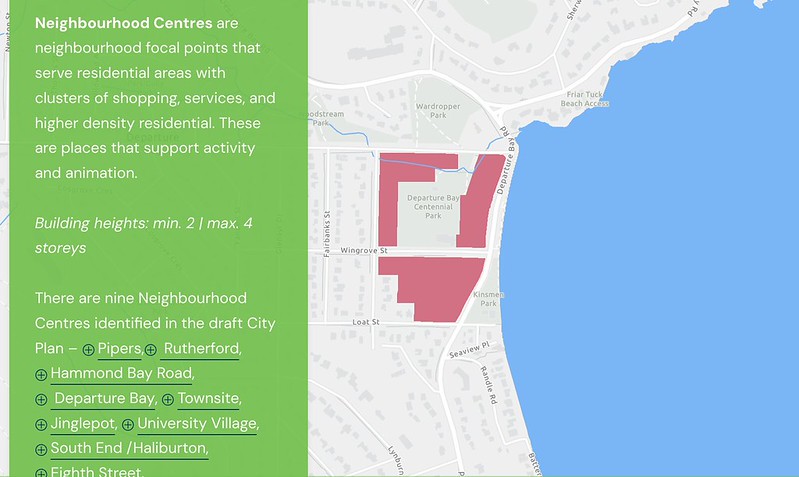
Neighbourhood Centres

Neighbourhood Centres are neighbourhood focal points that serve residential areas with clusters of shopping, services, and higher density residential. These are places that support activity and animation.

Building heights: min. 2 | max. 4 storeys

I live in the Departure Bay area, a designated 'neighbourhood centre' and outside of a nice condo development not much has happened in the last twenty years. That is about to change with three 'modest' developments on the way or underway.

54176709211_8e2b2ffe6c_c.jpg


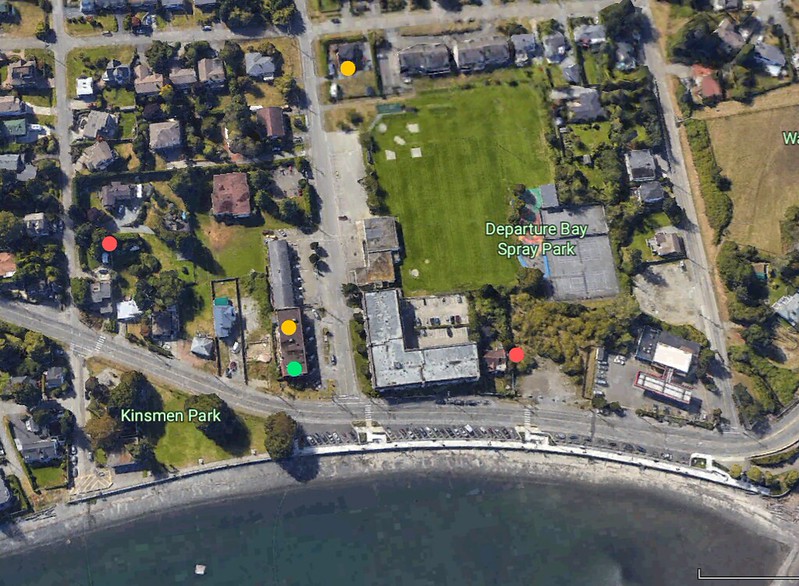
Aerial view of Departure Bay Neighbourhood centre marked in red above
: Yellow = new apartments red = new(er) condos or townhomes and green = new commercial

54177005889_85ac8a9fae_c.jpg


City Plan - Nanaimo ReImagined
 
Last edited:
City Planning and Development - Part Two

After 40 years of zero density development to having three multi-unit residential and commercial projects building or in development today is remarkable.

The latest, and only, project in Departure Bay for at least four decades is Legasea, a condo building with a very popular street front coffee shop. The apartment block next door to Legasea was built in 1982 and appears to be the last effort at adding density to the neighbourhood.

Images below show the latest condo with another commercial/apartment building under construction and two new developments for townhouses and apartments.

54178478221_90f7e107a2_c.jpg


54179312253_7858b63789_z.jpg


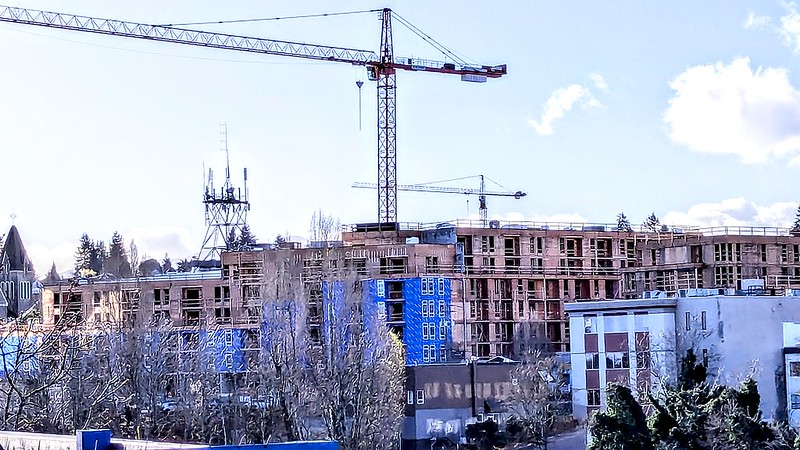
Currently under construction is an apartment building with street front commercial space.

54178906925_4bef199009_c.jpg


54177592982_17946533eb_c.jpg


On the same street is an in development apartment block.

54144641921_df86f0cde3_c.jpg


And lastly, at least for now, is a townhouse development.

54178845408_ae65b79301_c.jpg


City of Nanaimo
 
It surprises me that there hasn’t been much development in that part of DBay. As a former resident down there I found it an awesome spot to live. Maybe Nimbyismkeep development away???
 
It surprises me that there hasn’t been much development in that part of DBay. As a former resident down there I found it an awesome spot to live. Maybe Nimbyismkeep development away???

It seems to me that by the late 1980's Departure Bay had been built out, at least as far as residential development was concerned. Everything then, literally, headed north.

The only buildable land left in the Departure Bay area is either a few empty lots, infill or teardown. Nanaimo has now created three types of density zones and with Departure Bay being designated a 'Neighbourhood Centre' with the intent of creating neighbourhood focal points that serve residential areas with clusters of shopping, services, and higher density residential, we are, hopefully, going to see newer developments that serve that purpose in the community.

Upzoning a portion of Departure Bay makes it economically attractive to tear down older houses and replace them with higher density apartment/condo and commercial space.
 
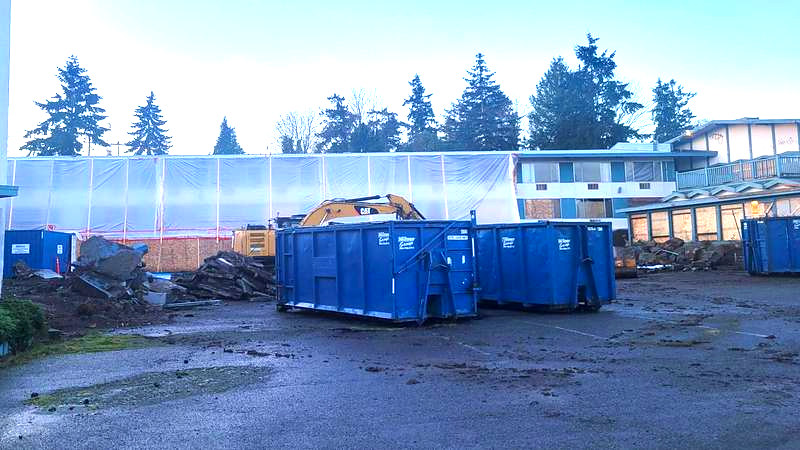
Howard Johnson demolition

The city of Nanaimo has finally awarded a demolition permit for the removal of the Howard Johnson hotel. Sitting empty since 2018 the hotel will come down in the mid January to mid February period.

Nanaimo Community Archives manager Christine Meutzner said the site was originally a sawmill from the 1870s to about 1930, serving as storage for all of the lumber coming to the mid-island area.

She said at the time, the property was hardly a central downtown location.

“In the early days that would have been the very fringe of town,” Meutzner said.

She said a hotel was first built on the site in 1962 when the Tally Ho Travelodge opened...“When it first opened, that would have been considered kind of cool and modern compared to the rest of the hotels in town.”

The Tally Ho became a key figure in a row of motels along what was Nanaimo’s “north end” at the time.

Although harbouring huge respect for Nanaimo’s history and its old buildings, Meutzner was less than nostalgic about the hotel.

“I guess if you had your wedding there or significant life event you’ll miss it. But I’m more concerned with what replaces it really. I have to say, architecturally, I don’t feel it’s a very good example of anything.”

54196273020_de8717c93a_c.jpg


54195850211_716bfa2a32_c.jpg


https://nanaimonewsnow.com/2018/09/05/nanaimos-notorious-howard-johnson-hotel-to-shut-down/

https://nanaimonewsnow.com/2024/12/10/crews-to-start-tearing-down-eyesore-howard-johnson-hotel-in-nanaimo/

Google Earth
 
Thanks for the update Islandtime, it's just too bad there's no high-rises (or even mid-rises) underway

The last mid-rise was that Marriot hotel and what a fiasco that was all for a measly 9 story hotel to finally get built
 
Last edited:
Thanks for thne update Islandtime, it's just too bad there's no high-rises (or even mid-rises) underway

The last md-rise was that Marriot hotel and what a fiasco that was all for a measly 9 story hotel to finally get built

I agree. With what Kelowna is able to build you'd think Nanaimo could crank out some nice high rise, skyscrapers etc. When I was in high school Nanaimo and Kelowna were roughly the same population... Disappointing really.
 
Thanks Wethers and Great Scaper for your comments.

With respect to taller structures in Nanaimo....they are, potentially, coming. A couple of good things and not so good, to note about the current state of Nanaimo. Regaring growth, at the last census Kelowna was the fastest growing city in Canada with Nanaimo and Kamloops tied for third. As for taller buildings the momentum currently in Nanaimo, as well as many other small cities, is for rental units. The taller, and more expensive, structures are primarily aimed at the condo/commercial market and especially in areas that are both desirable and land constrained.

It is worth noting that Nanaimo had an abundance of brownfield and greenfield land available until recently. This land was most economically developed as either residential or 5+1's and 6+1's primarily for rental with some condo activity. I posted an example of a north Nanaimo greenfield that had been approved for two 20+ storey condo buildings but was ultimately used, due to construction costs, for three 6+1 condo buildings.

Looking to the near future there are larger/taller structures on the horizon. In the immediate future is the new student residence building at the university and the promised $2 billion hospital tower. Farther down the road are the Sandstone, Green Thumb and downtown waterfront developments. I will post more on these projects in the coming weeks.
 
I agree. With what Kelowna is able to build you'd think Nanaimo could crank out some nice high rise, skyscrapers etc. When I was in high school Nanaimo and Kelowna were roughly the same population... Disappointing really.

When I was young Kelowna, Prince George, Kamloops and Nanaimo all had similar populations. Today Kelowna is double the population of Kamloops and Nanaimo with PG a distant fourth but it seems that almost all the development is happening in Kelowna with very little in the other three
Thanks for the info Islandtime, but a $2 billion hospital tower? That can't be right, that would be half the price of One World Trade Center in New York City
 
BC Municipal Population Growth

When I was young Kelowna, Prince George, Kamloops and Nanaimo all had similar populations. Today Kelowna is double the population of Kamloops and Nanaimo with PG a distant fourth but it seems that almost all the development is happening in Kelowna with very little in the other three


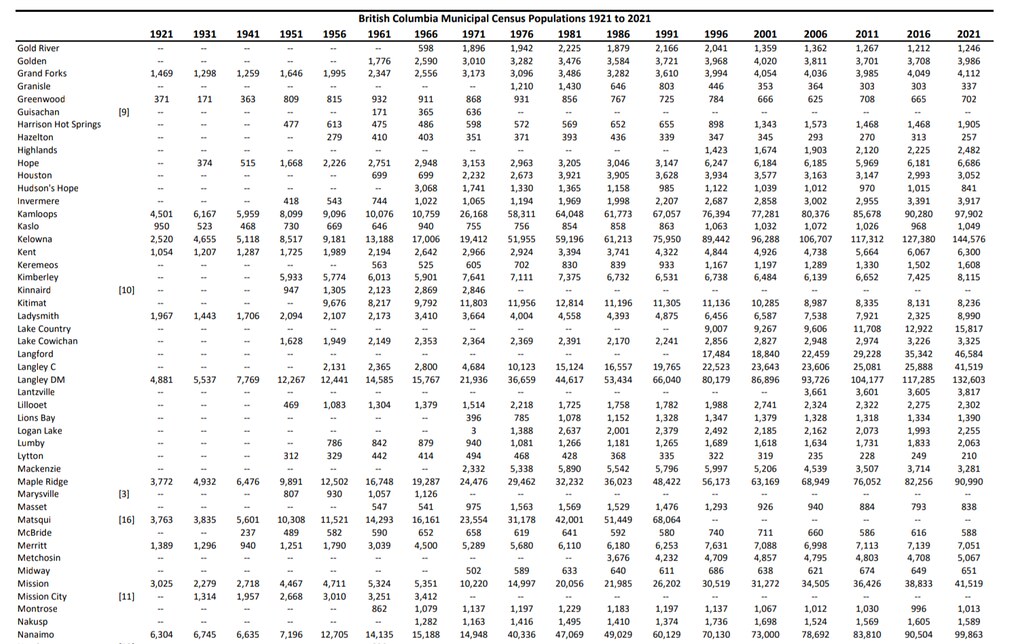
Comparative growth of Kelowna, Kamloops and Nanaimo. In the table below it shows that in 1986 Kamloops and Kelowna were equal in population while Nanaimo was a distant third. In 2024 it is estimated that Kamloops CMA is 108,551, Nanaimo CMA is 120,213 and Kelowna CMA is 160,507.

Between 1986 and today Kelowna grew 166% with Nanaimo growing 155% and Kamloops growing 80%

54204140964_3e8bfd4e61_b.jpg
 
NDP and Conservatives pledge new $2B patient tower for Nanaimo hospital

by Kendall Hanson
September 27, 2024 5:50 pm

https://cheknews.ca/ndp-and-bc-conservatives-pledge-new-2b-patient-tower-for-nanaimo-hospital-1216777/

$2 billion still seems outlandish to me but yeah, that's what it said :shrug:

The Royal Jubilee Hospital in Victoria got an 8 story patient care tower back in 2011 which cost $348 million and while that would obviously cost more than $348 million today almost 6X the price today seems crazy although they didn't mention how big the one in Nanaimo is going to be but I doubt it will be bigger

As far as the city populations go, I was going by Wikipedia's numbers:

Ten largest metropolitan areas by population

Metropolitan area 2021 2016 2011

1 Vancouver 2,642,825 2,463,431 2,313,328
2 Victoria 397,237 367,770 344,615
3 Kelowna 222,162 194,882 179,839
4 Abbotsford 195,726 180,518 170,191
5 Nanaimo 115,459 104,936 98,021
6 Kamloops 114,142 103,811 98,754
7 Chilliwack 113,767 101,512 92,308
8 Prince George 89,490 86,622 84,232
9 Vernon 67,086 61,334 58,584
10 Courtenay 63,282 54,157 55,213
 
Last edited:
Discovered something interesting today

As far as the city populations go, I was going by Wikipedia's numbers:

Well this is interesting. Apparently the CMA of Kelowna matches the boundaries of the Regional District of Central Okanagan and includes the City of West Kelowna and others.

The Regional District of Central Okanagan (RDCO) is a regional district in the Canadian province of British Columbia, representing two unincorporated Electoral Areas of Central Okanagan East and Central Okanagan West, along with the member municipalities of the City of Kelowna, City of West Kelowna, the District of Lake Country, the District of Peachland, and Westbank First Nation. The RDCO office is located in Kelowna.

Statistics Canada defines the Kelowna CMA (Census Metropolitan Area) or Kelowna Metropolitan Area as being identical in area with the RDCO.

The Capital Regional District also matches the Victoria CMA.

But....Nanaimo CMA does not, for reasons unknown, match the Nanaimo Regional District. The population of the Regional District of Nanaimo (RDN) in 2024 is projected to be 182,367.

If Nanaimo were treated the same as Kelowna and Victoria, and probably others, the city population would be 182.367.

Fascinating stuff. Thanks Werthers, I discovered something interesting today.
 
Last edited:
Yes, good observation Islandtime. Kelowna and Victoria have West Kelowna and the Western Communities, respectively. I believe Statistics Canada has a threshold percentage of population that must be employed and work in the core area, but live and commute (work remote part time) from the surrounding communities in order to be considered a part of the CMA or CA. Perhaps the number of people living in Parksville/Qualicum/Nanoose Bay areas that are employed do not meet that percentage threshold that would need to be employed in the Nanaimo core area? There’s probably other factors Statistics Canada considers that I’m not aware of.
 
Last edited:
Yes, good observation Islandtime. Kelowna and Victoria have West Kelowna and the Western Communities, respectively. I believe Statistics Canada has a threshold percentage of population that must be employed and work in the core area, but live and commute (work remote part time) from the surrounding communities in order to be considered a part of the CMA or CA. Perhaps the number of people living in Parksville/Qualicum/Nanoose Bay areas that are employed do not meet that percentage threshold that would need to be employed in the Nanaimo core area? There’s probably other factors Statistics Canada considers that I’m not aware of.

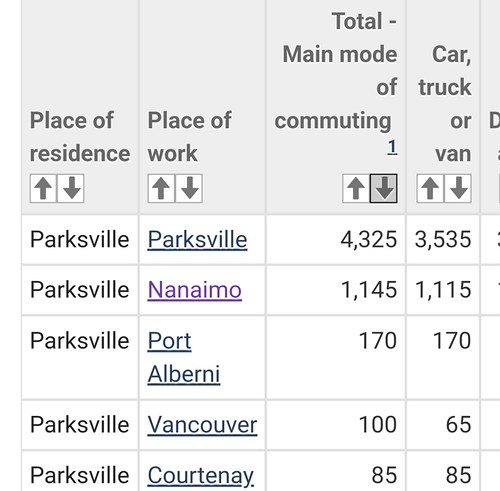
Yes, thank-you, that appears to be the case. There are a couple of other considerations but the commuting component seems to need to reach a 35% threshold from contiguous communities to be considered part of the CMA. The areas you mentioned, people living in Parksville/Qualicum/Nanoose Bay areas, are in large part retirement communities, so I don't see things changing anytime soon.

Edit: It seems that the threshold may be closer than I realized for Parksville according to the 2016 census.

54206140239_933cd91a5d.jpg


Just for the fun of it....the population of Nanaimo today is estimated to be 108,457 while the population of Victoria is only 95,717. Those figures are city proper of course.
 
Last edited:
^And that's exactly why I alway ignore the city populations and only focus on metro populations because everyone knows Victoria is way bigger than Nanaimo


Back
Top