Development Rumours


Back in the 1960's, '70's and probably '80's, this building housed The Cake Box. It was the bakery my parents always went to for baked goods, and our birthday cakes. I remember they made the most amazing donuts, in a similar style to those found now at the Masstown Market. I believe it was owned by Ron Wallace, who was Mayor of Halifax from 1980 to 1991.

Good recall, visualman57. I do remember The Cake Box, though our family favoured the French Pastry on Quinpool, another fabulous lost Halifax bakery.

According to the Open Corporates database, 1034353 NOVA SCOTIA LIMITED, formerly The Cake Box Limited, operated at 5190 Blowers, owned by Ron and Julia Wallace. The company was incorporated in 1968, revoked in 1992 and struck off in 2002.
 
EaVXRkQWsAEJhjh


https://twitter.com/RickyBobbie75/status/1271518438360600577/photo/1

The house next to the KFC on Titus St. has been torn down.
 
I was wracking my brain too, trying to come up with the name of the cafe. I finally located it: 5190 Blowers was Pineau's Cafe. I visited there for lunch once and remember it being quite agreeable. According to an entry in the Halifax Rainbow Encyclopedia it was a gay-friendly spot; in fact it suggests the place was the only gay restaurant in town at the time, c. 1996-2007.

As to the history of the building or what was there before, I'm not sure. As if I needed more evidence of my faulty memory, I thought the place was the former home of Reid Sweet Photographic but, as the photo shows, that was next door at 5188.

49998050777_4a50fb7abc_w.jpg

Source: Halifax Rainbow Encyclopedia

(The Reid Sweet building was proposed for a heritage designation back in 1985 but special council minutes show no one spoke in favour of it -- the owner opposed it -- and the matter was deferred. Sometime later that building was demolished.)

According to a story in the Halifax Examiner the owner of 5190 Blowers was (is?) Ramia's Barrington Street Historical Development Limited. The city ordered them to clean up the property two years ago but, as far as I know, they did nothing before now.

When walking by the place I've remarked several times that I've been surprised the place stood empty for so long. No clue though what, if anything, is planned for the site.

Thanks for that. Pineau's is what it was when we went there. I recall the food was good, service was good, loved the decor and ambiance of the place, and was disappointed when it closed. I always thought it had a nice streetside presence and thus hoped it would be reimagined by somebody, rather than to die a death of neglect.

I don't recall it being the Cake Box, but do recall the Reid Sweet store.

Good memories, and am continually perplexed that these old places aren't held in higher regard in Halifax, one of the more historic cities in North America...

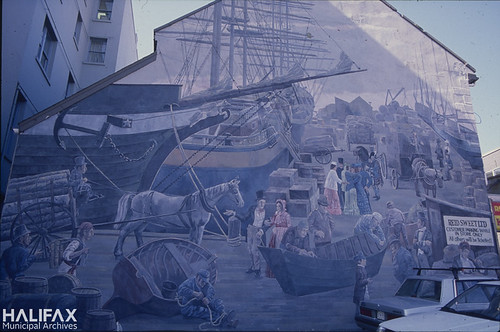
I agree. The Reid Sweet building appeared to have a handsome stone facade despite the commercial storefront. Why there was no apparent enthusiasm for historical designation, I'm not sure. Without the 1985 information report it's not clear what the building's history was. I had forgotten, until I saw the photo below in the municipal archive, that there was once an attractive historical mural painted by Peter Bresnen on the side of the building.

The former Pineau's/Cake Box structure seems less distinctive, although it's clear from the initial photo that under the broken vinyl siding the construction was originally brick.

50002008707_dce063fee0.jpg

Source: Tourism Halifax photo
 
Nice find. I remember that mural.

I don't think there is much precedent for registering privately-owned heritage buildings in Halifax. The Dennis Building scenario was unusual, and the province (i.e. nobody in particular) owned it. If the Reid Sweet owners didn't want to preserve it and wanted to develop, that alone may explain the lack of heritage designation. This was an unfortunate setup because, especially after real estate crashes like 1990, random people would scoop up historic real estate. Just like how DongDu bought the Pacific Building and then ruined it a little more (claiming it was part of a $3B investment plan for NS). If anything the need for heritage protections has increased because there are more and more faceless global real estate transactions. Investors will play by the rules the city puts in place but they will not follow local norms or care about local history and culture. If there are no official rules the outcome will be chaotic.

I've also found that the heritage values of the Heritage Trust don't seem to match those of architecture enthusiasts very much. To my mind something like the Ralston was a big potential heritage save at one point, and comparatively rare stone buildings or those with distinctive and rare architectural styles are much more valuable than wooden buildings. But the HT often valued buildings based on history or age. The Morris House is a good example. I am happy it's saved but as a priority I would have put it below, say, the stone BMO building torn down for the Doyle. The HT doesn't decide what gets registered or not but their lobbying has historically had some impact.

I agree on all points and will say that I think this is part of the reason why the HT doesn't have more support of the general public.
 
I agree on all points and will say that I think this is part of the reason why the HT doesn't have more support of the general public.

On top of this there is a murky link between the Heritage Trust and NIMBY activism, with the Heritage Trust sometimes fighting not just to preserve heritage buildings but to preserve empty lots. To people concerned with more than just heritage they may be perceived as a net negative.

I think Peggy Cameron and Bev Miller for example might be both Heritage Trust and Friends of the Commons members, and they tend to be outspoken in the media. This Friends of the Commons opposed the Wanderers pop-up stadium but that must be the most effective use of the Wanderers Grounds in many years.
 
I've often thought that the HT folk failed to make the link between people and the need for buildings. ie. without people there is no need for buildings. Said differently, most of Halifax's heritage buildings are downtown but it seemed for the longest time that so few could live there due to the lack of homes. If the long buildings in Clayton Park and beyond had been allowed to be built in an upright fashion closer to city centre that surely would have created a need for the smallish heritage buildings for use as small offices, shops, etc. No doubt some of the blame for the loss of heritage buildings rests on the shoulders of the city too.
 
On top of this there is a murky link between the Heritage Trust and NIMBY activism, with the Heritage Trust sometimes fighting not just to preserve heritage buildings but to preserve empty lots. To people concerned with more than just heritage they may be perceived as a net negative.

I think Peggy Cameron and Bev Miller for example might be both Heritage Trust and Friends of the Commons members, and they tend to be outspoken in the media. This Friends of the Commons opposed the Wanderers pop-up stadium but that must be the most effective use of the Wanderers Grounds in many years.

Not murky at all, been obvious for years! They're all about protecting their own residential property values, that's it.
 
Not murky at all, been obvious for years! They're all about protecting their own residential property values, that's it.

Is there something wrong with people wanting to protect property values? Is that not an issue for you where you live? :shrug:
 
Not murky at all, been obvious for years! They're all about protecting their own residential property values, that's it.

That's not a fair characterization of the HT and its related people at all. In my experience, it is authentically about heritage, it's just taken to a larger extreme than most other people would.

As for things like Friends of the Common, most of them don't live in the area of things like the Willow Tree. So again, it can't be about property values. I can only assume it's about protecting their idea of what Halifax is as a city.

I have to agree, actually. I think people become a little cynical for whatever reasons, perhaps because the HT are always in the news opposing something that people want to happen, I'm not sure.

My only issue is that they sometimes appear to focus on some structures of seemingly lesser significance, while other more prominent structures continue to suffer purposeful neglect and demolition, sometimes resulting in the lot remaining vacant for years, so that the developer can sit on it while paying lower property tax on an undeveloped lot. The end result is the loss of a heritage building, with those of us who care asking how did that happen yet again.

In other words, I wish they would reorganize and consider their operations more carefully, as they currently appear to be somewhat ineffective.

As for the HT getting negative opinions on a site that exists for fans of new skyscrapers being built, it's only natural. If this were a heritage protection website, I would expect more support for the HT in general...
 

Fair enough, but for some reason I'm not feeling the HT has been the driving force behind the decision to keep the Dennis? Correct me if I'm wrong, though.

Then it begs the question as to why they haven't been effective in saving a number of other buildings that we've lost. Sure, they've tossed their hat in the ring, but the end result is the same. I get the impression that the real tool that is needed is some sort of legislation with actual teeth, that can be used to both prevent the neglect and destruction of historic buildings as well as incentivize owners to preserve buildings, or at least to incorporate the actual building into a development.

In the meantime, we've lost numerous historical buildings that the HT were unsuccessful in saving. Don't get me wrong, I'm in favour of the HT and the work they are doing (or could be doing), but wish it could be more focused and more successful in actually saving heritage buildings, rather than just getting a byline in the news that they are against some development. My comments come more from frustration than anything else. I'm not saying anything new here, it has all been said before by others on this forum, more eloquently than I could ever phrase it...
 
At the end of the day it's usually regional council or the province who have the say in these matters. Some of the heritage registration rules were provincial for example (the one year vs. 3-5 year demolition delay; in most places demolition isn't allowed at all).

The Heritage Trust can lobby but so can anybody else.

To your point, anybody can lobby about anything, so why do we always get up in arms about NIMBYism? They are just lobbying, but don't have any effect on the rules. The government controls the rules and the people have the right to lobby for what they believe in. If the govt gives in, it's their fault and not the NIMBYs' fault - so I hereby suggest that we stop complaining about NIMBYs in this forum for that very reason.

Why the criticism about the HT, since effectiveness is pretty much out of their responsibility because all they can do is lobby?

I now withdraw my criticism of the HT, and instead place it on the governments, who have done little to nothing to protect heritage structures in Halifax. :2cents:

:shrug:
 
I was trying to get at the idea that there's interplay between the province, regional council, staff, developers, and public lobby groups, with the HT being only one small part of the puzzle. The HT can lobby effectively or ineffectively, and can have an impact, but it doesn't make sense to hold them solely accountable for demolition of heritage buildings. They don't have the authority to save anything on their own.

One factor I've observed in the past is that a bunch of councillors, mostly the suburban ones, could not care less about heritage issues. And then on top of this provincial-level heritage protections in NS are very weak.

Even the federal government does a bad job of preserving heritage overall. They are the main force behind the Ralston demolition for example. While JT goes on about climate change, federal departments abandon urban buildings to move out to the suburbs.
 
I understand, and I realize that's how it works. For years I've supported the HT on this forum and amidst much criticism of it. I've listened to the arguments of the detractors, and have considered their points and have come to the conclusion that the HT could/should be more effective, even though our laws are pretty weak regarding protection of heritage properties, not much more than a volunteer effort on the part of the owner, actually, which means nothing if the owner bought the place simply for the land. Perhaps my expectations have been too high as to how much they can accomplish.

To bring it full circle, I was originally just responding to your post, where it appeared that you were expressing the same frustration, and thought that the HT should refocus. Perhaps I misunderstood your point...

I've also found that the heritage values of the Heritage Trust don't seem to match those of architecture enthusiasts very much. To my mind something like the Ralston was a big potential heritage save at one point, and comparatively rare stone buildings or those with distinctive and rare architectural styles are much more valuable than wooden buildings. But the HT often valued buildings based on history or age. The Morris House is a good example. I am happy it's saved but as a priority I would have put it below, say, the stone BMO building torn down for the Doyle. The HT doesn't decide what gets registered or not but their lobbying has historically had some impact.
 
To your point, anybody can lobby about anything, so why do we always get up in arms about NIMBYism? They are just lobbying, but don't have any effect on the rules. The government controls the rules and the people have the right to lobby for what they believe in. If the govt gives in, it's their fault and not the NIMBYs' fault - so I hereby suggest that we stop complaining about NIMBYs in this forum for that very reason.

Why the criticism about the HT, since effectiveness is pretty much out of their responsibility because all they can do is lobby?

I think we criticize them because for years they were the leading go-to voice the media went to when they needed someone to criticize a development proposal, so they were always in the news opposing something new.They seemed to oppose any development that came forward, which is hardly a way to win broad support. And to say they don't have any influence on the rules is false. It was their work that saddled us with ridiculous viewplane laws, and both HRMxD and the Centre Plan were watered down with height limits that satisfied them and their supporters. For decades they have focused on building height as the enemy of heritage for reasons that I have never understood.


Back
Top