Development Rumours


This kind of history is pretty common in Halifax. Sir Sandford Fleming lived a couple of blocks down. There were lots of important people living and passing through in Halifax in the 18th and 19th centuries, whether you're talking about national politicians and royalty, inventors, or founders of major businesses. There was a time when it had more of a reputation as a "city of firsts" but that seems to have all but disappeared.

I find that the level of heritage preservation tends to be much lower in Halifax than elsewhere in Canada for something of the same level of significance, and that things that happened in Halifax that are of national significance (during the 1750-1950 period a lot happened) have a much lower profile than less significant events in Ontario and Quebec. The city should be investing a lot more into heritage preservation and interpretation. Halifax should have a Philadelphia or Boston type reputation within Canada, with heritage sites and tourism to match.

I agree completely. It seems that since the early 20th century Halifax has had this feeling of "we're not worthy" (think Wayne's World) when it comes to comparisons to other cities, and this even comes down to its history. We are one of the oldest and most interesting (IMHO) cities in Canada and arguably North America and yet we often seem to shrug it off as if to say "well that's all good, but what have we done lately". That attitude spills over to our century+ old buildings, but I've ranted enough about that...

To be honest, other than the time to put it together, I don't think it would take too much to implement heritage preservation and interpretation as you describe. Most of it is out there, it just isn't organized or interrelated enough to be easily comprehensible by the average interested person. If government were to undertake a project to coordinate history and historical buildings/places, and make it available to tourists/citizens on a website (for example) anybody interested could explore the city's history at their leisure and to whatever depth their interest drives them.

:2cents:
 
This kind of history is pretty common in Halifax. Sir Sandford Fleming lived a couple of blocks down. There were lots of important people living and passing through in Halifax in the 18th and 19th centuries, whether you're talking about national politicians and royalty, inventors, or founders of major businesses. There was a time when it had more of a reputation as a "city of firsts" but that seems to have all but disappeared.

I find that the level of heritage preservation tends to be much lower in Halifax than elsewhere in Canada for something of the same level of significance, and that things that happened in Halifax that are of national significance (during the 1750-1950 period a lot happened) have a much lower profile than less significant events in Ontario and Quebec. The city should be investing a lot more into heritage preservation and interpretation. Halifax should have a Philadelphia or Boston type reputation within Canada, with heritage sites and tourism to match.

I also agree. There should be heritage signage literally all over downtown, at every corner, building, or structure of historical note or significance.

I'd *like* to know if Sir Sanford Fleming lived in a house! Or a Father of Confederation worked here. Or died there. Or even that a certain well known business once was housed here or there.

Instead, our Heritage people are over trying to stop affordable housing in the North End or block the new YMCA development from building a few inches higher and wider. Losers.
 
They got money in the last round of Barring St. Heritage District grants to restore the facade and restore the window proportions (e.g. the bricked windows on the top floor). Hopefully what you posted is a sign of the work starting.

Assuming there is any valid justification for a govt to give public money to a private property owner for such purposes - which I seriously doubt - the photographs would suggest that the only "heritage restoration" work that could possibly be done to make this worthwhile would be not to remove the bricked-up part of the top floor window openings, but rather to remove the entire top floor facade and rebuild the dormers and roofline that originally existed. This is currently a much later and totally artless addition that has no redeeming value whatsoever. Just another example of HRM throwing tax dollars down the drain.
 
It's going to take quite a bit of work to make something interesting out of the dreary box of a structure we have today.

"Something interesting", maybe, but even just a fresh coat of paint (and probably some non-aesthetic, infrastructural upgrades) would be a massive improvement. There are already a lot of interesting buildings on this block - IMO it would be enough for this one to just "not look like shit", basically.
 
I think we're actually lucky there aren't more examples of this in Halifax/Canada. When visiting Berlin a few months ago, I discovered that in the post-war era, building owners went crazy trying to be as modern as possible by stripping all the ornamentation off of the city's 19th-century Grunderzeit apartment houses, which are basically the dominant building form of most of the inner city. The result is a city of endless boxes. (Here's a good juxtaposition: the building on the left retains ornamentation, while the one on the right is de-facaded. There are thousands of these all over the place.)

Anyway, as far as Barrington: If the city is serious about the street as a heritage street, I think there should be more financial incentive, or simply direct financial assistance, in a case like this. Otherwise it seems unlikely to truly be restored to its historic appearance.
 
Regarding the 1678 Barrington Street building (with the Elle's Bistro sign) here is an image from year 1900. It is just to the left (south) of what was at that time the New York Life Insurance Co. office.

(source: https://novascotia.ca/archives/Notman/archives.asp?ID=205 )
200714316.jpg

Thanks!

Here are a few more views:

To the left with the Phinneys sign on it, from the early 1960s (the archives say 1960, but the third vehicle from the left is a 1962 Pontiac). If you zoom in using the archives link below, it shows the fourth level façade as an add-on piece with different materials and window framing than the levels below.

15024.jpg


https://novascotia.ca/archives/NSIS/archives.asp?ID=1716&Language=

Another one from 1900. It's amazing when you think that the building was already 70 years old when this pic was taken. There's a subtle difference in this photo, as the Buckley Bros. sign is not below the New York Life Insurance signage.

200715746.jpg


https://novascotia.ca/archives/Notman/archives.asp?ID=956

Here's one that blows my mind - circa 1868, predating the New York Life Insurance building. Note: only 2 dormers, and of a different style than the pic from 1900.

b6YY9Nb.jpg


From the archives site:
Wm. Fraser & Sons', Piano Forte Warerooms. — West side of Barrington Street. In background is St. Paul's Anglican Church, the Grand Parade and Dalhousie College. Photographed circa 1868.

https://novascotia.ca/archives/Rogers/album.asp?ID=76#imagebox
 
Last edited:
They got money in the last round of Barring St. Heritage District grants to restore the facade and restore the window proportions (e.g. the bricked windows on the top floor). Hopefully what you posted is a sign of the work starting.

Here's a link to the document.

http://www.halifax.ca/boardscom/hac/documents/bshcd201516bshcdgrantsreportwebcopy.pdf

15-01 1678 Barrington St. Phinney Building
Storefront restorations, and upper façade restoration including the reinstatement of four ‘lost’ windows at the 2nd floor, and replacement of 3 inappropriate windows at the 4th floor.
 
.
.
.
Here's one that blows my mind - circa 1868, predating the New York Life Insurance building. Note: only 2 dormers, and of a different style than the pic from 1900.

b6YY9Nb.jpg


From the archives site:


https://novascotia.ca/archives/Rogers/album.asp?ID=76#imagebox


Thanks for finding this picture in the archives. It is great to see how the (then) W. Frazer & Sons building looked in ca 1868.

I wonder when the (then) Smith building on the corner of Prince and Barrington Street was built? Would it have been an original building that dates back to the founding of Halifax? Here is a link to a map of that part of Halifax in 1878 - http://novascotia.ca/archives/maps/plate.asp?ID=3. The Smith building was the one torn down and replaced by the majestic New York Life building, which would have been an engineering and architectural marvel in 1900, and is still one of the more impressive buildings in Halifax (in my opinion). PS: It is too bad that the clock and roof feature have been removed from the former New York Life building.
 
Last edited:
Thanks for finding this picture in the archives. It is great to see how the (then) W. Frazer & Sons building looked in ca 1868.

I wonder when the (then) Smith building on the corner of Prince and Barrington Street was built? Would it have been an original building that dates back to the founding of Halifax? Here is a link to a map of that part of Halifax in 1878 - http://novascotia.ca/archives/maps/plate.asp?ID=3. The Smith building was the one torn down and replaced by the majestic New York Life building, which would have been an engineering and architectural marvel in 1900, and is still one of the more impressive buildings in Halifax (in my opinion). PS: It is too bad that the clock and roof feature have been removed from the former New York Life building.

I was fascinated when I found the photo. It's extraordinary that photos like this even exist, as photography had only been commercially available for about 30 years when that pic was taken.

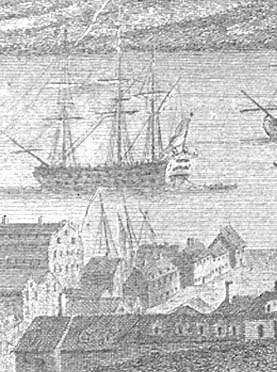
I'm not sure how one would find out the history of the Smith building, but I'm guessing that it had been built some time after the founding of Halifax (1749). Of course there aren't any photos from that time, but this illustration of Halifax in the 1750s shows a very small town and indicates that most of the structures built at that time would have been somewhat simple and basic. I think that Haligonians were still dealing with basic survival and establishing a colony (and defending it) at that point, so most private buildings would have been built to cover the basics. That's just my speculation, however.

70-103.jpg


http://www.fineart.utoronto.ca/canarch/maritimes/halifaxplans.html

I'm not an expert in architecture, but I would guess from the style and condition that it was probably built in the early 1800s, but that's as far as I can go.

The New York Life building is still impressive to this day, and yes I agree that reinstating the clock and roof feature would make it even nicer.

While we're at it, another feature of note in the photograph is the absence of the current City Hall building, which was constructed starting in 1887.
 
A reliable media source (think of a bridge) reported that IKEA is considering building a 300,000 square foot full-size store in Dartmouth Crossings.

I've also heard chatter in the development community that IKEA has been scouting locations but has been looking at Bayer Lake. Personally, I'll believe it when I see the "coming soon" sign go up but not before.
 
The Khyber preservation folks unveiled their new plan yesterday. I can't speak to whether it looks financially feasible or not, but if the dollars and cents are in order, it seems pretty awesome.

Bottom line: if the city sells them the property for a buck (reasonable, since that's what the city bought it for way back when) a coalition of community groups will operate it with income-generating businesses to pay for maintenance, etc.

The building will be structurally and aesthetically restored, will be home to a new 80-seat theatre, office and retail space, the KAS, etc. They also plan to add a fourth storey, though I'm cautious about that until I see how they'd integrate it architecturally.

They say the city contribution will be a "a couple hundred thousand", not the $4 million originally put forth by city staff.

If the business plan makes sense, city council would be a bunch of lunatics not to endorse it.
 
Remains to be seen how they have reduced the $4 million estimate for repairs/remediation to a smaller number - why bother with remediation of that pesky asbestos, and what's a building code, man? - and how much they ask the taxpayer to cough up to help give them a clubhouse.
 
Remains to be seen how they have reduced the $4 million estimate for repairs/remediation to a smaller number - why bother with remediation of that pesky asbestos, and what's a building code, man? - and how much they ask the taxpayer to cough up to help give them a clubhouse.

Well, the plan is to solicit funding from all three levels of government (I expect the province will be the hardest to extract money from) and do some local fundraising. Plus those 4 million costs were probably quite inflated.
 
Well, the plan is to solicit funding from all three levels of government (I expect the province will be the hardest to extract money from) and do some local fundraising. Plus those 4 million costs were probably quite inflated.

I would trust construction estimates from city engineers more than those from a bunch of stoner artsy kids.
 
I'm not sure how one would find out the history of the Smith building, but I'm guessing that it had been built some time after the founding of Halifax (1749). Of course there aren't any photos from that time, but this illustration of Halifax in the 1750s shows a very small town and indicates that most of the structures built at that time would have been somewhat simple and basic. I think that Haligonians were still dealing with basic survival and establishing a colony (and defending it) at that point, so most private buildings would have been built to cover the basics. That's just my speculation, however.

I think this would have been true only for a short period of time after the town got started; a couple of years maybe, not decades. Halifax was a planned capital for an area that was already, in New World terms, moderately developed and very accessible. It started with thousands of people and St. Paul's was built only a year after the actual founding. In the 1750's the Great Pontack Inn that was three storeys. Here's an engraving from 1759:

GreatPontackHalifaxNovaScotia1759.png

https://en.wikipedia.org/wiki/Great_Pontack_(Halifax)

I think there's a Pontack House in Historic Properties that's meant to be a kind of modernist nod to the building but it is not very interesting. According to the Wikipedia article the Pontack survived until at least 1925. Something like that seems like it would be an interesting building to reconstruct.

Halifax was quite different from the pioneer type areas of the Midwest, or the year pioneer settlements of Nova Scotia that were founded in the 1600's. I doubt average people in Halifax lived in good housing in the 1750's and 60's but even back then there would have been wealthy residents and visitors who would have stayed in much nicer buildings.

Fair enough, as the Carleton was also built around 1760, which was right around the time that England had pretty much defeated France for control of the province. My line of thought was that a shop such as the one mentioned would probably have come along a little later than the grander government/church buildings that would have been first built to establish the city. Again, just speculation, of course.


Back
Top