
-
City-versus-city activity is flat-out banned from being posted here in all its forms.
City vs city trolling sets up a rather nasty and personal fight between forumers from one place and forumers from another place, potentially affecting hundreds of members any time it breaks out. Nothing good comes of versus-trolling, but long after the insults and mockery have been removed, bad feelings between individuals and between groups tend to linger, oftentimes popping up in unrelated threads for months afterwards.
Thus, when it comes to 'versus' trolling, a line must be drawn--sharply. Anyone who crosses that line shall be disciplined, up to and including suspension and even summary banishment without warning. Forum moderation and administration shall be the arbiter of what constitutes versus-trolling, so if you think your post might be perceived as an unfair attack on an entire city that will upset residents there, tread lightly or reconsider how you intend to express your opinion. No forumer shall successfully claim ignorance of our policy against versus trolling, and no forumer should believe he can get away with it.
The ban on versus activity applies to all posts and all threads, even ones that are not initially set up as city-versus-city.
If you see any troublesome posts please report them using the "report a post" icon -in the upper right corner of every post on the forum.
You are using an out of date browser. It may not display this or other websites correctly.
You should upgrade or use an alternative browser.
You should upgrade or use an alternative browser.
Dense in the future?
- Thread starter Dariusb
- Start date
iheartthed
Active member
L.A. is obviously going to continue to grow up, since it doesn't have much room to grow out anymore.
I could see Austin grow dense but I'm not familiar enough with it.
Charlotte is already investing in rail transit, and will likely densify.
Lastly, I would bank on the big Rust Belt cities recovering density over the next half century.
I could see Austin grow dense but I'm not familiar enough with it.
Charlotte is already investing in rail transit, and will likely densify.
Lastly, I would bank on the big Rust Belt cities recovering density over the next half century.
The longest commutes most people seem to tolerate are about 45 minutes to an hour.
The mode of transportation does not matter and density does not matter thats about the limit people land on. So until a faster mode of transportation than trains and cars can get you from the farthest Exurb to your job they are about as spread out as they are going to get.
Now this does get a little warped as major Metro areas have multiple employment hubs and of course outliers of people willing to travel outrageous lengths to get their little slice of suburban (or rural) bliss. But unless its a smaller city with lots of room to expand outward like Boise or Odessa-Midland, id expect most of the top cities in america to continue their current trend towards more density.
Of course there is a cultural component too, from 1940-(even now in many places) getting your own little house in the suburbs was a big cultural push, id never discount a turn against urbanism like we saw after WW2 happening again sometime in the future.
But, things will still change a lot with the growing prevalence of working from home with modern communication tech which could see really odd changes in living patterns. There is no reason why you cant be a day trader or independent tech contractor working from a small town in Montana as long as you have a good internet connection and are willing to be up early. etc.
And of course if we get Jetsons flying cars, Futurama people tubes or teleporters then all bets on built form are off.
i always feel like columbus is due for some sister city austin-style densifying downtown some day.
and speaking of ohio downtown's, cleveland is on deck for a huge downtown densification office project, but as with everything clevelandy there is also a chance it could all fall apart (new sherwin-williams hq). we'll see.
and speaking of ohio downtown's, cleveland is on deck for a huge downtown densification office project, but as with everything clevelandy there is also a chance it could all fall apart (new sherwin-williams hq). we'll see.


MonkeyRonin
¥ ¥ ¥
I was going to mention Toronto's post-war sprawlburbs as a good example. Most of them are fully built out at this point, but still rapidly growing - and as a result almost all of them are creating new high-rise city centres, building LRT & BRT, redeveloping shopping malls, and building TODs around new high-frequency commuter rail stations.
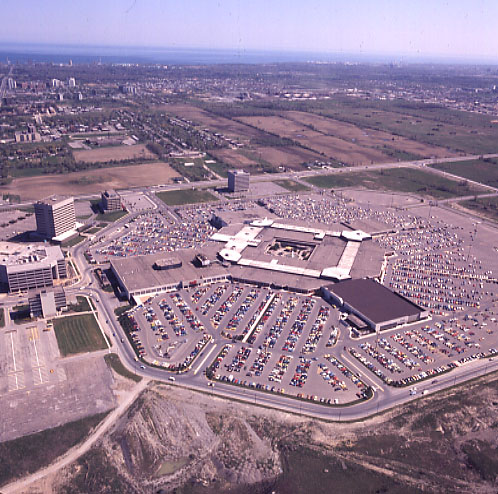
Mississauga is the most notable - in the 60s/70 its city centre looked like this:
http://www.mississauga.ca/portal/re.../portal/residents/citycentregallery?start=181
Now:

https://urbantoronto.ca/forum/threads/jasonzeds-mydrone-activity-of-toronto-and-area.20755/page-103
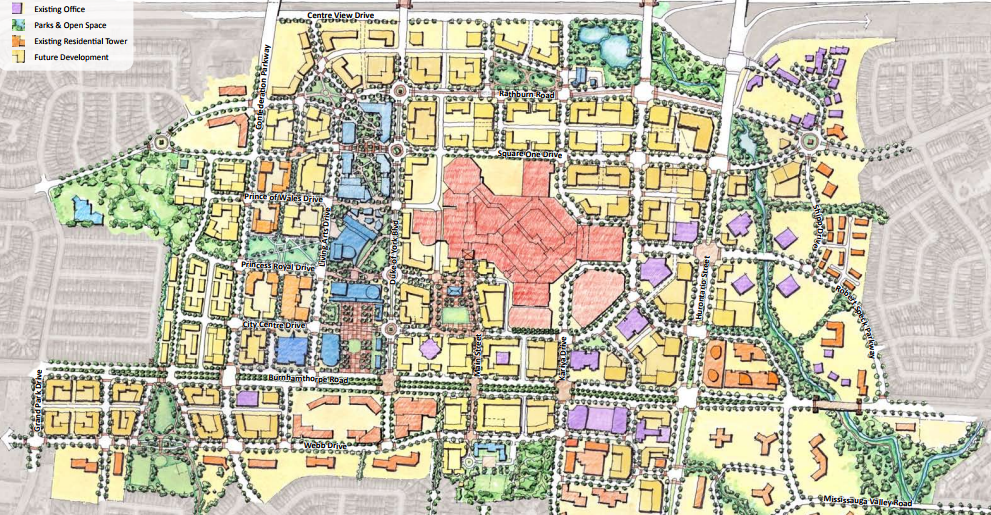
And here's the longer term plan to continue filling it in, including upgrading the current BRT to LRT:

Also in Mississauga is the Lakeview Village redevelopment, which will add 8,000 residential units & 4,000 jobs:


Here's the long-term vision for Brampton. What's currently a sprawling industrial estate:

Is planned to transform into this over the next few decades:


https://www.cbc.ca/news/canada/toronto/brampton-2040-vision-1.4651520
Vaughan's city centre, which is in the process of developing a post-war industrial / big box wasteland around a new subway extension & BRT:


https://www.century21.ca/roger.townsend/blog/Vaughan_s_Glorious_Downtown_Vaughan_Metropolitan_Centre
Langstaff Gateway redevelopment in Markham, which would add 15,000 residential units (plus commercial) around a commuter rail station:


It's also art of the larger Richmond Hill/Langstaff Gateway Urban Growth Centre, congruent with Richmond Hill's new city centre:


http://mshplan.ca/Project Sheet_Richmond Hill_Langstaff Centre Gateway.pdf
Markham's other city centre:

Still suburban, but at least they'll be dense. :shrug:
Mississauga is the most notable - in the 60s/70 its city centre looked like this:
http://www.mississauga.ca/portal/re.../portal/residents/citycentregallery?start=181
Now:
https://urbantoronto.ca/forum/threads/jasonzeds-mydrone-activity-of-toronto-and-area.20755/page-103
And here's the longer term plan to continue filling it in, including upgrading the current BRT to LRT:
Also in Mississauga is the Lakeview Village redevelopment, which will add 8,000 residential units & 4,000 jobs:
Here's the long-term vision for Brampton. What's currently a sprawling industrial estate:
Is planned to transform into this over the next few decades:
https://www.cbc.ca/news/canada/toronto/brampton-2040-vision-1.4651520
Vaughan's city centre, which is in the process of developing a post-war industrial / big box wasteland around a new subway extension & BRT:
https://www.century21.ca/roger.townsend/blog/Vaughan_s_Glorious_Downtown_Vaughan_Metropolitan_Centre
Langstaff Gateway redevelopment in Markham, which would add 15,000 residential units (plus commercial) around a commuter rail station:
It's also art of the larger Richmond Hill/Langstaff Gateway Urban Growth Centre, congruent with Richmond Hill's new city centre:
http://mshplan.ca/Project Sheet_Richmond Hill_Langstaff Centre Gateway.pdf
Markham's other city centre:
Still suburban, but at least they'll be dense. :shrug:
Still suburban, but at least they'll be dense. :shrug:
The high rises mixed in with fields just screams CHINA to me.

dc_denizen
Selfie-stick vendor
That’s who’s funding it lol
It’s the Vancouver/Miami model of growth
In the us, I would say Houston, Dallas will show the greatest densification. Not with high rises, more like big 6-7 story midrises wrapped around parking, with the odd inner loop high rise
High rises nodes in currently low rise edge cities would include Tyson’s, new Rochelle, Bellevue, maybe north Austin, east Portland downtown (Lloyd center) , parts of queens, jersey city. Nimbyism will probably keep more redevelopment core focused and brownfield elsewhere (ie Chicago and sf)
IrishIllini
New member
Houston and Dallas??? What?

Nouvellecosse
Volatile Pacivist
That’s who’s funding it lol
It’s the Vancouver/Miami model of growth
Where are you getting this from exactly?
LA will have the most and it's been happening with large 5-7 story mixed use buildings everywhere.
I think it's going to start adding 15-20 story buildings in the same fashion, as well as keep adding the 5-7 mixed use stuff.
Even parts of south los angeles and the Valley are adding these buildings all over the place.
Downtown will continue adding 40-60 story buildings. Century City, Hollywood and Koreatown, Wilshire, will likely add a ton of 30-40 story buildings (already planned/u/c)

TexasPlaya
Active member
Houston and Dallas??? What?
Probably given 20-40 years per the OP. They present two different versions of future density: DFW has a midwestern feeling with it's orderly development and clean look and Houston's libertarian roots come out in it's haphazard, a "mother's type of love" look. Both cities have the bones to support a dense multi nodal metropolis.
However, Houston does need to figure out it's future in order to densify... Are they going to get very serious about flooding and are they going to get very serious about investing in a plan to development new industries. Houston has been getting more involved in its local public university which is not among the state's flagship.


Dariusb
Active member
LA will have the most and it's been happening with large 5-7 story mixed use buildings everywhere.
I think it's going to start adding 15-20 story buildings in the same fashion, as well as keep adding the 5-7 mixed use stuff.
Even parts of south los angeles and the Valley are adding these buildings all over the place.
Downtown will continue adding 40-60 story buildings. Century City, Hollywood and Koreatown, Wilshire, will likely add a ton of 30-40 story buildings (already planned/u/c)
I know when I went to LA in 2013 I didn't recognize it. Previous to that the last time I was there was in 1994! Nearly 7 years later I'm sure the city has changed yet some more.

Quixote
Inveterate Angeleno
Toronto's urban development patterns/strategies are unlike anything else in the developed world. That parcel situated between the highway and cemetery... speechless. Propose anything like that in LA (or even OC), and the NIMBYs will be sure to stymie it... thank goodness.

Nite
Active member
Toronto's urban development patterns/strategies are unlike anything else in the developed world. Propose anything like that in LA (or even OC), and the NIMBYs will be sure to stymie it.
You can thank the Ontario government for that, The province has pretty much told all the GTA cities that they are going to get denser whether they want to or not. but even with the heavy hand of the province, getting skyscrapers built in Toronto is not a smooth process taking many years and about 1/3 of the cost to build is from fees and taxes.
A full unrestrained GTA would look like Asian cities with highrises replaces the miles of single-family homes in the region. The current process will take longer and be more expensive for home-owners but as long as the greenbelt holds the non-stop construction will continue
Last edited:
Nite
Active member
That’s who’s funding it lol
It’s the Vancouver/Miami model of growth
In the us, I would say Houston, Dallas will show the greatest densification. Not with high rises, more like big 6-7 story midrises wrapped around parking, with the odd inner loop high rise
High rises nodes in currently low rise edge cities would include Tyson’s, new Rochelle, Bellevue, maybe north Austin, east Portland downtown (Lloyd center) , parts of queens, jersey city. Nimbyism will probably keep more redevelopment core focused and brownfield elsewhere (ie Chicago and sf)
You may think that but the real reason is that Vancouver and Toronto don't have any more land to build out with and have to build up to house their fast-growing populations

Cirrus
cities|transit|croissants
Houston. Already in 2019 nobody in North America is converting single-family zones into dense neighborhoods faster than Houston. They still have to make it less car-oriented, but the infill is impressive and different than what other cities are seeing.
The future:

The future:

JManc
Moderator
Houston and Dallas??? What?
Yeah Houston and Dallas. See post above. Both densifying pretty rapidly and both were heavily low density sleepy neighborhoods well into city centers. There's parts of them that will remain sprawling and low density but mostly outside the loop in Houston's case. For now.