CHICAGO | General Developments


Status
Not open for further replies.
Where is all of Chicago's wealth?

A region of nearly 10 million people.

And a good deal of people with lots of money, or at least I thought.

The fact that now, even in places like Lincoln Park or Lakeview, despite price slashes, units aren't selling, gives me pause.

There are some great bargains out there, but where are all the buyers? Where are all the companies out there that swoop in and buy cheap real estate in bulk?

I am perplexed as to why there isn't more absorption of these cheap units in prime areas of town. What are people hanging on to their money for?

I realize Chicago isn't Manhattan, and you're unlikely to flip a unit and double your investment, but I have a hard time believing that more people don't perceive the obvious--that real estate in the downtown area and the north lakefront, west loop, south loop aren't good places to own property in the long haul.

Some people are probably waiting for the bottom. You don't want to buy when prices are falling. Also, a lot of people have seen the value of their house drop substantially, and many are under water. So a person that needs to sell their house before buying a new one may be reluctant to do so because he or she will end up losing money.

Real estate companies can't get the funding to buy up empty units. Banks got burned and are still getting burned due to speculation.

The Chicago market needs renters to become homeowners and new residents.

Economix has this neat index regarding renting vs. buying.
http://economix.blogs.nytimes.com/2010/12/22/buy-vs-rent-an-update/

"A good rule of thumb is that you should often buy when the ratio is below 15 and rent when the ratio is above 20. If it’s between 15 and 20, lean toward renting — unless you find a home you really like and expect to stay there for many years."

Chicago's ratio is currently 16.6.
 
A region of nearly 10 million people.

And a good deal of people with lots of money, or at least I thought.

The fact that now, even in places like Lincoln Park or Lakeview, despite price slashes, units aren't selling, gives me pause.

There are some great bargains out there, but where are all the buyers? Where are all the companies out there that swoop in and buy cheap real estate in bulk?

I am perplexed as to why there isn't more absorption of these cheap units in prime areas of town. What are people hanging on to their money for?

I realize Chicago isn't Manhattan, and you're unlikely to flip a unit and double your investment, but I have a hard time believing that more people don't perceive the obvious--that real estate in the downtown area and the north lakefront, west loop, south loop aren't good places to own property in the long haul.

Have you been sleeping for the past 3 years?
 
Some people are probably waiting for the bottom. You don't want to buy when prices are falling. Also, a lot of people have seen the value of their house drop substantially, and many are under water. So a person that needs to sell their house before buying a new one may be reluctant to do so because he or she will end up losing money.

Real estate companies can't get the funding to buy up empty units. Banks got burned and are still getting burned due to speculation.

The Chicago market needs renters to become homeowners and new residents.

Economix has this neat index regarding renting vs. buying.
http://economix.blogs.nytimes.com/2010/12/22/buy-vs-rent-an-update/

"A good rule of thumb is that you should often buy when the ratio is below 15 and rent when the ratio is above 20. If it’s between 15 and 20, lean toward renting — unless you find a home you really like and expect to stay there for many years."

Chicago's ratio is currently 16.6.

^ Thanks for the info, and that is a neat link. But what is wrong with a city full of renters? Investing and renting out your unit, for example, is a good way to at least break even, get some tax shelters, and perhaps build some long term equity as real estate values slowly trend back up again. This notion that people expect to live in a unit which they buy, even in the core of Chicago, just seems odd to me.

I'm not talking about flipping real estate, but buying property with the knowledge that over the next 20 years, Chicago's central area & lakefront hoods will continue to blossom as young professionals flock to live there, and thus having units available to rent or sell puts one in a very good position. It seems that this is a much more common practice in New York and I wonder if it will develop in Chicago. In New York, much fewer people ever expect to buy a place to live--people are much more used to renting.

This stigma against renting in Chicago really needs to go, and I think it keeps investors out of the market that the city may badly need. Why would I want to buy a condo, as an invester, in a building in which the condo board only allows 30% of the units to be rented out? Think about it on the flip side--I live in & own a condo and now have to move to Phoenix, but the market of people whom I can sell my unit to is shrunken because of this 30% rule. So I end up only being able to sell my unit to somebody in Chicago (ie somebody who will occupy the unit) instead of some deep pocketed investor in China or something.
 
Last edited:
University of Chicago lighting project
52974447655d482f7a3ez.jpg

Bryan Chang/ flickr
5298041740bf41b3cb30b.jpg

Bryan Chang/ flickr
 
Oh fuck yes! That is sexy!

There are some great bargains out there, but where are all the buyers?

Waiting because they are scared or unable to get a loan. The average consumer is still not buying right now. Nearly all transactions are cash and mostly have investors as the buyers. All of the demand for first time homebuyers and owner-occupants was devoured by the homebuyer credit earlier this year. There is, however, huge pent up demand among those looking to buy who aren't first timers, none of whom have been able to get a loan for three years. At some point the banks will start lending again and then lookout because its going to be a wild boom in home prices.

Where are all the companies out there that swoop in and buy cheap real estate in bulk?

All over the place, but not wasting their time with single units. There are too many low hanging fruits in this market (just look at the feeding frenzies at some of the failed condo developments).

For example, a friend of mine sold his mortgage company at the height of the bubble to Bear Sterns for several hundred million dollars and now runs a REIT that buys only distressed properties. They are only about $300 million of the way through total equity of $1 billion and are buying as fast as they can. The thing is they are only willing to pay ten or twenty cents on the 2007 dollar because they know there are enough desperate people out there willing to give them that price. They also don't buy anything less than 8 unit properties or blocks of 8 or more unsold condos at one address because they know those deals are out there and are not willing to waster their time on condos. Everything they do is cash and they are going to probably quadruple their money or more over the next five years.

Again though, the smart money (the only people left with cash) is not screwing around with single units selling at a 30-40% discount to 2007 prices. Heck I am just getting into the game myself and have a three flat under contract for $136,600 where the owner had an offer in 2006 for $360,000, but turned it down like an idiot. I wasn't going to buy anything that was worth more than half of what it was worth three years ago. And my limit would have been lower if I weren't trying to close on this with a loan. (Only have access to a loan because I have a big down payment, perfect credit, and know people in the business).


Real estate companies can't get the funding to buy up empty units. Banks got burned and are still getting burned due to speculation.

While its true that banks aren't giving loans, there are a ton of real estate companies out there sucking up properties, just not single units that have only lost 30% of their value.
 
...
Why would I want to buy a condo, as an invester, in a building in which the condo board only allows 30% of the units to be rented out?
...

Although I'm sure some boards do this to preserve a feeling of ownership by residents, this is primarily done due to bank/mortgage rules, not just condo board preference. If they allowed the number of renters to violate mortgage rules, you'd have even fewer buyers since no one would be able to get a mortgage for the units.
 
^^^ Exactly, if you are buying a condo to live in then that's a great rule to have in place. Plus it keeps the hooligan renters out.

Condos are a relatively poor investment anyhow, the real price appreciation is in the land. Renting out a condo is usually not profitable after assessments are factored in unless you buy at a ridiculously low price. Point is buying condos to rent them out is a poor business model which is why developers don't do it.
 
9416_lg.jpg

Recent rendering of new Jones College Prep. addition, looking south on State St., posted on PBC's website
http://www.pbcchicago.com/content/projects/project_detail.asp?pID=05265

From what I remember, the current Jones School building was designed to accommodate additional floors. Not sure how many...

Once the south building is completed, I'd close the north tower and add whatever the structure was designed to accommodate. I'd turn the school into a Prep & Trade school.
 
A region of nearly 10 million people.

And a good deal of people with lots of money, or at least I thought.

The fact that now, even in places like Lincoln Park or Lakeview, despite price slashes, units aren't selling, gives me pause.

There are some great bargains out there, but where are all the buyers? Where are all the companies out there that swoop in and buy cheap real estate in bulk?

I am perplexed as to why there isn't more absorption of these cheap units in prime areas of town. What are people hanging on to their money for?

I realize Chicago isn't Manhattan, and you're unlikely to flip a unit and double your investment, but I have a hard time believing that more people don't perceive the obvious--that real estate in the downtown area and the north lakefront, west loop, south loop aren't good places to own property in the long haul.
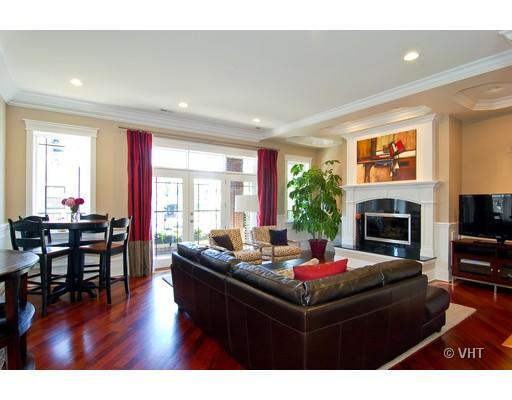
As someone who just tried and FAILED to sell my condo in Lakeview, I can tell you this:

Financing is very difficult. Our unit has 21% commercial ownership (first floor retail). As of February 2009, Fannie Mae will only buy loans with less than 20% commercial ownership. That means we have to find a buyer whose bank is willing to hold the loan, which immediately eliminates 75% of the loan market.

Even at rock bottom prices, buyers are picky. You're competing with inferior properties that are in foreclosure, but because of the inventory available, you don't have a choice but to offer at a comparable price.

Lastly, property taxes are high in those areas, and the city and state's looming financial problems are certainly not attracting many out of towners.

There are almost zero speculators in this market.


Here's a picture courtesy of Baird & Warner RE of our condo...

1640-W-Belmont-Unit-3-CHICAGO-IL-60657-1.jpg
 
^^^ Nice digs, what are you asking for it? Can you link to the listing or would that be creepily revealing your address?

It's off the market now. Rented it for $2400 a month. The asking was $500,000, 3 BR, 2 Ba, 2000 sq ft.

We had 6 offers on our place, all but one of them started below $450. We were under contract twice but bank financing fell through on both. After the second, we said screw it and decided to rent. We weren't desperate to sell anyway. We just didn't want the headache of being a landlord.
 
^^^ Well you'll probably make a good deal of money in the long run by not selling now. I imagine a place that would go under contract for $450k in this market is probably more like $600k in a few years.
 
^^^

I think it was the right decision. The market at this point is artificially depressed with all the foreclosures sitting out there. The people that are desperate to sell have come and gone in this market. We just need the economy to pick up so the inventory out there will drop...

That, and Fannie & Freddie need to stop shitting the bed. They were too lax on their underwriting for too long, but now they have over-corrected and further suppressing the market.
 
^^^ They still are too lax, my sister got pre-approved for an FHA loan of $150k with 3.5% down on $40k salary after only one year of work experience in which she changed jobs one time. Reckless lending by the government to fix a problem caused by reckless lending in private industry which was subsidized by the government, I love it! These people are idiots...
 
Chicago to Redevelop U.S. Steel Site on Lakefront


http://www.nytimes.com/2010/12/29/realestate/commercial/29chicago.html?_r=1&ref=business

A plan to redevelop the site of the long-closed U.S. Steel plant on the south lakefront here is ambitious even in a city whose attitude has long been Daniel Burnham’s maxim, “Make no little plans.” The about 470-acre South Works site juts into Lake Michigan and has dazzling views of downtown nine miles to the north. The master plan, by the architecture firm Skidmore, Owings & Merrill, calls for 13,575 market rate and affordable homes to serve 50,000 new residents, 17.5 million square feet of retail and commercial space, a high school and a marina with 1,500 slips, to be built in phases over the next 30 years. The estimated cost is $4 billion.

The project took a major step forward in September when the city awarded it a $98 million tax increment financing grant that will be used to build infrastructure for the development’s first phase. This followed a decision by the city last spring to approve the master plan. “The scale of the project is extraordinary,” said Chris Raguso, who recently left her position as acting commissioner of the city’s Department of Community Development to become Mayor Richard M. Daley’s chief of staff. “The fact that anybody in this economy still wants to take a shot at developing a site that is basically a landfill and is basing the development on retail and housing is also extraordinary.” Over three-quarters of the site is landfill in the form of slag, a byproduct of steel production.


chicago-1-articleLarge.jpg
 
Status
Not open for further replies.


Back
Top