
You are using an out of date browser. It may not display this or other websites correctly.
You should upgrade or use an alternative browser.
You should upgrade or use an alternative browser.
CHICAGO | General Developments
- Thread starter ChicagoBruce
- Start date
-
- Tags
- chicago
- Status
- Not open for further replies.

Busy Bee
Closeted Normie
Found this on Google. Couldn't find anything on Van Berkel's design, but it should be unveiled officially later this week.

Burnham Pavilion, Chicago
Zaha Hadid Architects participation in the Burnham Plan Centennial celebrations is a great opportunity to participate in Chicago’s ongoing tradition of bold plans and big dreams with an architectural design at the scale of a pavilion. Our design will echo Chicago’s cutting edge cultural and architectural landscape by introducing a new Zaha Hadid Pavilion Concept into Millennium Park.
The form of the pavilion is derived from the intersection of ellipsoids creating arching interior spaces that envelope the visitor flow. The structure is expressed via a series of diagonal sections that are in line with the historic axis of the unbuilt Plan of Chicago. These arching structural devices are erected along a gradient and therefore display areas of lesser density towards the centre of the pavilion in order to allow controlled daylight into the structure. The louvers in the ceiling underline the design intent of referring to the historic diagonal that cuts through the site and help to create a vivacious interior space that changes throughout the day according to sun angles and weather conditions. They appear like cuts in a canvas and cohere with the choice of material and construction method.
The pavilion is made from a light weight aluminium structure that is then “dressed” in a tensile fabric. As fabric behaves in specific ways, once tensile forces are applied, the resulting exterior skin undulates in anticlastic curvatures along the guiding rails of the aluminium substructure. The aluminium ribs are deliberately expressed through the external skin.
In the pavilions interior the materiality corresponds with its exterior. The continuity of material allows for a coherent overall look and feel. Since the pavilion will serve as a display for projections layers of fabric are integrated in its interior walls that allow for front and back as well as for double projections taking place throughout the day. Layering of fabric and of images create visual highlights and involve the visitor in a unique overall experience. The superimposition of visual materials and the visitor within the pavilion leads to the integration of the pavilion, the visitor and the display. The pavilion becomes the display and the visitor becomes part of the image.
Alien larva.
i_am_hydrogen
tilted & shifted
City plans $15.5B in downtown projects
March 31, 2009
BY DAVID ROEDER AND FRAN SPIELMAN
A draft of Chicago's plans for the city's central area through 2020 calls for $15.5 billion in public works, mostly for transportation improvements, and asserts the projects are attainable with or without the 2016 Olympics.
The projects include a West Loop transit hub beneath Clinton Street with an estimated price tag of almost $6 billion. The hub would connect Metra and CTA rail and bus lines with a proposed Carroll Street rail line, itself a $260 million item, near the north bank of the Chicago River.
» Click to enlarge image
http://www.suntimes.com/business/1503475,CST-NWS-action31.article

Nowhereman1280
New member
Another thing mentioned in the article:
The report will be discussed Thursday at an open meeting. It is scheduled for 6 p.m. at Erie Cafe, 536 W. Erie.
The report will be discussed Thursday at an open meeting. It is scheduled for 6 p.m. at Erie Cafe, 536 W. Erie.

lawfin
New member
^^^ I'm not saying the 13 billion is going to be profit from the games, I'm saying a large chunk of it will come from the Federal government (as has happened with every American city that has gotten the games) if we secure the bid. If you don't believe that we'll get billions in transit funding if we win the game then you are ignoring history.
Also, your assessment about the games doing "economic damage" to this city is just false. If you want to discredit other's opinions on Architecture because you are an architecture student, then I will simply discredit your opinions of Economics being a Economics and Finance major myself... I will say this, looking at past precedent and theoretical predictions, there is almost zero chance of the games having a net negative effect on the economy. I'm sorry but every single summer games that has come to the United States has been profitable, that is fact...
^^Just ignore him he routinely spouts out just plain kooky ideas that have little basis in reality other than what is going on between his ears
Via Chicago
Active member
Another thing mentioned in the article:
The report will be discussed Thursday at an open meeting. It is scheduled for 6 p.m. at Erie Cafe, 536 W. Erie.
Thats right by my office; i might actually go to this...
Via Chicago
Active member
these documents have nothing to do with the olympics.
So its just coincidence that almost all these documents have 2016 as projected completion dates?
So its just coincidence that almost all these documents have 2016 as projected completion dates?
no, its not, you don't plan these things in a bubble. the olympics are the obvious catalyst providing timeframes and focused federal/state/city funding, but that doesn't mean these are olympic related documents. Most of these plans have been in city pipelines for years (ie the monroe/east-west transitway has been on the drawing board for 50 years; in fact I can't find a single thing in the document which is solely olympics based) and are needed regardless of the olympics for city development over the long term. its bad logic to use these numbers against the olympic bid when they're long range city planning documents, that's how most people spin the costs of olympics as "out of control", a city speeds up its natural capital improvement programs/wishlists to coincide with the olympics and people turn that into olympic spending; these are different things.
Thats right by my office; i might actually go to this...
If you can make it and there's a chance to speak up - could you mention the St. Charles Air Line Greenway, specifically why it's mentioned in some places but obviously omitted elsewhere? Notice how item #2 is omitted in the text but present on the map, and located exactly where the SCAL is.

I'd be pretty happy if it's omitted because it's not going to happen. The SCAL should either be used for transit or for HSR. Chances are it was left out by mistake, but perhaps there was a last-minute revision as planners came to their senses and realized that, once this incredibly valuable right of way has been promised for a trail, there's no turning back.
So its just coincidence that almost all these documents have 2016 as projected completion dates?
Riiiggghht...and Chicago would do absolutely NONE of this if it didn't get the Olympics?
Listen, we get it. You don't trust city hall and you think that the Olympics will be a financial disaster the city will never recover from. Message received.
Now how about listening to this rational voice of reason: Chicago will invest in large infrastructure projects and will probably be OK regardless of whether it gets the Olympics. I'm not going to sit here and say the Olympic will be a complete financial success and mayor Daley always has our best interests at heart. That would be a naive and one-sided view. But it is no less silly than shouting from the rooftop that this WILL FAIL without proof, knowledge or the even the ability to know.
Face it: your proclamations are without basis in fact. They are based entirely on your perceptions of the Olympics, the mayor and our local government. Please try to broaden your perspective, see other points of view and not drag this board down with your bleating on these topics.
Okay, so where is the non-Olympics-related source of money for all this?
where all infrastructure money is, city state and federal capital programs, what is so hard to understand about this. these projects will be funded the same way with or without the olympics, olympic money does not go to these things, the olympics is the carrot you use to out-compete other cities in these funding programs (or earmarks, whatever). its a catalyst for actually winning the money to get these things done. typically these long range planning documents achieve nothing of what they set out to do, because the ambition is far greater than ability to find funding mechanisms,
for example, the east-west/lakefront transitway is literally the central area circulator repackaged from the 1968 cta plan.
Last edited:

VivaLFuego
New member
typically these long range planning documents achieve nothing of what they set out to do, because the ambition is far greater than ability to find funding mechanisms,
The 20-year CTA strategic plan from 1980 (I think) amusingly has:
- Extension to O'Hare
- Easing of operational bottlenecks
- Extensions to the Skokie Swift and Dan Ryan Lines
- A circumferential line
I would argue that such documents are often, in fact, successful, on condition that (1) the targeted projects don't frequently change with whimsy and (2) the chosen projects are at minimum plausible from the perspective of cost and politics.
The reality of modern government and regulation is that a few decades is indeed the time horizon these things occur on. The more ambitious, expensive, and politically-complicated (Second Avenue Subway), the longer. Heck, the O'Hare extension only got built as early/quickly as it did with money redirected from the failed Crosstown Expressway, if memory serves. If strategic planning is done sensibly, persistently, and consistently, it does pay dividends.
I would argue that such documents are often, in fact, successful, on condition that (1) the targeted projects don't frequently change with whimsy and (2) the chosen projects are at minimum plausible from the perspective of cost and politics.
I think it depends on how you are defining success. if the success is accomplishing the stated goals of the document I'd disagree, they rarely get accomplished according the time frames of the documents which isn't the fault of the document producers but as you've stated, political realities which don't necessarily enter in at the conceptual planning phase. If you define success as eventually getting built, then there really is no failure because eventually everything could get built. if the need of an east-west route through the loop that connects navy pier and mccormick place exists in 1968 then it likely isn't going to disappear in 2008 and the plan will stay on the drawing board. that's my hope for the olympics in that the event can muster the political will at the state and federal level to actually push through the eventual roadblocks.




ardecila
TL;DR
what a terrible waste of money. :yuck:
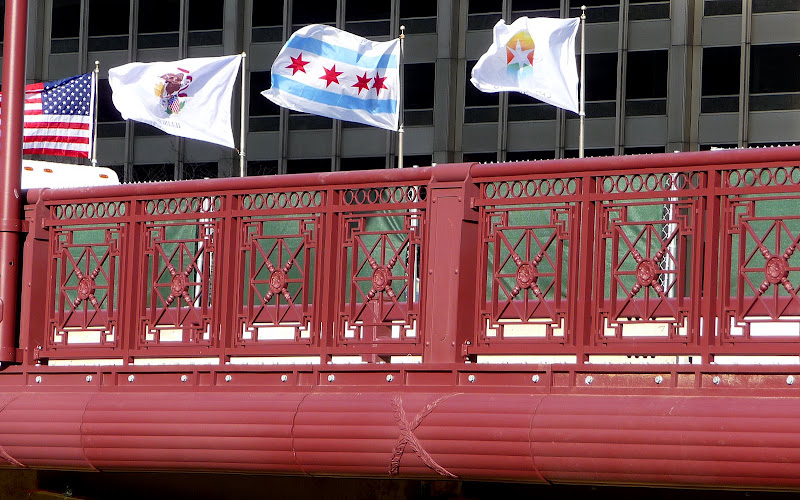
It's a Beaux-Arts bridge. What do you want? It was renovated sometime in the 60s and we got the very simple railing and slab edge. Very Miesian. Now it's being restored to something close to the original.
In fact, I actually think this is rather tastefully done, way better than the stuff that LaGrange puts out. Of course, it's not really a modern imitation of a historic style... it's actually the original design that Edward Bennett made back in the 1920s, with a few minor modifications to meet building code. Compare it to this 1955 photo.

Corbis
Loopy, I'm a little hesitant about the fasces decoration. It could look tacky... the scale doesn't seem right. I want to see it on a large scale.
- Status
- Not open for further replies.