Thats a beauty, but traffic is atrocious on Howell Mill.
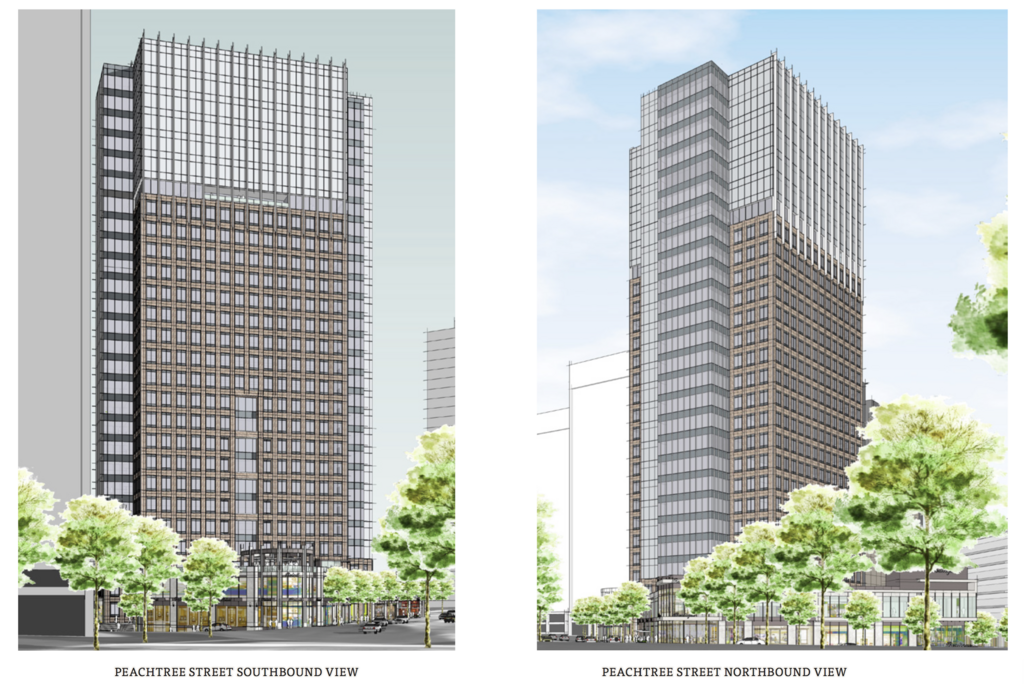
I believe that is the Related tower in Buckhead.

Thats a beauty, but traffic is atrocious on Howell Mill.

Land Development Permit filed today for this development in Buckhead by Related Group
Also a land development permit has been filed for 1034 Howell Mill Road for a mixed use development in the old Atlanta Builders Supply location.
I'm of the opinion that all new buildings in the Midtown submarket should at least have one retail streetfront. At least, especially for the projected densities that Midtown will eventually have.
That was the plan in 2008 but that plan is constantly being updated as realities change. In my opinion it is more important to demonstrate to developers/architects how to do the street level whether it has retail or not. Much of the new stuff in Midtown that does have retail is cold, bland and out of scale. You mentioned earlier that Atlantic Station was too cheesy, yet it is one of the few places in the city that is human-scaled and inviting at the street level.

Is this going on peachtree road where that church is?

They are digging deep at the corner of Glen Iris and Ralph McGill.
One other thing I noticed. During the building cycle that wrapped up in 2009, all the hi rises around town were wrapped in that yellow GP siding. This time around, I am seeing a lot of that green USG siding going up. Did something change in the siding market?

One other thing I noticed. During the building cycle that wrapped up in 2009, all the hi rises around town were wrapped in that yellow GP siding. This time around, I am seeing a lot of that green USG siding going up. Did something change in the siding market?



While on the topic of the mid 2000s building boom versus the current one, another thing I've noticed and wondered about is the burying of power lines in Midtown. The buildings from the prior cycle (Metropolis, Spire, Plaza Midtown, 1010 Midtown, 1065 Peachtree, etc.) all buried their power lines during construction. Alternatively, all the new Midtown buildings in this current cycle (both Skyhouses, 77th 12th, 131 Ponce, University House, etc.) have all opted not to bury their power lines.
The question(s) I have are - was the burying of power lines previously mandatory in Midtown and this requirement was removed during the recession or did all of the developers during the prior cycle do this voluntarily? If it was once a requirement that has since been removed, how do we get that requirement added back to the zoning and/or development codes? Alternatively, if burying power lines was and is still mandatory, are developers using zoning variances to get around this requirement?
No, it has NEVER been mandatory. Doing so would be unconstituntional because the developer doesn't actually own the lines - they are owned by third party utilities.
And while off topic and before all my posts get deleted, does anyone know how the City determines which parcels/projects in Midtown require pedestrian lights? This question comes to mind because along North Avenue, Ivy Hall Apartments, built in the mid 2000s, installed pedestrian lights along North, but 131 Ponce, built in 2014, did not install pedestrian lights along North. 131 Ponce and Ivy Hall are directly adjacent to each other, so it just seems odd that one has the pedestrian lights and the other does not.

While on the topic of the mid 2000s building boom versus the current one, another thing I've noticed and wondered about is the burying of power lines in Midtown. The buildings from the prior cycle (Metropolis, Spire, Plaza Midtown, 1010 Midtown, 1065 Peachtree, etc.) all buried their power lines during construction. Alternatively, all the new Midtown buildings in this current cycle (both Skyhouses, 77th 12th, 131 Ponce, University House, etc.) have all opted not to bury their power lines.
The question(s) I have are - was the burying of power lines previously mandatory in Midtown and this requirement was removed during the recession or did all of the developers during the prior cycle do this voluntarily? If it was once a requirement that has since been removed, how do we get that requirement added back to the zoning and/or development codes? Alternatively, if burying power lines was and is still mandatory, are developers using zoning variances to get around this requirement?
All those developments except Plaza Midtown are located on Peachtree in Midtown, thus on the Midtown Mile. That vision included streetscape improvements. Which usually includes burying power lines. But the newer developments aren't on Peachtree. So maybe that has something to do with it.
http://www.bizjournals.com/atlanta/real_talk/2016/03/dewberry-to-add-retail-office-to-midtowns.html
New renders of Dew-nothings Campanile expansion plans:

