
-
City-versus-city activity is flat-out banned from being posted here in all its forms.
City vs city trolling sets up a rather nasty and personal fight between forumers from one place and forumers from another place, potentially affecting hundreds of members any time it breaks out. Nothing good comes of versus-trolling, but long after the insults and mockery have been removed, bad feelings between individuals and between groups tend to linger, oftentimes popping up in unrelated threads for months afterwards.
Thus, when it comes to 'versus' trolling, a line must be drawn--sharply. Anyone who crosses that line shall be disciplined, up to and including suspension and even summary banishment without warning. Forum moderation and administration shall be the arbiter of what constitutes versus-trolling, so if you think your post might be perceived as an unfair attack on an entire city that will upset residents there, tread lightly or reconsider how you intend to express your opinion. No forumer shall successfully claim ignorance of our policy against versus trolling, and no forumer should believe he can get away with it.
The ban on versus activity applies to all posts and all threads, even ones that are not initially set up as city-versus-city.
If you see any troublesome posts please report them using the "report a post" icon -in the upper right corner of every post on the forum.
You are using an out of date browser. It may not display this or other websites correctly.
You should upgrade or use an alternative browser.
You should upgrade or use an alternative browser.
Amazon HQ2 thread
- Thread starter CypressClinton
- Start date
- Status
- Not open for further replies.


James Bond Agent 007
MI6 Agent
As long as it doesn't go to one of the usual Sunbelt or Western US candidates I'll be happy. If Dallas gets it I think I'll puke.
James Bond Agent 007
MI6 Agent
Why else would they not want to continue expanding in Seattle?I dont really buy that as a reason. At all. The company has more than enough cash to build as much as they want in Seattle and environs if they really wanted to.
They *have* said traffic is a concern ... which would also be a strike against places like NYC.The company itself hasnt stated that lower cost of living is a criteria, that's speculation by the media.
Perhaps ... but if, as you just said, they've got tons of cash, why would they be concerned about that? If they've got enough cash to pay huge salaries in a place like NYC then surely local tax rates aren't going to be a concern.I do think this open call for bids is more to elicit huge tax breaks.

The North One
Active member
Yeah, I'd be more than happy if Chicago, Pittsburgh, St. Louis, Columbus or Milwaukee got it.
It seems like nobody is really mentioning Minneapolis.
It seems like nobody is really mentioning Minneapolis.
James Bond Agent 007
MI6 Agent
Good point about Minneapolis.
Do they have any spots capable of squeezing in about 8 million sq ft?
Do they have any spots capable of squeezing in about 8 million sq ft?

emathias
Adoptive Chicagoan
Good point about Minneapolis.
Do they have any spots capable of squeezing in about 8 million sq ft?
They're a midwestern city - they can find the space.
I think Minneapolis is of a size where the problems that exist in Seattle would become the same in Minneapolis rapidly. And I think that Minneapolis is just too much like an inland Seattle, culturally. I think part of this is that Amazon wants a place with a complimentary but different culture to give employees more a choice of where to locate. That's reading between the lines, I know, but I think it's probably part of their thought process.
I'm sure part of the thought process, too, is, if we pick city X over city Y, how many people in Y would relocate to X? How many people are choosing to relocate to Minneapolis versus them just doing a good job of keeping locals around and drawing from the upper plains states?

5. Logistics. Amazon is first and foremost a master of logistics, so it should come as no surprise that the company cares a lot about transportation. Amazon wants on-site access to mass transit—train, subway, or bus—and to be no more than one or two miles from major highways and connecting roads. It wants to be within 45 minutes of an international airport with daily direct flights to Seattle, New York, the San Francisco Bay area, and Washington DC. The company is also asking applicants to identify “all transit options, including bike lanes and pedestrian access” for the proposed site and to rank traffic congestion during peak commuting hours.
This is a HUGE part of the RFP... especially the bolded section. I would say this rules out Bay Area, DC and NYC as HQ2 considerations if they're looking for cities with flights TO these places. With these requirements in place, I would say the top 5 considerations are going to be:
Chicago, Philadelphia, Boston, Atlanta and Dallas/Fort Worth in no specific order. For Canada, Toronto and Montreal.
Honorable mentions but will likely not get the HQ2 will be Pittsburgh, Miami, Nashville, Baltimore, Atlanta, Memphis, Austin, Houston, Charlotte, Detroit, Minneapolis, etc. All of these cities don't offer everything Amazon is seeking. I'm also unsure if they would be able to handle the infrastructure required to accommodate adding 8 million square feet of office space, and 50,000 employees in 9 short years.

softee
Aimless Wanderer
Toronto's real estate is expensive, but it's salaries are not. They are 30-40% lower than Seattle salaries, more if you account for the exchange rate. Between salaries, taxes, and insurance, I think it would would be relatively low cost.
The big problem I see for Toronto is that it is not in the US. Labour mobility will be a big pain to deal with.
In terms of sites, there is a 10 million square foot office campus already under development just east of downtown. It will feature a subway stop in a few years as well as a commuter rail station and streetcar line. Easy access to the highway network (albeit congested ones), to both a downtown airport and a large international airport, etc. etc., etc.

And in the short term, the 32 storey office tower 16 York is already being constructed on spec, Amazon could lease it and move in within a couple of years. The Nearby 48 storey Union centre and 46 storey 160 Front office towers are approved for construction and waiting for a big tenant to get them underway. The Well office Tower is also nearby and in site prep. That's four major office towers all within easy walking distance of Union Station in the heart of the CBD.
I think Boston will be a sneaky top contender here. Bezos is motivated by politics a lot more than other tech barons, and I think this takes red states out of the equation. Texas, North Carolina, and Georgia will hurt Austin's, the Research Triangle's, and Atlanta's chances.
Transit will also be a big part of the selection equation, which again hurts the above three.
Then there's the graduate talent pool Boston has, which gives it an advantage over Philly and Chicago.
Massachusetts will go all out in its tax break offers; winning the GE competition has just fueled Beacon Hill's desire to land new economy relocations even more.
The cost of living will hurt, though. Pittsburgh seems like a good alternative.

goat314
New member
I expect we'll see proposals from every metro area above one million people going forward.
Here's what St. Louis has had to say.
http://www.stltoday.com/business/lo...cle_c9f6d958-1ac2-5678-82fd-2c3fcb4332b2.html
Metro St. Louis is already fucking up though because St. Clair County, IL plans on submitting its own proposal separate from St. Louis City and County's. Madison County, IL plans on working with the City/County's bid.
I'd die if they picked St. Louis, and I know officials there would give them half the city if it meant they could land Amazon, but my money is on Chicago. Rahm is a barracuda.
St. Louis (and Pittsburgh) may be one of the few mid-sized metros that can meet the qualifications though. We have plenty of develoble land near mass transit, right next to highways, and a short ride from an airport, great universities, new NGA West HQ being built just North of downtown, an innovation district in Cortex that has been cited as a model for other cities, etc.. Amazon in St. Louis would be completely transformational on a regional scale that it wouldn't be in many superstar cities. I'm actually rooting for an underdog city like St. Louis, Pittsburgh, or Detroit, but I'm positive it goes to either Denver, Dallas, or Atlanta, possibly Chicago.

Pedestrian
New member
You know Amazon is really an modern new old school catalog company like The Big ones of old . . . .
Funny thing is that these stoic companies refused to envision the future and now all of the " catalog shipping companies not on line are pretty much dead."
Its weird they couldn't buy out the Amazons of the world in the early days nor have the foresight to do so.
Many years ago Sears owned and occupied the Sears Tower in Chicago. The tallest floor building in North America since it was completed in the 70's.
This is not a new thought. The investment community has been having this argument for years: Whether to value Amazon as a technology company or as a retailer. Everybody more or less recognizes its a retailer but with access to the capital markets normally accessible only to tech so that it could keep taking market share from traditional competitors by underpricing them and foregoing profits.
In the early days (the 1990s) when Amazon essentially was a book seller, nobody really needed to buy them out. Competing with them de novo would have been easy for the Borders and Barnes & Nobles of the world if they'd been good at it. There were no real barriers to entry except the skills of Jeff Bezos. But the others didn't have those and so the competitive efforts they made, and both Border's and B&N made efforts, were unsuccessful. For one thing, they were trying to make money and Bezos really wasn't--he was trying to grow a gargantuan company even if it lost money. For another, they saw themselves as book sellers ONLY whereas Bezos saw selling books as only the starting point.
Even today Amazon is shockingly unprofitable:
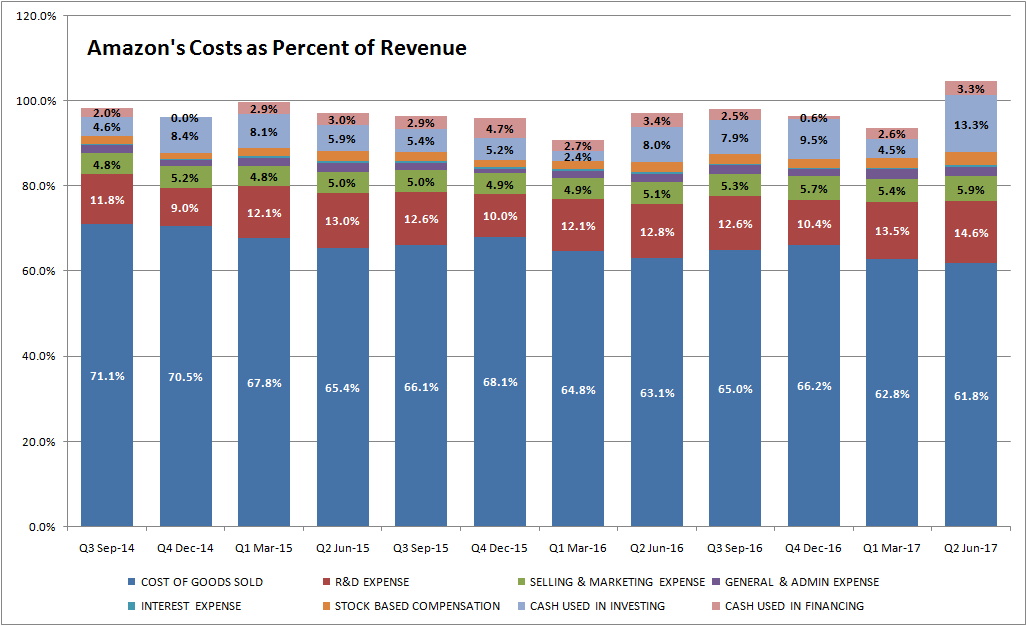
https://seekingalpha.com/article/4092076-amazon-missed-q2s-earnings-estimate-mile
But its leadership and its investors love it because of its potential and the assumption that any time it gets tired of wiping out competitors by losing money they can't afford to lose, it can instantly become as shockingly profitable as it now is unprofitable.

Pedestrian
New member
No one has mentioned Mexico City.
Or more likely Monterey.
the urban politician
The City
Then there's the graduate talent pool Boston has, which gives it an advantage over Philly and Chicago.
Huh? Yes, Chicago doesn't quite have Harvard or MIT (although U of C is top notch and Northwestern has always been highly ranked), but Chicago has lots of universities and the whole damn Big Ten goes here when they graduate.
Amazon not only needs talent but it needs volume. It doesn't need 50,000 Harvard grads. The best and the brightest at Harvard or MIT go to Wall St or Silicon Valley anyway.
Yes, a bit of hometown boosterism here, but the sheer volume of grads Chicago can tap from such a large hinterland, many of who are capable of achieving what Amazon needs but not necessarily being the "best of the best", is exactly one of its biggest advantages.
This is not a new thought. The investment community has been having this argument for years: Whether to value Amazon as a technology company or as a retailer. Everybody more or less recognizes its a retailer but with access to the capital markets normally accessible only to tech so that it could keep taking market share from traditional competitors by underpricing them and foregoing profits.
In the early days (the 1990s) when Amazon essentially was a book seller, nobody really needed to buy them out. Competing with them de novo would have been easy for the Borders and Barnes & Nobles of the world if they'd been good at it. There were no real barriers to entry except the skills of Jeff Bezos. But the others didn't have those and so the competitive efforts they made, and both Border's and B&N made efforts, were unsuccessful. For one thing, they were trying to make money and Bezos really wasn't--he was trying to grow a gargantuan company even if it lost money. For another, they saw themselves as book sellers ONLY whereas Bezos saw selling books as only the starting point.
Even today Amazon is shockingly unprofitable:
https://seekingalpha.com/article/4092076-amazon-missed-q2s-earnings-estimate-mile
But its leadership and its investors love it because of its potential and the assumption that any time it gets tired of wiping out competitors by losing money they can't afford to lose, it can instantly become as shockingly profitable as it now is unprofitable.
Amazon is shockingly unprofitable (or barely profitable) because they choose to be. They have prioritized innovation and growth over profits. When a company decides to rest on their laurels and maximize profits at the expense of innovation and growth is when it's time to short their stock. That 13.2% "Cash Used In Investing" didn't have to happen if they didn't want to. They could be extremely profitable by basically tomorrow if they wanted to cut off their nose to spite their face. The company I work for (Spotify) is basically in the same boat, albeit a much smaller one.

nature's calling
New member
An opinion piece but still

http://www.marketwatch.com/story/he...ia-for-amazons-second-headquarters-2017-09-07
http://www.marketwatch.com/story/he...ia-for-amazons-second-headquarters-2017-09-07
An opinion piece but still
http://www.marketwatch.com/story/he...ia-for-amazons-second-headquarters-2017-09-07
No Philadelphia? No Chicago? Literally not a single midwest city? Not even a Dallas or Houston? What a joke of an opinion piece.


LOL, I'm fairly certain that if Bezos and Emmanuel have had multiple discussions about this and then Amazon goes and announces a selection process, Chicago is not in the running.
I think it will be a site east of the Mississippi River (I guess St. Louis can also be included). There are a lot of people that just don't want to live on the west coast. I have a friend with very specialized skills that Amazon tried to hire away. They ended up offering to double her already quite substantial salary and she wouldn't move away from her extended family. I recently had a conversation with an Amazon recruiter and told them that I would be willing to work at their Detroit office. But no, all the teams that did what they wanted me to do were all in Seattle. I have some family out there and like the city plenty, but I just don't want to live there. Oh well.
I think Pittsburgh, Philadelphia, Detroit, Columbus and Dallas are the most likely locations.
- Status
- Not open for further replies.