• City-versus-city activity is flat-out banned from being posted here in all its forms.

    City vs city trolling sets up a rather nasty and personal fight between forumers from one place and forumers from another place, potentially affecting hundreds of members any time it breaks out. Nothing good comes of versus-trolling, but long after the insults and mockery have been removed, bad feelings between individuals and between groups tend to linger, oftentimes popping up in unrelated threads for months afterwards.

    Thus, when it comes to 'versus' trolling, a line must be drawn--sharply. Anyone who crosses that line shall be disciplined, up to and including suspension and even summary banishment without warning. Forum moderation and administration shall be the arbiter of what constitutes versus-trolling, so if you think your post might be perceived as an unfair attack on an entire city that will upset residents there, tread lightly or reconsider how you intend to express your opinion. No forumer shall successfully claim ignorance of our policy against versus trolling, and no forumer should believe he can get away with it.

    The ban on versus activity applies to all posts and all threads, even ones that are not initially set up as city-versus-city.

    If you see any troublesome posts please report them using the "report a post" icon -
    report.gif
    in the upper right corner of every post on the forum.

Amazon HQ2 thread


Status
Not open for further replies.
I would believe that yes, Seattle is the #2 tech region after the Bay Area (Silicon Valley+San Francisco+Oakland).

I would also argue that L.A. is closer to #3 in that conversation than people who automatically claim that N.Y., Boston or D.C. is might think. Between Facebook & Google in Playa Vista, Snapchat in Venice, and all the other startups sprouting up in Culver City, Santa Monica, Pasadena, etc., Greater L.A.'s tech influence is undoubtedly booming.

LA could make that claim, but not because of Snapchat which is becoming to LA what Foursquare became to NYC. But solely due to SpaceX, which could actually “change the world” without overstating that line tech companies always do.
 
Surely some kudos also needs to be given to IBM (founded 1911), i think they also had an early presence in Dayton, OH.

Yeah I have heard that but I don't know the whole story. There is still some hi-tech stuff (although not "tech") in Dayton because of the Wright-Patterson AFB.

Also, Amazon is building the Prime Air hub at CVG, Cincinnati's airport (which is actually in Kentucky). About 100 Amazon cargo planes are going to be based there, in addition to the 28~ DHL planes that are there, so CVG is going to become one of the top 10 cargo airports in the world.

How did this happen? By chance.

Delta had its #2 hub in Cincinnati until 2005 when it bought Northwest and combined the Cincinnati hub with Northwest's Detroit hub. That same year, a third north-south runway was completed. So the anticipated passenger growth never arrived and the airport turned into a ghost town.

That huge unused runway capacity is what motivated DHL to move there, and then Amazon.


>SpaceX


There are like 20 other companies doing what SpaceX does, they just don't have a hype man with a twitter account.
 
The only time things get done in this country is when it's crisis levels. With Amazon and the overburdening on existing infrastructure the follows, so will the improvements to the subway, water taxis, roads, ramps to the bridges and tunnels, etc...

You'll be holding your breath forever if the America did the responsible thing and upgrade infrastructure first before new development. It simply doesn't happen that way. The priority is solving the immediate crisis.

Very true it seems.....:(:uhh:
 
The only time things get done in this country is when it's crisis levels. With Amazon and the overburdening on existing infrastructure the follows, so will the improvements to the subway, water taxis, roads, ramps to the bridges and tunnels, etc...

You'll be holding your breath forever if the America did the responsible thing and upgrade infrastructure first before new development. It simply doesn't happen that way. The priority is solving the immediate crisis.

There are some important examples where this wasn't true. Two that come immediately to mind are the interstate highway system, which took decades after it was built to approach its capacity to move vehicles, and the fiber data network which was built out in the 1990s and still isn't fully utilized.

It takes (a) visionary leadership like Pres. Eisenhower had in the 1950s and/or (b) a financial incentive such as the '90s tech boom seemed to offer.

Today we are having, or are about to have, a competition in the US to build out 5G networks and it will happen because T-Mobile, ATT and Verizon all want to capture as much of the business as possible.

And finally, here's some interesting charts showing something you may not be aware of:

43967339730_ae38f44b62_b.jpg


43967338410_93b5a57251_b.jpg

Source both: https://blogs.wsj.com/dailyshot/201...8B-1314&mod=searchresults&page=2&pos=14&dsk=y
 
I'm wowed by those charts! Very interesting trends.

The Interstate System was visionary but a little different in terms of public infrastructure investment when we're talking about subways and sewer systems... Wasn't there a strategic military argument for the creation of the Interstate? Followed by the economic development argument?

As for fiber optic networks, I assume this was not a direct result of government subsides but instead private companies responding to market demand and the potential for profit... kind of like how the old streetcar networks were built (but maybe that's not the best example).

On Econ Development, the Hudson Bergen Light Rail across the river originally had an alignment down Kennedy Blvd, the backbone of Hudson County, which would have served the most people. However, the final alignment was moved to the waterfront in hopes it would spur economic development, which it did. There has been few improvements for the thousands of people that would have benefited from the old light rail alignment. Only now is there talk of a BRT along Kennedy Blvd and increasing PATH service to the city at the main junction of Journal Square, but that's only because things are nearing crisis levels with overcrowding. If there was no crisis, I doubt there would have been any discussion on improvements and all funds would go towards other areas of the county with the most potential for continued Econ development.

Just some thoughts, I don't disagree with what you said Pedestrian. Just approaching it from a different angle.
 
The Interstate system had nothing whatsoever to do with the military. It was simply a way to package a federal bill written by the automobile and oil industries. Recruiters use the interstates to drive to their strip mall offices, but otherwise, it serves no military purpose. Military equipment continues to be transported by the railroads that were built 100 years before the highways.

https://www.youtube.com/watch?v=HNJc_GU1wE4

https://en.wikipedia.org/wiki/Pershing_Map
 
There are some important examples where this wasn't true. Two that come immediately to mind are the interstate highway system, which took decades after it was built to approach its capacity to move vehicles, and the fiber data network which was built out in the 1990s and still isn't fully utilized.

It takes (a) visionary leadership like Pres. Eisenhower had in the 1950s and/or (b) a financial incentive such as the '90s tech boom seemed to offer.

Today we are having, or are about to have, a competition in the US to build out 5G networks and it will happen because T-Mobile, ATT and Verizon all want to capture as much of the business as possible.

And finally, here's some interesting charts showing something you may not be aware of:

43967339730_ae38f44b62_b.jpg


43967338410_93b5a57251_b.jpg

Source both: https://blogs.wsj.com/dailyshot/201...8B-1314&mod=searchresults&page=2&pos=14&dsk=y

Municipalities have been voting and passing a record number or near record bond measures. Not sure how much of a trend this or if it’s more a play catching up since this is a relatively short time frame.

Interesting nevertheless.
 
Last edited:
The Interstate system had nothing whatsoever to do with the military. It was simply a way to package a federal bill written by the automobile and oil industries. Recruiters use the interstates to drive to their strip mall offices, but otherwise, it serves no military purpose. Military equipment continues to be transported by the railroads that were built 100 years before the highways.

https://www.youtube.com/watch?v=HNJc_GU1wE4


Strategic Highways

During World War I, the Army quickly found that U.S. railroads could not serve its logistical needs and turned to truck convoys. Civilian motorists soon found that the convoy routes offered such unheard-of amenities as regular maintenance, snow plowing, and route markers.

d784ab22872f5cdb6c543e1684635e1effdc8b8e


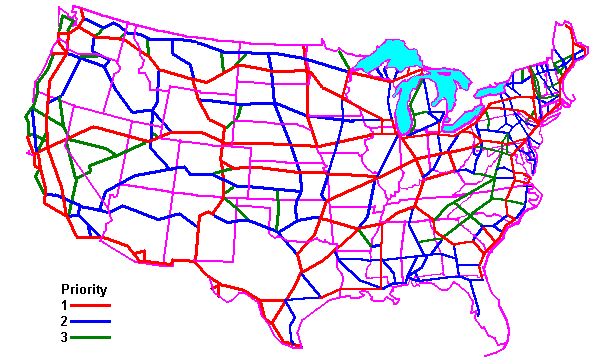
Shortly after the war, General Pershing proposed a national network of military and civilian highways. He ranked his routes by priority, shown here in red for highest priority, green for second and blue for third. The differences between this map and today's Interstate system are as interesting as the similarities. They reflect:

Military priorities: these were the days of Pancho Villa, who had raided into the U.S. in 1912; hence access to the Mexican border was a high priority. Note that there is no north-south link in Arizona. There is no link to Phoenix and Tucson is linked almost as an afterthought.

In an era before air power, attacks on the U.S. would come by sea if at all, so coastal routes are emphasized.

Technology: there is no Mackinac Bridge joining upper and lower Michigan on Pershing's map because the ability to build such a bridge was wholly beyond the technology of the day. Since Michigan consisted of two disconnected peninsulas with no easy surface connection, Michigan routes were of low priority.

Demographics: nobody at this time was very interested in traveling to Miami. Miami was little more than a village, and the only port of consequence on the Florida peninsula was Tampa. Defending southern Florida was of low priority because even if an enemy did land there, there were no roads suitable for moving an invasion force.

Economic Geology: access to coal fields is critical on Pershing's map, but not the oil fields of Oklahoma or west Texas, which had not yet been developed. Also there are numerous spurs to the iron ports on Lake Superior.

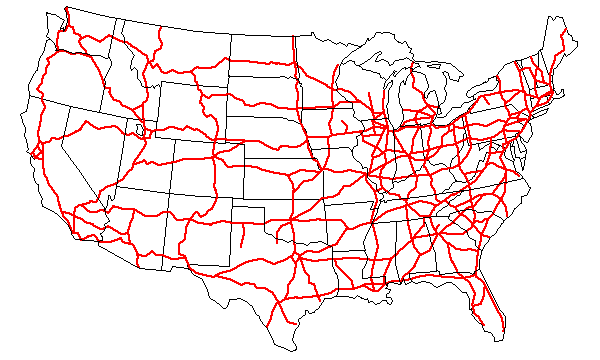
In 1919, the Army drove the first truck convoy across the United States, just to see if it could be done. It could, but only barely. The trip took several weeks. One of the participants was a young lieutenant named Dwight Eisenhower. Years later, as President, he signed the act creating the Interstate Highway System, officially called the Interstate and Defense Highway System. It looks very much like the network Pershing proposed. The fact that the system is the Interstate Defense Highway System accounts for the anomaly that Hawaii has Interstate highways: they connect all the major defense installations.
72a03147ae38adb2dd11c0ce1ae71b85558cc6bb


The first superhighways were in the U.S., and they in turn inspired the German Autobahn system, which mightily impressed the U.S. military during World War II. There had actually been plans for an American version in the 1930's, but World War II interrupted the plans. After the war, inspired in part by the Autobahns, Americans began building superhighways. So in reality, American and German superhighways inspired each other.

The U.S. love affair with the auto, with all its social and environmental impacts, would probably have happened anyway, but its actual development was strongly influenced by military considerations. It is all but impossible to overstate the environmental impact of the Interstate System. It is the largest engineering project in history.

http://www.uwgb.edu/dutchs/EnvirGeolNotes/Military.HTM
 
Municipalities have been voting and passing a record number or near record bond measures. Not sure how much of a trend this or if it’s more a play catching up since this is a relatively short time frame.

Now that interest rates are coming off zero. I wonder what that will do to bonding and debt service...
 
I wouldn't go that far. Clearly Stanford + heavily regionalized Cold War defense spending + NASA (originating in SV) + liberalized immigration rules favorable to Asian-heavy metros played major roles. H-P is an old company, long before anyone heard of SV.

Yes, there was some degree of luck, but I'm not sure if SV could have been anywhere else. Perhaps Southern CA or Central NJ (both had heavy postwar govt. spending in tandem with major science-oriented research universities feeding innovation cycles).

Also ironically, the federal govt has been joined at the hip with UC Berkeley for decades due to research and development and even today, SF is the only major US city with nuclear weapons within it's metro borders, at Livermore.
 
More propaganda. The USSR had a massive military and didn't build a highway network to move it. They moved it by rail, as we do.

There's no one reason for the creation of the interstate system.

This is a very fractious country. We never have big changes unless the interests of several powerful groups come into alignment.

Did we build the interstates because of oil and auto companies? yes
Did we build the interstates because of military planning? also yes
Did the interstates satisfy the general public's demand for wider and faster roads to escape congested city streets? also yes
Did the interstates enable homebuilders to colonize vast swaths of the countryside with new homes and shopping centers? also yes

Perfect storm, really, which helps explain why the transformation of American cityscapes was so sudden, drastic and universal. Nobody except Jane Jacobs ("cataclysmic money") or Lewis Mumford was really against the interstates in principle, and even those two were kinda late to the game with those opinions after seeing the first round of highway-building in the late 40s/early 50s. Other countries may have enthusiastically adopted cars, but they didn't have big auto manufacturers, or they didn't have big oil companies, or they had a lot of housing production in the public sector and weren't relying on private builders, or they didn't see a need to move war materiel thousands of miles - so they did not suburbanize as completely and did not destroy their inner cities so totally.
 
Miami still has hope. Well... at least their trying.


================

Miami’s Chances Of Landing Amazon Improved After HQ2 Split, Worldcenter Developer Says

Amazon has decided not to award any single city HQ2 and will instead split it, according to multiple reports.

The last-minute change is good news for Miami, according to the developer of Miami Worldcenter.

“Accommodating half the people makes it exponentially easier,” Miami Worldcenter Managing Principal Nitin Motwani told the WSJ.

Miami’s odds of landing Amazon are now better “given we don’t have industry and infrastructure on the scale they are talking about, but we have an incredible place to live,” Motwani added.

On Monday, Mayor Carlos Gimenez said that Miami was still in talks with the company, despite reports that a deal was near elsewhere.

The New York Times reported on Monday that sources in both Long Island City in New York and Crystal City in Arlington, Virginia say they are close to finalizing deals with Amazon. Sources in Miami are bound by non-disclosure agreements which prevent any information on negotiations from being disclosed.

Negotiations are also still under way with other finalists, in addition to late stage negotiations that are taking place with Long Island City and Crystal City, according to the FT. A final decision has not been made, the paper said.
===================
NXT
 
I'm not totally sold on long island, seems like it was leaked to get Austin to cough up some incentives, especially since that times article highlighted NY's state incentives and how Cuomo was so desperate to do anything. Plus why the fuck do they need two east coast HQs?
 
I'm not totally sold on long island, seems like it was leaked to get Austin to cough up some incentives, especially since that times article highlighted NY's state incentives and how Cuomo was so desperate to do anything. Plus why the fuck do they need two east coast HQs?

NY is the commercial capital of America and arguably, of the world. That's part of LIC's allure.
 
NY is the commercial capital of America and arguably, of the world. That's part of LIC's allure.

Yeah, I mean this NY boasting crap is irrelevant, companies choose places based on what makes sense. The whole world has no desire to cram into NYC, sorry.

And if the goal was a city that had an alternative appeal to Seattle where they had plenty of room to grow (a side plus that Texas is business friendly and Whole Foods is already there), then Austin was it.

As usual, there's a lot of NY-envy. Very few are complaining about the DC choice, but everyone who feels encumbered by being in NY's shadows are boisterous about LIC to say the least.
 
I'm not totally sold on long island, seems like it was leaked to get Austin to cough up some incentives, especially since that times article highlighted NY's state incentives and how Cuomo was so desperate to do anything. Plus why the fuck do they need two east coast HQs?

LIC + Austin would make sense on every applicable level, including (but not limited to) geographic strategy/logistics, regional appeal/city desirability, educated/diverse workforce, etc.

Crystal City makes no sense aside from Bezos living nearby in D.C. and owning the local newspaper (i.e., not good enough reasons to locate a company somewhere).
 
Status
Not open for further replies.


Back
Top