Quote:
Originally Posted by Johnland

I just came to Pittsburgh Wed for a week's visit. One thing that struck me was how empty the airport is .. I came in an A gate and it was the only one in operation in the whole concourse. Just dead.
|
Long article, but a lot of good stuff. Summarized it below.
Pittsburgh International Airport's midfield terminal at 20: A shell of its past self
Yet some see a new and solid future for Pittsburgh International
http://www.post-gazette.com/stories/news...l-of-its-past-self-655513/#ixzz27zQPz5Mx
By Mark Belko / Pittsburgh Post-Gazette
September 30, 2012 12:21 am
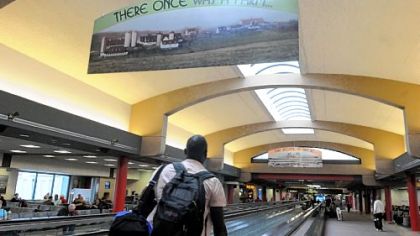 Travelers walk through the terminal at Pittsburgh International Airport, which opened 20 years ago.
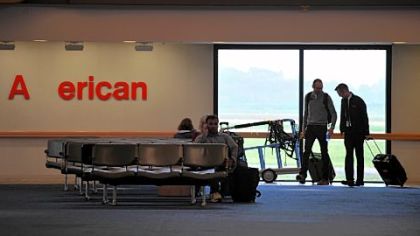
It wasn't supposed to be this way.
Close to 40.8 million people were expected to travel through Pittsburgh International Airport this year, the 20th anniversary of the midfield terminal. A new satellite terminal should have been facilitating travel to far-flung international destinations.
Instead, an estimated 8.3 million passengers will use the airport in 2012. And the $1 billion terminal, an architectural marvel praised often for its efficiency and ease of use, sits half empty in the middle of the airfield, like a Ferrari on blocks.
"It makes my stomach grind," said Tasso Katselas, the Pittsburgh architect who designed the complex. "I try to fly at peak hours so that it appears to be busy."
It's easy to forgive the 1993 master plan that calculated 40.8 million travelers by 2013, given that it would have taken a biblical prophet to predict the kind of upheaval in the airline industry that has left the midfield terminal a shell of its former self.
No one foresaw the changes, certainly not Edwin I. Colodny, the former USAir chairman who cut the deal with Allegheny County
to build the facility, one tailored specifically to his airline's needs.
"We were building for the long term," he said.
No doubt the midfield that dignitaries will commemorate on Monday is a far different terminal, at least in terms of usage, than the one that opened at 5:30 a.m. sharp on Oct. 1, 1992, when USAir Flight 620, a red eye from San Diego, docked at the new building.

Gone is the Pittsburgh hub that US Airways built and then dismantled, one that at its peak pumped 20.7 million travelers through the midfield terminal. At one time, the terminal handled
633 nonstop flights a day to 114 destinations.
Today, midfield is down to
155 daily flights to 36 destinations. Airlines at one time occupied as many as 104 gates, including those in a commuter wing, with US Airways leasing three-quarters of them. Now use is down to 50 gates, with US Airways occupying 10. The airport has closed half of the A and B concourses, once used exclusively by US Airways. The commuter wing has been vacated and part of it is now used as a secondary security checkpoint.
- With the elimination of the hub in 2004 and numerous flight cutbacks, US Airways employment in the region has dropped from a
peak of 12,000 people to 1,800 today.
- To the county, the terminal project was a major economic development initiative, one that would generate thousands of jobs and open up nearly 10,000 acres of land surrounding the airport to business.
- There were few dissenting voices, but one of them was Dr. Cyril Wecht, a Democrat who did not oppose the project but who raised concerns about tying midfield's fortunes to one airline (USAir). He was out of office by the time the county finalized the deal to build the terminal.
- Barbara Hafer, a former Republican commissioner who signed the agreement to build the terminal in 1988, said she also was uneasy about that aspect of the deal but didn't believe the county had much choice. She said US Airways insisted on being top dog at midfield.
- For most of the first decade after the midfield terminal opened, much of the news was good. Passenger traffic grew from 16.7 million in 1991 to an all-time high of 20.7 million in 1997. The terminal itself won widespread acclaim from travelers who enjoyed its wide concourses and modern amenities, such as moving sidewalks.
- Midfield seemed to be poised for a record year in 2001 when the bottom fell out after the Sept. 11 terrorist attacks. As airlines struggled to survive in an industry increasingly dominated by low-fare carriers, US Airways filed for bankruptcy twice.
- The end of the first bankruptcy in March 2003 came with a surprise. Shortly before emerging, the airline rejected its midfield leases, signaling the beginning of the end of its Pittsburgh hub. By late 2004, it was gone for good.
- ... an airline struggling to make ends meet didn't need three hubs. The hub in Philadelphia offered US Airways a much larger local market, while the one in Charlotte, N.C., gave it a foothold in the south and in one of the largest financial centers in the country. "There's nothing wrong with Pittsburgh. It was just the odd man out," he said.
- All those US Airways cutbacks opened the door for low-fare carriers like JetBlue and Southwest, now the airport's second largest airline.
 Great...
- After a slow start, development on the county land surrounding the airport has started to take off. Some
16 buildings representing more than $325 million in private investment have gone up on the property. The projects have
created or retained more than 5,000 jobs, according to the airport authority.
- County Executive Rich Fitzgerald, who has made increasing air service a priority, said he believes midfield can become a hub again, or at least a focus city, for a major airline. "It is a state-of-the-art facility built for US Airways. It has all that infrastructure in place. It's not like it's obsolete by any means.
It's still one of the best facilities in the country and in the world," he said.
I'm no airport expert by a long shot, but I have to doubt that PIT is still one of the best in the world
- There's more than convenience at stake. A good airport can be a big selling point in attracting and retaining business in a region. Conversely, the lack of adequate air service can drive companies out. Cincinnati discovered that last year when one of its best known companies, Chiquita Brands International, announced that it was moving to Charlotte. The move was made in large part because of inadequate service out of Cincinnati, where Delta had decimated its hub.
- Consultants are less optimistic about midfield's chances for a comeback, particularly given that many airlines are in a period of limited growth and are looking to close or downsize secondary hubs, not add them... "I don't think anybody is harboring any dreams that it's going to be a gateway to the world," he said.
- Nonetheless, Mr. George believes the midfield terminal has a chance to defy the odds. He noted that the region's population is starting to grow again, the city is strong... "I just feel, how can it get any worse?" he said.





 Prev
Prev




 IT_Concourse_B.jpg


 Linear Mode
