HomeDiagramsDatabaseMapsForum About
     

Go Back   SkyscraperPage Forum > Discussion Forums > City Discussions


Reply

 
Thread Tools Display Modes
     
     
  #161  
Old Posted Aug 27, 2021, 1:39 PM
jmecklenborg jmecklenborg is online now
Registered User
 
Join Date: Jul 2003
Posts: 4,005
Quote:
Originally Posted by yuriandrade View Post
Downtown Kansas City


------------------------------ 2020 ------ 2010 ------ 2000 ------ 1990 ------ Growth ------ Density

Downtown ---------------------- 9,743 ------ 5,089 ------ 3,755 ------ 3,856 ---- 91.5% ---- 35.5% --- -2.6% ------- 2.3 km² --- 4,275.1 inh./km²

Kansas City Metro Area ---- 2,136,403 -- 1,952,470 -- 1,757,083 -- 1,568,274 ----- 9.4% ---- 11.1% --- 12.0% -- 12,899 km²


Downtown Kansas City is all inside the freeway loop and the 4 census tracts match it exactly. Explosive growth and the adjacent neighbourhoods are also growing.

It's a perfect example on how even metro areas that people hardly associated with urban life, are also attracting tons of people to their downtowns.

I lived in Kansas City for a year in the 90s. I hadn't been back for 25 years until this past June. Wow, it was amazing. There is still some room for improvement but the city has taken a complete 180 from steady decline to energetic growth.

A quick drive along Brush Creek that sunny June day felt glamorous - it already had exotic cars buzzing around so if they had palm trees it would have felt like Los Angeles.
Reply With Quote
     
     
  #162  
Old Posted Aug 27, 2021, 4:02 PM
mhays mhays is online now
Never Dell
 
Join Date: Jul 2001
Posts: 20,924
Vancouver's "housing first" model in core districts dates to the 1960s iirc. Its lack of freeways (and rail back then) was a huge reason people wanted to live within walking distance to work. And its healthcare and social safety net have always kept it relatively free of urban ills, aside from the highly-concentrated Lower East Side. For this thread I wouldn't do the whole peninsula, but I'd guess they could be 20k/sk depending on the area.

Your definition for Seattle is fine. South Lake Union and Uptown (Lower Queen Anne) are fairly commercial and mixed, but they're mostly not tall (a lot of 160' office buildings in SLU, the Space Needle on LQA). On average they're not as dense with residents yet, particularly in 2020. The Capitol Hill segment has some of our densest residential tracts, but is mostly lowrise/midrise residential with some retail. SoDo should clearly be omitted.

Last edited by mhays; Aug 28, 2021 at 4:31 PM.
Reply With Quote
     
     
  #163  
Old Posted Aug 27, 2021, 7:01 PM
Yuri's Avatar
Yuri Yuri is online now
Registered User
 
Join Date: Sep 2008
Posts: 5,577
Downtown St. Louis


------------------------------ 2020 ------ 2010 ------ 2000 ------ 1990 ------ Growth ------ Density

Downtown ---------------------- 9,642 ------ 6,998 ------ 3,385 ------ 3,250 ---- 37.8% --- 106.7% ---- 4.2% ------- 3.2 km² --- 3,034.0 inh./km²

St. Louis --------------------- 301,578 ---- 319,294 ---- 348,189 ---- 396,685 ---- -5.5% ---- -8.3% -- -12.2% ----- 159.9 km² --- 1,886.0 inh./km²

St. Louis Metro Area ------ 2,754,124 -- 2,717,079 -- 2,648,607 -- 2,492,525 ----- 1.4% ----- 2.6% ---- 6.3% -- 16,489 km²


St. Louis Downtown lost traction compared to the previous intercensus period, but still posting a very solid growth, which is even more remarkable as the city continues losing people. I've seen some pics on the street level and it seems a very pleasant place with plenty of nice architecture.
__________________
London - São Paulo - Rio de Janeiro - Londrina - Frankfurt
Reply With Quote
     
     
  #164  
Old Posted Aug 27, 2021, 8:10 PM
SFBruin SFBruin is offline
Registered User
 
Join Date: Sep 2015
Location: Seattle, WA
Posts: 1,190
Quote:
Originally Posted by yuriandrade View Post
Since 2000 Census, we started to think about the Big 12 regarding the largest US metro areas as they had a clear head over others.
I feel like there are a pretty clear big 2, big 3, and big 12 metro areas in the US.
__________________
Pretend Seattleite.

Last edited by SFBruin; Aug 27, 2021 at 8:21 PM.
Reply With Quote
     
     
  #165  
Old Posted Aug 27, 2021, 8:19 PM
Yuri's Avatar
Yuri Yuri is online now
Registered User
 
Join Date: Sep 2008
Posts: 5,577
Quote:
Originally Posted by SFBruin View Post
I feel like there are a pretty clear big 2, big 3, and big 11 metro areas in the US.

I don't really include Detroit in these lists, perhaps because I am too young to remember when it was the fourth largest city in the US.
Well, it's included because it's over 5 million people, and up to 2010 Census Detroit, Atlanta, Washington, Miami and Boston had pretty much the same population, ranging from 5.2 to 5.6 million people.

Now, with the 2020 Census, all of them (plus Philadelphia) are above 6 million people, so maybe now we could talk about the "Big 11" leaving Detroit out, but it would be a bit weird to place the threshold on 6 million mark instead of 5 million. And now, as Seattle is about to join the 5 million club, with a GDP larger than Miami's, it would be even more problematic to move the mark up.
__________________
London - São Paulo - Rio de Janeiro - Londrina - Frankfurt
Reply With Quote
     
     
  #166  
Old Posted Aug 27, 2021, 8:20 PM
Yuri's Avatar
Yuri Yuri is online now
Registered User
 
Join Date: Sep 2008
Posts: 5,577
Downtown Dallas-Fort Worth


------------------------------ 2020 ------ 2010 ------ 2000 ------ 1990 ------ Growth ------ Density

Downtown Dallas -------------- 36,456 ----- 19,975 ------ 9,510 ------ 7,520 ---- 82.5% --- 110.0% --- 26.5% ------ 10.8 km² --- 3,365.6 inh./km²

CBD Dallas ---------------------- 6,514 ------ 3,712 ------ 1,920 ------ 2,841 ---- 75.5% ---- 93.3% -- -32.4% ------- 2.0 km² --- 3,310.0 inh./km²

Downtown Fort Worth -------- 11,977 ------ 6,435 ------ 6,739 ------ 6,443 ---- 86.1% ---- -4.5% ---- 4.6% ------ 11.8 km² --- 1,018.3 inh./km²

CBD Fort Worth ---------------- 6,345 ------ 3,210 -------- 857 -------- 489 ---- 97.7% --- 274.6% --- 75.3% ------- 2.0 km² --- 3,214.3 inh./km²

Dallas MSA ---------------- 7,637,387 -- 6,366,542 -- 5,156,217 -- 3,984,437 ---- 20.0% ---- 23.5% --- 29.4% -- 22,469 km²


What was a shame here for Dallas was the shape of their census tracts, not making possible to take the whole freeway loop area, which would be the best definition for their Downtown. So I came up with one strict (3 tracts), covering only half of the loop and a broader one, comprising 10 census tracts and including Uptown and Victoria Park north of loop and Cedars south. And to make Fort Worth comparable to Dallas, I also brought two definitions, one with 1 tract and the other comprising 3.

But back to the numbers, Downtown Dallas growing super fast and already reached a good density giving we're talking about a large area (almost 11 km²).

Downtown Fort Worth, on the other hand started its process only in the 2010's but they're already moving on the right direction.

And regarding the MSA, as Houston, it doesn't seem to slow. By the 2030 Census, the CSA will be quite close to the 10 million mark.
__________________
London - São Paulo - Rio de Janeiro - Londrina - Frankfurt
Reply With Quote
     
     
  #167  
Old Posted Aug 27, 2021, 8:43 PM
SFBruin SFBruin is offline
Registered User
 
Join Date: Sep 2015
Location: Seattle, WA
Posts: 1,190
Quote:
Originally Posted by yuriandrade View Post
Well, it's included because it's over 5 million people, and up to 2010 Census Detroit, Atlanta, Washington, Miami and Boston had pretty much the same population, ranging from 5.2 to 5.6 million people.

Now, with the 2020 Census, all of them (plus Philadelphia) are above 6 million people, so maybe now we could talk about the "Big 11" leaving Detroit out, but it would be a bit weird to place the threshold on 6 million mark instead of 5 million. And now, as Seattle is about to join the 5 million club, with a GDP larger than Miami's, it would be even more problematic to move the mark up.
Yeah, the more that I thought about this, the more it became problematic. At least we can agree that NYC is number 1.
__________________
Pretend Seattleite.
Reply With Quote
     
     
  #168  
Old Posted Aug 28, 2021, 1:15 PM
streetscaper streetscaper is offline
Registered User
 
Join Date: May 2004
Location: New York
Posts: 2,939
Loving the data and commentary Yuri! Keep it coming
__________________
hmmm....
Reply With Quote
     
     
  #169  
Old Posted Aug 28, 2021, 1:23 PM
mrnyc mrnyc is offline
cle/west village/shaolin
 
Join Date: Jul 2006
Posts: 14,668
Quote:
Originally Posted by streetscaper View Post
Loving the data and commentary Yuri! Keep it coming
yeah this is an interesting thread!
Reply With Quote
     
     
  #170  
Old Posted Aug 28, 2021, 2:01 PM
jtown,man jtown,man is offline
SUSPENDED
 
Join Date: Dec 2003
Location: Chicago
Posts: 4,162
I've always been bullish on downtown Dallas. It has so much potential.

However, they are going to have to step up their game over the next two decades.

More residential conversions, parks, D2, etc. are needed to give the area more life.
Reply With Quote
     
     
  #171  
Old Posted Aug 28, 2021, 4:32 PM
mhays mhays is online now
Never Dell
 
Join Date: Jul 2001
Posts: 20,924
These threads truly are heaven. Thanks for the data!

BTW, I mis-typed my guess on Vancouver's equivalent...20k/sk, not 20k/sm. In other words about 60k/sm...guessing.
Reply With Quote
     
     
  #172  
Old Posted Aug 28, 2021, 5:22 PM
dktshb's Avatar
dktshb dktshb is offline
Environmental Sabotage
 
Join Date: Jun 2005
Location: San Francisco/ Los Angeles/ Tahoe
Posts: 5,136
Quote:
Originally Posted by badrunner View Post
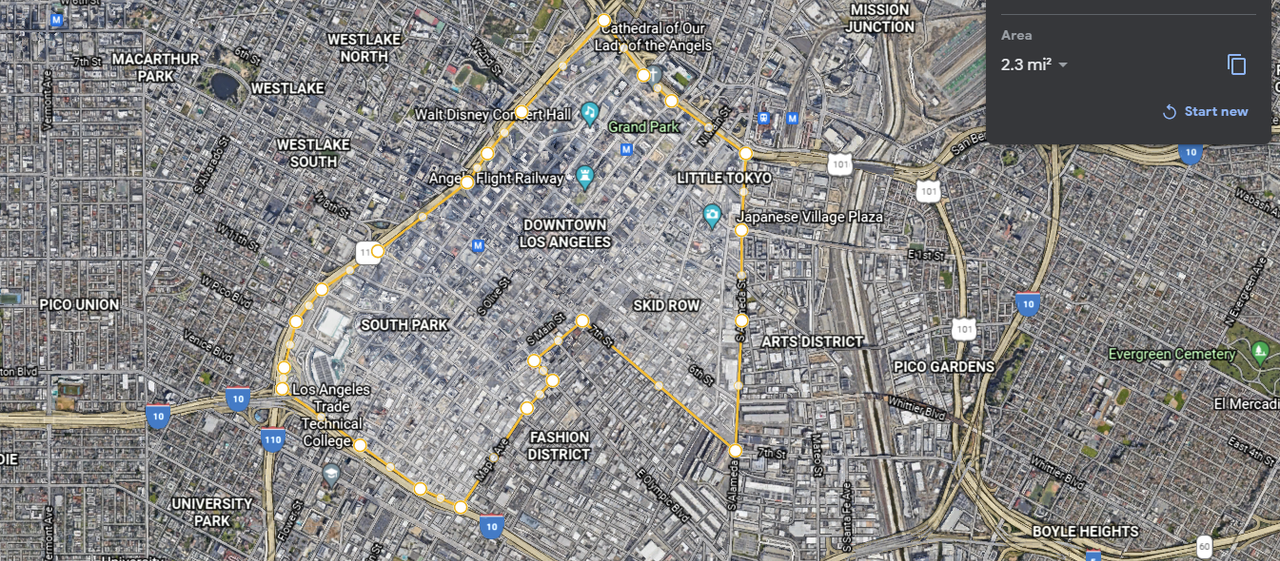
It depends on how you slice it. I got these 19 census tracts at a population of 52,691 in 2.3 square miles for a density of 22909 ppsm or 8845 per sq km.

2074 - 2002
2075.01 - 2489
2075.02 - 4113
2077.11 - 2280
2077.12 - 4737
2240.10 - 3621

2079.01 - 3645
2079.02 - 7405
2073.03 - 2311
2073.04 - 2124
2073.05 - 1181
2073.06 - 2227
2073.07 - 1160
2073.08 - 1407

2062.01 - 2647
2062.02 - 3035
2063.01 - 2074
2063.02 - 1375
2063.03 - 2858

It's basically everything inside the freeway loop, west of Alameda, minus the Fashion District. It's not perfect. You can add tracts in Chinatown or City West for better numbers, or add the Arts District or Fashion District for lower density. I'm not sure you can get a good border just using census tracts, but it's better than just using the freeway loop.

Quote:
Originally Posted by yuriandrade View Post
Comparisons between cities are indeed very complicated. Context is everything.

But if we're looking at higher densities, we could put Westlake together, limited on three sides by the freeways and west by Hoover St. It would add tons of people, density, but growth rates wouldn't be that impressive. It's a bit like Nob Hill-Tenderloin bordering San Francisco's Financial District or Chicago's Near North Side bordering the Loop.
That is probably the most accurate boundary for Downtown Los Angeles. I may even take out skid row. These numbers are much more a true representation.
Reply With Quote
     
     
  #173  
Old Posted Aug 28, 2021, 5:56 PM
Yuri's Avatar
Yuri Yuri is online now
Registered User
 
Join Date: Sep 2008
Posts: 5,577
^^
Thank you guys! You're kind!


------------------------------------------------------------------------------


Downtown Pittsburgh


------------------------------ 2020 ------ 2010 ------ 2000 ------ 1990 ------ Growth ------ Density

Downtown ----------------------- 4,729 ------ 2,831 ------ 4,364 ------ 3,114 ---- 67.0% --- -35.1% --- 40.1% ------- 1.4 km² --- 3,331.6 inh./km²

Central Pittsburgh ------------- 15,497 ----- 13,101 ----- 12,195 ------ 9,739 ---- 18.3% ----- 7.4% --- 25.2% ------- 4.8 km² --- 3,225.2 inh./km²

Pittsburgh -------------------- 302,971 ---- 305,306 ---- 334,325 ---- 369,962 ---- -0.8% ---- -8.7% --- -9.6% ----- 143.4 km² --- 2,112.8 inh./km²

Allegheny County ---------- 1,250,578 -- 1,223,348 -- 1,281,666 -- 1,336,449 ----- 2.2% ---- -4.6% --- -4.1% --- 1.891 km² ------- 601.3 inh./km²

Pittsburgh MSA ------------ 2,370,930 -- 2,356,285 -- 2,431,088 -- 2,468,289 ----- 0.6% ---- -3.1% --- -1.5% -- 13,683 km²


Downtown Pittsburgh, the Golden Triangle, is so tiny that comprises only 1 census tract. Giving half of it is taken by the park, the highways and there are still plenty of office buildings there, it's a quite decent density. I also worked a broader definition, including 4 census tracts adding the Bluff, Craford-Roberts and the Strip districts.

Pittsburgh MSA and Allegheny County growing for the first time since 1950-1960 while the city of Pittsburgh almost ended positive, which would be the first time since 1940-1950. Very promising for the area.

__________________
London - São Paulo - Rio de Janeiro - Londrina - Frankfurt
Reply With Quote
     
     
  #174  
Old Posted Aug 28, 2021, 8:45 PM
James Bond Agent 007's Avatar
James Bond Agent 007 James Bond Agent 007 is offline
Posh
 
Join Date: Aug 2003
Location: Kansas City, MISSOURI
Posts: 23,236
Thanks for all your work, Yuri!

Interesting that Kansas City and St Louis have almost identical downtown populations.
__________________
You fill me with inertia.
Reply With Quote
     
     
  #175  
Old Posted Aug 28, 2021, 10:39 PM
MplsTodd MplsTodd is offline
Registered User
 
Join Date: May 2005
Location: Columbus & Mpls
Posts: 765
Great series of posts! Thanks for undertaking this project.
Could you prepare one for Minneapolis & St. Paul?
__________________
Every City has something worth seeing!
Reply With Quote
     
     
  #176  
Old Posted Aug 28, 2021, 11:18 PM
Yuri's Avatar
Yuri Yuri is online now
Registered User
 
Join Date: Sep 2008
Posts: 5,577
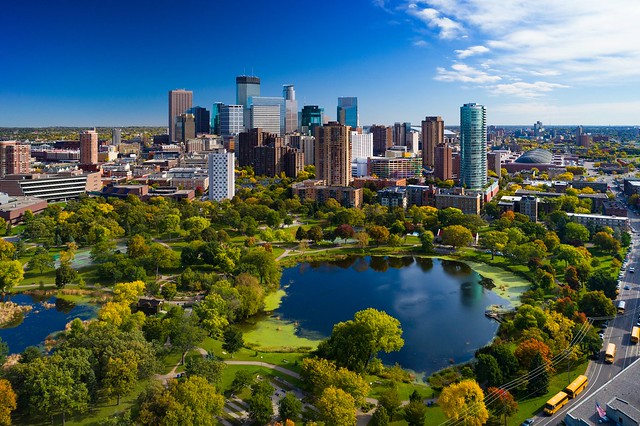
Downtown Minneapolis-St. Paul


------------------------------ 2020 ------ 2010 ------ 2000 ------ 1990 ------ Growth ------ Density

Downtown Minneapolis --------- 41,093 ----- 29,725 ----- 24,149 ----- 21,157 ---- 38.2% ---- 23.1% --- 14.1% ------- 7.5 km² --- 5,471.0 inh./km²

Downtown St. Paul ------------- 11,808 ------ 9,050 ------ 7,999 ------ 6,711 ---- 30.5% ---- 13.1% --- 19.2% ------- 3.2 km² --- 3,663.7 inh./km²

Minneapolis ------------------- 429,954 ---- 382,603 ---- 382,824 ---- 368,397 ---- 12.4% ---- -0.1% ---- 3.9% ----- 139.9 km² --- 3,073.3 inh./km²

St. Paul ----------------------- 311,527 ---- 285,103 ---- 287,029 ---- 272,065 ----- 9.3% ---- -0.7% ---- 5.5% ----- 134.6 km² --- 2,314.5 inh./km²

Minneapolis Metro Area ---- 3,635,128 -- 3,279,833 -- 2,968,806 -- 2,538,834 ---- 10.8% ---- 10.5% --- 16.9% -- 15,609 km²


Both Downtowns are doing quite well, growing much faster this decade than the previous ones. Minneapolis is one of the most populated in the country, with 41,000 people. St. Paul's, that is completely overlooked by Minneapolis', it's in fact more populated than St. Louis', for instance.

Regarding the metro area, it's one of the very few in the country that grew faster this decade than the past one.
__________________
London - São Paulo - Rio de Janeiro - Londrina - Frankfurt
Reply With Quote
     
     
  #177  
Old Posted Aug 29, 2021, 4:36 AM
mhays mhays is online now
Never Dell
 
Join Date: Jul 2001
Posts: 20,924
I love the stats for density and growth figures. But comparing downtown populations isn't fair here. The numbers aren't parallel enough.
Reply With Quote
     
     
  #178  
Old Posted Aug 29, 2021, 5:22 AM
twinpeaks twinpeaks is offline
Registered User
 
Join Date: Nov 2006
Posts: 258
Quote:
Originally Posted by yuriandrade View Post
I calculated Tenderloin as part of Downtown San Francisco. It's 29,638 people living in 0.697 km² for a 42,500 inh./km² density (multiply for 2.59 for miles). That's comparable to the densest Paris arrondissements. It's very hard to reproduce elsewhere.

But it's beautiful this region. Lots of potential.
First - thanks for all the stats and work you put in to this. Great job, very interesting outcomes.

Second - I knew Tenderloin was dense, but I had no idea it was super dense.

Last edited by twinpeaks; Aug 29, 2021 at 3:29 PM.
Reply With Quote
     
     
  #179  
Old Posted Aug 29, 2021, 5:59 PM
Yuri's Avatar
Yuri Yuri is online now
Registered User
 
Join Date: Sep 2008
Posts: 5,577
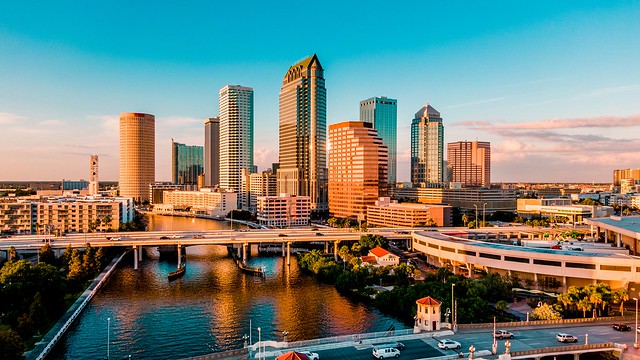
Downtown Tampa


------------------------------ 2020 ------ 2010 ------ 2000 ------ 1990 ------ Growth ------ Density

Downtown ------------------------ 3,777 ------ 1,134 -------- 709 ------ 1,171 --- 233.1% ---- 59.9% --- -39.5% ------- 1.9 km² --- 2,015.5 inh./km²

Channel District ------------------ 4,422 ------ 1,844 ---------- 0 ----------- 6 --- 139.8% ----- (-) ----- -100.0% ------- 0.8 km² --- 5,264.3 inh./km²

Tampa MSA ----------------- 3,175,275 -- 2,783,243 -- 2,395,998 -- 2,067,959 ---- 14.1% ---- 16.2% ---- 15.9% --- 6,514 km²

Tiny population, but growth is very promising. I brought together Channel District, just east of Downtown, in former dockyards or something like that. It's under a condo boom and already reached high density.
__________________
London - São Paulo - Rio de Janeiro - Londrina - Frankfurt
Reply With Quote
     
     
  #180  
Old Posted Aug 29, 2021, 8:15 PM
thoughtcriminal thoughtcriminal is offline
Registered User
 
Join Date: Jan 2020
Location: philadelphia
Posts: 561
Quote:
Originally Posted by mcgrath618 View Post
Could you expand the limits of Center City to include everything from Girard to Tasker (with the same E/W borders)? Philadelphia City Hall defines this as “Greater Center City,” and in 2018 estimated it to be more dense than Chicago (or for that matter, anywhere outside of Manhattan). It had ~174K residents in 2010.
the expectation, pre-covid, had been that the population of "greater center city" was going to exceed 200,000 in 2020. would be interesting to see if it had achieved that.
Reply With Quote
     
     
This discussion thread continues

Use the page links to the lower-right to go to the next page for additional posts
 
 
Reply

Go Back   SkyscraperPage Forum > Discussion Forums > City Discussions
Forum Jump


Forum Jump


All times are GMT. The time now is 12:08 AM.

     
SkyscraperPage.com - Privacy Statement - Top

Powered by vBulletin® Version 3.8.7
Copyright ©2000 - 2026, vBulletin Solutions, Inc.