HomeDiagramsDatabaseMapsForum About
     

Go Back   SkyscraperPage Forum > Regional Sections > Canada > Ontario > Hamilton > Urban, Urban Design & Heritage Issues


Reply

 
Thread Tools Display Modes
     
     
  #161  
Old Posted Mar 26, 2008, 9:04 PM
markbarbera markbarbera is offline
Registered User
 
Join Date: May 2007
Location: Hamilton
Posts: 3,050
Description of Market Street, Manchester (source: Main Roads that define Manchester)

Quote:
The A6 is one of the longest and most ancient roads in England. It runs from Carlisle to Luton. The final leg into London is along the A5. The A6 passes along many famous towns and streets. Gently curving, rising and falling with the terrain, it often seems to have a similar width and character, whether passing through Lancaster, Little Hulton, Hazel Grove, Leicester or Luton.

The A6 is the post-1974 City of Salford’s main street, linking Walkden, Swinton, Pendlebury and the old city of Salford, before crossing the Irwell into Manchester. In modern times its route has been diverted and obscured due to city centre pedestrianisation and the construction of by-pass routes, including the so-called Inner Relief Route.

But we need to get back to the realisation that Market St is the A6, part of the Carlisle to London Road, one of the ‘big 6′ routes through England. Perhaps there should be blue signs by Deansgate pointing to Carlisle and Scotland, and on the corner of Market St, a sign pointing to Birmingham and London, though not that many people walk from Manchester to London nowadays.

The continuation of Market St is Piccadilly - a name copied from London in the mid-19th century. It continues as London Road, next to Piccadilly, formerly London Rd station - still the main station for the capital. The A6 is London Rd as far as the River Medlock, then turns into Downing St - another name with London connections, then Ardwick Green, then Stockport Rd. Now we’re back on the A6 proper - people often refer to it as such. London is another 185 miles, though this has ceased to be the main route to London since the coming of the M6 in the 1960s.
Reply With Quote
     
     
  #162  
Old Posted Mar 26, 2008, 9:05 PM
RePinion's Avatar
RePinion RePinion is offline
Bobo in Purgatory
 
Join Date: Feb 2008
Location: London (Islington), UK
Posts: 365
I thought we were having a constructive argument too, until I realized you were refusing to engage my points and belabouring one particular issue ad nausea. It is certainly fair to draw the inference that you had nothing else to rely upon.

I didn't make any personal insults. Nor, in my opinion, did I make any low blows. My criticisms were focused exclusively on your argumentative strategy.

The only remark I made which could reasonably be interpreted as a personal attack was in response to your personal attack against me.

I hold no grudge against you for that earlier post - and certainly to say that I have a "personal vendetta" is a gross exaggeration.

I don't think it's much fun to have a debate with someone who doesn't debate honestly, but aside from that, I have nothing against you.
Reply With Quote
     
     
  #163  
Old Posted Mar 26, 2008, 9:14 PM
RePinion's Avatar
RePinion RePinion is offline
Bobo in Purgatory
 
Join Date: Feb 2008
Location: London (Islington), UK
Posts: 365
Quote:
Originally Posted by markbarbera View Post
Description of Market Street, Manchester (source: Main Roads that define Manchester)
Wow. You've really taken this to the level of obsession!

And yet, you still don't engage the substantive points at issue.

You may say, and say and say again, that Market Street is the A6 but this goes to show very little in the long run. Clearly you aren't reading my posts.

You have failed to show, and continue to fail to show, that the pedestrianization of Market Street is a compelling argument for the pedestrianization of King.

While a similarity very much open to equivocation may exist on one level, this simply does not carry across the board.
Reply With Quote
     
     
  #164  
Old Posted Mar 26, 2008, 9:15 PM
Millstone Millstone is offline
Registered User
 
Join Date: Feb 2008
Location: Port Colborne, ON
Posts: 889
Why this on and on reposting fest of Market St formerly being A6? We get it, the street was repurposed and the highway's route was bypassed. It happens all the time here too.

The only thing I can really contribute to this is that King St was not part of Hwy 8 until about 1960 when King and Main were one-way couplets. Before that, it was just a municipal street. Most of Hwy 8 (provincial) ceases to exist today except in RM Waterloo. Hwy 8 between Hamilton and Niagara Falls was already obsolete in the late 30s when the QEW was opened and so it disappeared mostly in the 70s.

Apart from that, RePinion is pretty much owning markbarbera all over the shop but all markbarbera's doing is quoting Google and Wikipedia.
Reply With Quote
     
     
  #165  
Old Posted Mar 26, 2008, 9:19 PM
markbarbera markbarbera is offline
Registered User
 
Join Date: May 2007
Location: Hamilton
Posts: 3,050
I have attempted to collaborate my arguments with facts that RePinion has summarily dismissed as weak and/or inadequate without providing any evidence to refute them as such, other than your opinion. In fact, while accusing me of not providing strong arguments in favour of pedestrianisation of King, he himself has never offered sound arguments against pedestrianisation. Perhaps you can present us with collaborations for your arguments so we too can weigh them accordingly.
Reply With Quote
     
     
  #166  
Old Posted Mar 26, 2008, 9:23 PM
RePinion's Avatar
RePinion RePinion is offline
Bobo in Purgatory
 
Join Date: Feb 2008
Location: London (Islington), UK
Posts: 365
No no - you really don't understand. I have not summarily dismissed anything. That really is unfair. I have engaged your points, both through fact and through rational analysis. I have scarcely interjected my own opinions, as such, at all.
Reply With Quote
     
     
  #167  
Old Posted Mar 26, 2008, 9:59 PM
Millstone Millstone is offline
Registered User
 
Join Date: Feb 2008
Location: Port Colborne, ON
Posts: 889
Quote:
Originally Posted by markbarbera View Post
I have attempted to collaborate my arguments with facts that RePinion has summarily dismissed as weak and/or inadequate without providing any evidence to refute them as such, other than your opinion. In fact, while accusing me of not providing strong arguments in favour of pedestrianisation of King, he himself has never offered sound arguments against pedestrianisation. Perhaps you can present us with collaborations for your arguments so we too can weigh them accordingly.
Collaborations? arguments? I already gave you mine; I think the idea sucks because I own a car and I'd like to drive on King St. I think a lot of other people would too. I think a lot of businesses would like to remain visible to car drivers.
Reply With Quote
     
     
  #168  
Old Posted Mar 26, 2008, 10:37 PM
markbarbera markbarbera is offline
Registered User
 
Join Date: May 2007
Location: Hamilton
Posts: 3,050
Quote:
Originally Posted by RePinion View Post
Wow. You've really taken this to the level of obsession!

And yet, you still don't engage the substantive points at issue.

You may say, and say and say again, that Market Street is the A6 but this goes to show very little in the long run. Clearly you aren't reading my posts.

You have failed to show, and continue to fail to show, that the pedestrianization of Market Street is a compelling argument for the pedestrianization of King.

While a similarity very much open to equivocation may exist on one level, this simply does not carry across the board.

My point is not simply that Market Street is the A6. My point is, prior to its pedestrianisation, Market Street in Manchester was a main road through that city which handled traffic in a fashion very similar to King Street. I was asked to provide an example of a successful pedestrianisation of a road that had the same function as King Street in Hamilton, which is what I did. Yet you refused to concede that point's validity because you 'think' Market Street is not similar to King Street. Well, I have been along Market Street in Manchester, both pedestrianised and non-pedestrianised. In fact, the similarities are uncanny.

Moreover, the existing conditions surrounding Market Street's conversion were strikingly similar to King Street. Market Street was a retail area that went into decline during the early 80's, much due to the fact that the retail outlets chose to relocate inside Arndale Centre, an indoor shopping centre perceived as a more desireable downtown retail location compared to an outdoor location on a high-traffic road. Visits to the downtown core were being negatively impacted by the recession. While population density supported higher order transit, the only available transit system was in the form of bus service. During the same time in Hamilton, the retail along King Street was relocating into newly constructed Jackson Square because it was perceived as a more desireable downtown location. Its public transit system too was limited to bus service, even though traffic was (and still is) at a level that could support higher-order transit. The stories are indeed quite similar.

Come the 90's, the parallels in the two cities diverge. Both cities are suffering from economic decline during this time. Hamilton decided to do nothing and ride the storm out. Manchester decided to be more proactive and adopts a multi-pronged downtown revitalization initiative. They obtain funding to initiate an ambitious LRT system and they secure thier role as host of the 2002 COmmonwealth Games. They decide to divert the A6 and pedestrianise Market Street. Granted, the IRA bombing of Marks and Spencer accelerated the process and expanded it to inlude the reconstruction of Arndale. However, the Market Street pedestrianisation was a project considered long before the bombing. Post-pedestrianisation, automobile traffic was easily managed by alternate routes, and the newly constructed Metrolink LRT system brought a whole new wave of pedestrian traffic to the area. The pedestrianisation was a complete success.

Today, Hamilton has many of the same infrastructure opportunities that Manchester had in the 90's. Higher-order transit is about to be implemented, and downtown will be the hub for the two main routes. King Street can be redesigned in the same manner as Market Street was in Manchester. In other words, the pedestrian-only section can be serviced directly by these transit lines, and can therefore be designed to funnel the additional pedestrian traffic in the same manner as Manchester's Market Street handles the pedestrian flow of those using the Metrolink. Businesses along this stretch will benefit greatly as these transit users walk past these shops, and the pedestrian zone will promote prolonged visits and can host civic events, much like Market Street in Manchester does. Just as automobile traffic to downtown Manchester was unhindered by the pedestrianisation, the many underused alternate routes in downtown will not make this pedestrianisation any kind of hinderence to automobile traffic.

The City of Hamilton's recently released an update on the two-way conversion project. It clearly indicates that east-west routes currently operate well below capacity. This is a bit of an inconvenient truth for those who claim downtown automobile traffic would be greatly hindered by this initiative.
Reply With Quote
     
     
  #169  
Old Posted Mar 26, 2008, 10:40 PM
RePinion's Avatar
RePinion RePinion is offline
Bobo in Purgatory
 
Join Date: Feb 2008
Location: London (Islington), UK
Posts: 365
Quote:
Originally Posted by Millstone View Post
Collaborations? arguments? I already gave you mine; I think the idea sucks because I own a car and I'd like to drive on King St. I think a lot of other people would too. I think a lot of businesses would like to remain visible to car drivers.
LOL - I guess you can see the frustration of trying to have a conversation with markbarbera too!

I really don't mean this to be snide or personally offensive to markbarbera, but the whole thing really brings back memories of law school for me. There was always a group of nerdy students who when backed into a corner (argumentatively) would always yell out "Substantiate this! Collaborate that!", to which the best response was invariably, "But I just did!". This is a cheap tactic to force the opponent to completely restate his argument in the hopes either that an inconsistency might arise or that he will just be too mentally exhausted to do it and will cede the whole thing. Politicians use the trick all the time, to varying degrees of success.

Anyway, your point basically unravelled markbarbera's whole tangential argument. There was nothing more to prove.
Reply With Quote
     
     
  #170  
Old Posted Mar 27, 2008, 12:16 AM
I, Sinclair I, Sinclair is offline
Registered User
 
Join Date: Mar 2008
Location: Hamilton
Posts: 49
Now that RePinion, Esq. has killed a fly with a cannon, can we return to our futile pontificating?

These castles in the clouds don't build themselves, you know.

I personally do not see a strong parallel between Hamilton and the European experience in pedestrianization. There are fundamental differences in development patterns and quotidian rhythms.

Mr Coalmine suggested the most sensible plan further upthread. I hope some of that sensibility is in the official plan.
Reply With Quote
     
     
  #171  
Old Posted Mar 27, 2008, 12:35 AM
RePinion's Avatar
RePinion RePinion is offline
Bobo in Purgatory
 
Join Date: Feb 2008
Location: London (Islington), UK
Posts: 365
Sorry to keep shooting off the old cannon, but I asked for a more substantive response, and now that markbarbera's given it, I feel bound to respond.

Quote:
Originally Posted by markbarbera View Post
My point is not simply that Market Street is the A6. My point is, prior to its pedestrianisation, Market Street in Manchester was a main road through that city which handled traffic in a fashion very similar to King Street. I was asked to provide an example of a successful pedestrianisation of a road that had the same function as King Street in Hamilton, which is what I did. Yet you refused to concede that point's validity because you 'think' Market Street is not similar to King Street. Well, I have been along Market Street in Manchester, both pedestrianised and non-pedestrianised. In fact, the similarities are uncanny.
This is a much better argument. You've fleshed things quite a bit. I still think you're making some dubious claims, though ...

Quote:
Moreover, the existing conditions surrounding Market Street's conversion were strikingly similar to King Street. Market Street was a retail area that went into decline during the early 80's, much due to the fact that the retail outlets chose to relocate inside Arndale Centre, an indoor shopping centre perceived as a more desireable downtown retail location compared to an outdoor location on a high-traffic road. Visits to the downtown core were being negatively impacted by the recession. While population density supported higher order transit, the only available transit system was in the form of bus service. During the same time in Hamilton, the retail along King Street was relocating into newly constructed Jackson Square because it was perceived as a more desireable downtown location. Its public transit system too was limited to bus service, even though traffic was (and still is) at a level that could support higher-order transit. The stories are indeed quite similar.
These are interesting parallels, but the truth of the matter is that the retail on Market Street was well in decline well before the advent of the Arndale Centre. The whole British economy had been in the shitter since the 70s, with former industrial powerhouses like Manchester and Birmingham being hit the hardest. Consumer retail was similarly hurt, with major retailers, including Harrods, repeatedly changing hands and/or going through corporate reorganizations to adjust to the new reality. Major shopping centres (like the Arndales) were seen as a means of reinvigorating consumer retail. They were not built to compete with the high street, per se, but rather were a tacit acknowledgment by planners and developers that the high street as an economic institution was probably dead. (Ultimately they were wrong, but that is neither here nor there.) Regardless of whether pedestrianisation was contemplated in the past, when Market Street was actually pedestrianized, this was done as part of a joint effort between Manchester City Council and Prudential (the owner of the Arndale) to comprehensively redevelop the city's commercial core with Arndale as the centrepiece. Market Street, in its current incarnation, is thus only one component of a much broader redevelopment of Manchester's city centre. It does not, in the broader scheme of things, compete with the Arndale, but is rather a complement to it - and in reality, its success is only an extension of the redeveloped Arndale's success (for the success of the Arndale is at the heart of the success central Manchester generally). The pedestrianisation of Market Street was not the catalyst for Manchester's upswing in economic fortune. It was an effect more than it was a cause (although no doubt it has helped to solidify Manchester's current prosperity). If the pedestrianisation scheme had been attempted without the comprehensive redevelopment of the Arndale, I suspect it would have failed. But then again, the city by this time already had so many affluent residents living in its centre that the pedestrianisation might have been able to stand on its own two feet. This is something Hamilton certainly does not have now.


Quote:
Come the 90's, the parallels in the two cities diverge. Both cities are suffering from economic decline during this time. Hamilton decided to do nothing and ride the storm out. Manchester decided to be more proactive and adopts a multi-pronged downtown revitalization initiative. They obtain funding to initiate an ambitious LRT system and they secure thier role as host of the 2002 COmmonwealth Games. They decide to divert the A6 and pedestrianise Market Street. Granted, the IRA bombing of Marks and Spencer accelerated the process and expanded it to inlude the reconstruction of Arndale. However, the Market Street pedestrianisation was a project considered long before the bombing. Post-pedestrianisation, automobile traffic was easily managed by alternate routes, and the newly constructed Metrolink LRT system brought a whole new wave of pedestrian traffic to the area. The pedestrianisation was a complete success.
Actually, Manchester economically was quite ahead of Hamilton by the 90s. Certainly it was, on the surface, still rather depressed, but it had begun the transition phase to a modern knowledge/service based economy (its manufacturing base having already eroded) while Hamilton, for good or ill, was still almost wholly reliant on heavy industry. The nub is that while British manufacturing had been comprehensively hollowed out over the prior three decades, Hamilton still had reason to rely on its heavy manufacturers during this time. The North American automotive industry went through one final (and on the surface, quite glorious) boom, which directly fed Hamilton's steel makers and kept unemployment low even if the downtown was languishing. The view in North America, though, was that the suburbs would house most of society's wealth in the future and that the downtowns of secondary cities without major financial sectors would almost ineluctably decay - consequently, attempts at downtown urban renewal in cities like Hamilton were either half-assed or grossly short sighted. This was never the view in Europe, where car dependency was never as easy an option as in North America, and the hollowing out of urban centres was taken much more seriously at a national level. So, in the long and short of things, it wasn't just a question of Manchester being more "proactive". Manchester's city council had to act differently because the nature of the city itself and its economy were different. It was never as car-dependent as Hamilton and never had so many of its citizens with disposible income living contentedly at its far fringes. Moreover, it has also traditionally hosted the third largest legal-financial sector in the UK (after London and Scotland), which has largely remained in the city centre and kept a sizeable population of affluent citizens in the vicinity. Considering this, and the importance of Manchester's economy regionally, a better comparison to the city might be Montreal or Vancouver - but certainly not Hamilton. Another point of contrast is that Manchester has always been the focal point of a region of millions. It has always been the place where northerners go to shop and do business, much as Toronto is for southern Ontario. Manchester and its shops have always been a destination; Hamilton's never have been and perhaps never will be (if only by virtue of the fact that Hamilton's status within southern Ontario is perpetually and profoundly secondary to Toronto's). As you've been to Market Street and the Arndale, you no doubt noticed that a great many of the shoppers were not Mancs.


Quote:
Today, Hamilton has many of the same infrastructure opportunities that Manchester had in the 90's. Higher-order transit is about to be implemented, and downtown will be the hub for the two main routes. King Street can be redesigned in the same manner as Market Street was in Manchester. In other words, the pedestrian-only section can be serviced directly by these transit lines, and can therefore be designed to funnel the additional pedestrian traffic in the same manner as Manchester's Market Street handles the pedestrian flow of those using the Metrolink. Businesses along this stretch will benefit greatly as these transit users walk past these shops, and the pedestrian zone will promote prolonged visits and can host civic events, much like Market Street in Manchester does. Just as automobile traffic to downtown Manchester was unhindered by the pedestrianisation, the many underused alternate routes in downtown will not make this pedestrianisation any kind of hinderence to automobile traffic.
No, King Street can't be designed in the same manner that Market Street was because the economic and demographic conditions are not yet there to support it (see above). Implementing LRT is undoubtedly a first step in reurbanizing Hamilton. Complete pedestrianisation may very well be a logical progression at one point in the future. I gladly acknowledge Hamilton's infrastructural opportunities, but if the LRT were implemented tomorrow, who do you think it would serve? Almost exclusively: students and people with minimal disposible income. These demographics, as hard as they might try, simply would not be able to support the sort of economic rejuvenation you expect as a result of pedestrianisation. The wealth in this city is concentrated almost exclusively on the fringes, such as to be effectively segregated from the city proper. LRT will not magically integrate this wealth back into the city. It will surely do a lot to attract newcomers to downtown Hamilton, and may in the long term convince educated Hamiltonians who might otherwise leave the city to stay (and perhaps even to live downtown). But the truth of the matter is that there is virtually nothing there to keep them as it is, and I seriously question the value of a pedestrianised King Street as an incentive in itself. I'll say it again (because I can't seem to make the point stick): I am not opposed to pedestrianisation in principle. I think it will possibly prove an excellent option in the long or even medium term. I think before it will be a viable option, however, the downtown needs to become host to a large urban population with disposible income. I do not think pedestrianisation has been proven as a reliable catalyst for economic rejuvenation.

Reply With Quote
     
     
  #172  
Old Posted Mar 27, 2008, 12:50 AM
I, Sinclair I, Sinclair is offline
Registered User
 
Join Date: Mar 2008
Location: Hamilton
Posts: 49
There was a point in my Rhetoric class when I realized I was too lazy to be a lawyer. So I went into management instead.

Well said, BTW.
Reply With Quote
     
     
  #173  
Old Posted Mar 27, 2008, 2:17 AM
raisethehammer raisethehammer is offline
Closed account
 
Join Date: May 2005
Posts: 6,054
geez, you guys are writing books here. wow. great stuff. keep it coming.
Reply With Quote
     
     
  #174  
Old Posted Mar 27, 2008, 2:20 AM
HAMRetrofit's Avatar
HAMRetrofit HAMRetrofit is offline
Pro Urban Degenerate
 
Join Date: Jan 2007
Location: Toronto-Hamilton Mega Region
Posts: 839
You guys should start a PHD:

A comparative analysis of infrastructure and urban renewal in Manchester, England and Hamilton, Ontario.

Now go do it.
Reply With Quote
     
     
  #175  
Old Posted Mar 27, 2008, 2:34 AM
RePinion's Avatar
RePinion RePinion is offline
Bobo in Purgatory
 
Join Date: Feb 2008
Location: London (Islington), UK
Posts: 365
Quote:
Originally Posted by HAMRetrofit View Post
You guys should start a PHD:

A comparative analysis of infrastructure and urban renewal in Manchester, England and Hamilton, Ontario.

Now go do it.
Man, no thank you. I'm quite bored of this topic for now.

I, Sinclair: there are plenty of lazy lawyers. They're the ones raking it in the east end working contingency fee deals on sure fire slip-and-falls and MVAs while we poor slogs downtown work weekends for the banks and insurers haha!
Reply With Quote
     
     
  #176  
Old Posted Mar 27, 2008, 3:00 AM
LikeHamilton's Avatar
LikeHamilton LikeHamilton is online now
Registered User
 
Join Date: Apr 2006
Location: Hamilton, Ontario
Posts: 2,758
I find this whole discussion about Manchester fascinating and good example of what might happen if certain things are done. But I think where talking apple and oranges. Problem with putting people downtown, regardless of the types of road you have on any one street is that you need people living close by. And even with people close by you will only get a small percentage will go there. This will be even though we tell them how great it is, the vast majority will not be interested or only mildly interested.
The problem with Hamilton is the lack of people. There are only 505,000 people in Hamilton. In comparison, Manchester city it self has a population of 452,000 in an area the size of old Hamilton. What gives Manchester it’s population advantage over Hamilton is the population of the Greater Manchester Urban Area (GUMA). This area includes the City of Manchester and has a population of 2,240,230 or roughly the population of Toronto. The size of the GMUA is 492 sq miles where the new City of Hamilton is 411 sq miles. There are 1.7 million more people to feed Market Street in Manchester than in Hamilton. If there is only a very small percentage of people interested in going/moving to this area it will fill up very fast.
This is also in a country 1/5 the size of Ontario with 4 ½ times the population.

.....................Ontario...............Great Britian
Sq Mi.............415,598..................80,823
Population....12,850,636.............58,845,700

.................Old Hamilton............Manchester
Sq mi...............42.........................44
Population.....318,000..................452,000

.................New Hamilton.............GMUA
Sq Mi..............411.......................492
Population.....505,000................2,240,230

Numbers from Wikipedia®
Reply With Quote
     
     
  #177  
Old Posted Mar 27, 2008, 3:50 AM
markbarbera markbarbera is offline
Registered User
 
Join Date: May 2007
Location: Hamilton
Posts: 3,050
I have only enough time for a few brief comments tonight.

Quote:
Originally Posted by RePinion View Post
Regardless of whether pedestrianisation was contemplated in the past, when Market Street was actually pedestrianized, this was done as part of a joint effort between Manchester City Council and Prudential (the owner of the Arndale) to comprehensively redevelop the city's commercial core with Arndale as the centrepiece.
You are overstating Prudential's involvement in the pedestrianisation scheme. As an owner of some properties along Market Street, Prudential had significant input in the overall development of the pedestrian scheme, but the pedestrianisation itself was singularly a City of Manchester urban redevelopment scheme.

Quote:
Originally Posted by RePinion View Post
Market Street in its current incarnation, is thus only one component of a much broader redevelopment of Manchester's city centre. It does not, in the broader scheme of things, compete with the Arndale, but is rather a complement to it - and in reality, its success is only an extension of the redeveloped Arndale's success (for the success of the Arndale is at the heart of the success central Manchester generally).
I'm afraid you are overstating the impact Arndale Centre has had in the urban renewal Manchester has enjoyed during the past decade. Arndale was somewhat successful when it first opened in the 70's (much like Hamilton's Jackson Square). However, it has never enjoyed much favour in the eyes of Mancunians, and its sheen was fading prior to the 1996 IRA bombing. Even now, after significant redevelopment efforts post-1996, the mall is in decline. It currently has about a 15% vacancy rate, and its current anchors are BHS, NEXT and, er, TJ Maxx.(http://www.manchesterarndale.com/)

Quote:
Originally Posted by RePinion View Post
The pedestrianisation of Market Street was not the catalyst for Manchester's upswing in economic fortune. It was an effect more than it was a cause (although no doubt it has helped to solidify Manchester's current prosperity).
I completely agree with you here. The Market Street pedestrian zone in of itself certainly was not the catalyst for the urban renewal Manchester has enjoyed during the past decade. It was but one of several components of an overall redevelopment strategy that contributed to that success. It coincided with the redevelopment of downtown properties including, but not exclusive to the Arndale Centre. More importantly, it coincided with the development of Metrolink, Manchester's incredibly successful LRT system. Having said that, the single most influential element in Manchester's successful urban renewal was hosting the 2002 Commonwealth Games.

Ok this is all the time I have to comment on this tonight. I'll continue with this discussion when I next have the opportunity to do so.
Reply With Quote
     
     
  #178  
Old Posted Mar 27, 2008, 4:04 AM
RePinion's Avatar
RePinion RePinion is offline
Bobo in Purgatory
 
Join Date: Feb 2008
Location: London (Islington), UK
Posts: 365
That's fine. I'll let you have the last word.
Reply With Quote
     
     
  #179  
Old Posted Jun 8, 2008, 6:38 PM
SteelTown's Avatar
SteelTown SteelTown is offline
It's Hammer Time
 
Join Date: Mar 2004
Location: Hamilton
Posts: 20,364
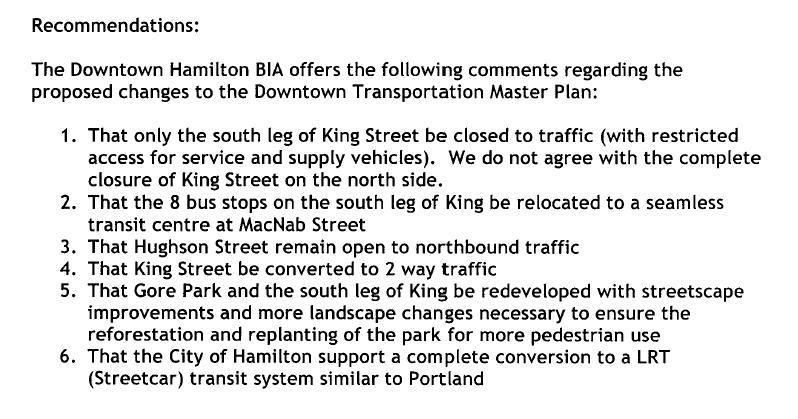
From the Downtown BIA....


Reply With Quote
     
     
  #180  
Old Posted Jun 8, 2008, 10:50 PM
Millstone Millstone is offline
Registered User
 
Join Date: Feb 2008
Location: Port Colborne, ON
Posts: 889
King be converted to 2-way in which part?
Reply With Quote
     
     
This discussion thread continues

Use the page links to the lower-right to go to the next page for additional posts
 
 
Reply

Go Back   SkyscraperPage Forum > Regional Sections > Canada > Ontario > Hamilton > Urban, Urban Design & Heritage Issues
Forum Jump


Forum Jump


All times are GMT. The time now is 3:57 PM.


Powered by vBulletin® Version 3.8.7
Copyright ©2000 - 2026, vBulletin Solutions, Inc.