HomeDiagramsDatabaseMapsForum About
     

Go Back   SkyscraperPage Forum > Regional Sections > Canada > Atlantic Provinces


Reply

 
Thread Tools Display Modes
     
     
  #16421  
Old Posted Jul 29, 2025, 2:58 PM
irisheyes irisheyes is offline
Registered User
 
Join Date: Jul 2025
Location: Saint John, New Brunswick
Posts: 78
Quote:
Originally Posted by sailor734 View Post
Well, to each their own, but even with a bunch of apartment buildings it would be pretty far down my list of attractive places to live.
Fairville Blvd. is not designed for residential development really at all. Just bizarre. We are talking an arterial strip. Developments like the Aquarius are really anti-urban-design and anti-community.

We seem to forget that we have the Main Street West corridor that IS geared toward pedestrians and should really be viewed as "Downtown Lancaster" in a sense. But of course to avoid these pitfalls requires a level of care and sophistication we simply do not have at city hall.
Reply With Quote
     
     
  #16422  
Old Posted Jul 29, 2025, 4:10 PM
adamuptownsj adamuptownsj is online now
Registered User
 
Join Date: Aug 2020
Location: Saint John NB
Posts: 1,992
A road diet on Fairville would be nuts. There's gigantic medians that could easily be expanded into multi-use, if there was anything approaching a need, but closing up the centre lane of a street with lots of left hand turns into businesses on both sides would be damaging. Compare to Main Street, where there's precisely nothing. Manawagonish is right there, too.

If the city's going to spend any energy on building up a 'walkable core' in Lancaster, it should try and densify the area roughly bounded by McKiel Street, Moosehead, Ready Street, and Catherwood Street. You're starting from a much healthier position than in, for example, King West or the Old North End. There's restaurants, a couple of bars, existing apartments, etc. The vacant lots here are gaps in an existing street... isn't that where we should prioritize mixed-use? Rather than try and cold-start King Street West or something?

About 14,000 people live between City Line and South Bay/the Martinon bypass. 2,500 live below City Line, and just over 3,000 west of the bypass.

Some form of rapprochement with the west side is needed, after the decade-plus of bridge work and isolation. But it should be carefully thought out.
Reply With Quote
     
     
  #16423  
Old Posted Jul 29, 2025, 4:48 PM
ell ell is offline
Registered User
 
Join Date: Jun 2025
Posts: 18
Quote:
Originally Posted by adamuptownsj View Post
Some form of rapprochement with the west side is needed, after the decade-plus of bridge work and isolation. But it should be carefully thought out.
Agreed! Extending Harbour Passage alongside or underneath Harbour Bridge would be a huge improvement for the west side.
Reply With Quote
     
     
  #16424  
Old Posted Jul 29, 2025, 4:50 PM
bingun bingun is online now
Registered User
 
Join Date: Dec 2024
Posts: 1,047
I have mixed feelings about Fairville Boulevard. On one hand, it has some of the best access to services and retail in the city, but it's also really not designed or intended to be a residential area, and it is not somewhere I would live unless I had little other choice. Perhaps they could make some pedestrian improvements without altering the road itself; that would be my preference.

Also, remember the mosque is trying to build an apartment building just down from Aquarius Towers, and I think it was of a similar size. Although I haven't seen any activity there, I assume that's not happening this year.

Other underutilized lots along that north side could go a similar way, and then perhaps the southern side retains the retail focus.
Reply With Quote
     
     
  #16425  
Old Posted Jul 30, 2025, 5:17 AM
cdnguys cdnguys is online now
Registered User
 
Join Date: Sep 2010
Posts: 2,325
Unbsj

Reply With Quote
     
     
  #16426  
Old Posted Jul 30, 2025, 11:32 AM
nwalbert nwalbert is offline
Registered User
 
Join Date: Mar 2008
Posts: 773
Quote:
Originally Posted by sailor734 View Post
Well, to each their own, but even with a bunch of apartment buildings it would be pretty far down my list of attractive places to live.
I totally agree with you, it wouldn't be for me either, lol. However I have always lived in suburban residential. I think as the city densifies and we have more people who want a more urban setting, it has potential as less expensive options to the uptown core.
Reply With Quote
     
     
  #16427  
Old Posted Jul 30, 2025, 11:33 AM
nwalbert nwalbert is offline
Registered User
 
Join Date: Mar 2008
Posts: 773
Quote:
Originally Posted by irisheyes View Post
Fairville Blvd. is not designed for residential development really at all. Just bizarre. We are talking an arterial strip. Developments like the Aquarius are really anti-urban-design and anti-community.

We seem to forget that we have the Main Street West corridor that IS geared toward pedestrians and should really be viewed as "Downtown Lancaster" in a sense. But of course to avoid these pitfalls requires a level of care and sophistication we simply do not have at city hall.
It would certainly be cool to see one of these developments get built on Main Street West.
Reply With Quote
     
     
  #16428  
Old Posted Jul 30, 2025, 11:35 AM
sailor734 sailor734 is offline
Registered User
 
Join Date: Apr 2023
Posts: 2,633
I see council gave third reading to the Sand Cove road project on the site of the old Seawood school. I have to say I'm of two minds about projects like this in mature neighbourhoods. On one hand this seems to be a decent proposal with some buffers and greenspace. On the other hand I have to wonder if the neighbourhood wouldn't be better served by more moderate densification.....things like garden homes, duplexes and/or 2 story condo units with 4-6 units in each.
Reply With Quote
     
     
  #16429  
Old Posted Jul 30, 2025, 11:53 AM
cdnguys cdnguys is online now
Registered User
 
Join Date: Sep 2010
Posts: 2,325
Quote:
Originally Posted by sailor734 View Post
I see council gave third reading to the Sand Cove road project on the site of the old Seawood school. I have to say I'm of two minds about projects like this in mature neighbourhoods. On one hand this seems to be a decent proposal with some buffers and greenspace. On the other hand I have to wonder if the neighbourhood wouldn't be better served by more moderate densification.....things like garden homes, duplexes and/or 2 story condo units with 4-6 units in each.
Cities need to grow upwards to be sustainable. IMO
Reply With Quote
     
     
  #16430  
Old Posted Jul 30, 2025, 3:13 PM
adamuptownsj adamuptownsj is online now
Registered User
 
Join Date: Aug 2020
Location: Saint John NB
Posts: 1,992
There's gobs of lots on Main W/Prospect/etc that you could fit 12-to-24-unit, 3-4-storey stick frames with ground floor commercial on, no problem. In some of the more residential areas, duplicating those newer 6plexes between Church and McKiel seems like an easy infill project. Are a lot of these lots JDI/Moosehead owned or something?
Reply With Quote
     
     
  #16431  
Old Posted Jul 30, 2025, 3:58 PM
sailor734 sailor734 is offline
Registered User
 
Join Date: Apr 2023
Posts: 2,633
Quote:
Originally Posted by adamuptownsj View Post
There's gobs of lots on Main W/Prospect/etc that you could fit 12-to-24-unit, 3-4-storey stick frames with ground floor commercial on, no problem. In some of the more residential areas, duplicating those newer 6plexes between Church and McKiel seems like an easy infill project. Are a lot of these lots JDI/Moosehead owned or something?
Yeah, in what used to be "downtown" Fairville (Main between Ready and Church) there are both vacant lots and some buildings that could be replaced with that kind of 3-4 floor commercial with residential over type of thing.

Edit Although, the retail/commercial stuff west seems pretty centered on Fairville Boulevard these days. I guess that's not to say there wouldn't be room for both.

Last edited by sailor734; Jul 30, 2025 at 4:14 PM.
Reply With Quote
     
     
  #16432  
Old Posted Jul 30, 2025, 5:27 PM
cdnguys cdnguys is online now
Registered User
 
Join Date: Sep 2010
Posts: 2,325
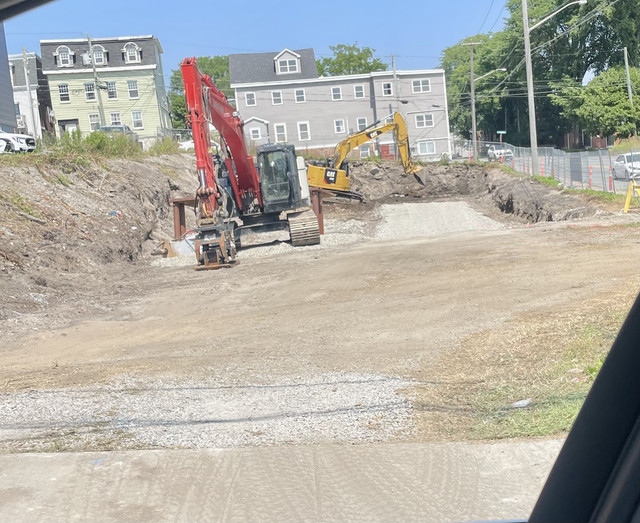
Leinster at Crown

Reply With Quote
     
     
  #16433  
Old Posted Jul 30, 2025, 6:22 PM
cdnguys cdnguys is online now
Registered User
 
Join Date: Sep 2010
Posts: 2,325
I saw this posting on a Saint John Facebook group today (I can’t credit because they posted anonymously). I find it intriguing and wondering if anyone has opinions on the following:

- are we building architecturally significant buildings today? I feel IOL HQ had a lot of thought put into it. The Wellington is interesting and I personally love the Bauhaus style of SW building of Fundy Quay and the design of the podium for other Fundy Quay buildings. Do you think they will contribute to Saint John’s beauty in the future, or be considered soulless?
- would a building built in Saint John be nicer because of surrounding landscapes? For example, is it possible SW Fundy Quay building looks nicer because it’s on the harbour at the bottom of a hill, and would it be “uglier” if the exact same building was on Assomption Blvd in Moncton? Like are our surroundings complimenting our buildings?
- in hindsight was heritage preservation legislation an excellent idea for city? Do you think we would have experienced what Halifax went through with losing so many historic buildings?


How economic doldrums saved Saint John, and why people are attracted to the city today

In the first half of the 19th century, Saint John experienced significant booms. This was fueled by seaborne commerce, shipbuilding, the timber trade and a population surge during the Irish famine. By 1851, Saint John was the third largest city in British North America. Saint John was fortunate to boom at a time when buildings were a reflection of civic pride and there was care about the appearance of buildings, focusing on ornamentation, craftsmanship and historical continuity. Architectural styles like Gothic Revival, Italianate and Queen Anne were popular, reflecting a desire for aesthetic beauty and a connection to the spirit of the people who built them. This is evident with the gargoyles, bricks and beams, stone work and grandeur you see in uptown buildings. In contrast, some Canadian cities rapidly expanded from the 1980’s to today, which was a time marked by a shift to contemporary designs and the desire for functionality. Practicality took precedence over ornamentation. Although some of these cities have pockets of historical buildings, they can lack the sense of architectural richness found throughout Saint John. Saint John entered economic doldrums in the 20th century, especially from the 1970’s to 2010’s despite the frigate program at Saint John shipbuilding. Peaking in population of just under 90,000 in 1971, the population declined to 68,000 in the early 2000’s as residents moved to the surrounding bedroom communities and there was a lack of influx of new residents. During this time there was very little investment in Saint John, which ironically was our saving grace. Aside from pockets of urban renewal in areas considered at the time to be slums, the economics were not favourable to tear down old buildings to build new offices and apartment buildings like in Halifax. Halifax is a similar historical city like Saint John, however of the 8,931 historical buildings present in 1878, only 1,143 have survived – an attrition rate of 87.2%. This lack of tearing down of buildings left Saint John with a historical landscape second to Quebec City. The recognition that we have something special reemerged in 1982 with the creation of the Trinity Royal Heritage Conservation Area. Since then uptown Saint John is recognized as a national treasure – with the unique and beautiful spaces of theatres, restaurants, cafes, bars and Georgian-era parks such as King’s Square, Queen Square and Loyalist Burial Ground. Over the last few years the population of Saint John surged, with the city itself just under 80,000 and the greater Saint John area approaching 150,000. New residents are coming for new job opportunities, driven by the recently expanded port and the health and social services sector, among others. But with job opportunities across Canada, what specifically is attracting new residents to put down roots in the city? One of the main reasons is everybody yearns for some beauty in their life, and our buildings in Saint John are beautiful and inspiring. According to multiple studies, there is a measurable emotional attachment to places that are beautiful. There is a strong correlation between a place’s physical beauty and people’s satisfaction out of many other attributes. Aesthetic attraction to a city is the third most important factor, even scoring above education, safety and basic services. In addition, Saint John has beautiful neighborhoods stretching along the bays and rivers on the west, north and east points of the city that many are not aware of. When thinking of Saint John, most outsiders picture uptown or industry, not knowing of the leafy waterfront neighborhoods that stretch for over 30 KMs offering among the best boating waterways in North America. Halifax is famous for it’s passenger ferries, but did you know Saint John has car ferries operating connecting neighborhoods along the Kennebecasis Bay? There are many spots in this beautiful city that you can pause and be inspired, whether it’s on the iconic Prince William Street streetscape, a historical square laid out in the pattern of the Union Jack flag, a cliffside neighborhood overlooking the water or a cozy enclave tucked away in a cove. In many cities that recently rapidly expanded, you wouldn’t look at strip malls and think how inspiring it is, as it’s rather soulless. Many cities lost touch with the beauty of the past, but due to economic circumstances of the past, Saint John luckily has her beauty preserved. Now we are experiencing an economic boom, but paired with our preserved beauty making it an ideal place to call home. When you’re walking down a historical block in the fog, and you hear the haunting fog horn in the bay, you’ll know you are in a special place.
Reply With Quote
     
     
  #16434  
Old Posted Jul 30, 2025, 11:01 PM
sailor734 sailor734 is offline
Registered User
 
Join Date: Apr 2023
Posts: 2,633
Quote:
Originally Posted by cdnguys View Post
I saw this posting on a Saint John Facebook group today (I can’t credit because they posted anonymously). I find it intriguing and wondering if anyone has opinions on the following:

- are we building architecturally significant buildings today? I feel IOL HQ had a lot of thought put into it. The Wellington is interesting and I personally love the Bauhaus style of SW building of Fundy Quay and the design of the podium for other Fundy Quay buildings. Do you think they will contribute to Saint John’s beauty in the future, or be considered soulless?
- would a building built in Saint John be nicer because of surrounding landscapes? For example, is it possible SW Fundy Quay building looks nicer because it’s on the harbour at the bottom of a hill, and would it be “uglier” if the exact same building was on Assomption Blvd in Moncton? Like are our surroundings complimenting our buildings?
- in hindsight was heritage preservation legislation an excellent idea for city? Do you think we would have experienced what Halifax went through with losing so many historic buildings?


How economic doldrums saved Saint John, and why people are attracted to the city today

In the first half of the 19th century, Saint John experienced significant booms. This was fueled by seaborne commerce, shipbuilding, the timber trade and a population surge during the Irish famine. By 1851, Saint John was the third largest city in British North America. Saint John was fortunate to boom at a time when buildings were a reflection of civic pride and there was care about the appearance of buildings, focusing on ornamentation, craftsmanship and historical continuity. Architectural styles like Gothic Revival, Italianate and Queen Anne were popular, reflecting a desire for aesthetic beauty and a connection to the spirit of the people who built them. This is evident with the gargoyles, bricks and beams, stone work and grandeur you see in uptown buildings. In contrast, some Canadian cities rapidly expanded from the 1980’s to today, which was a time marked by a shift to contemporary designs and the desire for functionality. Practicality took precedence over ornamentation. Although some of these cities have pockets of historical buildings, they can lack the sense of architectural richness found throughout Saint John. Saint John entered economic doldrums in the 20th century, especially from the 1970’s to 2010’s despite the frigate program at Saint John shipbuilding. Peaking in population of just under 90,000 in 1971, the population declined to 68,000 in the early 2000’s as residents moved to the surrounding bedroom communities and there was a lack of influx of new residents. During this time there was very little investment in Saint John, which ironically was our saving grace. Aside from pockets of urban renewal in areas considered at the time to be slums, the economics were not favourable to tear down old buildings to build new offices and apartment buildings like in Halifax. Halifax is a similar historical city like Saint John, however of the 8,931 historical buildings present in 1878, only 1,143 have survived – an attrition rate of 87.2%. This lack of tearing down of buildings left Saint John with a historical landscape second to Quebec City. The recognition that we have something special reemerged in 1982 with the creation of the Trinity Royal Heritage Conservation Area. Since then uptown Saint John is recognized as a national treasure – with the unique and beautiful spaces of theatres, restaurants, cafes, bars and Georgian-era parks such as King’s Square, Queen Square and Loyalist Burial Ground. Over the last few years the population of Saint John surged, with the city itself just under 80,000 and the greater Saint John area approaching 150,000. New residents are coming for new job opportunities, driven by the recently expanded port and the health and social services sector, among others. But with job opportunities across Canada, what specifically is attracting new residents to put down roots in the city? One of the main reasons is everybody yearns for some beauty in their life, and our buildings in Saint John are beautiful and inspiring. According to multiple studies, there is a measurable emotional attachment to places that are beautiful. There is a strong correlation between a place’s physical beauty and people’s satisfaction out of many other attributes. Aesthetic attraction to a city is the third most important factor, even scoring above education, safety and basic services. In addition, Saint John has beautiful neighborhoods stretching along the bays and rivers on the west, north and east points of the city that many are not aware of. When thinking of Saint John, most outsiders picture uptown or industry, not knowing of the leafy waterfront neighborhoods that stretch for over 30 KMs offering among the best boating waterways in North America. Halifax is famous for it’s passenger ferries, but did you know Saint John has car ferries operating connecting neighborhoods along the Kennebecasis Bay? There are many spots in this beautiful city that you can pause and be inspired, whether it’s on the iconic Prince William Street streetscape, a historical square laid out in the pattern of the Union Jack flag, a cliffside neighborhood overlooking the water or a cozy enclave tucked away in a cove. In many cities that recently rapidly expanded, you wouldn’t look at strip malls and think how inspiring it is, as it’s rather soulless. Many cities lost touch with the beauty of the past, but due to economic circumstances of the past, Saint John luckily has her beauty preserved. Now we are experiencing an economic boom, but paired with our preserved beauty making it an ideal place to call home. When you’re walking down a historical block in the fog, and you hear the haunting fog horn in the bay, you’ll know you are in a special place.
That's an interesting question. What's the happy medium between preserving heritage buildings (or renovating/repurposing them in a sensitive way) and not turning into some sort of historic display, frozen in time?
I mean, done right, today's modern architecture is tomorrow's heritage preservation district.

Edit. Just a note to the original FB poster but the Partridge Is fog signal was discontinued in 1999
Reply With Quote
     
     
  #16435  
Old Posted Jul 31, 2025, 12:32 AM
cdnguys cdnguys is online now
Registered User
 
Join Date: Sep 2010
Posts: 2,325
Quote:
Originally Posted by sailor734 View Post
That's an interesting question. What's the happy medium between preserving heritage buildings (or renovating/repurposing them in a sensitive way) and not turning into some sort of historic display, frozen in time?
I mean, done right, today's modern architecture is tomorrow's heritage preservation district.

Edit. Just a note to the original FB poster but the Partridge Is fog signal was discontinued in 1999
I live on Orange and hear a fog horn. I think it’s Courtney bay or beyond it. In fact went off this morning
Reply With Quote
     
     
  #16436  
Old Posted Jul 31, 2025, 11:18 AM
bridgeoftea's Avatar
bridgeoftea bridgeoftea is offline
Registered User
 
Join Date: Nov 2021
Posts: 687
Quote:
Originally Posted by cdnguys View Post
I live on Orange and hear a fog horn. I think it’s Courtney bay or beyond it. In fact went off this morning
Live in the North End and can hear it any time it's remotely foggy.
Reply With Quote
     
     
  #16437  
Old Posted Aug 1, 2025, 1:07 AM
EnvisionSaintJohn's Avatar
EnvisionSaintJohn EnvisionSaintJohn is online now
New Brunswick, Canada ⛵️
 
Join Date: Apr 2023
Location: Canada's first City 🍁🌊
Posts: 3,769
Courtenay Bay Breakwater: Saint John's answer to Dublin's Great South Wall?🚢🌊🏭

Live on the West Side, and can definitely hear a fog horn sometimes, and can also see the spotlight from Partridge Island. Courtenay Bay Breakwater Lighthouse would make sense as the location for the foghorn.

I think there's a great opportunity for a walking trail on the Courtenay Bay Breakwater, as its much more stable than the Partridge Island breakwater, and would cost a lot less to safely open up to the public.


This still from a drone video really shows the similarity between Dublin's Great South Wall and the Courtenay Bay Breakwater


I think Courtney Bay Breakwater could be Saint John's version of Dublin's "Great South Wall" which is also connected to a nitty, gritty industrial area. 🏭

The Bayside generating station's smokestacks aren't quite as huge as the Poolbeg smokestacks in Dublin, but there's definitely a similarity... except for of course, Courtenay Bay breakwater being completely inaccessible to the public. 😅

As I understand, it's port owned land, but Irving owns the land it's connected to... it wouldn't exactly be hard for them to maintain a public trail from Little River Beach to the end of the breakwater.


Dublin's Great South Wall, Poolbeg lighthouse, and Poolbeg Stacks in the background.

Last edited by EnvisionSaintJohn; Aug 1, 2025 at 11:08 AM.
Reply With Quote
     
     
  #16438  
Old Posted Aug 1, 2025, 12:03 PM
sailor734 sailor734 is offline
Registered User
 
Join Date: Apr 2023
Posts: 2,633
Quote:
Originally Posted by bridgeoftea View Post
Live in the North End and can hear it any time it's remotely foggy.
Very weird. The CG List of Lights, Buoys and Fog Signals doesn't seem to list any horns closer than Musquash Head. I'm obviously missing something
I wonder where it is?


https://publications.gc.ca/collections/collection_2024/mpo-dfo/Fs151-9-2024-01-eng.pdf
Reply With Quote
     
     
  #16439  
Old Posted Aug 1, 2025, 2:10 PM
EnvisionSaintJohn's Avatar
EnvisionSaintJohn EnvisionSaintJohn is online now
New Brunswick, Canada ⛵️
 
Join Date: Apr 2023
Location: Canada's first City 🍁🌊
Posts: 3,769
Quote:
Originally Posted by sailor734 View Post
Very weird. The CG List of Lights, Buoys and Fog Signals doesn't seem to list any horns closer than Musquash Head. I'm obviously missing something
I wonder where it is?


https://publications.gc.ca/collections/collection_2024/mpo-dfo/Fs151-9-2024-01-eng.pdf
Maybe the port operates one separately from the Coast Guard? You can definitely hear a fog horn from the West Side. Would like to find out where it is.
__________________
Peace and Athabasca and Coppermine and Slave, And Yukon and Mackenzie—the highroads of the brave. Saskatchewan, Assiniboine, the Bow and the Qu'Appelle, And many a prairie river whose name is like a spell. They rumor through the twilight at the edge of the unknown, "There's a message waiting for you, and a kingdom all your own. — Bliss Carman
Reply With Quote
     
     
  #16440  
Old Posted Aug 1, 2025, 2:21 PM
sailor734 sailor734 is offline
Registered User
 
Join Date: Apr 2023
Posts: 2,633
Quote:
Originally Posted by EnvisionSaintJohn View Post
Maybe the port operates one separately from the Coast Guard? You can definitely hear a fog horn from the West Side. Would like to find out where it is.
I don't think that would matter. That publication includes privately maintained aids in the list as well.(Canaport, LNG Terminal, Irving docks in Courtney Bay etc) You see "priv" under the remarks column.

Maybe someone more knowledgeable about port operations today can chime in? Google searches only turn up the history and that the Partridge Is horn was discontinued in 1999
Reply With Quote
     
     
This discussion thread continues

Use the page links to the lower-right to go to the next page for additional posts
 
 
Reply

Go Back   SkyscraperPage Forum > Regional Sections > Canada > Atlantic Provinces
Forum Jump


Forum Jump


All times are GMT. The time now is 12:33 PM.

     
SkyscraperPage.com - Privacy Statement - Top

Powered by vBulletin® Version 3.8.7
Copyright ©2000 - 2026, vBulletin Solutions, Inc.