Downtown Albuquerque News had a story this morning confirming that the Silvermans and Geltmore have plans and are under contract to purchase the Wells Fargo building and convert most of it to residential use. They say they will create between 100 and 120 units of affordable/workforce housing in the upper floors of the structure. They will retain and enhance the commercial uses on the ground floor. They also say that they expect Wells Fargo to maintain its operations and branch in the structure, which the bank expressed a desire to do so in the sale listings.
An even more exciting thing revealed in the story is that Geltmore also has early plans for two more highrise structures on the southern half of the property, where a giant parking lot exists now. They say that this will be for a hotel and more residential uses, such as condos. They say that both structures may be taller than Albuquerque Plaza, and thus the new tallest structures in the state!
https://downtownalbuquerquenews.com/
Quote:
Wells Fargo building is under contract and slated for residential conversion, new retail
Project would be the first of its kind in the core post-pandemic
A second phase, with two new and taller buildings immediately to the south, is contemplated
New residents seen as key to Downtown's future
Geltmore, the developer behind the Imperial Building and Ex Novo's new location at Seventh and Central, is under contract to purchase the Wells Fargo building and plans to turn 85 percent of it into apartments, company principals Adam and David Silverman confirmed Wednesday. The remainder would be dedicated to ground-floor retail, installing new entertainment and hospitality ventures in a corner of Downtown known mainly for government office buildings and courthouses.
Though the firm has been looking at buying the building for over two years, it only signed the purchase agreement in July. It expects to take full possession sometime next year following an extended due diligence period.
If everything goes according to plan, a massive renovation of the 1973 building will then begin. The to-do list includes asbestos removal, plus all-new plumbing, electrical, and mechanical systems. Somewhere between 100 and 120 apartments would be constructed - an array of studios, one-bedroom, and two-bedroom units. That would work out to about 10 units per floor: The building has 14 stories, but the fourteenth is dedicated to mechanical equipment and the first would be reserved for commercial space.
Assuming 110 total units and an average of 1.5 residents per unit, the project would singlehandedly increase the Downtown core's population by about 12 percent.
The units would be rented to households bringing in between 80 and 100 percent of the area median income, a category typically known as "workforce housing," meaning about 40 percent of the project could be financed through federal low-income housing tax credits. (For a family of two, the AMI in Bernalillo County is about $69,000, according to Freddie Mac.)
What exactly the ground floor will look like when the project is completed is still to be determined. Adam Silverman said he plans to block out space for a restaurant and some offices. Wells Fargo is expected to keep a bank branch, ATM, and some office space there, he added.
Silverman did not disclose the price of the building but did allow that it combined with the remediation and renovation would come to $50-60 million. He added that while a vast majority of the financing has already been identified, it will be necessary to find public funding to get to 100 percent. Possible sources include industrial revenue bonds and grants from the state, county, and city. Silverman said conversations with possible public funders are ongoing.
The building had previously been identified as a prime redevelopment target by the Middle Rio Grande Housing Collaborative, which estimated that $15 million in public "gap" financing would be required to finish the project.
Cobbling together multiple funding sources into what is known as a "capital stack" is standard procedure for major development projects. The Imperial Building, which opened in 2016, had 12 different funding sources.
"We would imagine this to be very similar," Silverman said. "It's going to take a lot of helping hands to complete the largest office-to-residential conversion ever completed in the state of New Mexico."
Albuquerque's other prominent office-to-residential conversion project, a tower located at Central and San Mateo, involves about 30,000 fewer square feet than the Wells Fargo building.
Renovating office towers into apartments is widely seen as an economic slam dunk for downtown areas across the nation in a post-pandemic era of remote and hybrid work (DAN, 10/17/24). At a stroke, such projects remove commercial space that is often vacant or vastly underused, take a bite out of the housing supply crunch, and install a customer base in city centers that are always hungry for more pedestrian footfall and consumer spending - all while neatly ducking the sorts of political pushback and zoning restrictions common in neighborhoods where detached single-family homes are the norm.
But the construction itself is far from easy to pull off. Plumbing in tall office buildings is generally directed to a few isolated spots per floor, HVAC is highly centralized, and the internal walls are often in the wrong places if apartments are the goal. Many buildings are so wide that it is difficult for natural light to reach deep into the interior of whatever apartment might be built there.
The Wells Fargo building, however, offers at least some advantages on this front, Silverman said. Its width is thin enough to avoid the natural light problem. The center area also contains large air ducts that won't be needed in the new arrangement because HVAC will be handled mostly by individual units in the apartments. The space can thus be used to run new pipes and wires instead.
Another advantage: Besides one law firm and a suite of offices used by Wells Fargo, there are no tenants.
"Ninety-five percent of the building is vacant," Silverman said.
Once begun, construction should last about 18 months, meaning it could finish in 2027 if all goes well, he added.
Geltmore also believes the location itself to be ideal. At Second and Lomas, future tenants will enjoy easy access to the future Rail Trail, I-25, and what is generally seen as a quieter side of Downtown, Silverman said.
The renovation of the Wells Fargo building is in the advanced preparatory stage, but that building takes up only the north end of the 5.3-acre property, meaning Geltmore has plenty of space to dream. Silverman envisions two new buildings on the land - both taller than the Wells Fargo structure - that would be home to more apartments (possibly condos), a hotel, office space, a parking structure, and more ground-floor retail. Both of the buildings would potentially be taller than all others in the Downtown core - and thus, the state.
The new buildings are all but guaranteed to require additional public funding, though Silverman argues such money should be thought of as an investment capable of both contributing to Downtown revitalization and boosting the city's tax base.
It is not the first time Geltmore has proposed a new skyscraper. About eight years ago, the firm backed a proposal to construct a building called Symphony Tower on a city parking lot just north of Civic Plaza - part of a competition launched by Mayor Richard Berry. The project was scrapped by Mayor Tim Keller not long after he took office.
But things may be different now, not least because of the housing shortage. Geltmore hopes to begin preparations for the two new buildings as soon as the sale is closed next year.
"There have been no new skyscrapers built in Downtown in over four decades," Silverman said. "We want to assist in solving the housing crisis and this project is a start. It will also help to create a new vibe in that section of Downtown."
|

This is all very exciting and I hope that the city, county and state will help them to realize this vision as much as possible. I hope Mayor Keller gets his head out of his @ss and will realize that projects such as these are a public benefit in and of themselves. Remember that he canceled the Skyline Competition RFP and Geltmore's winning Symphony Tower proposal because he said he didn't think it provided enough of a public benefit.
Remember also that he issued the Civic North RFP a few years later for the proposed site of the Symphony Tower only to cancel it as well because he said each of the projects wanted too much public funding and help for their projects. The Silvermans and Geltmore re-submitted their Symphony Tower proposal to that RFP and renamed it as The Duke.
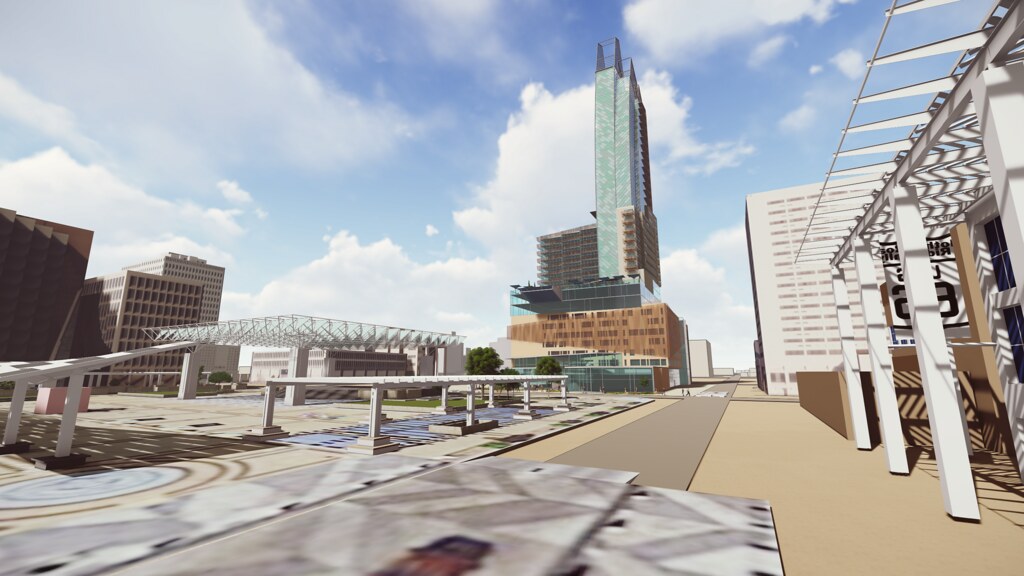
Clearly, they are interested, motivated and hope to bring a new tallest building to fruition in Albuquerque. They just need help to do so, which most every city across the country which has built a new tallest recently has done to bring those projects to fruition, such as El Paso and Omaha, both of which are in our size range.
A reminder that Albuquerque Plaza itself also received government help to come to fruition 34 years ago. Can anybody imagine Albuquerque and our skyline without it now??
People here get tattoos of it, murals feature it, it's on our police uniforms, government and company logos, etc. Pics of it in the skyline are on almost every local company or organization's website or social media account. Quite ironically, even the NIMBY groups and those opposed to height have it on their Facebook or other social media pages. It's the most common symbol of our city. Only San Felipe de Neri Church in Old Town and the KiMo Theater in Downtown come close to rivaling it in representing our city.
The tallest building is a powerful symbol and representation of a city. It becomes vital to that city’s reputation, vibe and image to the rest of the world.
Our city and downtown area need projects such as these to point to as progress and proof that our area is advancing and not stuck in the past or mired in a malaise. We have tons going on all across the city and plenty to look forward to, we just need to add something that's very visible to easily point to and show this progress, development and prosperity that we are having.
Downtown Albuquerque's skyline is the face of our city and region, how awesome it will be to have two new tallest buildings to add to this view below!






 Prev
Prev






















 Linear Mode
