HomeDiagramsDatabaseMapsForum About
     

Go Back   SkyscraperPage Forum > Regional Sections > Canada


Reply

 
Thread Tools Display Modes
     
     
  #121  
Old Posted Oct 27, 2023, 11:58 PM
theman23's Avatar
theman23 theman23 is offline
Registered User
 
Join Date: Apr 2007
Location: Ville de Québec
Posts: 6,278
.
__________________
For entertainment purposes only. Not financial advice.

Last edited by theman23; Oct 28, 2023 at 12:10 AM.
Reply With Quote
     
     
  #122  
Old Posted Oct 28, 2023, 7:15 PM
ssiguy ssiguy is offline
Registered User
 
Join Date: Mar 2006
Location: White Rock BC
Posts: 11,779
If Ottawa was serious about getting our housing crisis under control, which it most certainly isn't, then we must have a MASSIVE cut to our immigration levels. I'm not talking tinkering here but bring the level down to 100,000 a year and only applying to the most needed area ie healthcare. Businesses say they need the workers but a good chunk of the reason we don't have enough is due to our soaring population.

International student numbers should be chopped by 90% only allowing in the most needed professions ie engineers. If this means that it will hurt our colleges and universities then too damn bad. Canadians should not be living on the streets in order to keep our post-secondary institutions happy. If that means they have to start cutting some programs or reducing their bloated bureaucracy then so be it. Canada has the highest level of university attainment on the entire planet by a significant margin but it sure hasn't done much for our productivity levels as we continue to fall behind all of our Western peers.

I feel very sorry for the students who are being given false acceptance letters and the schools that do it should be forced to pay 100% of the student's loses, a $5000 fine going to the students for personal compensation, and pay for their airfare back. Other students who come here with valid acceptance but can't find housing I feel very little empathy for and they should NOT be entitled to any student housing as long as there are Canadian kids who can't find any. They say they are surprised or were lied to but these are suppose to be students who are entering university and college and yet they make a conscious decision not inform themselves on the Canadian housing situation. Just 10 minutes on Google would enlighten them but apparently that is too much to ask as it would take away 10 minutes from their crucial IPhone time with their BFF. Those that are already actively in school should be allowed to stay and complete their studies but all future applications should be cut by 90%.

Housing for Canadians must be our priority not educating the planet.
Reply With Quote
     
     
  #123  
Old Posted Oct 28, 2023, 8:27 PM
Nite's Avatar
Nite Nite is offline
Registered User
 
Join Date: Dec 2007
Location: Toronto
Posts: 3,332
Quote:
Originally Posted by Truenorth00 View Post
It really is an accomplishment to achieve Japanese birth rates without their infrastructure or social services.
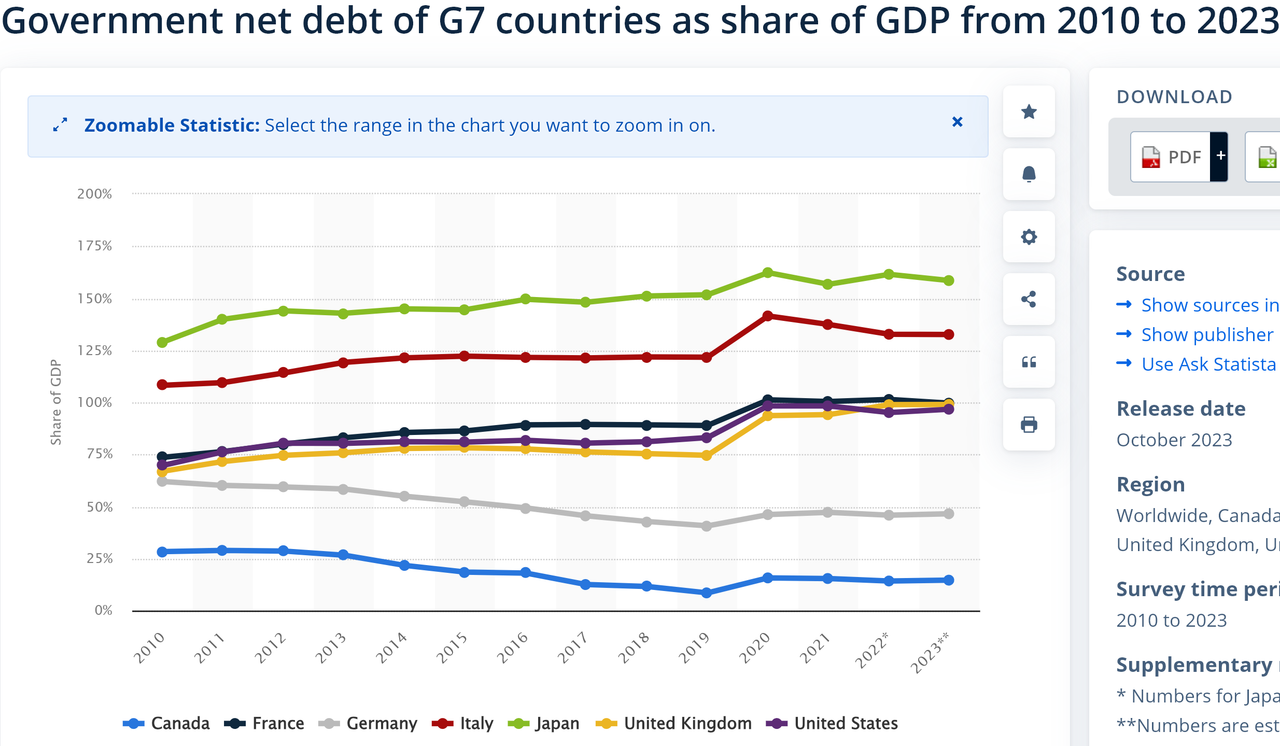
The quest is do Canadian want to take on the same level of debt as Japan to have the same type of infrastructure and social programs?
Canada would have to run a $300 billion deficit for 10 years to match the debt Japan currently has


Last edited by Nite; Oct 28, 2023 at 8:40 PM.
Reply With Quote
     
     
  #124  
Old Posted Oct 28, 2023, 8:47 PM
Nite's Avatar
Nite Nite is offline
Registered User
 
Join Date: Dec 2007
Location: Toronto
Posts: 3,332
Quote:
Originally Posted by ssiguy View Post
If Ottawa was serious about getting our housing crisis under control, which it most certainly isn't, then we must have a MASSIVE cut to our immigration levels. I'm not talking tinkering here but bring the level down to 100,000 a year and only applying to the most needed area ie healthcare. Businesses say they need the workers but a good chunk of the reason we don't have enough is due to our soaring population.

International student numbers should be chopped by 90% only allowing in the most needed professions ie engineers. If this means that it will hurt our colleges and universities then too damn bad. Canadians should not be living on the streets in order to keep our post-secondary institutions happy. If that means they have to start cutting some programs or reducing their bloated bureaucracy then so be it. Canada has the highest level of university attainment on the entire planet by a significant margin but it sure hasn't done much for our productivity levels as we continue to fall behind all of our Western peers.

I feel very sorry for the students who are being given false acceptance letters and the schools that do it should be forced to pay 100% of the student's loses, a $5000 fine going to the students for personal compensation, and pay for their airfare back. Other students who come here with valid acceptance but can't find housing I feel very little empathy for and they should NOT be entitled to any student housing as long as there are Canadian kids who can't find any. They say they are surprised or were lied to but these are suppose to be students who are entering university and college and yet they make a conscious decision not inform themselves on the Canadian housing situation. Just 10 minutes on Google would enlighten them but apparently that is too much to ask as it would take away 10 minutes from their crucial IPhone time with their BFF. Those that are already actively in school should be allowed to stay and complete their studies but all future applications should be cut by 90%.

Housing for Canadians must be our priority not educating the planet.
300,000+ workers retire every year in canada, how would you plan replace these workers, without more workers the Canadian economy would grind to a halt as firms would not be able to expand in Canada and move operations to other locations where works are available or go out of business.
What should the government response be to Canadian businesses who want to grow in Canada be??

How does your plans account for financing of higher education institutions in Canada?, tutions would have to go up by 2-5x or provinces would have to spend billions more on education instead of cutting which they have been doing.
Reply With Quote
     
     
  #125  
Old Posted Oct 28, 2023, 8:48 PM
lio45 lio45 is offline
BANNED
 
Join Date: Aug 2007
Location: Quebec
Posts: 44,901
https://en.m.wikipedia.org/wiki/Canadian_public_debt

Most recent figures (2021) Canada was at 117.2% of GDP, so right below Italy (red line on that graph).

(Third most indebted, behind Japan and Italy.)

BTW I’m open to seeing a more apples to apples comparison if anyone has more accurate figures for other peer countries.
Reply With Quote
     
     
  #126  
Old Posted Oct 28, 2023, 8:56 PM
Xelebes's Avatar
Xelebes Xelebes is online now
Sawmill Billowtoker
 
Join Date: Nov 2006
Location: Rockin' in Edmonton
Posts: 14,102
Quote:
Originally Posted by Nite View Post
300,000+ workers retire every year in canada, how would you plan replace these workers, without more workers the Canadian economy would grind to a halt as firms would not be able to expand in Canada and move operations to other locations where works are available.

How does your plans account for financing of higher education institutions in Canada?, tutions would have to go up by 2-5x or provinces would have to spend billions more on education instead of cutting which they have been doing.
300,000 retirees but we're letting in more than that. It really tells me that you are looking at lines without bringing much to offer. This thread is about housing, not lines on charts to dazzle other users.

If you want to talk about planning, financing, construction, distribution, that would be great. But stop with the lines and charts. After a certain point, they are off-topic.
__________________
The Colour Green
Reply With Quote
     
     
  #127  
Old Posted Oct 28, 2023, 9:01 PM
someone123's Avatar
someone123 someone123 is offline
hähnchenbrüstfiletstüc
 
Join Date: Nov 2001
Location: Vancouver
Posts: 35,304
Not sure where 300,000 comes from but it sounds like a plausible number for total retirees, not net change to the labour market. Canada had around 350,000 births last year and still has a slight natural increase overall. Employment grew by around 500,000 last year. Clearly whatever influx we are seeing is far above the break-even point.

We've been over it a million times but the main complaint is about the skills fit and volume of nonpermanent residents coming here. Maybe somebody thinks immigration in Canada should be cut off but I'm not sure I've ever read it on SSP. There does seem to be some confusion around immigration vs. nonpermanent migrants.
Reply With Quote
     
     
  #128  
Old Posted Oct 28, 2023, 9:06 PM
lio45 lio45 is offline
BANNED
 
Join Date: Aug 2007
Location: Quebec
Posts: 44,901
Quote:
Originally Posted by someone123 View Post
Canada had around 350,000 births last year and still has a slight natural increase overall.
Yeah, if ~300,000 people retire every year while ~350,000 young Canadians enter the workforce per year, I fail to see where there’s a problem there that requires the importation of an extra ~1,500,000 new suckers per year…?

(Unless, as discussed earlier multiple times, one sees “Canadian real estate is way too cheap right now” as a problem that needs to be actively fixed by the Feds.)
Reply With Quote
     
     
  #129  
Old Posted Oct 28, 2023, 9:10 PM
Nite's Avatar
Nite Nite is offline
Registered User
 
Join Date: Dec 2007
Location: Toronto
Posts: 3,332
Quote:
Originally Posted by Xelebes View Post
300,000 retirees but we're letting in more than that. It really tells me that you are looking at lines without bringing much to offer. This thread is about housing, not lines on charts to dazzle other users.

If you want to talk about planning, financing, construction, distribution, that would be great. But stop with the lines and charts. After a certain point, they are off-topic.
300,000 just replaces the workers we already have without adding any new jobs, this would be the amount we would need if our aim was for 0 economic growth.
Canada also added 550,000 new jobs in the last 12 months on top of the 300,000 who retired, with the unemployment rate staying steady at 5 +/- 0.5%.
Reply With Quote
     
     
  #130  
Old Posted Oct 28, 2023, 9:24 PM
someone123's Avatar
someone123 someone123 is offline
hähnchenbrüstfiletstüc
 
Join Date: Nov 2001
Location: Vancouver
Posts: 35,304
Quote:
Originally Posted by lio45 View Post
Yeah, if ~300,000 people retire every year while ~350,000 young Canadians enter the workforce per year, I fail to see where there’s a problem there that requires the importation of an extra ~1,500,000 new suckers per year…?
I think the whole idea that there's a number of workers metric we want to grow is wrong anyway. What matters is productivity. Our biggest problem is that we struggle to grow productivity in Canada. It is not surprising because we struggle to implement large-scale resource or value-add projects while investing a lot in residential real estate and bringing in people to do things like food delivery.
Reply With Quote
     
     
  #131  
Old Posted Oct 29, 2023, 6:12 AM
Loco101's Avatar
Loco101 Loco101 is offline
Registered User
 
Join Date: May 2013
Location: Timmins, Northern Ontario
Posts: 8,848
Quote:
Originally Posted by lio45 View Post
https://en.m.wikipedia.org/wiki/Canadian_public_debt

Most recent figures (2021) Canada was at 117.2% of GDP, so right below Italy (red line on that graph).

(Third most indebted, behind Japan and Italy.)

BTW I’m open to seeing a more apples to apples comparison if anyone has more accurate figures for other peer countries.
The debt levels showing are for national or federal governments only. The number for Canada is for the federal government only and same goes for the U.S..

The 117.2% you refer to is Canada's public debt to GDP ration which includes debt from provincial governments.

What's interesting is that Canada's public debt to GDP ratio used to be quite a bit higher than that of the U.S. until 9/11 happened and the U.S. ran huge deficits since then and now the U.S. has a higher public debt level per capita than Canada. The big difference between Canada and the U.S. in terms of public debt is that in Canada much of the debt growth was at the provincial level and in the U.S. it was at the federal level.
Reply With Quote
     
     
  #132  
Old Posted Oct 29, 2023, 7:03 AM
Loco101's Avatar
Loco101 Loco101 is offline
Registered User
 
Join Date: May 2013
Location: Timmins, Northern Ontario
Posts: 8,848
Reply With Quote
     
     
  #133  
Old Posted Oct 29, 2023, 3:40 PM
C3YVR C3YVR is offline
Registered User
 
Join Date: Jan 2020
Posts: 230
There is a USB Bubble Index that was posted in the City Discussions that is very interesting. If you want to learn the truth where Toronto and Vancouver stand (both today and over time) compared to other major cities I recommend downloading it and READ THE FULL REPORT. It shows how long a skilled service worker needs to work to buy a flat and how long it takes to rent a unit to pay for itself amongst other info. What many think on this forum and what is shown on the report might surprise some. (If they are willing to open their minds.)

Download the report on the link
https://www.ubs.com/global/en/wealth...ble-index.html
Reply With Quote
     
     
  #134  
Old Posted Oct 29, 2023, 3:42 PM
thewave46 thewave46 is offline
Closed account
 
Join Date: Aug 2013
Posts: 3,530
Quote:
Originally Posted by Loco101 View Post
The debt levels showing are for national or federal governments only. The number for Canada is for the federal government only and same goes for the U.S..

The 117.2% you refer to is Canada's public debt to GDP ration which includes debt from provincial governments.

What's interesting is that Canada's public debt to GDP ratio used to be quite a bit higher than that of the U.S. until 9/11 happened and the U.S. ran huge deficits since then and now the U.S. has a higher public debt level per capita than Canada. The big difference between Canada and the U.S. in terms of public debt is that in Canada much of the debt growth was at the provincial level and in the U.S. it was at the federal level.
This actually is probably a bigger problem.

The federal government has an advantage that lower levels of government don't - they control the money supply and can inflate their way out of debt (It's bad to do, but they can do it). Provinces are subject to the money supply decisions of the national government. The federal government also has more diversity in the overall economic base, being the product of multiple sub-national governments.

Provinces tend to have less diversity internally and are more prone to economic oscillations. If the price of commodities takes a hit, certain provinces suffer more. If the CAD$ spikes, the manufacturing/export industries suffer more. Liabilities weigh more on their budgets, relatively speaking.

Ultimately though, the headline number is the issue. Most Canadians live in provinces (a handful live in Territories), so bear the complete burden of government debt, regardless of the level of government that owes it. Newfoundland nearly defaulted during COVID, but the implicit guarantee of the federal government saved it, so the liability of debt seems a blurry concept at best.

A comparison to the country that has the world's reserve currency and most largest and most diverse economic base seems folly.
Reply With Quote
     
     
  #135  
Old Posted Oct 29, 2023, 4:41 PM
YOWetal YOWetal is online now
Registered User
 
Join Date: Oct 2006
Posts: 7,416
Quote:
Originally Posted by Nite View Post
300,000+ workers retire every year in canada, how would you plan replace these workers, without more workers the Canadian economy would grind to a halt as firms would not be able to expand in Canada and move operations to other locations where works are available or go out of business.
What should the government response be to Canadian businesses who want to grow in Canada be??

How does your plans account for financing of higher education institutions in Canada?, tutions would have to go up by 2-5x or provinces would have to spend billions more on education instead of cutting which they have been doing.
As below we also have new workers being added. Yes there will be some upward pressure on wages which will also bring more (new and old) workers into the labour market. If you can make $20 an hour working part time in the mall there won't be a shortage. Yes some of this is inflationary except we won't have 500,000 fake students chasing after the same housing.

I would in fact pay Universities and help them build residences so in 3-5 years we can be back in the good business of bringing in students and sending them back afterwards some of whom will stay as they make ideal immigrants on the whole but with some kind of criteria not simply inertia.

I say all this as someone who owns their home and has an investment property that has had students as tenants. If the younger millennials and Gen Z are too woke to demand what is obviously in their interest than don't blame us anymore.
Reply With Quote
     
     
  #136  
Old Posted Oct 29, 2023, 5:17 PM
thewave46 thewave46 is offline
Closed account
 
Join Date: Aug 2013
Posts: 3,530
Quickie math time:

Retirements in Canada (2023): ~307k

Number of Canadians entering the labour market (those born from 2000-2005, 18-23 years old): Between 329-345k, depending on year born, so let’s split the difference and call it 337k.

Alleged growth of jobs in past year (I can’t find a source, but I’ll take it at face value): 550,000.

Population growth 2022 from immigration: ~ 1 million. Operating under assumption that all migrants want employment.

So: (retirements + job growth) - (Canadians entering labour force + immigration)

= (307k+550k) - (337k+1m)
= 857k - 1.337m
= -480k

If under a very high job growth scenario we have an excess of nearly 1/2 million people per year relative to employment available, I am curious as to how long we need to sustain such a pace for population growth. If the job market falters, what then?

This is all very simplistic I admit, as the chronic worker shortages are of the skilled variety.

Reply With Quote
     
     
  #137  
Old Posted Oct 29, 2023, 7:21 PM
Atrial78 Atrial78 is offline
Registered User
 
Join Date: Dec 2022
Posts: 141
I think it's clear that Canada is bringing too many people in at this time (whether permanent or non-permanent). If we cannot house everyone then it does not matter how many retirements there are or how many jobs are created.

In addition, we cannot grow indefinitely. We do not have infinite resources to do so. Eventually, we will have to decide on a fair amount of immigration to maintain our population, rather than to simply keep growing.
Reply With Quote
     
     
  #138  
Old Posted Oct 30, 2023, 1:06 AM
P'tit Renard P'tit Renard is offline
Registered User
 
Join Date: Sep 2018
Location: WQW / PMR
Posts: 1,426
From Eric Lombardi's tweet of the G&M article:

To revive Canada’s economy, housing prices must fall, property investors must take a hit: https://www.theglobeandmail.com/busi...rices-economy/

“Shifting resources away from rent-seeking toward productive activities would cause short-term pain in the rent-earning part of the economy.

However, it would also improve the prospects of the broader economy accelerating.”

https://twitter.com/EricDLombardi/st...7Ctwgr%5Etweet
Reply With Quote
     
     
  #139  
Old Posted Oct 30, 2023, 1:28 AM
harls's Avatar
harls harls is offline
Mooderator
 
Join Date: Jan 2002
Location: Aylmer, Québec
Posts: 21,119
Quote:
Originally Posted by P'tit Renard View Post
From Eric Lombardi's tweet of the G&M article:
To revive Canada’s economy, housing prices must fall, property investors must take a hit:
Gatineau late to the party again, telling me that in 2024 my property is worth 55% more.
Reply With Quote
     
     
  #140  
Old Posted Oct 30, 2023, 4:18 AM
whatnext whatnext is offline
Registered User
 
Join Date: Feb 2009
Location: Vancouver
Posts: 26,731
Quote:
Originally Posted by Xelebes View Post
300,000 retirees but we're letting in more than that. It really tells me that you are looking at lines without bringing much to offer. This thread is about housing, not lines on charts to dazzle other users.

If you want to talk about planning, financing, construction, distribution, that would be great. But stop with the lines and charts. After a certain point, they are off-topic.
Nite is offering a masterclass in Casperization.
Reply With Quote
     
     
This discussion thread continues

Use the page links to the lower-right to go to the next page for additional posts
 
 
Reply

Go Back   SkyscraperPage Forum > Regional Sections > Canada
Forum Jump


Forum Jump


All times are GMT. The time now is 4:45 AM.

     
SkyscraperPage.com - Privacy Statement - Top

Powered by vBulletin® Version 3.8.7
Copyright ©2000 - 2026, vBulletin Solutions, Inc.