 Posted Feb 19, 2008, 7:30 PM
|
 |
Ferris Wheel Hater
|
|
Join Date: Jun 2006
Posts: 8,371
|
|
More info on the reef.
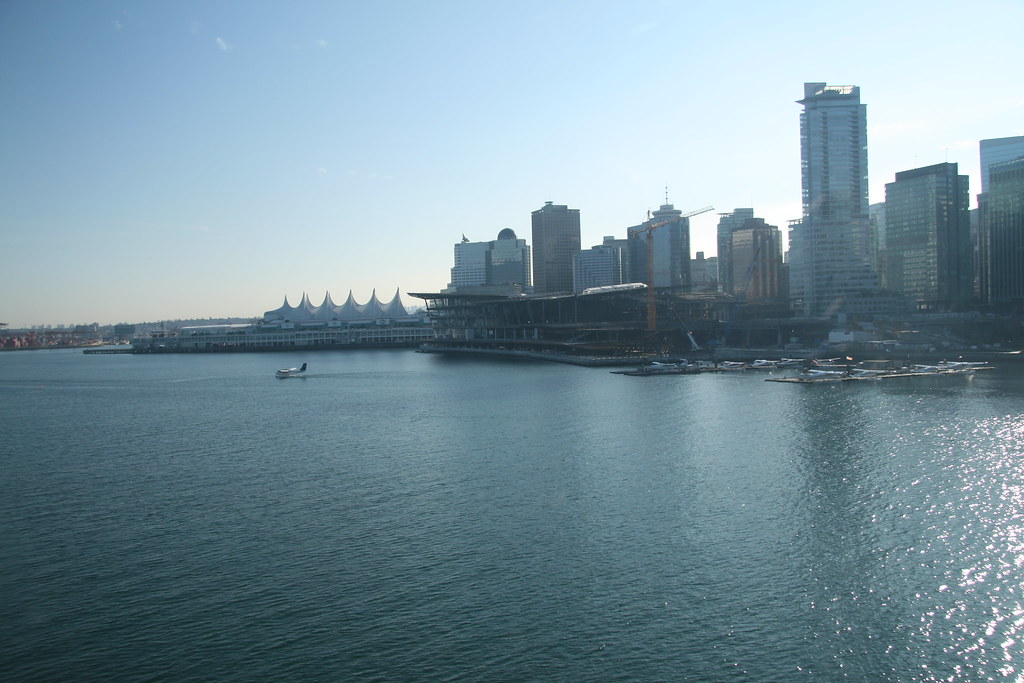
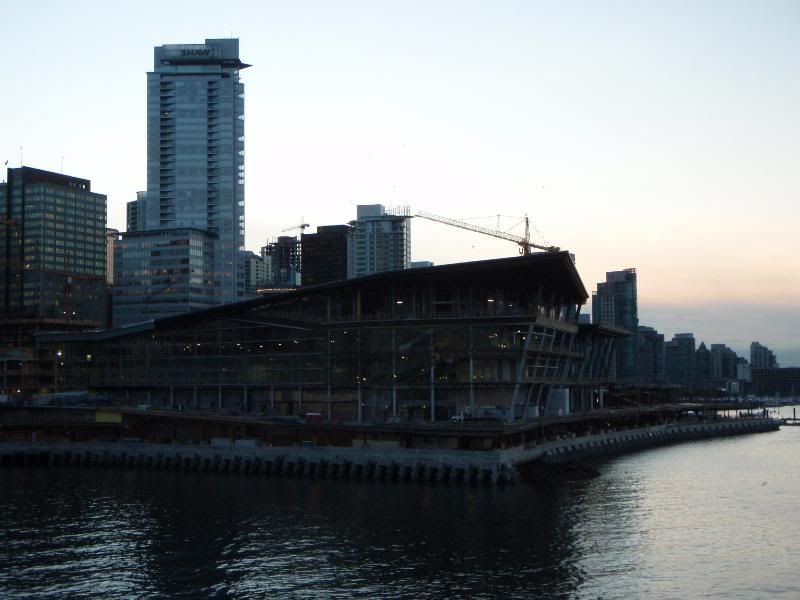
A new $8.3-million concrete reef -- or marine life "habitat skirt" -- should be swarming with new sealife within months around the base of the Vancouver convention centre expansion project.Barnacles, mussels, seaweed, starfish, crabs and various fish species are expected to inhabit the five-tiered underwater structure being installed this week.
"You'll see all kinds of marine life living there by this summer," convention centre environmental consultant Rick Hoos said in an interview. "It will take a couple of years for things to stabilize as various species compete for space.
"The strong guys will win out and the weak ones won't."
The Department of Fisheries and Oceans demanded the convention centre install the new marine life facility to replace the habitat displaced by the expanded centre.
The skirt looks like a set of bleachers dropped into the water, with 76 concrete frames weighing more than 36,000 kilograms each. The frames will accommodate 362 1.2-metre-by-6.4-metre horizontal slats that will attract marine life and contain their own 15-cm-deep tidal pools.
The lowest level of the structure will remain covered at low tide but upper levels will be clearly visible to the public much of the time.
Surespan Structures Ltd. general manager Jason Kearns, whose company built the frames in Duncan over the past five months, said the artificial reef contains a certain kind of concrete texturing that encourages marine life to attach itself.
He said the 3 1/2-day installation of the concrete frames should be completed late today, with the slats to be installed in about a month.
"Any person looking across from the Pan Pacific Hotel will definitely notice it because it's a real eye catcher," Kearns said.
Surespan operates a 12-hectare facility in Duncan, employing 80 to 100 workers. Previous company projects include temporary Canada Line bridges and bridges for the Olympic Nordic Centre in Whistler.
Hoos said the marine life project is part of the convention centre's goal to achieve a LEED (Leadership in Energy and Environmental Design) gold certification from the U.S. Green Building Council.
He expects the new marine environment near the convention centre will be considerably better than the one that existed before, as the site was a historic fill that contained a lot of contaminated material.
"We removed a lot of contaminated sediment and fill and rubble and things like old pavement and cables," Hoos said. "Marine life still tried to live on that stuff but it wasn't the best of environments for them."
He said all kinds of fish will love the concrete reef -- including sea perch, sticklebacks, flounder and baby salmon.
"Seals will absolutely come around to check it out, although we don't want too many predators there," Hoos said. "But that's nature. You can't keep predators from a site when there's food there."
He said the public walkway around the outside of the expanded convention centre will offer great views of the marine life habitat, with special viewing platforms in certain locations
Officials also plan to install underwater cameras that will provide marine life images that can be viewed at an information centre inside the convention centre. Cameras are also expected to provide images of the convention centre's 2.4-hectare "living roof" -- featuring Pacific Northwest vegetation.
"We hope when it's finished, schools will send busloads of kids down to tour all the environmental features," Hoos said.
A HOUSING PROJECT FOR MARINE LIFE
The 'habitat skirt' being constructed for the Vancouver convention centre expansion project is a bioengineered structure that uses a series of pre-cast, concrete benches designed for rapid colonization by a wide diversity of marine life throughout all levels of the intertidal zone.
76: Number of "stair-step" style concrete frames to be used in the skirt
36,000 kilograms: Weight of each concrete frame
Five months: Time it took to make those frames, at Surespan Structures Ltd. in Duncan
450,000 kilograms: amount of steel rebar used to reinforce those frames
2,000 cubic metres: amount of concrete used in the frames
46,000 square metres: Size of the surface area of the habitat skirt, roughly equal to six soccer pitches

|





 Prev
Prev






 Yeah.... well, if it's really going to be $80 million, you can bet it won't be that well received or make a whole lot of sense to a lot of people. Maybe it'll be cool and floodable like Shangri-la's art...





 Linear Mode
