Welcome to 'television city', home to the world's media
It's been called the most technologically advanced meeting facility in the world. Given its Olympic role, its builders had no other choice
By Bruce Constantineau, Vancouver Sun
October 21, 2009
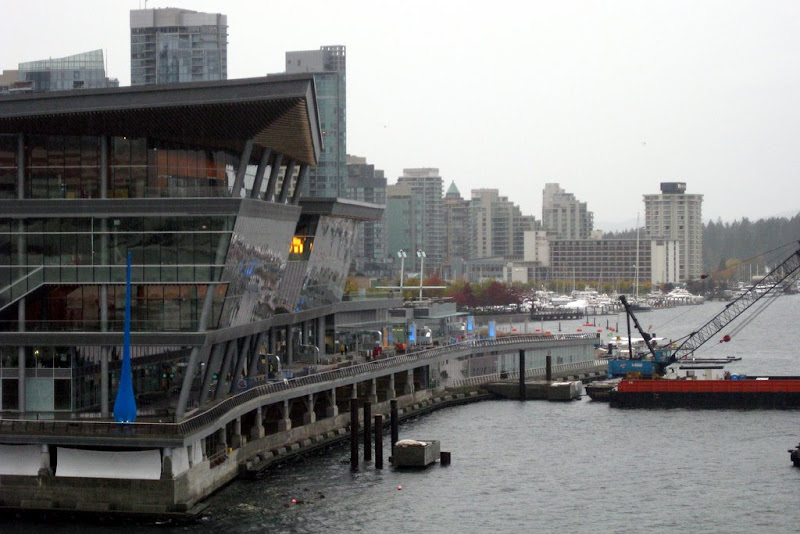
The Vancouver Convention Centre will become the world's largest broadcasting facility next year, supporting about 80 different telecasts when it becomes the International Broadcast Centre during the 2010 Olympics.
Millions of dollars are being spent on a state-of-the-art "television city" sprouting up within the centre that was turned over to the Vancouver Olympic Organizing Committee last week.
Glitches like dead air in the middle of an Olympics broadcast are still everyone's worst nightmare, but Greg Davey can't see that happening.
If it does, Bell Canada's Vancouver Convention Centre technology director doubts it will have anything to do with the convention centre itself -- arguably the most technologically advanced meeting facility in the world.
Bell, the official telecommunications provider to the 2010 Games, spent more than $10 million to ensure the centre has more than enough capacity for Olympic broadcasters and future major conventions.
There are 357 kilometres of copper communications cabling and 118 kilometres of air-blown fibre tubes throughout the venue and everything has been installed so a "Plan B" will kick in automatically if anything goes wrong.
"Instead of having one of everything, we have two and they take different paths," Davey said. "So we have two entrances to the building for the 432 strands of fibre that come in."
The excess capacity -- or redundancy -- and different routing systems will help broadcasters maintain their 10,000-plus hours of dedicated Olympic coverage if there's some kind of equipment failure or something happens to the building that affects transmission. A backup power generator will ensure electricity keeps flowing to the facility if regular BC Hydro power is knocked out.
Davey said a team of about 50 Bell Canada experts worked on the "complex solution" needed to solve the convention centre's telecommunications needs and at least two other Canadian companies provided significant input.
Belden Nordx provided the copper cable, while Nortel provided the phone systems, switches and Wi-Fi phones. Financially challenged Nortel fulfilled its commitment, in part, by building a special model that replicated the entire Olympic communications network.
"They built out the whole model in their California lab so when we actually did it here, we were doing it for the second time, which is always better," Davey said.
The 7,000 accredited broadcasters and technicians at the Games broadcast centre will have 8,000 jacks for network access, 350 Wi-Fi access points for mobile devices and Internet connection bandwidths of up to one gigabit per second.
The organizer of a major convention to take place at the facility in 2011 thought he was challenging the Vancouver centre when he said the event would need 15 to 20 megabits of bandwidth. The venue has more than 50 times that capacity.
"He couldn't believe it and he started looking at what he could do with that kind of capacity, compared with other convention centres," Davey said. "We can do things other places couldn't dream of doing.
"We can offer videoconferencing from any room in the building and that takes just a few minutes to set up."
Bell has built special network transmission lines from Vancouver to New York and from Vancouver to Seattle, and extended bandwidth to Los Angeles that can connect with international carriers and undersea cable.
Remote broadcast locations -- like NBC's daily Today Show, which will broadcast from Grouse Mountain -- will connect with the International Broadcast Centre through a fibre optic network.
Bell also has installed six high-definition-capable Bell Electronic News Gathering (BENG) boxes at the convention centre, which will allow camera crews to connect to a digital video network and send video around the world.
Similar facilities also will be provided for non-accredited broadcast media at Robson Square in Vancouver and Millennium Place in Whistler.
With less than four months to go before the Bell network is put to the ultimate test, Davey said he remains calm and confident about the whole process.
"These are my fourth Olympic Games so I've been through this a few times," he said. "A lot of the contacts I made at previous Games [in Athens, Turin and Beijing] will be showing up in my hometown, which is kind of fun."
[email protected]
© Copyright (c) The Vancouver Sun





 Prev
Prev






 Linear Mode
