Quote:
Originally Posted by Nouvellecosse

What I always enjoyed about Montreal . . .
|
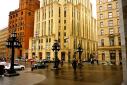
I also like the gaps for this reason and have always liked the multiple focal points. The experience of the city is complicated by these: downtown views often include these spaces and the identifiable groups of buildings "over there." Moving about heightens this even more. In Calgary/Vancouver you are largely inside the centre looking out or the opposite. In Montreal you can be in the centre and looking over at another part of the centre at the same time. Toronto has a similar thing but the scale is different/larger in size and distance (The Bloor area and downtown). Vancouver and Toronto also have a similar thing but at a more distant scale: downtowns and large suburban clusters.
As with buildings and local urban spaces, empty space is a big contributor to the dynamic experience of skylines. I find that this is a forgotten, not yet considered, or undervalued concept on this forum.
There is some relation to other kinds of formal compositions: white space in poetry, empty time in music and film, blank space in terms of figure ground in graphic composition, even in industrial design: clothing has heightened areas of intensity/detail/trim/colour (think of a simple shirt cuff) and more empty like extension (think of the sleeve); or the bodywork of a car: extension over the flat (relative) surface of the panels, and then the convolutions bendings, intensifications, and and additions of different materials at edges, openings, etc. Hopefully you're still awake, because this is also part of nature: take a femur: complexity at the ends where the action takes place, and 'empty' extension in between in order to put the complex parts where they need to be.
OK, I'm done - back to the fun stuff.
Almost forgot: all the construction in Montreal is exciting to see, but I agree that it is the start of the dismantling of this quality.





 Prev
Prev












 .
.





 Linear Mode
