Quote:
Originally Posted by Airboy

During the Klein years he pushed the Alaska Canada México trade route. That is why the highway from around Grande Prairie in the north to the Sweetgrass boarder crossing is 4 lanes.
Sections of the Alaska highway through the Yukon are being upgraded as well. Through Canada its Yukon Highway 1, BC 37, AB 43,16, 216 (or60&19), 3 and 4 to the border.
|
Ah yes, the "North-South Trade Corridor" - it's still referenced in government documents. I think the one missing piece from that time was that they didn't complete a more extensive highway renumbering program to have the route have a continuous number from Coutts to the BC border. AB 43 was rerouted from Donnelly to BC 2 via AB 34 & 2 (the old section is now the N-S section of AB 49), but that was it. In fact, the last major Canadian highway renumbering connecting the Lower 48 to Alaska was in the 1950s when BC 97 was created out of BC 5 through the Okanagan and BC 2 between Cache Creek & Dawson Creek in anticipation that the Yukon and Alaska would follow suit. With the completion of the Interstates, the US/BC 97 corridor functions as scenic travel route but not a realistic direct connection to Alaska, especially the southern portions through the Okanagan (north of Cache Creek is a different story).
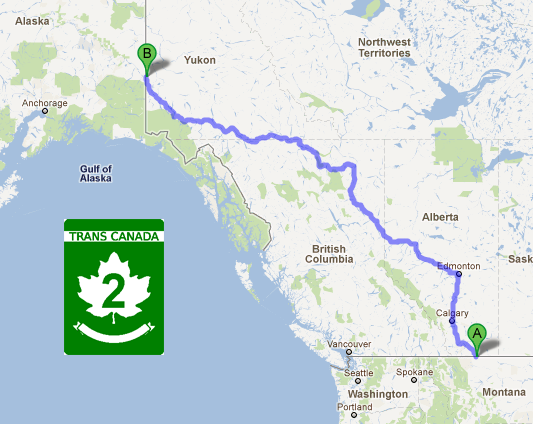
I think that AB 4/2/43, as well as BC 2 and the Alaska Hwy (BC 97 & YK 1) should be renumbered to TCH 2. The last major update to the Trans-Canada Highway was 30+ years ago when the Yellowhead Highway was added, and this could serve as a valuable addition. From a Canadian perspective, it would serve 4th & 5th largest metro areas and two capital cities. It would also directly pass through the Yukon and indirectly serve the NWT when accompanied by the Mackenzie Highway. From an international perspective, it would link I-15 with Alaska (AK 2) and would literally meet the definition of 'Trans-Canada' of crossing Canada. Distance wise, TCH 2 would be about 3,060 km while Yellowhead/TCH 16 is 2,860 km.





 Prev
Prev




 Linear Mode
