Wall Street Journal
Rebuilding Ground Zero
By STEVE MALANGA
May 12, 2007; Page A11
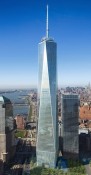
A few weeks ago, as Mr. Silverstein and I met at his headquarters on the 38th floor of 7 World Trade Center, the 52-story skyscraper that he quickly rebuilt just north of where the twin towers once stood, we could watch the reconstruction of the rest of the Trade Center site proceed. He pointed out to me the footprints of the three other office towers he is developing there and predicted with some confidence that the site, which will include a fourth skyscraper, the so-called Freedom Tower, as well as a new transportation terminal, will be completed within five years. "I just want to hang around until then to see this through to completion," the 75-year-old developer told me.
.........he built a 1.9 million square foot skyscraper -- the first 7 World Trade Center -- which nearly bankrupted him. Drexel Burnham Lambert planned to lease the entire tower but pulled out just days before signing the deal, when government investigations into the activities of the head of its junk bond department, Michael Milken, emerged as a threat to the firm's future growth. Drexel ultimately collapsed, and Mr. Silverstein was left without a major tenant until Salomon Bros. leased half the building two years later.
Yet despite that brush with failure, erecting 7 World Trade only sharpened his appetite for more.
"I remember at the topping out of 7 World Trade looking up at the twin towers and thinking, my building is huge, but it is made diminutive by the twin towers," he says. "So I said to myself, wouldn't it be incredible someday to own those?"
.........."After the attacks, I said to my wife, if you want to go sailing, I'll do that. If you want me to rebuild the Trade Center, I'll do that," says Mr. Silverstein. "And she said to me, you know you won't be satisfied with anything except rebuilding, so let's just get on with it."
Mr. Silverstein began planning for a new 7 World Trade -- which he controlled entirely and which had collapsed on 9/11 along with the towers -- barely a month after the attacks. Although in early 2002 Gov. Pataki and the head of the Lower Manhattan Development Corp. asked him to slow down preparations for rebuilding 7 World Trade to accommodate government planning for the rest of the site, he pressed ahead, putting shovels in the ground by May of that year and opening the tower for business in the spring of 2006.
"I simply did not listen to all the naysayers because I was spending my money, not theirs, and fortunately I had no government involvement in 7 World Trade, which gave me the opportunity to do what I do best," he says.
The agency charged with leading the redevelopment was torn by conflicting visions and tried to shoehorn as much as possible into their plan -- a museum, a memorial to the dead, a home for a major New York cultural institution, residential development and office space. Critics urged cutting back the office space to make room for these varied uses. In the midst of his re-election campaign, Mayor Bloomberg even declared that the market couldn't support new skyscrapers anyway.
Mayor Bloomberg threatened to withhold Liberty Bonds, which Congress had created to help finance reconstruction, while the vice chairman of the Port Authority called Mr. Silverstein "greedy" for not agreeing to the state's demands.
It is fitting that the final plan for Ground Zero owes such a debt to a private developer and the marketplace. The terrorists attacked the twin towers because they embodied the values of our democratic free-market economic system. The memorial that will rise on Ground Zero will make no reference to those values, nor seek to celebrate our way of life. Rather the memorial, in the way of postmodern monuments, will merely ask us to ponder the absence of those who died.
The real monument on the site will be its skyscrapers, and the buzz and hum of activity within them will celebrate the continuing triumph of the system that the terrorists attacked. "After five and a half years of laborious involvement in politics, we finally are at a point where we are building," says Mr. Silverstein triumphantly. "This is what I do."
http://online.wsj.com/article/SB117893280555400749.html



 Prev
Prev




 Linear Mode
