
 RESTORING AN ICON
The Southern Chiefs’ Organization’s Wehwehneh Bahgahkinahgohn project is transforming Winnipeg’s historic Hudson’s Bay building into a vibrant hub for housing, culture and economic opportunity – and setting a new standard for Indigenous-led urban revitalization.
By Kelly Parker
One of the most significant heritage retrofit projects in Canada – and a milestone in national reconciliation efforts and Indigenous-led urban revitalization – is underway. This transformative redevelopment of Winnipeg’s historic Hudson’s Bay building by the Southern Chiefs’ Organization (SCO), known as Wehwehneh Bahgahkinahgohn, was first covered in Build Manand since and since then the scope momentum of the project have only evolved.
The project, first announced in April 2022, represents a bold vision for reconciliation, urban renewal and economic empowerment. Once completed, Wehwehneh Bahgahkinahgohn – meaning “it is visible” in Anishinaabemowin – will feature:
- 373 housing units;
- 200 affordable housing units for First Nations citizens; and
- Office and retail spaces to foster First Nations entrepreneurship.
The redevelopment, led by SCO in partnership with multiple levels of government, aims to revitalize an iconic building into a space that prioritizes First Nations cultures, economic development and community services.
One major headline grabber has been the revised budget, with increasingly accurate budgeting bringing the total to $310 million, due in part to a sharp increase in materials costs. Beyond that, there have been other added features to the project. The project added more units – which was a large part of the new budget – and the construction manager, PCL, provided a budget that was much more accurate and not reliant on conceptual draft design and program elements.
Of course, the U.S. tariff situation and increasingly volatile global economics have also become part of the picture.
SCO Grand Chief Jerry Daniels says that the revised budget contains contingency to account for those potential unknown impacts, including “evolution of design and pricing, increased program, supply chain pressures, inflation and tariff threats on construction materials in addition to heritage building upgrades, structural reinforcements and modern energy-efficiency standards.”
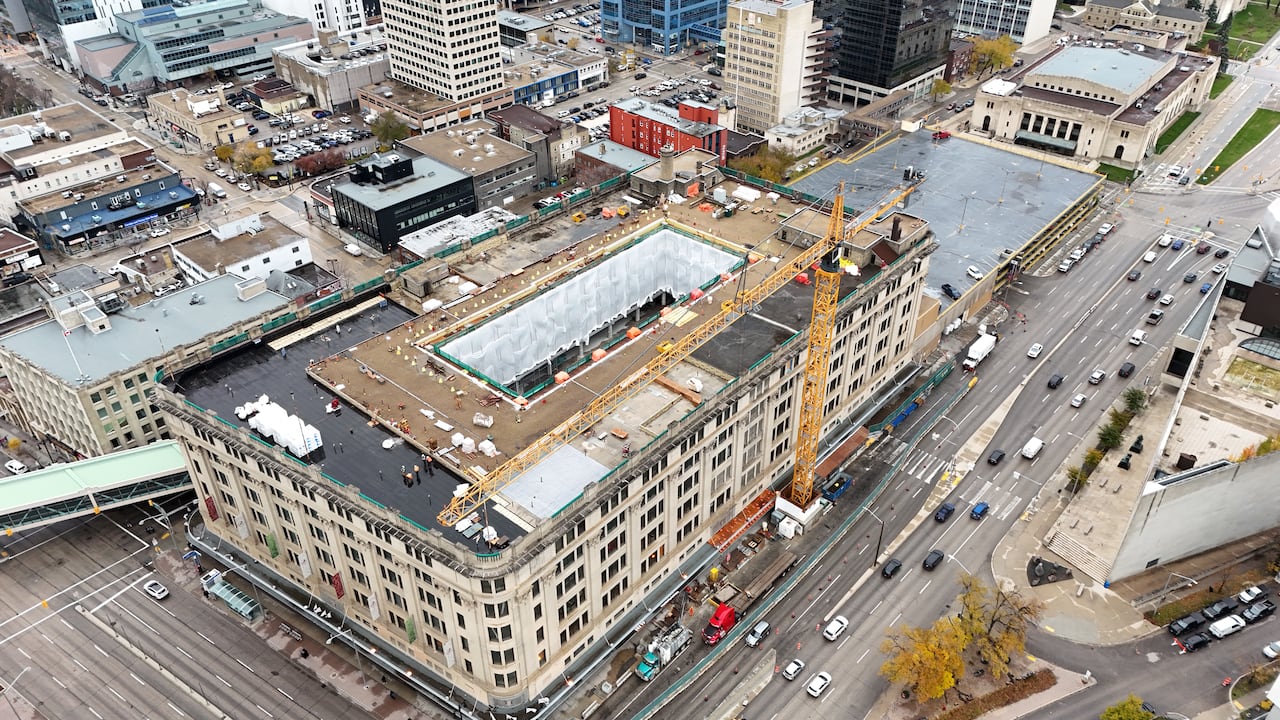
Although a drive-by of the former Hudson’s Bay building façade so well known to Winnipeggers doesn’t reveal much activity – apart from the construction crane on its west side – inside is a hive of activity. “Right now, we’re close to having interior demolition complete, which allows us to get in and get moving on the – call it interior work or renovation – says Kelly Wallace, vice president and district manager for PCL Construction’s Winnipeg District. “We are working through structural demolition that is opening up the centre for an atrium, which will probably be about 50-per-cent complete [in the next month or so].”
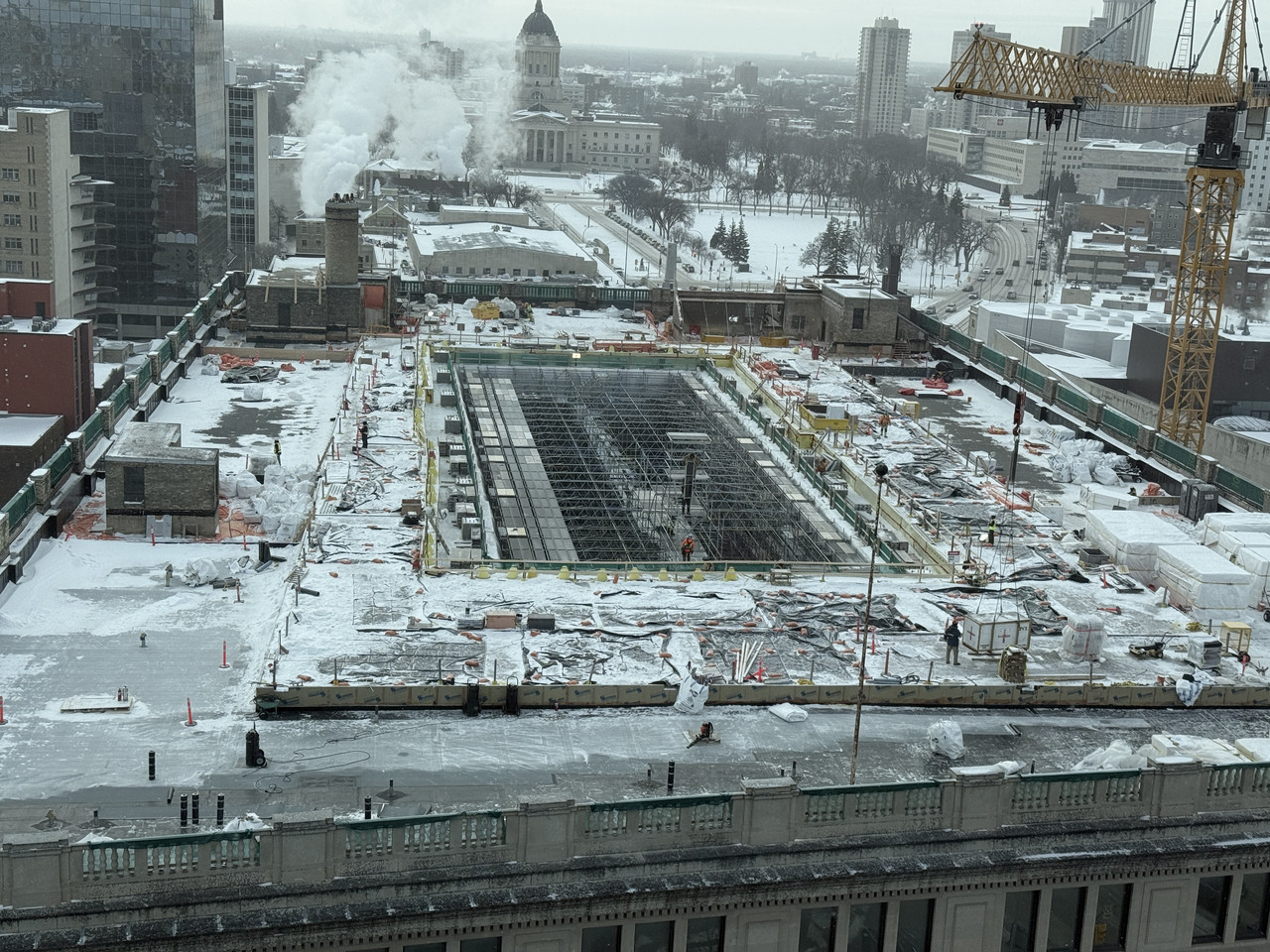
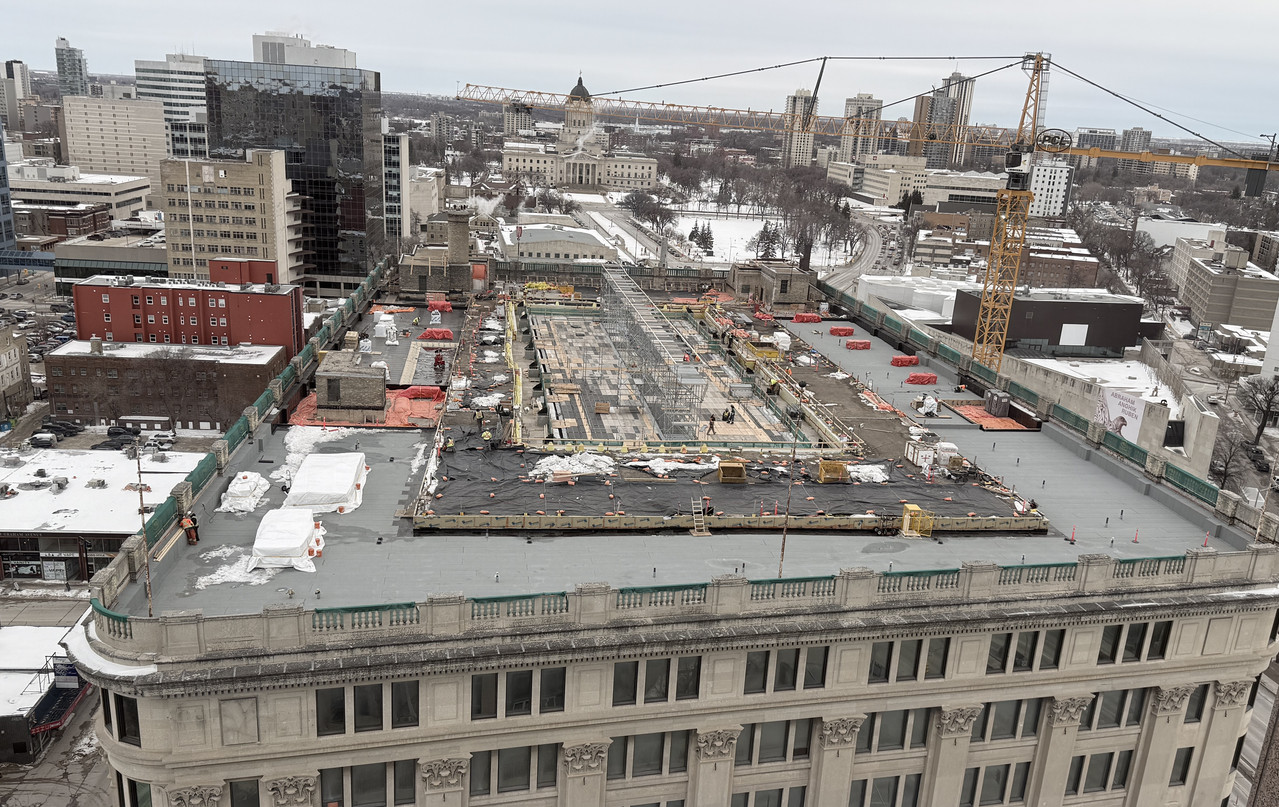
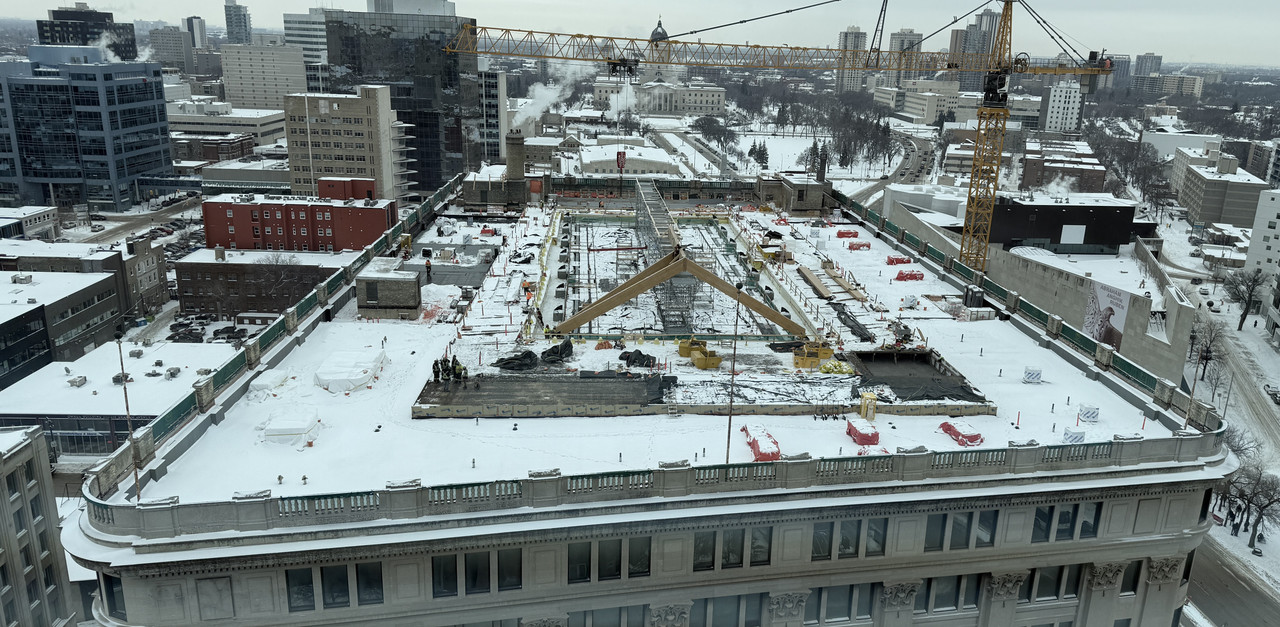
Wallace explains that there are two parts to the interior demolition. “First, we took the building back to its original base on the interior right Down to the bare structure, removing any asbestos or anything hazardous in the building,” he says. “Step two is more of a deconstruction. We’re essentially cutting an opening the size of a hockey rink, from the roof all the way down to the main floor. That’s what the tower crane is doing – it’s hoisting out the large pieces that we’re saw-cutting from the structure and removing all the pieces to make way for the new atrium.”
From the get-go, with this being a retrofit of a very old building, surprises have been expected along the way. The building has undergone plenty of renovating over the years, and original building codes are vastly outdated, uncovering the layers of previous renovations will inevitably reveal surprises.
“On the positive side,” says Wallace, “we discovered original terrazzo and hardwood flooring in several areas – elements that can be restored with a little TLC. This approach to sustainable adaptive reuse not only preserves character but also reduces waste and helps manage costs.”
“On the more complex side, as we continue to uncover the existing structure, we may encounter unexpected conditions," Wallace continues, "If and when we do our construction and design teams – including Number TEN Architectural Group, Crosier Kilgour and MCW Consultants – will address the conditions. “As with any project of this nature, planning for these situations is essential and part of a good management strategy.”
One of the most important aspects of the project is to prioritize employment opportunities for First Nations people wherever possible. “One of the things that we’re really focused on when we do First Nations work is, how do you increase the capacity of the First Nations members?” says Wallace. “How many people became apprentices during the course of construction, and then how many First Nations contractors were able to work on the job and actually grow so that they can do larger work in the future? That’s how we frame capacity building.”
To support this goal, the project is using Miikahnah Connect, a First Nations workforce recruitment app, which, to date, has led to Indigenous employees representing 77 per cent of the total workforce (combined prime and 155,400 worker hours as of June 2025.
“A significant number of that figure are members of the Nations that SCO represents,” says Daniels. “As much as we have been working on [employing] Indigenous workers – which includes the Métis, Inuit and all First Nations – we’ve also been very focused on the representatives from our Nations, and I think that’s a significant part of the work we’ve done.”
“We believe this is part of our journey to reconciliation,” says Wallace. “How do we work with our partners on these projects to grow their capacity because ideally, we want to work ourselves out of a job. I think that will tell a powerful story about what Manitoba has accomplished and hopefully sets the stage for what other regions can aspire to.”
The current timeline will see the suites completed in the summer of 2028 to allow for heritage preservation, sustainable construction and building for long-term community needs. At that point, Wallace says, “there might be some commercial areas we just waiting for fit-out based on tenant arrangements.”





 Prev
Prev














 Linear Mode
