HomeDiagramsDatabaseMapsForum About
     

Go Back   SkyscraperPage Forum > Global Projects & Construction > City Compilations


Closed Thread

 
Thread Tools Display Modes
     
     
  #8721  
Old Posted Jul 8, 2016, 5:44 PM
bunt_q's Avatar
bunt_q bunt_q is offline
Provincial Bumpkin
 
Join Date: Aug 2002
Location: Denver, CO
Posts: 13,203
Quote:
Originally Posted by mr1138 View Post
and having all that occupied square footage near the train station will generate better ridership than a commuter lot anyway. Hopefully RTD sees it the same way.
Do the math on that, it usually doesn't, not at the residential densities we build at. Nowhere close.

I assume RTD will require replacement parking somewhere. Might not be an issue, with the amount of retail in there, I am sure there's plenty of structured parking throughout. Surely enough to warrant a nasty streetsblog entry along the lines of "No development is better than development that accommodates the automobile, ahhh!"
     
     
  #8722  
Old Posted Jul 8, 2016, 6:26 PM
mr1138 mr1138 is offline
Registered User
 
Join Date: Nov 2004
Posts: 1,160
Quote:
Originally Posted by bunt_q View Post
Do the math on that, it usually doesn't, not at the residential densities we build at. Nowhere close.
While I admit I've never been able to get a 100% straight answer on how dense is "dense enough" to support transit, most estimates I've heard place the number somewhere between 25-50 DU/A or so (obviously there are a LOT of variables here).

Even a 5-story Texas Doughnut is in the range of 90-100 DU/A, and high-rises like the ones shown here are significantly higher. So even if it gets value-engineered into a bunch of boring full-block EIFS midrises as everybody fears, it should still be well above 50 DU/A after buildout.

Maybe my numbers are WAY off, but I have trouble seeing how the way we're building isn't dense enough to support transit. Viable levels of transit ridership exist in a lot of mid-rise neighborhoods, and shouldn't necessarily require Manhattan levels of density.
     
     
  #8723  
Old Posted Jul 8, 2016, 6:33 PM
bunt_q's Avatar
bunt_q bunt_q is offline
Provincial Bumpkin
 
Join Date: Aug 2002
Location: Denver, CO
Posts: 13,203
Density is the wrong measure. Look at actual units within 1/4 or 1/2 mile. And then estimate a reasonable percentage of how many of those occupants take transit.

Office isn't much harder - assume an employee per 200 square feet. And then a percentage of those who will arrive by transit (which is not unrelated to the parking rations associated with that office development). Although we do not have a very good track record with getting employees to take transit outside of the downtown core. Abysmal track record, really.

Retail, probably assume almost no transit usage, other than incidental usage by passing commuters. You can probably count on the fingers the number of transit riders each day whose destination is Park Meadows.
     
     
  #8724  
Old Posted Jul 8, 2016, 6:40 PM
mr1138 mr1138 is offline
Registered User
 
Join Date: Nov 2004
Posts: 1,160
Quote:
Originally Posted by bunt_q View Post
Density is the wrong measure. Look at actual units within 1/4 or 1/2 mile. And then estimate a reasonable percentage of how many of those occupants take transit.

Office isn't much harder - assume an employee per 200 square feet. And then a percentage of those who will arrive by transit (which is not unrelated to the parking rations associated with that office development). Although we do not have a very good track record with getting employees to take transit outside of the downtown core. Abysmal track record, really.

Retail, probably assume almost no transit usage, other than incidental usage by passing commuters. You can probably count on the fingers the number of transit riders each day whose destination is Park Meadows.
That all assumes that the mode share breakdown remains constant even as the urban form and changes character. From my experience, the exact opposite is true.
     
     
  #8725  
Old Posted Jul 8, 2016, 6:47 PM
mr1138 mr1138 is offline
Registered User
 
Join Date: Nov 2004
Posts: 1,160
Quote:
Originally Posted by bcp View Post
It's not so much the density or picking the right level for 1 or 10 projects....to have an impact you need sustained density in a half mile (min) radius...dropping to SFH on 1/4 acre lots won't cut it.
Very true, but I don't think anybody is suggesting that a single development (even of this scale) will radically change transit ridership overnight. It's just one puzzle piece. I personally wouldn't want that entire 1/2 mile radius developed all at once by a single developer anyway.

1/2 mile from this station doesn't even break beyond the current office park, and I think there's every possibility that this entire area could be rebuilt with high-density development eventually. We're talking about a LOT of units to make that happen, something I would expect would take at least 20-40 years. I think it's quite premature to declare this all a failure just because it didn't transform into the Fairfax-Clarendon corridor in the first 5-years.
     
     
  #8726  
Old Posted Jul 8, 2016, 6:51 PM
bunt_q's Avatar
bunt_q bunt_q is offline
Provincial Bumpkin
 
Join Date: Aug 2002
Location: Denver, CO
Posts: 13,203
Quote:
Originally Posted by mr1138 View Post
That all assumes that the mode share breakdown remains constant even as the urban form and changes character. From my experience, the exact opposite is true.
What experience is that? For 200 parking spaces to be replaced by 200 transit riders, you'd need upwards of 1000 residential units within that radius. We have nothing in Denver anywhere close to that. We generally count in the hundreds, not thousands.

Also, you - like most narrowly focused central Denverites - are looking only at what's immediately surrounding stations and that urban form. Take Broadway station. There is no change to urban form possible that is going to alter the status quo for residents of the Valverde, Barnum, Athmar Park and Westwood neighborhoods. For all of southwest Denver - people who live INSIDE the City and County of Denver, and are entitled to partake in downtown - the only feasible way for them to get to the light rail is to park at Broadway. Even if you were right that TOD could generate equivalent ridership - and in Denver, we have no evidence of that - ridership is not the only consideration. Parking is also about equitable access to transit and downtown for people who can't afford to pay $2400/month in rent to live on top of the station. Taking out 1000 parking spaces at Broadway to build 1,000 residential units is bad policy from my perspective - it will reduce ridership, and make it harder for a sizable portion of the city to use light rail. If we were going to build 5,000 or 10,000 residential units, I might think differently, but we won't...


Last edited by bunt_q; Jul 8, 2016 at 7:04 PM.
     
     
  #8727  
Old Posted Jul 8, 2016, 7:20 PM
PLANSIT's Avatar
PLANSIT PLANSIT is offline
ColoRADo
 
Join Date: May 2004
Location: Denver
Posts: 2,317
That's why it makes the most sense to focus in on the closer-in stations that have better connectivity to existing density, but also ability to add proper DUA in the future. We can wean ourselves off of parking slowly if we are able to develop correctly. This will just take time.

Decatur-Federal comes to mind as being able to generate more ridership while stripping parking. Currently there are like 1,900 spaces, but only parks a fraction of that (spaces were determined by modeling ridership). Walk-up ridership is low given that there aren't a lot of units nearby (Sun Valley has about 330 units) and Knox/Perry stations serving the neighborhoods to the west - most ridership comes from transfers and park-n-ride. With DHA's plans to build up to 1,000 units adjacent to the station, there seems to be an opportunity to both add proper density and reduce parking all while increasing ridership. Plus there is plenty of space to add even more density in the future.
     
     
  #8728  
Old Posted Jul 8, 2016, 8:01 PM
EngiNerd's Avatar
EngiNerd EngiNerd is offline
Registered User
 
Join Date: Sep 2005
Location: Englewood, CO
Posts: 2,003
Agreed, and the close in stations are more likely have people living around them that work downtown and actually would use the rail than someone who,say, lives at Parker and 225, works in the in the DTC, but wouldn't use the rail because the last mile transfer is basically non-existent, unless you like to ride a bike in your business attire.

I could see some of the ridership along the SE corridor drop if adequate cheap parking is not put in place with the new development, because let's face it, even when developments like Belleview Station are completed, the stations are still mostly PNR's, and will remain that way for the foreseeable future. I suppose the goal is to maybe shift some of those PNR's to other stations with more parking, like Arapahoe, but for some I imagine the inconvenience becomes too much that they will just drive instead of ride.
__________________
"The engineer is the key figure in the material progress of the world. It is his engineering that makes a reality of the potential value of science by translating scientific knowledge into tools, resources, energy and labor to bring them into the service of man. To make contributions of this kind the engineer requires the imagination to visualize the need of society and to appreciate what is possible as well as the technological and broad social age understanding to bring his vision to reality."
     
     
  #8729  
Old Posted Jul 8, 2016, 8:05 PM
mr1138 mr1138 is offline
Registered User
 
Join Date: Nov 2004
Posts: 1,160
I'm not sure where you got from anything that I said that I'm talking about eliminating commuter parking. Of course the parking would remain. That was how this whole topic came up - replacing park-n-rides with structured parking funded by development.

As for the single family neighborhoods, I actually have thought a lot about this, and I'm not sure there's any easy answer. Frankly, I feel a bit that those neighborhoods that resist up-zoning should reap what they sow. Stations should always still offer parking, but if the surrounding streets and access to that parking gets more difficult as a result of increasing density around the station, then so be it. Nobody ever said that suburban development patterns were sustainable.

I agree with PLANSIT that it's a gradual process. It takes decades for that much growth to happen, especially assuming it will be spread out across the entire system. I'm assuming that office will always be a component of these mixed-use districts, and so will retail. So many suburbs will gain their own local business districts at the same time that the larger urban network is growing. In this kind of time scale, people can push for supplementary transit systems like a local streetcar connecting suburban nodes together. And in this kind of time scale, a certain degree of self-sorting would certainly occur. People tend to move-in as close to their jobs as they can financially allow.

What I don't think is helpful is throwing the baby out with the bathwater because the perfect combination of circumstances isn't in place. The light-rail has some obvious design flaws. So do the buildings. But so do aspects of all cities. The way I see it, we can either wallow in self-pitty over it, or move on and see what can be done given the circumstances. Average commute times will likely continue to grow, and barring a major change in housing policy, patterns of gentrification will always continue; and those conversations should continue. But the system is not completely useless - far from it. And judging by the amount of Texas Doughnut construction happening near stations, and the prices they are getting for it, I'd say there is plenty of interest in living in these places.

Edit: The close-in stations definitely make the most sense to develop first I would agree. Though sometimes I'm surprised how other forces can make a far away location viable early on. Whether that be demand for new office space in the Tech Center, the pull of something like Stapleton or the Airport, or simply the pre-existing demand for housing in a city like Boulder (which may have a completed TOD neighborhood long before a train ever actually arrives). And the richer the system is, the more desirable it is for everyone living in that system. As more jobs and services pop up south of Broadway, the train gains usefulness even for those who aren't commuting all the way to downtown. Same goes for someone hypothetically living near Broadway, and commuting outward toward one of the new office buildings by Fiddlers Green, for example.

Last edited by mr1138; Jul 8, 2016 at 8:16 PM.
     
     
  #8730  
Old Posted Jul 8, 2016, 9:35 PM
mr1138 mr1138 is offline
Registered User
 
Join Date: Nov 2004
Posts: 1,160
Not to beat a dead horse, but I was thinking a bit about the numbers...

The development that spurred this discussion is proposing 1.7 million square feet of residential alone, which using a quick estimate of 1,000 square feet a unit (what the Census says is the current median for multi-family units), is 1,700 units. This is on a narrow strip along the highway barely .1 mile wide. And beyond this, within .5 mile (west of the freeway alone), are the several hundred units at Landmark, and acres and acres of additional development potential.

The Orchard Park-n-Ride has 48 parking spaces. For comparison, the Sheridan parking garage on the W-line accommodates 800 spaces, with room left on the block to be wrapped with development. It is definitely also possible to structure a large amount of parking, and still get a lot of units within .5 mile. Or, another way of looking at it, adding 48 spaces to a Texas Doughnut structure of 350 units (assuming a parking ratio of 1.0 per unit) would only increase that ratio to 1.14. I've seen much greater variations in parking ratio discussed on this forum.

Using an example that's already underway, Belleview Station has already built two Texas Doughnut apt. buildings with approximately 350 units each, and there are more multi-unit apartments nearby. Using Bunt's ratio, that would already add up to over 140 transit riders at a station that only has 59 commuter spaces. If the current pattern continues, and about half of everything in .25 radius is built as residential and "value-engineered" down to 5-story structures, we're still talking 1,700 units, and have the .5 mile radius left to go. This is not just a negligible difference in potential transit riders.
     
     
  #8731  
Old Posted Jul 10, 2016, 3:13 AM
Cirrus's Avatar
Cirrus Cirrus is offline
cities|transit|croissants
 
Join Date: Jul 2001
Location: Washington, DC
Posts: 18,718
Quote:
Originally Posted by bunt_q View Post
What experience is that? For 200 parking spaces to be replaced by 200 transit riders, you'd need upwards of 1000 residential units within that radius.
Do you have data on that, or is that a guess? I suspect you're generally right in saying the density floor to replace a PnR's ridership is probably often higher than Colorado will tolerate, but I'm interested in the number. It's something we've actually been looking at in real detail with my job. And in a different city with a different transit system, we've come up 0.7 transit trips per day for households that are within walking distance of transit stations.

That said, it's a little more complicated than straight up replacing parking spaces with units. If your TOD development improves the walk-to-transit conditions for nearby properties, you have to count that ridership impact too.
__________________
writing | twitter | bluesky | flickr | instagram | ssp photo threads
     
     
  #8732  
Old Posted Jul 10, 2016, 7:50 PM
Urbannizer's Avatar
Urbannizer Urbannizer is offline
Moderator
 
Join Date: Jan 2009
Location: Austin, TX / Portland,OR / Chicago, IL
Posts: 14,489
Greystar Speer St.

Quote:
Greystar Speer Street is a new mixed-use, urban residential development in the Golden Triangle neighborhood just outside of uptown Denver. The 16-story project includes 302 units, with 12,000 s.f. of retail at the street level anchored by an urban grocer and coffee shop at one corner and a restaurant at the other. The development is an elevated take on upscale urban living, with an extensive amenity level that features a Club Room, Aqua Lounge, Fitness Center, Dog Park, Community Room, WiFi Lounge and Morning Room, all culminating in a 14,275-s.f. deck whose pool offers spectacular views of the Rockies beyond.


__________________
HAIF
     
     
  #8733  
Old Posted Jul 11, 2016, 6:05 PM
corey corey is offline
Registered User
 
Join Date: Dec 2011
Posts: 269
Greystar Speer is very nice. For every cheapish looking apartment building going up in Denver I think there is a nice one as well. Especially appreciated since it is from an out of state developer. Often times non-local developers will build the crappier stuff.
     
     
  #8734  
Old Posted Jul 11, 2016, 6:17 PM
RyanD's Avatar
RyanD RyanD is offline
Fast. Fun. Frequent.
 
Join Date: Aug 2010
Location: Denver, Colorado
Posts: 2,988
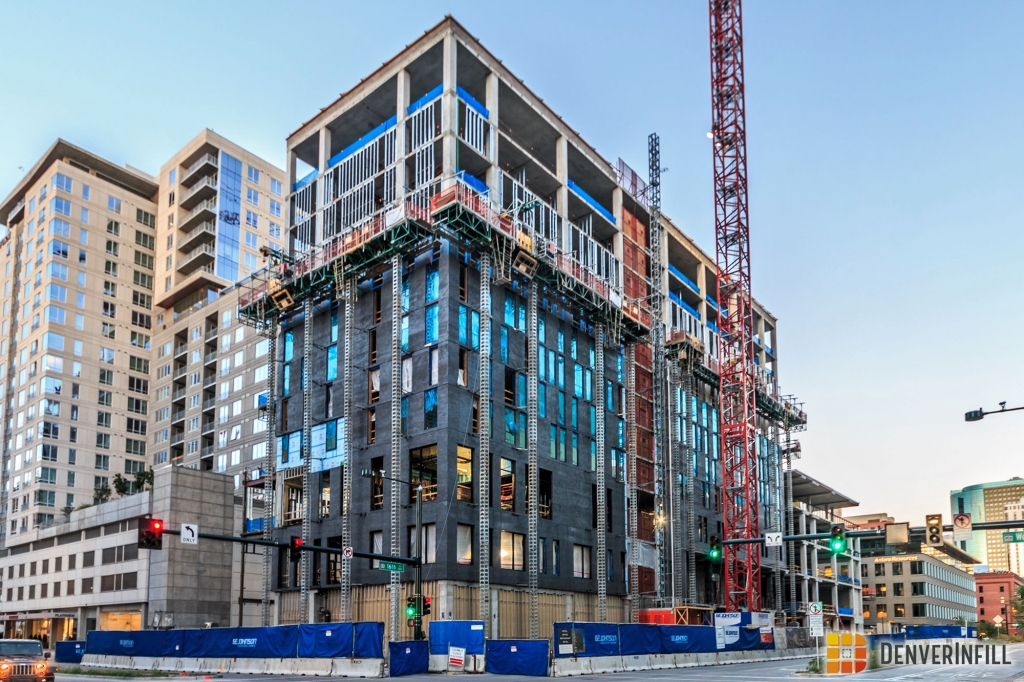
I like it. I'm worried about the big, brick-like chunky facade but we'll see how that comes out. Kind of like how we thought Confluence was going to be all glass, along with Eviva Cherokee. But I'll keep it positive until we see it!
__________________
DenverInfill
DenverUrbanism
--------------------
Latest Photo Threads: Los Angeles | New Orleans | Denver: 2014 Megathread | Denver Time-Lapse Project For more photos check out: My Website and My Flickr Photostream
     
     
  #8735  
Old Posted Jul 11, 2016, 8:35 PM
Interzen Interzen is offline
Registered User
 
Join Date: Feb 2013
Location: La Alma/Lincoln Park - Denver, CO
Posts: 356
Quote:
Originally Posted by Urbannizer View Post
I want to know where Speer Street is. It must be buried under Speer Blvd.
     
     
  #8736  
Old Posted Jul 11, 2016, 8:57 PM
jhwk jhwk is offline
Registered User
 
Join Date: Feb 2016
Posts: 101
Quote:
Originally Posted by Interzen View Post
I want to know where Speer Street is. It must be buried under Speer Blvd.
I want to know how expensive it will be to move Mt. Evans on top of Sloan's Lake like the first rendering shows. That's a lot of dirt to haul!
     
     
  #8737  
Old Posted Jul 11, 2016, 10:01 PM
Denver Dweller Denver Dweller is offline
Registered User
 
Join Date: Apr 2005
Location: Denver, CO
Posts: 828
Affordable housing construction underway on Broadway


  #8738  
Old Posted Jul 12, 2016, 4:33 PM
RyanD's Avatar
RyanD RyanD is offline
Fast. Fun. Frequent.
 
Join Date: Aug 2010
Location: Denver, Colorado
Posts: 2,988
__________________
DenverInfill
DenverUrbanism
--------------------
Latest Photo Threads: Los Angeles | New Orleans | Denver: 2014 Megathread | Denver Time-Lapse Project For more photos check out: My Website and My Flickr Photostream
     
     
  #8739  
Old Posted Jul 13, 2016, 3:20 PM
Stonemans_rowJ's Avatar
Stonemans_rowJ Stonemans_rowJ is offline
Registered User
 
Join Date: Apr 2013
Location: Hilltop
Posts: 391
Good morning, I have 5 RTD One Way Free Ride tickets, good for any zone, including airport zone.

They expire December 31, 2016.

Just don't think I'll be able to use them with a 1 year old and another baby arriving soon. Going to be staying put for awhile.

If you want them, PM your name and address and I will mail them to you. I'd prefer to send them to someone who would definitely use them!

***UPDATE Thanks, going to Agent Orange
__________________
JP

Last edited by Stonemans_rowJ; Jul 13, 2016 at 3:54 PM. Reason: update
     
     
  #8740  
Old Posted Jul 13, 2016, 3:48 PM
Agent Orange Agent Orange is offline
Registered User
 
Join Date: Sep 2004
Location: Denver, CO
Posts: 1,821
PM'd
     
     
This discussion thread continues

Use the page links to the lower-right to go to the next page for additional posts
 
 
Closed Thread

Go Back   SkyscraperPage Forum > Global Projects & Construction > City Compilations
Forum Jump


Forum Jump


All times are GMT. The time now is 10:11 PM.

     
SkyscraperPage.com - Privacy Statement - Top

Powered by vBulletin® Version 3.8.7
Copyright ©2000 - 2026, vBulletin Solutions, Inc.