Quote:
|
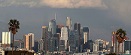
downtown la's got a decent collection of midrise architecture. still though, as with anything non-residential in this city, nothing groundbreaking (for example, no home insurance bdg or casa mila's, or ironically even, no dancing house) but standard urban design faire of the day is always welcome by my book - good contiguity, balanced setback, and human scaled.
|
Yes, those are the buildings I like best......built pre lifting of the earthquake restrictions.
Were you born in LA or did you move there from somewhere else?
Quote:
|
as i've stated before, i'm a big fan of craig ellwood's philosophy. he captures to me, the optimistic side of los angeles' suburban modernism before it became the contentious geopolitical issue of today. in a sense he fused modernism with flw's garden city spirit. elwood embraced the architect's duty to recognize the limitations of materials and rationality, such that the architect could understand first what he is working with in order to create spaces that are inspiring by the graceful efficiency through which they address real every day human needs. unlike gehry and most "brand name" architects of los angeles today, ellwood and his la contemporaries refused to hide behind style or remodel architecture into another branch of the visual arts (as gehry has unwittingly built an entire career on).
|
Form follows function? Ellwood is a pretty unorthodox pick which doesn't surprise me. He might not have been as concerned with elevating architecture because he wasn't an architect. Mavericks tend not to be too concerned with status. Some of Gehry's early work was not all that dissimilar to Ellwoods but his designs got more complicated as his status grew. I am not a fan of Gehry but I like some of his work.....like this building in NYC:
http://en.wikipedia.org/wiki/File:Beekman_Place_New_York.jpg
I like the texture and undulation of the curtain wall. Can't remember what the base looks like. Would have liked the building better had it narrowed more at the top.....and of course, its sheer mass and height overwhelm the surrounding buildings but I like what he did with the facade. Generally, I like smaller buildings.....not skyscrapers.
Quote:
|
every post and beam serves a structural and space-defining purpose that stands independently from whatever visual impact is extracted from (and yet balanced to) that function. there is a pleasing lightness to these spaces that results from each carefully proportioned beam, post, slab, and opening. ellwood, and other contemporaries like neutra or schindler more or less captured the spirit of la before architecture was bastardized by the prevailing spirit of hollywood commercialism and subsequently branded the "la school", as though there were a singular morality or conviction that unified likes of gehry, moss, and mayne the way the chicago or bauhaus architects were
|
.
Who do you think is guilty of bastardizing LA?
Quote:
so being the city of fabricated images, los angeles architecture inevitably departed from this kind of delicate material truthfulness into what is now just a bunch of crass visual one-upsmanship with only secondary concern for what was the primary object of commission (the building's purpose) to begin with.
modernism is now a stylized caricature of itself, like every other highly fashioned knock-off - la becoming the architectural equivalent of a cheap sound-byte compendium. little to no understanding or care for the true meaning of things
|
For me, architecturally, I think LA's best time was before WW II.......esp during the '30s when few American cities were building anything. Art deco and art nouveau became the defining architectural style for LA and Miami. Since WW II, I feel like the quality has gone downhill but I am not sure why.
Quote:
|
[I]so unfortunately there isn't much to be excited about in la. most critics rightfully note la's dearth of good architecture aside from it's collection of private craftsmen and modernist residences. even la's "brand name" buildings the latest of which is the bcam are mediocre failures when compared with projects by those very same architects elsewhere.
|
Wasn't aware of the bcam addition.........its awful. I don't know Piano, the architect, but I just looked at some of his work......and you're right, bcam doesn't even look like its by the same architect. You're bringing it back for me.........the annoyance I would feel every time a noted architect built in LA. I would like their prior work but be disappointed by their LA design. Something about LA seems to unnerve architects.
Quote:
|
think you're equating a cbd (district of primarily office buildings) with the much more general concept of an urban core. first of all, the word "downtown" has a different meaning in different places. in a relatively small city like bonn, "downtown" is large enough relative to the rest of town to capture the majority of the region's major cultural, business, and retail amenities - it's urban core and it's "downtown" are functionally synonymous. but in a large metro like ny or la, what is referred to as downtown tends to be a office district containing the seat of municipal services (courts, hall, civic center, etc) but in actuality, ny or la's functional counterpart to bonn's "downtown" would actually be manhattan or the dtla-santa monica basin respectfully.
|
I use the words, urban core, cbd and downtown interchangeably. I can see how that might not be appropriate when talking about Paris, London, Tokyo, NYC and other large world cities.....and maybe to a much lesser extent, LA. However, I just don't see any real equivalency between LA and say London. Spatially, what Brigham is calling the LA urban core is much larger than the urban core of London. And whereas London maintains some uniformity with densities throughout its urban core, densities in LA drop dramatically upon leaving downtown LA. Hell, Silverlake, Los Feliz, Beverly Hills, Hancock Park, West LA et al......are almost uniformly single family and in some places, look suburban in character. That's not my experience of the urban cores of London or Manhattan or Paris.
Quote:
|
the problem with that is it's a "two wrongs make a right" approach. you're using one incorrect view about urbanism to address another. as mentioned above, the functional urban core of la is alive and healthy - it's the area roughly contained within a triangle drawn between dtla, hollywood, and santa monica. investing billions of dollars of misguided redevelopment money, taxpayer financed subsidies and tax write-offs over the past few decades in one neighborhood (our cbd) represents billions that could have been spent over that same period on brownfields, public transit, bike lanes, park space, landscaping, and other improvements that could have unified and enhanced the broader aformentioned core. but more importantly, it ignores the vibrant city that los angeles already is outside of the cbd. the downtown=the city concept is a simplistic idea based on a chiefly american phenomenon of equating skyscrapers with urbanism - a subconscious worship of the new york archetype that continues in the minds of la politicians and developers, and prevents la from breaking true ground in its own right.
|
I just don't agree that its two wrongs make a right. LA has a very negative image in the rest of the country due in large part to its sprawl. Trying to focus on one central area I think will mitigate some of that negativity. How did you arrive at your definition of LA's urban core? Did you intentionally exclude East LA and Adams/South Central? Is that because you see the heart of the urban core as Miracle Mile or Beverly Hills, and East LA as suburban? Even large urban cores have a 'heart'. For an example, Times Square and Midtown are seen as the heart of Manhattan.
And I don't agree that the CBD is "a simplistic idea" with or without skyscrapers. In spite of the rapid suburbanization of American cities, the CBD still tends to be the focal point of most cities. Generally, the most vital and dynamic cities tend to have a strong CBDs......I am thinking SF, San Diego, Seattle, Portland, MPLS, Pittsburgh, Atlanta, Boston etc. There are exceptions like Dallas and LA but both cities appear to be struggling. Dallas nearly lost population during the past ten years and LA's job formation has really sucked since the 90s.
That's why I think strengthening LA's CBD is critical to the vitality of the metro area. I think there are whole bunch of people who avoid LA because the city appears to be a formless, giant amoeba with no heart. Now you can say to hell with them but I think its LA that may be missing out.
I do agree with you too much money was spent on LA's CBD that could have been better spent on the rest of the city. In retrospect, I think just building mass transit, strengthening Union Station and encouraging the development of housing through short term tax breaks would have been enough. Frustratingly, it seems since WW II this entire country had to relearn how to build cities.
Finally, I don't agree that those of us in other cities have a subconscious desire to emulate NYC. Frankly, I think Manhattan is way over crowded.......I don't need that level of density. I like Seattle because its Seattle.......the skyscrapers don't impress me but the rest of it does. A bunch of guys from my Master's cohort get together once a month to hang out. Frequently, one of the guys will suggest a movie and dinner downtown. Besides me, none of them having anything remotely to do with urban planning or architecture. One time when we were eating dinner I asked why they liked going downtown. They said a lot of things.....they liked the lights, the action, the buildings.....but most importantly they liked being with other people who were having a good time. And when you are downtown people tend to be laughing and talking and having a good time....esp at nite and during the weekends. Its a whole bunch of Old Pasadenas and third ave SM put together. I missed that in LA. I think others do too.





 Prev
Prev


 ) get biased reviews simply for being in la?



 @djlx2


 Linear Mode
