HomeDiagramsDatabaseMapsForum About
     

Go Back   SkyscraperPage Forum > Regional Sections > Canada > Ontario > Ottawa-Gatineau > General Discussion


Reply

 
Thread Tools Display Modes


  #1  
Old Posted May 18, 2021, 1:58 PM
J.OT13's Avatar
J.OT13 J.OT13 is offline
Moderator
 
Join Date: Mar 2012
Location: Ottawa
Posts: 27,610
I agree that recycling, at least plastic recycling, gives people a false sense of accomplishment. A large proportion of single use plastics could be eliminated over a year or two, but that's up to upper levels to impose legislation. Lots of promises, little action so far.

Only 30 years ago, Coke and Pepsi came in glass bottles that would be re-used, just like beer. Other drinks, I'm thinking Boost and Ensure for example, came in metal cans, now it's tetra packs or plastic, in the case of Ensure, with six pack rings that are detrimental to sea life.

It would be so easy to just move back 30 years. There are alternatives to single-use plastics for nearly everything.
Reply With Quote
     
     
  #2  
Old Posted May 26, 2021, 2:42 PM
LeadingEdgeBoomer LeadingEdgeBoomer is offline
Registered User
 
Join Date: Mar 2010
Posts: 1,213
They just came to pick up my garbage.

It was an all female crew.

In all my decades on this planet. it is the first time I have seen that.

Is the world coming to an end?
Reply With Quote
     
     
  #3  
Old Posted May 26, 2021, 5:54 PM
J.OT13's Avatar
J.OT13 J.OT13 is offline
Moderator
 
Join Date: Mar 2012
Location: Ottawa
Posts: 27,610
Quote:
Originally Posted by LeadingEdgeBoomer View Post
Is the world coming to an end?
The garbage is what will bring the world to an end, not the all female crew.
Reply With Quote
     
     
  #4  
Old Posted May 26, 2021, 7:32 PM
LeadingEdgeBoomer LeadingEdgeBoomer is offline
Registered User
 
Join Date: Mar 2010
Posts: 1,213
Quote:
Originally Posted by J.OT13 View Post
The garbage is what will bring the world to an end, not the all female crew.
Good Point.
Reply With Quote
     
     
  #5  
Old Posted Jun 3, 2021, 9:31 PM
rocketphish's Avatar
rocketphish rocketphish is offline
Planet Ottawa and beyond
 
Join Date: Feb 2009
Location: Greater Ottawa
Posts: 14,195
Ontario's updated blue box program to be phased in starting in 2023

Shawn Jeffords, The Canadian Press
Publishing date: Jun 03, 2021 • 57 minutes ago • 2 minute read


TORONTO — Ontario has finalized its plans to expand the list of items accepted in blue boxes as it moves to standardize recycling programs across the province.

Environment Minister Jeff Yurek announced the government has concluded consultations and will move forward with a plan that has been in development for years.

It will standardize the blue box program across more than 250 municipalities and shift the cost to operate it from communities to waste producers – a move it estimates will save $156 million a year.

Yurek says the program will mean additional items will be accepted in blue boxes including plastic cups, foils, trays and bags.

Single use items such as stir sticks, straws, cutlery and plates will also be permitted in blue bins under the proposal.

The program will be phased in starting in 2023 in Toronto, London, Kenora, and the Town of Hawkesbury.

The province will also expand blue box services to more smaller and rural communities with populations under 5,000.

It is also pledging to expand the service to locations where it is not provided, including apartment buildings, long-term care homes, schools and municipal parks by 2026.

Opposition critics have slammed the government for taking too long to implement the changes, but Yurek defended the timeline as realistic.

“When we looked at creating the blue box program we actually want to make the changes that are going to be effective and actually workable in the real day world,” he said. “Not just what’s thought about on a piece of paper.”

Yurek said Ontario’s overall waste diversion rate has stalled and about 70 per cent of recyclable materials continue to end up in landfills.

“This will allow more Ontarians to recycle,” he said.

Green party Leader Mike Schreiner praised the initiative for streamlining the province’s recycling program, but said if Ontario wants to tackle the issue of plastic waste it needs to ban single-use plastic bottles and coffee cups.

Those items were left off a recent federal list of banned single-use plastics, he said.

“My fear is that Premier (Doug Ford) does not understand that our plastic waste problem is reaching a crisis point,” Schreiner said in a statement. “I am worried that plastics will continue to pile up in landfills, parks, and lakes.”

This report by The Canadian Press was first published June 3, 2021.

https://ottawacitizen.com/pmn/news-p...3-d9c87cad23fb
Reply With Quote
     
     
  #6  
Old Posted Jun 4, 2021, 1:20 AM
J.OT13's Avatar
J.OT13 J.OT13 is offline
Moderator
 
Join Date: Mar 2012
Location: Ottawa
Posts: 27,610
Sooo, by 2023 we get to wish-cycle , or "recycle", if you prefer, single use plastics that are supposed to be banned by the Feds this year. Ok then.

Speaking of which, what's going on with the Feds' half-measure ban on single use plastics that was suppose to be implemented this year?
Reply With Quote
     
     
  #7  
Old Posted Jun 18, 2021, 8:54 PM
rocketphish's Avatar
rocketphish rocketphish is offline
Planet Ottawa and beyond
 
Join Date: Feb 2009
Location: Greater Ottawa
Posts: 14,195
City releases list of proposals to increase residential recycling with municipal dump 70-per-cent full
A draft solid waste master plan will be up for council approval in spring 2022 before the city holds a final round of public consultation.

Jon Willing, Ottawa Citizen
Publishing date: Jun 17, 2021 • 22 hours ago • 3 minute read


More than 70 proposals are on the table to achieve a “zero waste Ottawa,” including options that would make people pay fees based on the amount garbage they throw out or use clear plastic bags to prove they’re not trashing recyclable material.

The municipal dump on Trail Road only has about 17 years of capacity left for Ottawa’s residential garbage, based on the latest calculations made by city staff as they create a new 30-year solid waste master plan.

Staff updated councillors Thursday on the work of the master plan, with the second of three phases nearly complete.

On June 29, the standing committee on environmental protection, water and waste management will consider the vision, goals and long list of options under a new master plan.

Now is the time when staff throw a pile of ideas at the public to see what resonates when it comes to protecting the landfill and increasing diversion, while avoiding huge increases to the city budget.

A technical consulting team and public consultations helped develop the proposed vision and options.

Other proposals include banning materials from the garbage, enforcing curbside bag limits, mandating green bins in multi-residential buildings and implementing better recycling options in city facilities.

The city could also pursue non-landfill waste technologies, like incineration or gasification, to prevent the landfill from reaching capacity or as a long-term disposal option. The city attempted to move down that road with Plasco Energy Group’s “plasmafication” technology before severing the partnership in 2015 when the company couldn’t secure financing for a full-scale plant.

It will be up to the public to weigh in before the city creates a short list of options.

Staff are recommending 11 goals for the next waste plan, with extending the life of the municipal landfill on Trail Road being one of the top priorities. A special “residual waste management strategy” in the works alongside the larger solid waste master plan.

The city believes the dump will be full between 2036 and 2038. There was 30 per cent of capacity left at the end of 2019.

During a briefing on the report, councillors heard it takes 12-15 years to secure a new landfill site, though Coun. Eli El-Chantiry believes it would take at least 20 years, highlighting a potential time crunch.

It’s a process that would undoubtedly be politically explosive.

Coun. Scott Moffatt, chair of the environment committee, said the decisions made in the second phase of the master plan study could extend the life of the dump.

“We know no one wants to have a conversation about a new landfill,” Moffatt said.

The city estimates it will have to manage 487,000 tonnes of trash by 2052, about 37 per cent more waste than 2020. The projections haven’t taken into account any legacy impacts of the COVID-19 pandemic, such as an increase in work-from-home protocols. The city only has authority over the waste generated by the residential sector.

The city will put together “moderate” and “aggressive” proposals for waste management, with the aggressive option likely including more culture-changing measures to increase diversion.

Moffatt said council might need to choose a stronger approach to achieve the city’s waste goals. It could require a blend between moderate and aggressive options, he said.

A draft solid waste master plan will be up for council approval in spring 2022 before the city holds a final round of public consultation.

The next municipal election is in October 2022.

The final solid waste master plan will be up for council consideration in early 2023.

[email protected]
twitter.com/JonathanWilling

https://ottawacitizen.com/news/local...-per-cent-full
Reply With Quote
     
     
  #8  
Old Posted Jun 19, 2021, 5:28 PM
rocketphish's Avatar
rocketphish rocketphish is offline
Planet Ottawa and beyond
 
Join Date: Feb 2009
Location: Greater Ottawa
Posts: 14,195
City garbage collection contracts proposed to go more than 10 years without full competition
Next month, city council will be asked to authorize a two-year extension of the current contracts through to June 2025.

Jon Willing, Ottawa Citizen
Publishing date: Jun 18, 2021 • 20 hours ago • 3 minute read


Ottawa’s garbage collection could go more than 10 years without being subjected to an open-market competition.

There are so many policy changes happening that the City of Ottawa wants to once again extend the collection contracts until the regulatory dust settles.

Next month, city council will be asked to authorize a two-year extension of the current contracts, securing the status-quo curbside garbage pickup between June 2023 and June 2025.

It would also mean garbage fees increase slightly for property owners who receive curbside collection.

The last competitively issued contracts for all five zones started on Oct. 29, 2012.

The city has five garbage collection zones and each has a contract. In 2011, council made a strategic decision to keep the complex downtown zone in-house without having a contract competition. The city’s in-house collection team also has the east zone, won fair and square in a contract competition against the private sector.

The other three collection zones are contracted to Miller Waste Services, which expanded its influence on garbage pickup in 2020 when the previous west-end contract-holder, Waste Management, couldn’t negotiate a new deal with the city. The city gave the zone to Miller after considering proposals from the company and the in-house collection team.

A staff report, which will first be considered by the standing committee on environmental protection, water and waste management on June 29, recommends giving city management the authority to extend the collection contracts for two additional years under a provision in the procurement bylaw that waives requirements for contract competitions.

The garbage collection program has been in a holding pattern while the provincial government makes policy decisions on waste management.

In 2016, council extended the garbage contracts one year until May 31, 2020, since the city didn’t know how any provincial measures would impact municipal waste management.

The city started working on a new solid waste master plan through more uncertainty at the provincial level, with the Progressive Conservatives ousting the Liberals from power in 2018. In 2019, council authorized another three-year extension to the collection contracts to cover the period between June 1, 2020 and June 4, 2023.

According to the staff report, the current contracts are together worth about $44.6 million annually.

One of the key variables has been the province’s approach to making producers responsible for the blue and black box program and the city’s involvement, or non-involvement, in collecting the material. City staff are crunching the numbers.

The other issue is local as the municipal government writes the solid waste master plan, which will inform the garbage collection requirements. The plan isn’t scheduled to get council’s approval until early 2023.

Staff are telling council that it’s too risky to tender and sign conventional five-year collection contracts lasting until at least 2028 when there are so many unresolved policy issues.

The city needs to sort out collection contracts well in advance of contract start dates so the suppliers can order and receive the necessary trucks. The in-house team, for example, will need to replace 22 trucks and add two trucks to handle the increase in homes in east Ottawa.

For property owners, it would mean the average single-family homeowner would pay about 71 cents more per month in 2023 and another 42 cents more per month in 2024, for a total of $13.60 over the proposed two-year contract extension.

The city has had to pump more money into in-house collection since 2012 because of operational deficits.

The two in-house zones might have turned a corner in the past year, according to an early city analysis, with staff reporting that the zones appear to have had surplus for the first of the current three-year contract extension.

[email protected]
twitter.com/JonathanWilling

https://ottawacitizen.com/news/local...ll-competition
Reply With Quote
     
     
  #9  
Old Posted Jun 27, 2021, 7:28 AM
J.OT13's Avatar
J.OT13 J.OT13 is offline
Moderator
 
Join Date: Mar 2012
Location: Ottawa
Posts: 27,610
A great presentation on waste diversion in Ottawa. Broken down into a few parts, starting with general info, including what is accepted or not in each bin.

Interesting fact is that 75% of household waste could be diverted into the blue, black and green bins, but only 43.2% actually is.

The video then goes into what happens to each type of waste at the facility, and what the recycled waste is used for (what the plastics, metal and paper are recycled into).

Video Link


The presenter goes into hazardous materials a bit as well. Unfortunately, the City only has a few sporadic depots throughout the year, rarely accessible by transit. There are a few private retailers and companies who take hazardous waste as well for free.

The City has a handy website where you can search most household items and it tells where they go; blue, black or green bin, trash or hazardous waste (and if so, what retailer takes it).

https://ottawa.ca/en/garbage-and-rec...waste-explorer

To go beyond what the City offers/suggests, I would recommend collecting scrap metal in a box and taking a yearly or bi-yearly trip to the scrap yard. They take ANY metal, including Christmas lights, extension cords, trinkets, cookware. They often take electronics as well (so does Best Buy and other electronic stores) and all sorts of other stuff. Scrapyards even pay you for your scarps. Could be just a few dollars for smaller/lighter things, but if you're bringing heavier stuff like a BBQ, steel wheels, patio furniture, it can go into the double digits (made $25 on old 16" alloys last year).

For green bins, don't just think of them as a receptacle for yard waste and food. Any soiled paper can go in there. Pizza boxes, tissue paper, Q-Tips (Q-Tip brand only, made of paper and cotton), lint (though you'd think not due to micro-plastics). At home, we have compost bins in each room, including washrooms, not garages. We only keep one garbage for floor for the few things that do not go in any black, blue or green bins, such as soft plastics and styrofoam.
Reply With Quote
     
     
  #10  
Old Posted Sep 28, 2021, 1:13 PM
roger1818's Avatar
roger1818 roger1818 is offline
Registered User
 
Join Date: Feb 2016
Location: Stittsville, ON
Posts: 6,610
It seems silly to be trucking in garbage from a large swath of the province. If we have to bring garbage in from a large catchment, it optimally should be done by train. Unfortunately the train lines that could have been useful have been torn up.
Reply With Quote
     
     
  #11  
Old Posted Oct 17, 2021, 12:36 AM
rocketphish's Avatar
rocketphish rocketphish is offline
Planet Ottawa and beyond
 
Join Date: Feb 2009
Location: Greater Ottawa
Posts: 14,195
Ottawa's municipal dump could fill up in 15 years if more garbage isn't diverted, city warns
A council committee with debate possible measures during a meeting scheduled for Tuesday.

Jon Willing, Ottawa Citizen
Publishing date: Oct 16, 2021 • 3 hours ago • 3 minute read


The City of Ottawa’s dump will fill up as early as 15 years from now if residents don’t change their garbage habits, a new report says.

The city is still writing a new 30-year solid waste master plan, but it needs urgent action to start saving space in the Trail Road dump, which might need to be expanded.

To free up capacity at the municipal dump, the city is considering new restrictions on waste coming into the dump, increasing tipping fees and sending trash to private dumps.

Councillors on the standing committee on environmental protection, water and waste management will have an opportunity to debate measures during a meeting scheduled for Tuesday.

Since no one wants to go through the acrimony of locating a new landfill, the city has hoped it can delay that decision until more waste-diversion programs are adopted by the province and municipality.

In fact, the city has succeeded in extending the life of the municipal dump, which opened in May 1980 and was only projected to last 20 years. Garbage diversion programs, like recycling boxes and green bins, and expansion of the landfill have helped push off the work of finding another place to build a dump.

A report submitted to council by the city’s head of public works and environmental services notes it takes up to 15 years, and between $100 million and $200 million, for a new dump to become operational.

That’s why the city has no time to waste in finding new ways to reduce the amount of trash going to the Trail Road facility.

The city has been building the case to adopt more strategies to extend the life of the dump as part of a new solid waste management plan, which has been under development for the past two years. The dump is projected to be filled to capacity sometime between 2036 and 2038, “sooner than previously thought,” the report says.

The municipal government is responsible for waste generated by homes and municipal facilities.

Of the 338,564 tonnes of waste that Ottawa residents generated in 2019, 55.4 per cent was sent to the dump, with the rest diverted through blue box, black box, green bin and yard waste programs, according to the report.

The city has been trickling out hints to the public that additional curbside garbage restrictions are likely. Options include reduced bag limits, pay-per-bag rules and mandatory clear garbage bags to ensure people aren’t sending recyclable material to the dump. A separate report is expected in first quarter of 2022.

Other measures under consideration in the next three years include keeping bulky items, like mattresses and couches, out of the dump if there’s another way to dispose of them and banning construction and demolition material.

There’s one other another option that the city is willing to investigate: testing a garbage-processing technology.

It harkens back to the city’s experiment with Plasco Energy Group and the company’s technology that reduced waste to rock that could be used in construction material. Plasco couldn’t raise enough money to build a large-scale plant by a city deadline.

City staff propose coming back in 2023 with a report on the potential for testing garbage-processing technologies.

The city is proposing to hire a consultant for $40,000 to come up with a more exact calculation on the Trail Road dump’s remaining life while looking at ways to expand the capacity at the 153-hectare landfill property beyond the current approved volume of 16.9 cubic metres.

[email protected]
twitter.com/JonathanWilling

https://ottawacitizen.com/news/local...ted-city-warns
Reply With Quote
     
     
  #12  
Old Posted Oct 18, 2021, 6:08 PM
Uhuniau Uhuniau is online now
Registered User
 
Join Date: Jan 2010
Posts: 8,833
It astounds me how much trash people who aren't me generate.

Even adjusting for household size, my neighbours put out about as much straight-up garbage-garbage in one week as my household puts out in about three or four months. Not exaggerating.
__________________
___
Enjoy my taxes, Orleans (and Kanata?).
Reply With Quote
     
     
  #13  
Old Posted Apr 12, 2022, 12:56 AM
rocketphish's Avatar
rocketphish rocketphish is offline
Planet Ottawa and beyond
 
Join Date: Feb 2009
Location: Greater Ottawa
Posts: 14,195
City staff want to force green bins on apartment and condo buildings utilizing municipal trash collection
While the city wants to assess how to bring existing buildings into the green bin program, it also wants to score a quick win when it comes to new developments.

Jon Willing, Ottawa Citizen
Publishing date: Apr 11, 2022 • 3 hours ago • 3 minute read


The City of Ottawa wants to make green bin use a condition for any multi-residential building to have its garbage picked up by the municipality — part of a larger strategy to extend the life of the taxpayer-owned dump on Trail Road.

As the city tries to protect its only municipal landfill from reaching capacity, one of the largest challenges has been convincing managers of apartment and condo buildings to adopt the green bin organics program.

Those property bosses might not have the choice in a few years if they want to receive municipal waste services.

A staff report on track for council’s approval recommends a waste strategy for multi-residential buildings, starting with a study to see how much it would cost and how long it would take to get more than 1,000 buildings using green bins.

The standing committee on environmental protection, water and waste management will consider the staff plan during a meeting on April 19 before making a recommendation to council.

Apartment and condo managers need to have the logistics in place and unit households need to be interested in separating waste. For example, many buildings have garbage chutes, rather than rooms on each level where residents can separate their recycling, organic waste and residual trash.

The municipal government is responsible for residential waste, but the province classifies multi-residential buildings as part of the industrial, commercial and institutional sector, which means each building would be responsible for waste pickup. The City of Ottawa, however, has provided municipal waste pickup to multi-residential buildings since 1995.

Today, the city collects garbage from 2,150 multi-residential buildings, or about 90 per cent of all multi-residential properties in Ottawa. Managers of the other 10 per cent have chosen to use private waste collectors or use private services since they don’t meet a site plan requirement, or their collection areas can’t be accessed by the city’s pickup crews.

As of Dec. 1, 2021, only 43 per cent of the buildings with municipal pickup had voluntary organics collection. That means residents of 1,221 buildings have had no option to use the green bin.

When the city did an audit of multi-residential building waste in 2019, staff discovered 74 per cent of the trash generated by the buildings was sent to the dump. Fifty-eight per cent of the landfilled garbage could have been diverted into a recycling program, the city says.

John Dickie, chair of the Eastern Ontario Landlord Organization, said the group supports the city’s waste diversion plan for multi-residential buildings, but it also wants the city to understand several complications for rental housing providers.

“The challenges include lack of space, the need to educate and motivate tenants and the enhanced cleaning and management of the waste handling areas needed to avoid pests and odours,” Dickie said.

The city received survey responses from 75 people in property management who also brought up those issues. More than half of the people said they don’t have a green bin program at their properties, citing tenants who aren’t participating in waste programs and lack of space for green bins as the top reasons.

While the city wants to assess how to bring existing buildings into the green bin program, it also wants to score a quick win when it comes to new developments.

As of June 1, 2022, the city wants new buildings to have organics collection in place for municipal waste pickup.

By mid-year 2023, staff expect to tell council how the city could make operators of multi-residential buildings implement the green bin and how much it would cost. Council would also receive information about how long it would take to make those buildings have organics collection.

The key year is 2025, when the city will be in a position to issue new collection contracts for multi-residential buildings if it doesn’t exercise options to extend the current contracts.

[email protected]
twitter.com/JonathanWilling


https://ottawacitizen.com/news/local...ash-collection
Reply With Quote
     
     
  #14  
Old Posted Apr 13, 2022, 11:52 AM
rocketphish's Avatar
rocketphish rocketphish is offline
Planet Ottawa and beyond
 
Join Date: Feb 2009
Location: Greater Ottawa
Posts: 14,195
Green bin strategy for apartments has early adopters, while others worry about new rules
Some property owners have told the city directly that their buildings will have major challenges adding the green bin program.

Jon Willing, Ottawa Citizen
Apr 12, 2022 • 10 hours ago • 3 minute read


No need to convince Accora Village to embrace the City of Ottawa’s green bin program.

It’s one rental community that has gone all-in on waste diversion, with nine of its 10 apartment buildings offering green bin service to their tenants, according to Sharon Ravnas, director of marketing and customer service for Ferguslea Properties.

The other apartment building will adopt organics diversion by the end of April, Ravnas said. The 10 apartment buildings date back to the 1960s and 1970s.

“Residents have been very receptive to the idea and the majority have picked up their individual organic bins for their apartments and are using them,” Ravnas said.

For city hall, those are 10 apartment buildings it doesn’t need to worry about as it moves to require all multi-residential buildings to have green bin programs if they want municipal waste pickup.

Later this month, council will be asked to approve a plan to get all multi-residential buildings on the green bin program if they receive municipal collection, with the standing committee on environmental protection, water and waste management scheduled to debate the idea on April 19.

There are 2,150 multi-residential buildings receiving municipal waste pickup, and as of last Dec. 1, 929 were participating in the green bin program. Property managers have the option to hire private companies to handle garbage pickup if they don’t want the municipal services.

Getting more people using green bins has been an ongoing project for the city ever since the organics program started in 2010. The city has encouraged multi-residential buildings to join the program on a voluntary basis since 2011.

While the city has been trying to raise the participation rate of homes in the green bin program over those 12 years, councillors and staff have identified multi-residential buildings as a major opportunity to increase the city’s rate of diversion for organic waste.

At Ferguslea Properties, Ravnas said the company had been watching the city moving toward a green bin strategy for multi-residential buildings, so it was proactive about trying organics collection in Accora Village.

“At the same time, it is something that many of our residents have shown interest in, as well as our own team, to help with sustainability within our community,” Ravnas said.

The company is implementing organics collection at townhomes and garden homes in May with an aim of having the program across its full property portfolio by October.

The largest advocacy group for landlords in the Ottawa area, the Eastern Ontario Landlord Organization, supports the city’s move to increase waste diversion in multi-residential buildings, while making sure the city is aware of potential obstacles for landlords.

Some property owners have told the city directly that their buildings will have major challenges adding the green bin program.

One of Centretown’s best-known apartment buildings, the Governor Metcalfe on Metcalfe Street, is one of those properties.

Capital Properties runs the Governor Metcalfe and the Montclair Apartments on Cooper Street. The buildings receive municipal waste pickup.

Mark Seaby, property manager for Capital Properties, says he’s not sure how to incorporate green bins into the operations of the apartment buildings.

When it comes to the Governor Metcalfe, built in 1958, there’s nowhere to easily set up organics collection, Seaby said, noting it would likely require constructing a new room with ventilation.

Taking away a parking spot, which brings in $150 a month in revenue, and setting up green bins isn’t an appetizing option, he said. He’s also concerned about the possibilities of rodents and the smell from the green bins getting into the building.

“I support recycling. However, the problem with the Governor Metcalfe is there’s no where to really put it,” Seaby said.

He has similar concerns about the Montclair Apartments, built in 1966.

Switching to a private garbage collector would be an option for the Governor Metcalfe and Montclair Apartments if the company can’t find a way to include green bins. Seaby says he doesn’t know the cost difference between municipal pickup and private pickup because he’s never had to look into it.

The buildings, which have recycling bins for other non-organic material, simply weren’t designed to accommodate waste diversion programs, Seaby said.

According to the city, 84 per cent of all multi-residential buildings in Ottawa were constructed before 2012, when current collection guidelines for multi-residential properties were implemented.

Until the city determines when green bin collection will be mandatory for multi-residential buildings on municipal collection, it plans to keep adding buildings to the program on a voluntary basis. The city estimates it will cost $550,000 to bring more multi-residential properties into the green bin program in 2023.

[email protected]
twitter.com/JonathanWilling


https://ottawacitizen.com/news/local...bout-new-rules
Reply With Quote
     
     
  #15  
Old Posted Apr 19, 2022, 8:57 PM
rocketphish's Avatar
rocketphish rocketphish is offline
Planet Ottawa and beyond
 
Join Date: Feb 2009
Location: Greater Ottawa
Posts: 14,195
City environment committee endorses plan to expand green bin program in apartments and condos
"It is something that people want and I do believe that it’ll be something that people take advantage of."

Jon Willing, Ottawa Citizen
Apr 19, 2022 • 32 minutes ago • 3 minute read


Unanimous support from a council committee means Ottawa is one step closer to rolling out mandatory green bin requirements for apartments and condos receiving municipal waste pickup.

On Tuesday, the standing committee on environmental protection, water and waste management approved a staff policy proposal to require organic-waste collection from multi-residential buildings receiving city garbage services, with an implementation date still being worked out.

Coun. Scott Moffatt, chair of the committee, said an organics strategy for multi-residential buildings should have accompanied the launch of the green bin program years ago, especially as a measure to satisfy the “put-or-pay” requirements for buildings under its processing contract with Convertus (formally Orgaworld).

Council awarded the 20-year organics contract to Orgaworld in 2008. The household green bin program was launched in 2010.

The plan to expand green bin collection in multi-residential buildings is a message to residents that “we’ve got your back,” Moffatt said after the meeting.

Coun. Catherine McKenney, who represents a downtown ward with a high concentration of apartments and condos, said they frequently receive requests from residents for green bin service in their buildings.

“It is something that people want and I do believe that it’ll be something that people take advantage of,” McKenney said.

If city council also approves the staff recommendations on April 27, staff will start crunching the numbers on how much it could cost and how long it would take to start mandatory green bin programs at the buildings.

However, new buildings signing up to begin municipal collection will need to have a green bin program as of June 1, 2022. Other buildings already receiving municipal collection can voluntarily join the program until the city sets a mandatory participation date.

The city offers garbage pickup for multi-residential buildings, but those property managers can hire private collection companies for the job instead. City staff couldn’t say how municipal collection fees compare with private collection fees since private contracts could either be based on the number of units or garbage tonnages.

Staff said they’ll report back to the committee by mid-2023 on costs and an implementation date. The proposed timeframe drew questions from Coun. Riley Brockington, who wondered why it would take so long to do the work.

“I just don’t want to wait up to 14 months to get a final report when you have been doing such great work for years,” Brockington told staff.

Project manager Lindsay Webley the time allows staff to talk with property managers about potential problems and make internal plans for the rollout.

The policy for multi-residential buildings is part of the city’s larger project of writing a new solid waste master plan, with a heavy focus on extending the life of the municipal dump on Trail Road.

Increasing diversion rates at apartment and condo buildings has been a long-standing challenge for the city since older buildings weren’t designed to accommodate multiple streams of garbage collection.

The city is also interested in improving communication with residents about municipal diversion programs.

Waste Watch Ottawa co-founder Duncan Bury said it’s a “long-standing scandal” that the city spends so little on waste collection promotion and education programs compared to other jurisdictions.

The city spends 48 cents per household annually on average, but staff research found some other municipalities spend between $2.28 and $6.50 per household.

The committee also approved a staff plan to look into beefing up education and promotion programs for waste diversion.

Coun. Shawn Menard suggested the policy for multi-residential buildings is a no-brainer, but he warned that other potentially controversial garbage proposals are coming in the next term of council.

When it comes to households receiving curbside collection, the city has been considering reducing the maximum-allowed number of garbage bags, introducing a pay-per-bag system or implementing mandatory transparent garbage bags, all to increase waste diversion.

“This is a big win for Ottawa, but it’s the easy win,” Menard said of the multi-residential building strategy.

“There’s a lot more to come here that’s not so easy.”

[email protected]
twitter.com/JonathanWilling


https://ottawacitizen.com/news/local...nts-and-condos
Reply With Quote
     
     
  #16  
Old Posted May 17, 2022, 4:58 PM
rocketphish's Avatar
rocketphish rocketphish is offline
Planet Ottawa and beyond
 
Join Date: Feb 2009
Location: Greater Ottawa
Posts: 14,195
Proposed waste management system could force residents to think twice about what they toss

Pippa Norman, Ottawa Citizen
May 17, 2022 • 1 hour ago • 7 minute read


Jay Allen stands in his driveway on a balmy day at his home in Old Ottawa East. As he’s peeling off his orange puffer jacket, a budding bush on his lawn catches his eye. Spring has come to Ottawa, at last.

Then he frowns, as his eyes drift to the garble of garbage bins lying haphazardly at the side of his neighbour’s home.

He motions to the heap, but it’s not the disarray that upsets him. It’s the gnarly holes chewed through the “rodent-proof” plastic that are getting on his nerves.

Ever since the City of Ottawa switched to bi-weekly garbage pickup in 2012, he has seen a dramatic increase in the number of raccoons, rats and skunks making stops at their trash buffet, he said.

“People have nowhere to put it. They think they have to put it outside, and the longer it sits outside, the more vermin it attracts,” Allen said.

Now, he is even more worried, as the city weighs a proposal to limit the amount of trash that residents can put out for collection every two weeks. Go over the limit, and you would have to pay a fee for each extra bag of garbage. This is a variation on the “pay-as-you-throw” (PAYT) system that is designed to deter people from throwing out items they could reuse or recycle instead.

It’s a recipe for illegal dumping, said Allen, predicting that some residents will refuse or be unable to pay for extra bag tags.

“Not picking up the waste simply means there’s going to be more trash on the streets. There’s going to be more vermin.”

Scott Moffatt, city councillor and chair of the environment committee, said he supports PAYT because it will make curbside collection fairer to those who prioritize recycling and composting.

“I’m a family of seven, so I might put out a bit more garbage than my neighbours, who might just be an elderly couple. But we pay the same amount,” Moffatt said. “Is that fair?”

Debate over the proposal is heating up. The city recently hosted a series of public-consultation events as part of its ongoing work on a new 30-year solid waste master plan, which is due to be tabled by 2023.

But Ottawa has come late to the PAYT debate — 132 Ontario municipalities are already using either full or partial PAYT programs.

Under a full PAYT system, residents pay for every garbage bag or container they put out on the curb. In partial PAYT systems, such as the one Ottawa is considering, residents have an allowance of one or two bags per week and must pay for any additional ones, usually by buying special “bag tags,” which typically cost $2 to $3 each. All other garbage and recycling costs are covered by property taxes.

Pressure is mounting on Ottawa to curb the amount of waste it sends to the Trail Road Landfill, which has only 30 per cent capacity left. According to a 2019 estimate by city staff, the landfill could hit full capacity as early as 2036.

By that year, residents will be generating a staggering 387,500 tonnes of waste — about the weight of three CN Towers — every year, if they continue to throw out garbage at the current rate according to a 2021 report by city staff. That’s 16 per cent more than 2022, due largely to an expected increase in population of some 250,000 people by 2036.

A PAYT system — even a partial one — could make a significant dent in those numbers, said Duncan Bury, co-founder of the advocacy group, Waste Watch Ottawa.

Under a full PAYT program, the city would be able to divert 10 per cent more waste from the landfill, and even a partial one would mean six-per-cent less waste, the group has estimated.

“It doesn’t sound like a lot, but with the kind of tonnage that we’re generating over time, this adds up,” he said.

Josh Snider, executive director of Ecology Ottawa, said the city has a comparatively low diversion rate, the rate at which waste is diverted from landfill to recycling or composting facilities.

“We really need to accelerate the pace in terms of our diversion rate, as a city,” Snider said. “There are many other jurisdictions that are faring much better.”

In 2018, the Regional Municipality of Peel, which has a population similar to Ottawa’s, had an overall diversion rate of 50.1 per cent, while Ottawa sat at 43 per cent.

York Region, in the Greater Toronto Area, stands out as a leader of waste management, Snider said. The region had a diversion rate of 66 per cent in 2020, according to the city’s commissioner of environmental services.

Factor in the region’s energy-from-waste program, which burns garbage to generate energy, and its diversion rate rises to a whopping 93 per cent, the report states.

But would a PAYT program spur illegal dumping? And what about low-income residents? Could they afford the extra costs of bag tags?

There has been little research on illegal dumping as a result of PAYT systems in Ontario, environmental policy analyst Christina Chiasson found in a 2018 report for the University of Ottawa’s Institute of the Environment, In fact, no data is being collected on illegal dumping in Ontario, according to the study.

In the U.S., research has found there is no substance to concerns that PAYT programs lead to illegal dumping. Lily Baum Pollans, an assistant professor of urban studies and planning at Hunter College in New York City, found the commercial sector is responsible for most illegal dumping, not residents.

“Look at where the trash is coming from. It’s not your neighbour, Betty, hiding her trash in your backyard because she doesn’t want to pay,” said Pollans. Business owners who don’t want to pay for hauling fees account for most illegal dumping in the U.S., she found.

In Ottawa, Bury said he’s not concerned about illegal dumping if the city introduces PAYT because, well, it’s just not the Canadian thing to do.

“Canadians generally follow the rules,” Bury said. “People aren’t going to start going out of their way and driving all over the place to dump and drop garbage.”

But critics such as Allen disagree. And they are not only concerned about illegal dumping and attracting vermin; they are also concerned about the impact of user-pay systems on disadvantaged people.

“Families with babies, families who have diapers and older people who do a lot of shopping online — they end up with a lot more packaging,” Allen said. “It’s got to go somewhere, and they can’t afford (additional fees).”

Christine Honsl is one such person. A resident of Old Ottawa East, she lives with a disability and because of the disposable medical products she uses, her caregivers often fill up multiple trash bins every two weeks.

If they miss the biweekly collection, it can be very stressful, she said: “I’ve had my sister running down the block, trying to catch (the garbage collectors) before.”

And even if exemptions are available for residents with excess medical waste, Honsl wouldn’t necessarily feel comfortable requesting one, she added.

“If they took my word for it, that’s one thing,” Honsl said. “But if I had to verify it somehow, as (with) some professional letter or outline, then I would find that quite intrusive.”

Moffatt said it’s too early to say what the city will do in terms of medical waste, but that all residents’ needs will be accommodated, as long as the request is reasonable.

Other municipalities that use partial PAYT systems offer some exemptions.

In Kingston, residents have a weekly allowance of one bag or container. Any additional bag tags cost $2, but residents with extra medical waste s can apply for an exemption if they provide a doctor’s note.

However, critics of PAYT say the added cost for extra trash is unfair, no matter what your personal circumstances.

Framing the proposal as “pay-as-you-throw” is misleading, Allen said, because it suggests that residents will be paying for something new.

“We’re already paying” for garbage collection, Allen said. “It just seems that now they’re trying to add an extra charge for what is already a municipal service.”

Ottawa residents pay for their curbside collection through a flat annual fee. Right now, the fee is $118 per household and $77.50 per unit in multi-residential buildings.

Under a partial PAYT system, the city has said this fee could increase by up to $4.50 per household annually, to pay for outreach, education and operational costs. This is in addition to the $2 to $3 cost of bag tags.

This cost may appear steep to some, but according to Chiasson’s report, that’s kind of the point.

“The intention of the user-pay mechanism is to decrease the amount of waste residents dispose in landfill by having them internalize the cost of each item/container they are disposing of,” Chiasson wrote.

Bury agreed, saying that the city must give residents a financial incentive to recycle and compost.

Right now, he explained, “there’s really no limit on what you can put out (on the curb) and that needs to change.”

https://ottawacitizen.com/news/local...what-they-toss

Reply With Quote
     
     
  #17  
Old Posted May 5, 2023, 3:23 AM
Richard Eade Richard Eade is offline
Registered User
 
Join Date: Mar 2008
Location: Nepean
Posts: 2,445
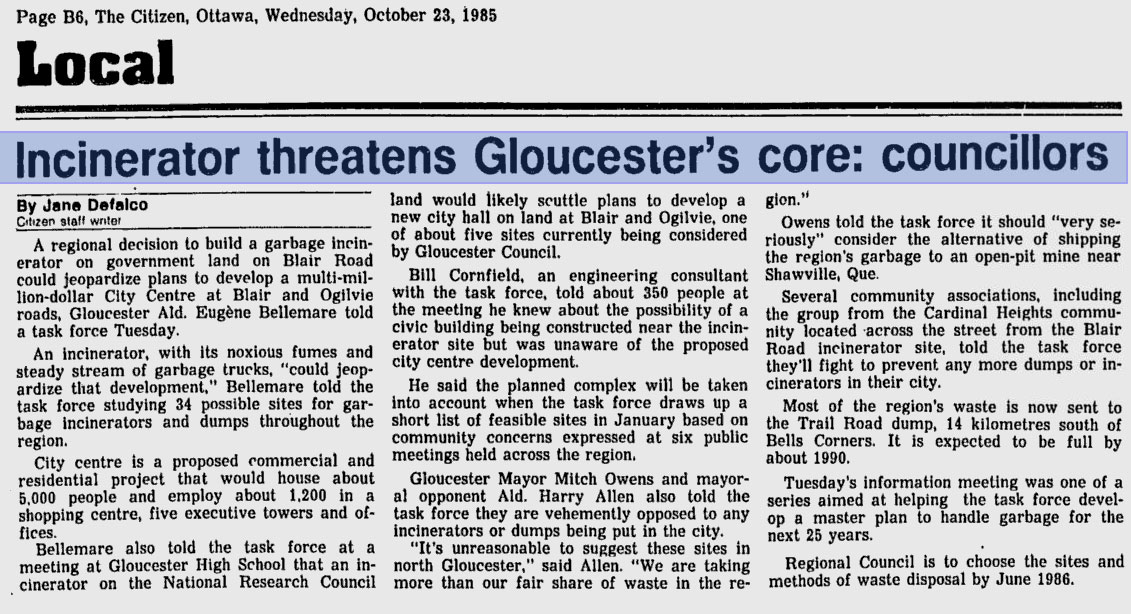
I’m not keen on simply throwing garbage into a hole, but I think that it would be good to actually know the truth about what is happening and what is not.

Here is an article from the Citizen, from October 1985. In it, there is the statement that the Trail Road dump will be full by about 1990.


The Trail Road Landfill site, which we currently use, is across Trail Road from the old Nepean Dump. It was established because the Nepean Dump was nearing its capacity. Stage 1 of the Trail Road Landfill began accepting waste in 1980 and has been enlarged in four stages. I believe that Stage 4 is the one that we are filling now.

A city report in 1997, estimated that the Trail Road Landfill site would be at capacity around 2006. However, it also mentioned that proposed waste diversion was expected to prolong the site’s life.

In 2001, the city of Ottawa applied for an expansion of the capacity of the Trail Road facility, and got Provincial approval. This expansion involved increased height over Stages 1-4, and creation of a Stage 5. It was estimated at the time that the expansion could add up to 40 years of capacity to the site.
https://www.ontario.ca/page/trail-wa...zation-project


In a 2019 tour of the site, Glen Gower was told that Stage 4 was expected to be full around 2042. This was also the date that staff presented to Council in a July 2019 report. https://pub-ottawa.escribemeetings.c...cumentid=25976

Now we are being told that it will be full by 2036. This, despite waste diversion climbing to 60%, currently. And the Province has mandated that 70% of solid waste be diverted.

In the 2022 budget, there was money allocated for “Landfill Disposal Stage 5 Development” ($18M) and “Trail Road Landfill – Expansion & Development” ($950K). Is the city finally getting around to implementing Stage 5? If so, won’t that add on decades of additional storage? https://pub-ottawa.escribemeetings.c...cumentid=80535

So, what is the complete story?

And while we are talking about landfills and dumps, how about we mine the old Nepean Dump, on the south side of Trail Road? It was not built to modern standards, and has a problem with leaching – despite being capped with a plastic sheet. Let’s mine it; line the resulting pit, and re-use the site for future waste disposal.

Yes, I know that we do need to find more sustainable solutions, but we are always going to need landfill facilities – even with other waste management strategies.

The city is finally getting around to creating a Waste Management Plan, and that should provide a much better view of the situation. But I’d still like to know what is really happening, today.
Reply With Quote
     
     
  #18  
Old Posted May 5, 2023, 5:22 AM
DTcrawler DTcrawler is offline
Registered User
 
Join Date: Feb 2019
Location: Ottawa
Posts: 998
Regardless of the actual longevity of the landfill, I don't have much issue with the proposed system after doing some quick research. The other five major Canadian cities all have some form of user fee for excess waste, most commonly in the form of tags. Additionally, based on the stats presented by staff, 74% of households set out two or fewer items per week, meaning most households would likely not even need to purchase extra tags.

Personally, living in a highrise, I'm not sure of the implications (if any) to my particular situation. When visiting my parents out in the burbs, however, I see households with one or two occupants setting out 3-4 bags/bins on a biweekly basis. I just don't understand how it's even possible. Meanwhile, my parents barely manage to fill a single 120L bin, with 240L being the actual max permissible bin size. I know it's not my place to judge others' personal circumstances, but I feel the proposed system strikes a good balance of allowing enough leeway before a fee is applied, while also disincentivizing the minority of households that consistently set out extra waste from doing so.

More broadly, people love to throw out the term "cash grab" very liberally in this city, but from my experience living here compared to other Canadian cities, we're pretty spoiled when it comes to city services. Lots of cities in southern ON and out west get plenty of snowfall with no snowbank removal service. Here, we complain when, in a year of record snowfall, the snowbanks aren't gone less than 2-3 weeks after accumulating.
Reply With Quote
     
     
  #19  
Old Posted May 5, 2023, 4:01 PM
Spoonsy's Avatar
Spoonsy Spoonsy is online now
You call that a knife?
 
Join Date: Jul 2016
Location: Centretown West
Posts: 320
"cash grab"

Reply With Quote
     
     
  #20  
Old Posted May 5, 2023, 12:50 PM
J.OT13's Avatar
J.OT13 J.OT13 is offline
Moderator
 
Join Date: Mar 2012
Location: Ottawa
Posts: 27,610
I agree something needed to be done, but I'm not sure the one-size-fits-all tags are the way to go. Why does a couple (or single person) have the same amount of tags as a family of 6? Or someone taking care of an adult child with health issues?

I preferred the see through bags (and one opaque bag for privacy) system, where the waste collector leaves bags with obvious recyclable or compostable content. It would be a more equitable solution.

And what happens to items that don't go in a garbage bag? A fence that was taken apart? Drywall? Larger items (furniture, old toys..)?

And the City will still take metal BBQs that can be recycled?

Personally, it doesn't effect us. We take out a small metal garbage can once a month, if that.
Reply With Quote
     
     
This discussion thread continues

Use the page links to the lower-right to go to the next page for additional posts
 
 
Reply

Go Back   SkyscraperPage Forum > Regional Sections > Canada > Ontario > Ottawa-Gatineau > General Discussion
Forum Jump


Forum Jump


All times are GMT. The time now is 9:45 PM.

     
SkyscraperPage.com - Privacy Statement - Top

Powered by vBulletin® Version 3.8.7
Copyright ©2000 - 2026, vBulletin Solutions, Inc.