Park board topples tower, and curtain of trees remains
A greater question involves the fate of the conservatory at Queen Elizabeth Park
Pete McMartin
Vancouver Sun
Tuesday, January 29, 2008
Here is the view from Queen Elizabeth Park: You still cannot see the forest for the trees.
On Monday night -- some hours after this column was written -- the Vancouver park board unanimously defeated a motion to erect a 50-metre tall observation tower in it.
Its defeat was a sure thing, at least to park board vice-chairman Ian Robertson, who had come to this towering conclusion before the vote was taken:
"I'm so convinced we won't approve it," he said Monday morning, several hours before the vote, "that I would bet next year's salary on it."
That's an $8,000 bet in Robertson's case. (Park commissioners get chump change.) It's also a safe bet.
It was to have been constructed, owned and operated by a private company called Observation Tower Inc., was to have cost an estimated $10 million.
Its purpose:
To offer panoramic views of Vancouver.
The reason for its proposal:
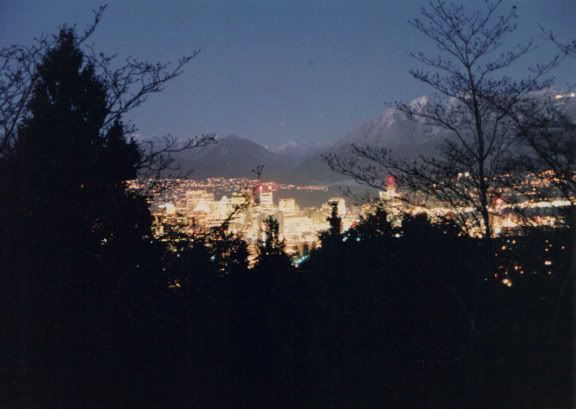
In Queen Elizabeth Park -- originally established because of its panoramic views, since Little Mountain is Vancouver's highest elevation above sea level; the park has in the intervening years given rise to a curtain of trees that have blocked most of those views.
"It's what I would call 'benign neglect,' " said the park's superintendent, Alex Downie.
"Many of the trees were planted in plantation-style blocks and were allowed to grow without any thinning, so that now they resemble something like a hedge."
Locals, of course, like it this way.
Views, they can do without.
But a forest next door? Who wouldn't want that?
But Queen Elizabeth was intended to be more than a forest, and something other than a place where the locals can go to have a picnic. It was planned as a destination park for both Vancouverites and tourists, and the views were integral to that end. It is the reason the park boasts formal gardens, a plaza, a high-end restaurant and the Bloedel Conservatory.
Nonetheless, when the park board held a couple of information meetings about the tower proposal, the expressed view of the 300 people who attended was unequivocally and overwhelmingly against a tower.
Add on written submissions, e-mails and angry letters, and almost 70 per cent of comments were against the proposal.
So, the likely result?
Locals and the park will end up with a compromise. There will be no tower, but its opponents will have to live with the idea that trees blocking the views will have to be culled or trimmed. To replace the number of trees that do come down -- none of which, by the way, are rare or endangered species -- the same number will be replanted elsewhere in the park.
"There's 120 acres in the park," Downie said, "and plenty of places in it that can take more trees."
(As predicted, Wednesday night's meeting produced a compromise: The park board directed staff to develop a tree-management project to open up the views at the park.)
A greater and unanswered question will remain, though, about the Bloedel Conservatory.
What should its future be, and should it have a future?
It has been hemorrhaging revenue for the last few years, to the point where its net cost to the park board is approaching $400,000 a year. A tower nearby would have acted as a draw it could have profited from.
But the tourists have stopped coming. The Canada Line construction along Cambie, the resurfacing of the reservoir that erased 160 parking spaces, the tired and unchanging display of exotic plants and birds -- they've conspired to drive attendance down at the Conservatory while costs have climbed. In 2001, tour buses brought 28,000 tourists to it: In 2006, they brought 940. Overall attendance dropped to 60,000 in 2006 from 120,000 in 2001. (Ask yourself: When was the last time you visited the Conservatory? For me, 25 years at least.)
"More importantly than the tower vote," Robertson said, "we have to take a step back and think about the future of the Conservatory and what we can put up there. What should we do with it? Should we think about new displays? Should we consider things like holding symphony concerts in it?
"Should it be torn down or replaced?"
The last option is unlikely, since the dome is designated a heritage site. But whatever the park board does, it will cost money. Downie estimates the Conservatory would need about $1 million in repairs.
The structure is tired. It leaks. A geodesic dome might have been a novelty in 1969, but the gaskets between the Conservatory's 1,490 translucent roof panels are failing and haven't been replaced for 20 years. The panels need replacing, too. Most of them have clouded with age, and some of them have fractured from -- wait for it -- being walked upon.
Kids, who find it an easy climb, like to scramble up to the top of the dome when security isn't looking.
It seems the top of the dome offers the best views of the city.





 Prev
Prev







 Linear Mode
