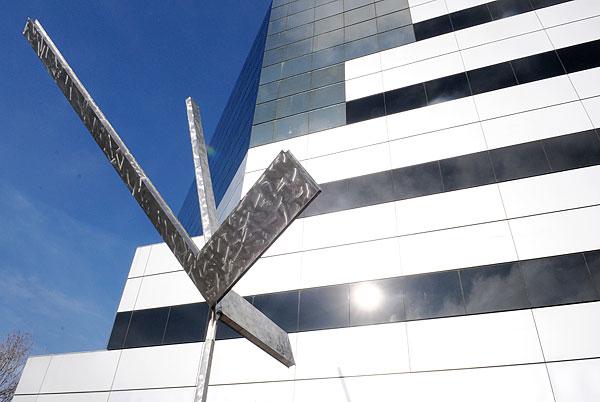
It's not a classical facade, it's a 1970s bank building. Sacamenna Kid, are you maybe thinking of the D.O. Mills Bank at 7th and J, a block away?
Majin is right on both counts--the production of new housing in the central business district is way, way behind, and there is a massive jobs/housing imbalance in the central city as a whole and in the CBD in particular. There are about 100,000 jobs in the central city--and roughly 30,000 residents. The vast majority of those residents are in Midtown, Southside and Alkali/Mansion Flat, and the majority of the jobs are in the CBD. Which means if everyone who lives in the central city, including retirees, children, the disabled, and the 2000 folks in the main jail all had jobs in the central city and none of them did a reverse commute, you still need more than twice as many commuters as residents driving to work every day.
The closest thing to a figure on how many people commute from the suburbs to downtown comes from the following report:
http://definingdowntown.org/read-the-report/ . This report states that of the roughly 73,000 people living in a zone defined as downtown Sacramento and the neighborhoods within a 1 mile radius, and 151,000 jobs. 27.2% of the people who live in that radius also work within that radius. Personally I'd suggest that those who live within the "grid" proper are even more likely to work in the central city, because it's that much easier to walk to work. Despite snefnoc's stereotypical caricature of the middle-aged, suburban state worker, I know a lot of folks who live in the central city who work for the state from their twenties to senior citizens, including retired state employees who apparently didn't get the memo that Midtown is only for young people. Some moved here for a short commute to work, some started working for the state after moving here because there were a lot of state jobs in their neighborhood (far more than the neighborhood population can possibly fill.)
I don't think building more office capacity is a good strategy for encouraging more residential use. Let's assume for a moment that snefnoc's 80% ratio is correct, and that of 1000 employees in the Vanir Building, 200 end up living downtown. Figure that the remaining 800 will primarily commute via automobile--some will take transit, maybe 5%, but that's still 750 cars on the roads, clogging up already overloaded highways. That also means 750 parking spaces--reinforcing demand for more parking garages, not downtown housing. Now, the idea is obviously not to force everyone to live downtown (far from it!), but if we can shift that balance from 20-30% to more like 40-50%, not only do we reduce rush hour traffic for all commuters, we meet more of the existing demand for downtown housing. The CBD is zoned for as many as 450 residential units per acre, but the number who actually live there (not counting the jail) is more like 7-8 per acre--which is the maximum zoned density for neighborhoods like Land Park and East Sacramento. Which is less than a quarter of the maximum density for Midtown, but that's another post.
And yes, there is demand--you can see it in the recently opened developments near the central business district. Legado de Ravel filled up very quickly, despite rents of $2000+ for 1 and 2 bedroom apartments, and the not-yet-completed 16 Powerhouse, with rents as high as $3000, has a long waiting list. For-sale housing, what little of it has come on the market, gets snapped up very quickly, even though it is priced considerably higher than houses of comparable size, and generally bigger lots, in the suburbs. Why? Because they're not comparable--being close to downtown is an amenity in and of itself, worth more money to the urban customer.
Some of the disappointment may stem from changes to the city's General Plan that happened recently--the 2030 General Plan was designed to really promote high-density housing in the CBD, but the latest update sets their sights much lower, accepting a few more fourplexes in Midtown in place of high-rise residential Downtown. My personal pet theory is that the biggest builders in the local market have an established business model, new greenfield residential in the suburbs, offices downtown, and they are too risk-averse to change their business model. Odds are, we may just have to wait for some of these developers to die off, because there are younger and more forward-thinking developers who are building new housing in parts of the central city, but only a handful so far within the central business district--and they'll make the money that the old-school suburban developers are leaving on the table, waiting for it to be the 1950s again.
That said, I don't have any particular problem with the Vanir building. I figure they can always convert part of it to residential use later.





 Prev
Prev


 But where the hell are the residential developments?




 I use a chrome extention that opens a new window in incognito mode anytime I click on any Sacbee link.






 Linear Mode
