HomeDiagramsDatabaseMapsForum About
     

Go Back   SkyscraperPage Forum > Regional Sections > Canada > Atlantic Provinces > Halifax > Halifax Photos


Reply

 
Thread Tools Display Modes
     
     
  #501  
Old Posted Nov 6, 2019, 4:53 PM
Keith P.'s Avatar
Keith P. Keith P. is offline
Registered User
 
Join Date: Mar 2006
Posts: 8,759
Tip Top would make a good business school case study of how a once-reputable chain became low-end and poor quality before succumbing. I remember buying a suit there in the '80s - not a cheap one either - that simply would not stay together, as if they had used the wrong kind of thread on the seams or fabric that was very weak. They didn't even argue when I took it back the second time and gave me a refund.
Reply With Quote
     
     
  #502  
Old Posted Nov 7, 2019, 12:44 AM
K-Man K-Man is offline
Registered User
 
Join Date: Sep 2019
Posts: 160
Quote:
Originally Posted by OldDartmouthMark View Post
Found video of the sign movement. You can see it starting at 6:18 on this video:

https://www.youtube.com/watch?v=mNAKpGV78R4
That's pretty cool, I was hoping you'd be able to find that. I actually ended up watching the whole thing, lol. Downtown sure was a lot more vibrant with activity then, eh? I always loved the look of all the canopies popped out over the sidewalk. And look at how many people are at Black Rock Beach!

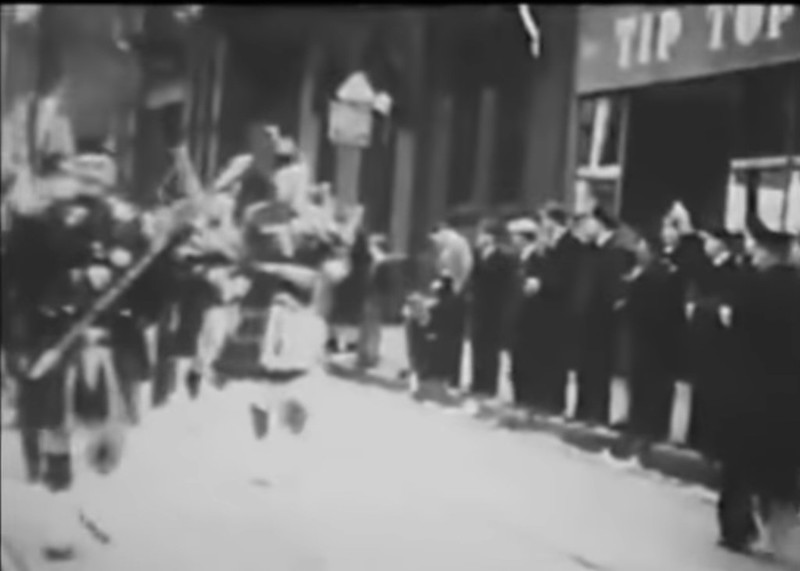
I noticed that besides the rotating sign the video also shows a quick shot of Tip Top before the 1940/41 renovations to the building. At 10:08 after the film turns b&w there's a short glimpse of the Tip Top sign again. You can see that it's the old signage before they completely moved out of the Tramway building into the "rotating sign" building right beside it at 1592 Barrington (1942 - 1980). Admittedly it's such a quick shot that you can barely notice it and it's only of the corner of the sign which is not all that exciting. Just for interests sake though I thought I'd throw up a screenshot from the video and then right below it a better image of the building and sign. You can see in the second image that the building is still just one story 'sans' the rotating sign. The last image below is a page from the Barrington Conservation .pdf which gives a little detail.


Source: YouTube - ninjaa54's Channel - https://www.youtube.com/watch?v=mNAKpGV78R4


Source: AGBANS - http://agbans.ca/2016/10/02/gone-the-tip-top-tailor-building/


Source: Barrington St. Conservation - https://www.halifax.ca/sites/default/fil...rrStHrtgCnsrvDist_RevitalizationPlan.pdf
Reply With Quote
     
     
  #503  
Old Posted Nov 7, 2019, 1:32 AM
OldDartmouthMark OldDartmouthMark is online now
Registered User
 
Join Date: May 2010
Posts: 10,206
Thanks for that. I had never considered the Tip Top building in its previous state, as a single-floorer.

I looked a bit on the NS archives site and found this one from 1945:


https://novascotia.ca/archives/EastCoastPort/archives.asp?ID=4462

This one, from 1955, showing the newer sign at night (figured out the year from "Pete Kelly's Blues" on the marquee):


https://novascotia.ca/archives/NSIS/archives.asp?ID=777

Actually it shows that Barrington Street was well lit with period signage that were of much higher quality and attractiveness compared to today's signage. I actually miss those days of animated and neon lighted signs.

And a daytime image from a similar vantage point from 1961 - you'll notice that the Canada Permanent Building has sprouted up in the background since the last photo - it was Halifax's first curtain wall construction.


https://novascotia.ca/archives/NSIS/archives.asp?ID=1720

Actually there are a few more pics of that area if you search for "Barrington", but I didn't want to overdo the picture posting...

Good stuff! Thanks for your research, I find it very interesting.
Reply With Quote
     
     
  #504  
Old Posted Nov 8, 2019, 12:17 AM
K-Man K-Man is offline
Registered User
 
Join Date: Sep 2019
Posts: 160
Quote:
Originally Posted by OldDartmouthMark View Post
....Actually it shows that Barrington Street was well lit with period signage that were of much higher quality and attractiveness compared to today's signage. I actually miss those days of animated and neon lighted signs.

Good stuff! Thanks for your research, I find it very interesting.
Gotta earn my stripes...
The streets were definitely more interesting, eh? I wish it was still in style for businesses to hang their signs out over the sidewalks like that...same as the canopies. I always thought it created such a great "downtown" feel to the streets - especially at night.
Reply With Quote
     
     
  #505  
Old Posted Nov 8, 2019, 10:06 PM
Keith P.'s Avatar
Keith P. Keith P. is offline
Registered User
 
Join Date: Mar 2006
Posts: 8,759
Those vintage Barrington St pics are always interesting. As a shopping destination it seemed to peak in the early '60s and like virtually every other shopping street in virtually every North American city, succumbed to the emergence of the shopping center.

One thing I find interesting is that canvas awnings were used quite extensively on Barrington. I remember them as a tyke, where someone would crank the mechanism to extend it over the sidewalk to provide shade. One thing I recall as a kid from visiting other places with my parents was how some buildings on shopping streets had permanent overhangs built above the sidewalk - I'm unsure of the proper name for them. They not only provided shade but also protection from inclement weather. This is an example:


I'd guess we might have had some similar examples here but I cannot think of any at the moment, at least on Barrington. These, combined with a vertically-oriented neon sign above the overhang, along with compact signage on the underside visible to pedestrians, always seemed a striking way to make your downtown store building stand out.
Reply With Quote
     
     
  #506  
Old Posted Nov 8, 2019, 11:38 PM
OldDartmouthMark OldDartmouthMark is online now
Registered User
 
Join Date: May 2010
Posts: 10,206
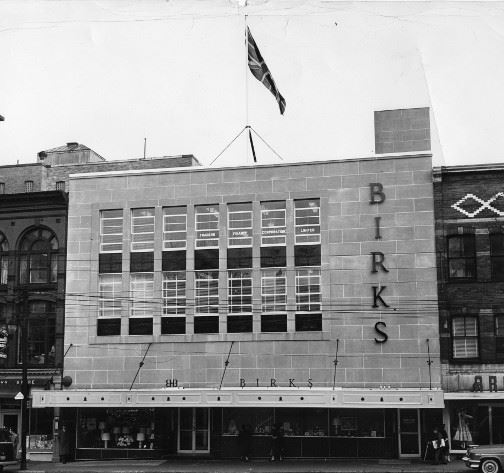
Interesting observation, Keith. The only permanent awnings that I recall from downtown were on the theatres and the Birks building (there may have been more, but they aren't coming to mind at the moment):


https://novascotia.ca/archives/Halifax/archives.asp?ID=59


https://halifaxbloggers.ca/builthalifax/2013/06/missing-from-barrington-street/

Funny, my strongest memory of the Birks building was seeing a delivery van, that was a little taller than the Birks awning, smashing its windshield and pillar on the awning when it attempted to park a little to closely to it.
Reply With Quote
     
     
  #507  
Old Posted Nov 9, 2019, 3:58 PM
Keith P.'s Avatar
Keith P. Keith P. is offline
Registered User
 
Join Date: Mar 2006
Posts: 8,759
Good find on the Birks building, I totally forgot about that. Your anecdote suggests that it went beyond the boundary of the sidewalk and stretched into the street, which seems to be confirmed by that first photo. Probably not the best idea. I now also recall something similar on the Offmans Furniture building on Spring Garden.
Reply With Quote
     
     
  #508  
Old Posted Nov 15, 2019, 1:06 AM
K-Man K-Man is offline
Registered User
 
Join Date: Sep 2019
Posts: 160
HALIFAX ORDINANCE YARD

I've been meaning to throw this up as I've never seen this shot of the Ordinance Yard before with the lamp over the gate - pretty cool but mostly pretty creepy. Judging by the clock tower & building the second image seems to be the reverse angle but only a newer photo. For lack of a better term note the 'bubbly' cap stones on top of the fence posts. Can't say I've seen those before.


Source: HMHPS - https://hmhps.ca/sites/halifax-ordnance-yard


Source: HMHPS - https://hmhps.ca/sites/halifax-ordnance-yard
Reply With Quote
     
     
  #509  
Old Posted Nov 18, 2019, 10:10 PM
K-Man K-Man is offline
Registered User
 
Join Date: Sep 2019
Posts: 160
HOUSES ON NORTH & ROBIE ST.

I always enjoy a little 'then & now' mixed with some overthinking so I thought I'd throw this one up. At first glance they're barely recognizable but the houses in the image are the houses that are on the corner of North & Robie Streets today. Supposedly the image is from the early 1900's so I pulled out 'ol trusty' and had a look at Plate S but it doesn't look like they were around in 1878.

It's hard to tell but in the second image where the blue arrow is the civic address is 164 North St. There's a pretty useful .pdf on the HRM Archive site that I used to see if '164' existed and sure enough it did. Nowadays though the address is 5810 and if you search that on google maps it take you right to these buildings.

The houses have been pretty heavily modified over the years though to the extent that the eastern part of the building enclosed in the red box doesn't even exist anymore. They sure looked a lot different then, eh?


List of Sources:

Image Source: NS Archives - Plate S of 'ol trusty - https://novascotia.ca/archives/maps/plate.asp?ID=21

Image Source: The Old North End Blog -
https://oldnorthend.wordpress.com/2013/01/05/arthur-f-pelton-album-1898-1914/

Image Source: Goole Maps: https://www.google.com/maps/place/Robie+...13686fe80!8m2!3d44.6546616!4d-63.5948451

PDF Source: City of Halifax Former Civic Address Cross-Reference -
https://www.halifax.ca/sites/default/fil...hives_SearchToolsCivicAddresses_PDF4.pdf

Last edited by K-Man; Nov 19, 2019 at 12:59 AM.
Reply With Quote
     
     
  #510  
Old Posted Nov 18, 2019, 10:17 PM
mleblanc mleblanc is offline
Registered User
 
Join Date: Dec 2015
Posts: 563
Quote:
Originally Posted by K-Man View Post
HOUSES ON NORTH & ROBIE ST.

I always enjoy a little 'then & now' mixed with some overthinking so I thought I'd throw this one up. At first glance they're barely recognizable but the houses in the image are the houses that are on the corner of North & Robie Streets today. Supposedly the image is from the early 1900's so I pulled out 'ol trusty' and had a look at Plate T but it doesn't look like they were around in 1878.

It's hard to tell but in the second image where the blue arrow is the civic address is 164 North St. There's a pretty useful .pdf on the HRM Archive site that I used to see if '164' existed and sure enough it did. Nowadays though the address is 5810 and if you search that on google maps it take you right to these buildings.

The houses have been pretty heavily modified over the years though to the extent that the eastern part of the building enclosed in the red box doesn't even exist anymore. They sure looked a lot different then, eh?


List of Sources:

Image Source: NS Archives - Hopkins Atlas Plate 'T' - https://novascotia.ca/archives/maps/plate.asp?ID=21

Image Source: The Old North End Blog -
https://oldnorthend.wordpress.com/2013/01/05/arthur-f-pelton-album-1898-1914/

Image Source: Goole Maps: https://www.google.com/maps/place/Robie+...13686fe80!8m2!3d44.6546616!4d-63.5948451

PDF Source: City of Halifax Former Civic Address Cross-Reference -
https://www.halifax.ca/sites/default/fil...hives_SearchToolsCivicAddresses_PDF4.pdf
Cool find! I've really been enjoying your posts lately - thanks for your contributions!
Reply With Quote
     
     
  #511  
Old Posted Nov 19, 2019, 12:04 AM
K-Man K-Man is offline
Registered User
 
Join Date: Sep 2019
Posts: 160
Quote:
Originally Posted by mleblanc View Post
Cool find! I've really been enjoying your posts lately - thanks for your contributions!
Hey, thanks man!
Reply With Quote
     
     
  #512  
Old Posted Nov 19, 2019, 12:34 AM
K-Man K-Man is offline
Registered User
 
Join Date: Sep 2019
Posts: 160
THE GRIGOR HOUSE

I had mentioned in another thread that I've always loved the charming creepiness of this place. Surprisingly there's not a lot of images/info online but a few days ago I did come across a pretty interesting article by Garry D. Shutlak on pg.9 of the June 2002 edition of the Griffin. I don't usually like to just paste a bunch of text but I thought I could save you a little clicking & scrolling. I've added some images and at 2-3 minutes it's a pretty interesting little read, or , if you're like me and still use your index finger to point at the words while moving your lips attempting to silently read to yourself then it's going to take much longer.

Date: 1879

Source: NS Archives - https://novascotia.ca/archives/builtheritage/archives.asp?ID=87

City Rambles: The Grigor House, a Gothic pile that’s been a home and a hospital
This splendid asymmetrical L-shaped Gothic brick, stone and wood cottage was erected on lots 245, 246 and 247 in the fields formerly owned by Andrew and John Smith, more commonly known as Smith’s Fields subdivision. John Henry Grigor, a teller of the Bank of British North America, was the son of the Honorable Doctor William Grigor and Catherine Louisa, fourth daughter of James Forman. He married Samuel Locke’s daughter Letitia in September 1862. The following month he purchased the land and the following year began construction of the house. Built by George Lang, the style of the building is strongly reminiscence of “Fernwood,” designed in 1862 by architect David Stirling for James Thomson. Unfortunately J. H. Grigor died at the age of 32, December 19, 1863 at his home at Freshwater Bridge, the former Trider house. The unfinished residence was put up for sale by James Forman, who as appointed the administrator of the estate. It was purchased by George Lang for £1,000 ($4,000) Mr. Lang was owed $2,890 by the estate. It appears that Mr. Lang completed the house, adding a stable and coach house to the property. It was purchased in September 1868 by John R. Murray of T. Boggs & Company, hardware merchants, for $6,200. In 1878, James W. Murray, assistant Commissary General, occupied the house, living there until 1881. Among the group of other nineteenth century tenants were Louisa M. Morrow, widow of James B. Morrow, Ann Brown, widow of Daniel M. Brown and Alexander M. Little. In 1895, Donald F. Archibald, High Sheriff of Halifax County, took up residency and with various members of his family lived there until 1912.

The Grigor House as it appears today

Source: My images

Between 1913 and 1916, the house became the Halifax Hospital for Women with E. Kirk MacLellan, physician, and Millicent Demme, superintendent. It reverted to a private residence in 1917 occupied by John F. McCarthy, collector at Farquhar Brothers, plumbing and heating contractors. In 1929 Willard W. & Ella Murray acquired the property. Mr. Murray was a sleeping car conductor with the Canadian National Railway until his death in 1936. Mrs. Murray occupied the house until her death in 1964, living there for many years with her daughter Aileen and her husband Royce N. Pitman. The family occupied the house until 1998, a tenure of sixty-nine years. In 1960, the fourteen-unit “Seaforth” Apartment building was erected on the lawns and gardens of the property. In 1963 the street address became 5470 Victoria Road and in 1965 it was changed to 1067 Bland Street, its present address. In recent years the owners have removed the wooden addition which, if not original to the house, is shown on Hopkins City Atlas of Halifax, 1878. This addition may have been the coach house mentioned in earlier advertisements. Another building on the property worth noting is the small stable building on the edge of the property at the intersection of Victoria Road and Bland Street. It became 19 North Bland and was converted into a grocery store in 1898. The street address was later changed to 1069. The first grocer was Samuel F. Archibald who was followed by assorted others until 1988 when it became an interior decorating establishment and in 1996 a tailor shop. In 2000/01 it was converted into a rental unit.


Source - NS Archives - Plate K of 'ol trusty - https://novascotia.ca/archives/maps/plate.asp?ID=13

Also, check out that ironstone fence, eh? One of my favorites around town.
Fence Source: Google Maps - https://www.google.com/maps/@44.636612,-...S-rGZ0IRDwWNKSZlKSaYw!2e0!7i13312!8i6656

Article Source - HTNS.ca - Griffin June 2002 - https://www.htns.ca/pdf_Griffin/G0206-2.pdf

Last edited by K-Man; Nov 19, 2019 at 11:41 AM.
Reply With Quote
     
     
  #513  
Old Posted Nov 19, 2019, 10:09 PM
OldDartmouthMark OldDartmouthMark is online now
Registered User
 
Join Date: May 2010
Posts: 10,206
Great stuff!
Reply With Quote
     
     
  #514  
Old Posted Nov 19, 2019, 11:08 PM
OldDartmouthMark OldDartmouthMark is online now
Registered User
 
Join Date: May 2010
Posts: 10,206
Quote:
Originally Posted by Keith P. View Post
Good find on the Birks building, I totally forgot about that. Your anecdote suggests that it went beyond the boundary of the sidewalk and stretched into the street, which seems to be confirmed by that first photo. Probably not the best idea. I now also recall something similar on the Offmans Furniture building on Spring Garden.
Somehow I missed responding to your reply initially.

Yes, from the 1940s photo it appears that the awning did extend into the street, unless the curb was extended outward subsequently. It would still be a tough one to explain to the boss - hitting a solid awning with your delivery van...

Here is a view of Offman's Spring Garden, from the Halifax Municipal Archives:


And one from the NS Archives:

Reply With Quote
     
     
  #515  
Old Posted Nov 22, 2019, 12:12 AM
K-Man K-Man is offline
Registered User
 
Join Date: Sep 2019
Posts: 160
THE CARLETON HOTEL - MARBLE MANTELPIECE

Hey everyone!

Thought I'd share this 1916 image of the marble mantelpiece that's at The Carleton Hotel.
The mantelpiece came from the Governor's Residence in the spoils of Loiusbourg. Before the Carleton that we know today came to be though a man by the name of Richard Bulkeley had built his mansion there in 1760. In 1749 Bulkeley was persuaded by Edward Cornwallis, newly appointed Governor of NS and a personal friend, to accompany him to the province as an aide-de-camp. Upon his arrival he eventually fell into the role of Director of Public Works.


Source: NS Archives - Taken with the camera on my phone of the image on their screen

It was after the siege of Louisbourg in 1758 that he built his house where The Carleton is today using the stone and said mantelpiece from the ruins of Louisbourg. Bulkeley was known for entertaining regularly there hosting dignitaries and grand parties with a dining room that could seat 50. The Carelton didn't get it's official name though until Bulkeley named his home 'Carleton House' after Guy Carleton, 1st Baron of Dorchester, during his visit to Halifax in 1786. Henry Cogswell eventually bought the house in 1816 and in 1867 it officially became The Carleton Hotel.

What really caught my attention with this though is that even after all the renovations and additions over the years Bulkeley's original house is still part of The Carleton today! It's built right into it. The front door of the hotel is the original front door of his mansion. The picture below shows how it's built into the current day design.


Image Source: http://www.gfduffusandco.ca/Carleton.htm

So in addition to the first image above I thought I'd post the note that is on the back of the photograph of the marble mantle. The handwriting though is REALLY hard to read so for the words that I couldn't make out or take a guess at I just left underscores. There's some sharp eyes on the forums here so maybe someone can make out some of the writing that I couldn't. Anyway, pretty damn cool eh?


Source: NS Archives - Taken with the camera on my phone of the image on their screen

The caption that NS Archives had on the digital copy of the file was:
Carleton House - Black marble mantelpiece on the west of northeast room of the Carleton. E.G.L. Wetmore ca.1916-7

Back of the Photograph - NS Historical Society 1919
Hon. Richard Bulkeley's stone residence at southeast corner of Argyle and Prince Streets, Halifax, NS, erected in 1760 by Bulkeley. It was afterwards the residence of Hon. H.H. Cogswell and later the Carleton House (hotel). Early in 1919 it's walls were included in exterior additions both laterally and in height.

This photograph was taken about 1916, and shows the ____ ____ in the building by the NS Hist. Society. The building was made of "ironstone" ( _____ ____), etc. with sandstone____ ____ ____ ____ ____ windows, and the ____ walls created (probably in ____ ____) with ____ or ____. The room in which the mantelpiece from Louisbourg was, is the room where in ____ the two ____ side windows on the ground floor. Transferred from NS Historical Society

Sources:
https://en.wikipedia.org/wiki/The_Carleton
https://en.wikipedia.org/wiki/Richard_Bulkeley_(civil_servant)
http://www.biographi.ca/en/bio/bulkeley_richard_4E.html
http://www.gfduffusandco.ca/Carleton.htm
https://halifaxbloggers.ca/builthalifax/2017/09/the-founding-of-halifax/

Last edited by K-Man; Nov 22, 2019 at 2:38 AM.
Reply With Quote
     
     
  #516  
Old Posted Nov 22, 2019, 11:27 PM
OldDartmouthMark OldDartmouthMark is online now
Registered User
 
Join Date: May 2010
Posts: 10,206
Quote:
Originally Posted by K-Man View Post
THE CARLETON HOTEL - MARBLE MANTELPIECE

Hey everyone!

Thought I'd share this 1916 image of the marble mantelpiece that's at The Carleton Hotel.
The mantelpiece came from the Governor's Residence in the spoils of Loiusbourg. Before the Carleton that we know today came to be though a man by the name of Richard Bulkeley had built his mansion there in 1760. In 1749 Bulkeley was persuaded by Edward Cornwallis, newly appointed Governor of NS and a personal friend, to accompany him to the province as an aide-de-camp. Upon his arrival he eventually fell into the role of Director of Public Works.


Source: NS Archives - Taken with the camera on my phone of the image on their screen

It was after the siege of Louisbourg in 1758 that he built his house where The Carleton is today using the stone and said mantelpiece from the ruins of Louisbourg. Bulkeley was known for entertaining regularly there hosting dignitaries and grand parties with a dining room that could seat 50. The Carelton didn't get it's official name though until Bulkeley named his home 'Carleton House' after Guy Carleton, 1st Baron of Dorchester, during his visit to Halifax in 1786. Henry Cogswell eventually bought the house in 1816 and in 1867 it officially became The Carleton Hotel.

What really caught my attention with this though is that even after all the renovations and additions over the years Bulkeley's original house is still part of The Carleton today! It's built right into it. The front door of the hotel is the original front door of his mansion. The picture below shows how it's built into the current day design.


Image Source: http://www.gfduffusandco.ca/Carleton.htm

So in addition to the first image above I thought I'd post the note that is on the back of the photograph of the marble mantle. The handwriting though is REALLY hard to read so for the words that I couldn't make out or take a guess at I just left underscores. There's some sharp eyes on the forums here so maybe someone can make out some of the writing that I couldn't. Anyway, pretty damn cool eh?


Source: NS Archives - Taken with the camera on my phone of the image on their screen

The caption that NS Archives had on the digital copy of the file was:
Carleton House - Black marble mantelpiece on the west of northeast room of the Carleton. E.G.L. Wetmore ca.1916-7

Back of the Photograph - NS Historical Society 1919
Hon. Richard Bulkeley's stone residence at southeast corner of Argyle and Prince Streets, Halifax, NS, erected in 1760 by Bulkeley. It was afterwards the residence of Hon. H.H. Cogswell and later the Carleton House (hotel). Early in 1919 it's walls were included in exterior additions both laterally and in height.

This photograph was taken about 1916, and shows the ____ ____ in the building by the NS Hist. Society. The building was made of "ironstone" ( _____ ____), etc. with sandstone____ ____ ____ ____ ____ windows, and the ____ walls created (probably in ____ ____) with ____ or ____. The room in which the mantelpiece from Louisbourg was, is the room where in ____ the two ____ side windows on the ground floor. Transferred from NS Historical Society

Sources:
https://en.wikipedia.org/wiki/The_Carleton
https://en.wikipedia.org/wiki/Richard_Bulkeley_(civil_servant)
http://www.biographi.ca/en/bio/bulkeley_richard_4E.html
http://www.gfduffusandco.ca/Carleton.htm
https://halifaxbloggers.ca/builthalifax/2017/09/the-founding-of-halifax/
Cool post! I'm wondering if the mantelpiece still exists within the Carleton. Will have to scope it out the next time I'm there.

Regarding your fill in the blanks question, I'll guess at some of them:
This photograph was taken about 1916, and shows the ____ ____ in the building by the NS Hist. Society. The building was made of "ironstone" ( _____ slate?), etc. with sandstone____ ____ ____ in the? windows, and the outside walls created (crafted?) (probably in recent years?) with concrete? or mortar?. The room in which the mantelpiece from Louisbourg was, is the room where in ____ the two ____ side windows on the ground floor. Transferred from NS Historical Society.

Those are my guesses for now...
Reply With Quote
     
     
  #517  
Old Posted Nov 24, 2019, 9:10 PM
K-Man K-Man is offline
Registered User
 
Join Date: Sep 2019
Posts: 160
Quote:
Originally Posted by OldDartmouthMark View Post
Cool post! I'm wondering if the mantelpiece still exists within the Carleton. Will have to scope it out the next time I'm there.
I'd say your right on the money with some of those in the middle sentence. Kinda funny how the words reveal themselves when you can see them legibly first then go back and have a another look. I have to say I had a bit of a laugh re-looking at this one. Never in a million years would the person who wrote that think that a century later someone would have their nose smooshed up against a monitor, zoomed into their note trying to decifer their over-pixilated handwriting . Anyway, I'm curious too as to weather or not it's still there. I can't see why it wouldn't be as it's a cool piece of history for the building but there's actually very little information about it online. There's no mention of it on their website either so you might have to sneak into someone's room to get a few photographs. And THAT could make for a very interesting post the next day, lol!
Reply With Quote
     
     
  #518  
Old Posted Nov 25, 2019, 1:24 AM
Keith P.'s Avatar
Keith P. Keith P. is offline
Registered User
 
Join Date: Mar 2006
Posts: 8,759
I would suggest the following section reads: "...the outside walls coated (probably in recent years) with concrete or mortar."

I'm not sure how the original writer could place the Carleton at the "southeast corner of Argyle and Prince St." since it is clearly on the northeast corner.
Reply With Quote
     
     
  #519  
Old Posted Nov 25, 2019, 9:25 AM
ILoveHalifax ILoveHalifax is offline
Registered User
 
Join Date: Aug 2011
Location: Palm Beach Gardens FL
Posts: 1,073
Quote:
Originally Posted by Keith P. View Post
I would suggest the following section reads: "...the outside walls coated (probably in recent years) with concrete or mortar."

I'm not sure how the original writer could place the Carleton at the "southeast corner of Argyle and Prince St." since it is clearly on the northeast corner.
Did they move it? St Paul's church always was on the north east corner and the Carleton Hotel on the south east
Reply With Quote
     
     
  #520  
Old Posted Nov 25, 2019, 12:16 PM
Keith P.'s Avatar
Keith P. Keith P. is offline
Registered User
 
Join Date: Mar 2006
Posts: 8,759
Quote:
Originally Posted by ILoveHalifax View Post
Did they move it? St Paul's church always was on the north east corner and the Carleton Hotel on the south east
The Carleton is on the northeast corner of Argyle at Prince.
Reply With Quote
     
     
This discussion thread continues

Use the page links to the lower-right to go to the next page for additional posts
 
 
Reply

Go Back   SkyscraperPage Forum > Regional Sections > Canada > Atlantic Provinces > Halifax > Halifax Photos
Forum Jump


Forum Jump


All times are GMT. The time now is 7:32 PM.

     
SkyscraperPage.com - Privacy Statement - Top

Powered by vBulletin® Version 3.8.7
Copyright ©2000 - 2026, vBulletin Solutions, Inc.