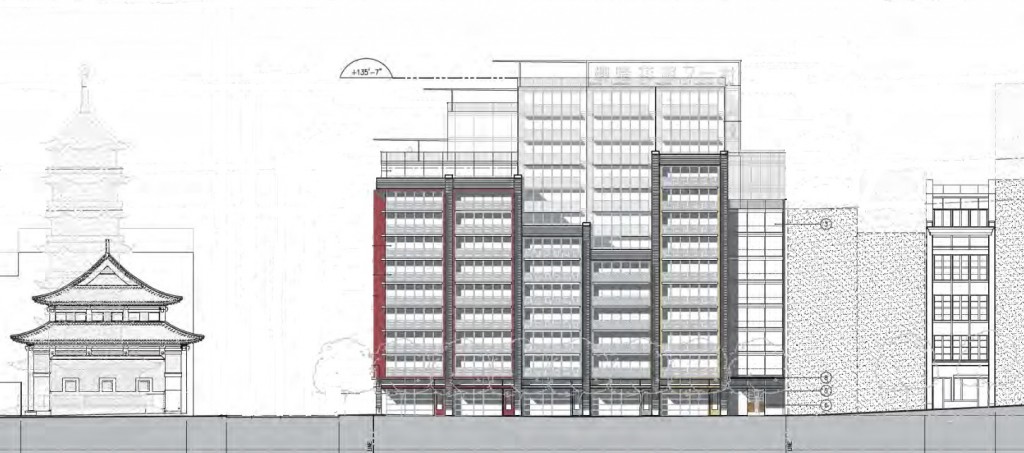
I'm happy to see some these projects completing in Chinatown. I am a little concerned about the proposed 200ft floor frontages proposed by the City. I would much prefer to see narrower developments, similar to the flats, which would add more architectural variety to the area, and I think ultimately keep the neighbourhood a lot more interesting. I can only imagine how bland it will look with monster blocks and large retail units...
The weird thing is that none of the designs address the corner very well.
A lot of historical buildings in Chinatown addressed the corners using a chamfered (cut off/angled) corner
(which would likely be the case if the block were, in fact, separate buildings)
That doesn't seen to have been considered.
I really wish they would keep the upper set back floors in the same brick as below. Instead we will have a huge spandrel mess on top. It's not very "historical" looking
I expect that the City is going to have a lot of issues with redevelopment in Chinatown. They should focus their attention elsewhere at the moment. They will only incite anti-development sentiments if they keep pushing, especially when there are a lot of other areas of Vancouver that are easier targets.
They need to go slow with a neighbourhood as important as Chinatown or they will harm the legitimacy of their future rezoning endeavours.
It makes no difference. Add 50 floors and no one would be the wiser. After 10 floors, no one is cognizant of the tower after that.
It has nothing to do with height. It's the fact that the top 2 floors are a spandrel mess. It has absolutely no relationship to the rest of the building
I wonder if there's any thought of re-locating that sub-station? As a high density residential property, it would be worth more than 100 million, and bring another 1000 residents to Chinatown and the DTES. Plus that electrical yard is a serious eyesore.
As mentioned in another thread, the Chinatown sub-station will be decommissioned at some point. This site is 1 square block, so another great opportunity to bring badly needed density to Chinatown/DTES (years down the road).
As mentioned in another thread, the Chinatown sub-station will be decommissioned at some point. This site is 1 square block, so another great opportunity to bring badly needed density to Chinatown/DTES (years down the road).
If everything goes to plan with their proposal they said it will be taken offline in 2032. And Dal Grauer is 2030.
There was a pretty large turnout. The thinking is that most of the crowd were looky loos driven by the recent media coverage. Somewhat surprising was that there were only 6 protesters decked out with signage, which was smaller than expected.
The developers are really embracing the Hendrix shrine. They apparently plan to incorporate it into the new retail. I believe that the Hendrix statue going forward and, if I recall correctly, they are also still negotiating the return of the Brick House as well.
Semi related - The developer manged to persuade the Jimmy Hendrix Estate to loan out a guitar for the event.
That's the Best thing to see. Do you want more traffic congestion? That's how you get more traffic congestion
68 spots with 140 units is also how you get West End parking problems! if the West end should teach us something, it is that no matter how central or how many services are in walking distance, a lack of building parking can create big problems for the streets.
That's the Best thing to see. Do you want more traffic congestion? That's how you get more traffic congestion
No it not. It's moronic. Strathcona already is pretty tight for parking because of the amount of Laneway Houses replacing off-street parking.
A house on a 25' lot can 4 units, all of which are reliant on street parking. At least half of those households will have 1 car.
Do you really think people who can afford $600K-900K condo don't want to own a car? That's the amusing thing about areas which are now getting expensive, the people who are moving in or buying there basically have to be fairly affluent. Affluent people usually don't care that their neighbourhood has decent transit service, they'll likely want a car.
__________________
"It's ok, I'm an engineer!" -Famous last words
Last edited by Alex Mackinnon; Jan 26, 2017 at 6:33 PM.
People with cars don't necessarily drive them everyday, especially if one works in the city centre and live close to public transit. Chinatown vicinity is a perfect example. Having a car is just being able to attain off-rush hour convenience like going grocery shopping, taking longer distance trips on weekends, etc, especially if a household has children. I say they should install more parking stalls in the building, and have everyone hooked up with electric charging.
People with cars don't necessarily drive them everyday, especially if one works in the city centre and live close to public transit. Chinatown vicinity is a perfect example. Having a car is just being able to attain off-rush hour convenience like going grocery shopping, taking longer distance trips on weekends, etc, especially if a household has children. I say they should install more parking stalls in the building, and have everyone hooked up with electric charging.
I agree with this. Dense living area also allow a family of 2 adults + children to get by on one car instead of two.
An adults-only family can go one step further and survive on car sharing/transit etc.
"Affluence" often goes hand in hand with financial literacy. People who understand the true cost of a vehicle may be much more willing to switch to these alternatives, including Uber whenever that may arrive.
I agree with this. Dense living area also allow a family of 2 adults + children to get by on one car instead of two.
An adults-only family can go one step further and survive on car sharing/transit etc.
"Affluence" often goes hand in hand with financial literacy. People who understand the true cost of a vehicle may be much more willing to switch to these alternatives, including Uber whenever that may arrive.
That building seems to only allow parking for the 3 and 2 bedroom units, and maybe a couple 1 beds. Nothing for the studios or most of the 1 beds. The commercial will also likely need some form of loading area.
I wouldn't base city policy on uber making taxis less awful. Car share maybe, but it's not as cheap as some would imply.
The idea that a car costs $10K/yr is pretty much bs though. An economy car or reasonably aged car is more like $3-4K/yr.
__________________
"It's ok, I'm an engineer!" -Famous last words





 Prev
Prev









 Linear Mode
