HomeDiagramsDatabaseMapsForum About
     

Go Back   SkyscraperPage Forum > Discussion Forums > City Discussions


Reply

 
Thread Tools Display Modes
     
     
  #21  
Old Posted Mar 17, 2026, 7:18 PM
kittyhawk28 kittyhawk28 is offline
Registered User
 
Join Date: Aug 2021
Posts: 189
Quote:
Originally Posted by pj3000 View Post
I wouldn't expect that. State boundaries are arbitrary lines on a map.

California is a huge state... ~900 miles N-S and 160k sq mi. Large population with high percentage clustered in few/relatively few areas.

Take a California-sized polygon and put it on the east coast with a line running from Boston 900 miles south to Savannah, then NW up to western NC, then NE up to central NY, and then east back to Boston... that gives you a roughly 900 mile N-S, 160k sq mi tract of land.

Where is this polygon's population clustered?
A hell of alot more decentralized, that's for sure. The Mid-Atlantic covers an area comparable to California, with over 60 million people. NYC Metro as 21-22 million overall, 19-20 million excluding Connecticut, meaning less than a third of this region resides in the largest metro area.
Reply With Quote
     
     
  #22  
Old Posted Mar 17, 2026, 8:58 PM
pj3000's Avatar
pj3000 pj3000 is offline
Registered User
 
Join Date: Jun 2005
Location: Pittsburgh & Miami
Posts: 7,869
Quote:
Originally Posted by kittyhawk28 View Post
A hell of alot more decentralized, that's for sure. The Mid-Atlantic covers an area comparable to California, with over 60 million people. NYC Metro as 21-22 million overall, 19-20 million excluding Connecticut, meaning less than a third of this region resides in the largest metro area.
But I didn't cite the "Mid-Atlantic" though, did I?

I referenced a California-shaped and California-sized coastal polygon... running from Boston all the way down to Savannah, up through the Appalachians, and back over to Boston.

Where is the majority of the population of this east coast, California-shaped polygon clustered? I think we all know the answer.
Reply With Quote
     
     
  #23  
Old Posted Mar 17, 2026, 9:42 PM
sopas ej's Avatar
sopas ej sopas ej is offline
Registered User
 
Join Date: Jul 2007
Location: South Pasadena, California
Posts: 8,029
__________________
"I guess the only time people think about injustice is when it happens to them."

~ Charles Bukowski
Reply With Quote
     
     
  #24  
Old Posted Mar 17, 2026, 10:24 PM
James Bond Agent 007's Avatar
James Bond Agent 007 James Bond Agent 007 is offline
Posh
 
Join Date: Aug 2003
Location: Kansas City, MISSOURI
Posts: 23,530
So what? It's no different than most other states. Or countries.
__________________
You fill me with inertia.
Reply With Quote
     
     
  #25  
Old Posted Mar 17, 2026, 10:42 PM
38 Geary 38 Geary is offline
你的媽媽
 
Join Date: Jan 2012
Location: The Bay
Posts: 11,575
Quote:
Originally Posted by iheartthed View Post
It's not really that surprising when you know that California is like half desert.
And mountains/national park/forest. Approximately 45-48% of California's land is owned or managed by the federal government, totaling over 45 million acres.
Reply With Quote
     
     
  #26  
Old Posted Mar 17, 2026, 11:12 PM
Yuri's Avatar
Yuri Yuri is offline
Registered User
 
Join Date: Sep 2008
Posts: 6,156
------------------------------ 2020 ------- 2010 ------- 2000 ------- 1990 ------ Growth
Code:
CALIFORNIA ------ 39,538,223 - 37,253,956 - 33,871,648 - 29,760,021 - 6.1% - 10.0% - 13.8%

Sout. California  22,673,967 - 21,665,851 - 19,833,506 - 17,616,315 - 4.7% -- 9.2% - 12.6%
Nort. California  12,552,687 - 11,497,989 - 10,532,992 -- 9,179,033 - 9.2% -- 9.2% - 14.8%
Central Valley --- 2,998,080 -- 2,790,151 -- 2,309,327 -- 1,905,152 - 7.5% - 20.8% - 21.2%
Rest of California 1,313,489 -- 1,299,965 -- 1,195,823 -- 1,059,521 - 1.0% -- 8.7% - 12.9%
* Southern California minus Bakersfield and Imperial;
** SF Bay Area, Salinas, Sacramento, Stockton and Modesto;
*** Merced-Bakersfield axis


- Despite the historical southern shift since it became an US state, "San Francisco/NoCal" has been growing faster than "Los Angeles/SoCal" for the past 30 years;

- It was precisely the San Francisco region that stopped California's growth to completely collapse between 2010-2020;

- Southern California growth was halved, Central Valley that has always been a booming region, is close to become stagnant and the rest of the state went from a healthy growth to Rust Belt growth.

And back to the thread's subject, almost 90% of Californians live in either San Francisco-Sacramento or Los Angeles-San Diego.

__________________
London - São Paulo - Rio de Janeiro - Londrina - Frankfurt
Reply With Quote
     
     
  #27  
Old Posted Mar 18, 2026, 3:14 AM
xzmattzx's Avatar
xzmattzx xzmattzx is offline
Registered User
 
Join Date: May 2006
Location: Wilmington, DE
Posts: 6,869
How big is that "Greater Los Angeles" area in square miles? 17 million is a lot, but if it takes 3-4 hours to go from one end to another, then an area the size of New Jersey should be able to hold 17 million people.

By the way, every state has lopsided populations. New Jersey, the densest state, has about 10 million people, and if you compare New Jersey to Greater Los Angeles, it makes sense that GLA has 70% more people because it's all urban, whereas New Jersey has rural places like Sussex County in the northwest, or Salem County in the southwest.
Reply With Quote
     
     
  #28  
Old Posted Mar 18, 2026, 5:00 AM
dimondpark's Avatar
dimondpark dimondpark is offline
Pay it Forward
 
Join Date: Apr 2003
Location: Piedmont, California
Posts: 8,128
Quote:
Originally Posted by Yuri View Post
------------------------------ 2020 ------- 2010 ------- 2000 ------- 1990 ------ Growth
Code:
CALIFORNIA ------ 39,538,223 - 37,253,956 - 33,871,648 - 29,760,021 - 6.1% - 10.0% - 13.8%

Sout. California  22,673,967 - 21,665,851 - 19,833,506 - 17,616,315 - 4.7% -- 9.2% - 12.6%
Nort. California  12,552,687 - 11,497,989 - 10,532,992 -- 9,179,033 - 9.2% -- 9.2% - 14.8%
Central Valley --- 2,998,080 -- 2,790,151 -- 2,309,327 -- 1,905,152 - 7.5% - 20.8% - 21.2%
Rest of California 1,313,489 -- 1,299,965 -- 1,195,823 -- 1,059,521 - 1.0% -- 8.7% - 12.9%
* Southern California minus Bakersfield and Imperial;
** SF Bay Area, Salinas, Sacramento, Stockton and Modesto;
*** Merced-Bakersfield axis


- Despite the historical southern shift since it became an US state, "San Francisco/NoCal" has been growing faster than "Los Angeles/SoCal" for the past 30 years;

- It was precisely the San Francisco region that stopped California's growth to completely collapse between 2010-2020;

- Southern California growth was halved, Central Valley that has always been a booming region, is close to become stagnant and the rest of the state went from a healthy growth to Rust Belt growth.

And back to the thread's subject, almost 90% of Californians live in either San Francisco-Sacramento or Los Angeles-San Diego.

Yes, I recall that during the 2010s, the Bay Area grow faster but I think it's because SoCal just had a really off decade, after like 80 years of nonstop booming.
__________________

"Two roads diverged in a wood, and I—I took the one less traveled by, And that has made all the difference."-Robert Frost
Reply With Quote
     
     
  #29  
Old Posted Mar 18, 2026, 2:17 PM
Yuri's Avatar
Yuri Yuri is offline
Registered User
 
Join Date: Sep 2008
Posts: 6,156
Quote:
Originally Posted by dimondpark View Post
Yes, I recall that during the 2010s, the Bay Area grow faster but I think it's because SoCal just had a really off decade, after like 80 years of nonstop booming.
If I’m not mistaken SF had a tough early 2000’s, estimates showing barely any growth, and only by the end of it it sped up.

For instance, between 1980-1990 Los Angeles went from 11.5 million to 14.5 million, a 26% growth; San Francisco did good as well, but nowhere near LA: 5.36 million to 6.29 million, 17% growth.

But I don't think it's a decade off. To me it was "northeasternized" for good and won't rebound again:

-------------------- 2020 ---------- 2010
Code:
Boston --------- 6,095,791 ---- 5,628,532 --- +8.3%
New York ------ 22,692,839 --- 21,358,372 --- +6.2%
Philadelphia --- 6,245,051 ---- 5,965,353 --- +4.7%
Baltimore ------ 2,794,636 ---- 2,662,691 --- +5.0%
Washington ----- 6,105,431 ---- 5,388,326 -- +13.3%

Los Angeles --- 18,644,680 --- 17,877,006 --- +4.3%
LA has grown less than all the old Northeast 4. Before that, none of the four has never grown faster than LA. Not even close.
__________________
London - São Paulo - Rio de Janeiro - Londrina - Frankfurt
Reply With Quote
     
     
  #30  
Old Posted Mar 18, 2026, 2:35 PM
iheartthed iheartthed is offline
Registered User
 
Join Date: Oct 2009
Location: New York
Posts: 11,858
Quote:
Originally Posted by Yuri View Post
If I’m not mistaken SF had a tough early 2000’s, estimates showing barely any growth, and only by the end of it it sped up.
Most likely. The early 2000s was the peak of the dot com bubble.
Reply With Quote
     
     
  #31  
Old Posted Mar 18, 2026, 3:00 PM
dimondpark's Avatar
dimondpark dimondpark is offline
Pay it Forward
 
Join Date: Apr 2003
Location: Piedmont, California
Posts: 8,128
Quote:
Originally Posted by Yuri View Post
If I’m not mistaken SF had a tough early 2000’s, estimates showing barely any growth, and only by the end of it it sped up.

For instance, between 1980-1990 Los Angeles went from 11.5 million to 14.5 million, a 26% growth; San Francisco did good as well, but nowhere near LA: 5.36 million to 6.29 million, 17% growth.

But I don't think it's a decade off. To me it was "northeasternized" for good and won't rebound again:

-------------------- 2020 ---------- 2010
Code:
Boston --------- 6,095,791 ---- 5,628,532 --- +8.3%
New York ------ 22,692,839 --- 21,358,372 --- +6.2%
Philadelphia --- 6,245,051 ---- 5,965,353 --- +4.7%
Baltimore ------ 2,794,636 ---- 2,662,691 --- +5.0%
Washington ----- 6,105,431 ---- 5,388,326 -- +13.3%

Los Angeles --- 18,644,680 --- 17,877,006 --- +4.3%
LA has grown less than all the old Northeast 4. Before that, none of the four has never grown faster than LA. Not even close.
Yes, the early 2000s were rough here, but we are accustomed to rising and falling due to the volatile local economy..
__________________

"Two roads diverged in a wood, and I—I took the one less traveled by, And that has made all the difference."-Robert Frost
Reply With Quote
     
     
  #32  
Old Posted Mar 18, 2026, 3:24 PM
kittyhawk28 kittyhawk28 is offline
Registered User
 
Join Date: Aug 2021
Posts: 189
Quote:
Originally Posted by Yuri View Post
If I’m not mistaken SF had a tough early 2000’s, estimates showing barely any growth, and only by the end of it it sped up.

For instance, between 1980-1990 Los Angeles went from 11.5 million to 14.5 million, a 26% growth; San Francisco did good as well, but nowhere near LA: 5.36 million to 6.29 million, 17% growth.

But I don't think it's a decade off. To me it was "northeasternized" for good and won't rebound again:

-------------------- 2020 ---------- 2010
Code:
Boston --------- 6,095,791 ---- 5,628,532 --- +8.3%
New York ------ 22,692,839 --- 21,358,372 --- +6.2%
Philadelphia --- 6,245,051 ---- 5,965,353 --- +4.7%
Baltimore ------ 2,794,636 ---- 2,662,691 --- +5.0%
Washington ----- 6,105,431 ---- 5,388,326 -- +13.3%

Los Angeles --- 18,644,680 --- 17,877,006 --- +4.3%
LA has grown less than all the old Northeast 4. Before that, none of the four has never grown faster than LA. Not even close.
LA ran out of most developable land south of the San Gabriel Mountains around the mid 2000s coincidentally, as the Inland Empire filled up. Up till that point, from the end of WW2 till 2010, much of its growth was from outward expansion of auto-centric sprawl, until sprawl it a hard limit in the mountains. Its no surprise that growth has been much slower since 2010, its a region in transition away from its historical model of sprawl and towards more infill and densification long term. But that requires LA to build out its rail system further, in order to adequately support any major new growth

That said, correct me if I'm wrong, but the Bay Area has lost alot more people this decade than Greater LA has right? A combination of WFH, outsourcing, a replacement by AI has severely impacted software jobs, and made the Bay Area the worst performing job market in California this decade, which is a reversal of the past 2 decades. The AI boom seems to be generating too few jobs to offset the SWE jobs getting replaced/moved out of the Bay.
Reply With Quote
     
     
  #33  
Old Posted Mar 18, 2026, 3:31 PM
Yuri's Avatar
Yuri Yuri is offline
Registered User
 
Join Date: Sep 2008
Posts: 6,156
Quote:
Originally Posted by iheartthed View Post
Most likely. The early 2000s was the peak of the dot com bubble.
I read on Demographia, where they made a direct comparison between San Francisco and Philadelphia metf99ro areas that were growing the same, something unimaginable around that time.

I used to read Demographia a lot in the 2000's. I was right-winger and I also liked sprawl.


Quote:
Originally Posted by dimondpark View Post
Yes, the early 2000s were rough here, but we are accustomed to rising and falling due to the volatile local economy..
The 2020's seem a bad time, not much for its economy that's stronger than ever, but in terms of population growth, jobs and dynamism. I bet SF (11 counties) will barely grow.
__________________
London - São Paulo - Rio de Janeiro - Londrina - Frankfurt
Reply With Quote
     
     
  #34  
Old Posted Mar 18, 2026, 3:40 PM
dimondpark's Avatar
dimondpark dimondpark is offline
Pay it Forward
 
Join Date: Apr 2003
Location: Piedmont, California
Posts: 8,128
Quote:
Originally Posted by Yuri View Post
I read on Demographia, where they made a direct comparison between San Francisco and Philadelphia metf99ro areas that were growing the same, something unimaginable around that time.

I used to read Demographia a lot in the 2000's. I was right-winger and I also liked sprawl.


The 2020's seem a bad time, not much for its economy that's stronger than ever, but in terms of population growth, jobs and dynamism. I bet SF (11 counties) will barely grow.
Yes, tech is merciless when it comes to job security, the Bay Area gains the most when times are good but loses the most when times are bad.
__________________

"Two roads diverged in a wood, and I—I took the one less traveled by, And that has made all the difference."-Robert Frost
Reply With Quote
     
     
  #35  
Old Posted Mar 18, 2026, 3:45 PM
dimondpark's Avatar
dimondpark dimondpark is offline
Pay it Forward
 
Join Date: Apr 2003
Location: Piedmont, California
Posts: 8,128
Quote:
Originally Posted by kittyhawk28 View Post
LA ran out of most developable land south of the San Gabriel Mountains around the mid 2000s coincidentally, as the Inland Empire filled up. Up till that point, from the end of WW2 till 2010, much of its growth was from outward expansion of auto-centric sprawl, until sprawl it a hard limit in the mountains. Its no surprise that growth has been much slower since 2010, its a region in transition away from its historical model of sprawl and towards more infill and densification long term. But that requires LA to build out its rail system further, in order to adequately support any major new growth

That said, correct me if I'm wrong, but the Bay Area has lost alot more people this decade than Greater LA has right? A combination of WFH, outsourcing, a replacement by AI has severely impacted software jobs, and made the Bay Area the worst performing job market in California this decade, which is a reversal of the past 2 decades. The AI boom seems to be generating too few jobs to offset the SWE jobs getting replaced/moved out of the Bay.
Well, both MSAs have lost about 2% this decade, at least according to the census bureau
https://en.wikipedia.org/wiki/Metropolitan_statistical_area
__________________

"Two roads diverged in a wood, and I—I took the one less traveled by, And that has made all the difference."-Robert Frost
Reply With Quote
     
     
  #36  
Old Posted Mar 18, 2026, 4:01 PM
Yuri's Avatar
Yuri Yuri is offline
Registered User
 
Join Date: Sep 2008
Posts: 6,156
Quote:
Originally Posted by kittyhawk28 View Post
LA ran out of most developable land south of the San Gabriel Mountains around the mid 2000s coincidentally, as the Inland Empire filled up. Up till that point, from the end of WW2 till 2010, much of its growth was from outward expansion of auto-centric sprawl, until sprawl it a hard limit in the mountains. Its no surprise that growth has been much slower since 2010, its a region in transition away from its historical model of sprawl and towards more infill and densification long term. But that requires LA to build out its rail system further, in order to adequately support any major new growth

That said, correct me if I'm wrong, but the Bay Area has lost alot more people this decade than Greater LA has right? A combination of WFH, outsourcing, a replacement by AI has severely impacted software jobs, and made the Bay Area the worst performing job market in California this decade, which is a reversal of the past 2 decades. The AI boom seems to be generating too few jobs to offset the SWE jobs getting replaced/moved out of the Bay.
What strikes me about LA is how fast it was this transition from double-digit growth to Northeast-style. Moreover, I imagine Inland Empire suffered a lot between 2008-2010, like Las Vegas and Phoenix. Without 2008, SoCal would probably had reached double-digit in the 2000's.

And yes, LA is ahead SF. Before the new immigration policies, I'd bet they would post some positive growth over the decade. Now I guess they might remain negative by 2030.

------------------------- 2024 --------- 2020 ----- Growth
Code:
Los Angeles --- 18,507,255 -- 18,650,651 --- -0.8%
San Francisco -- 7,979,579 --- 8,100,710 --- -1.5%
__________________
London - São Paulo - Rio de Janeiro - Londrina - Frankfurt
Reply With Quote
     
     
  #37  
Old Posted Mar 18, 2026, 4:28 PM
kittyhawk28 kittyhawk28 is offline
Registered User
 
Join Date: Aug 2021
Posts: 189
Quote:
Originally Posted by Yuri View Post
What strikes me about LA is how fast it was this transition from double-digit growth to Northeast-style. Moreover, I imagine Inland Empire suffered a lot between 2008-2010, like Las Vegas and Phoenix. Without 2008, SoCal would probably had reached double-digit in the 2000's.

And yes, LA is ahead SF. Before the new immigration policies, I'd bet they would post some positive growth over the decade. Now I guess they might remain negative by 2030.

------------------------- 2024 --------- 2020 ----- Growth
Code:
Los Angeles --- 18,507,255 -- 18,650,651 --- -0.8%
San Francisco -- 7,979,579 --- 8,100,710 --- -1.5%

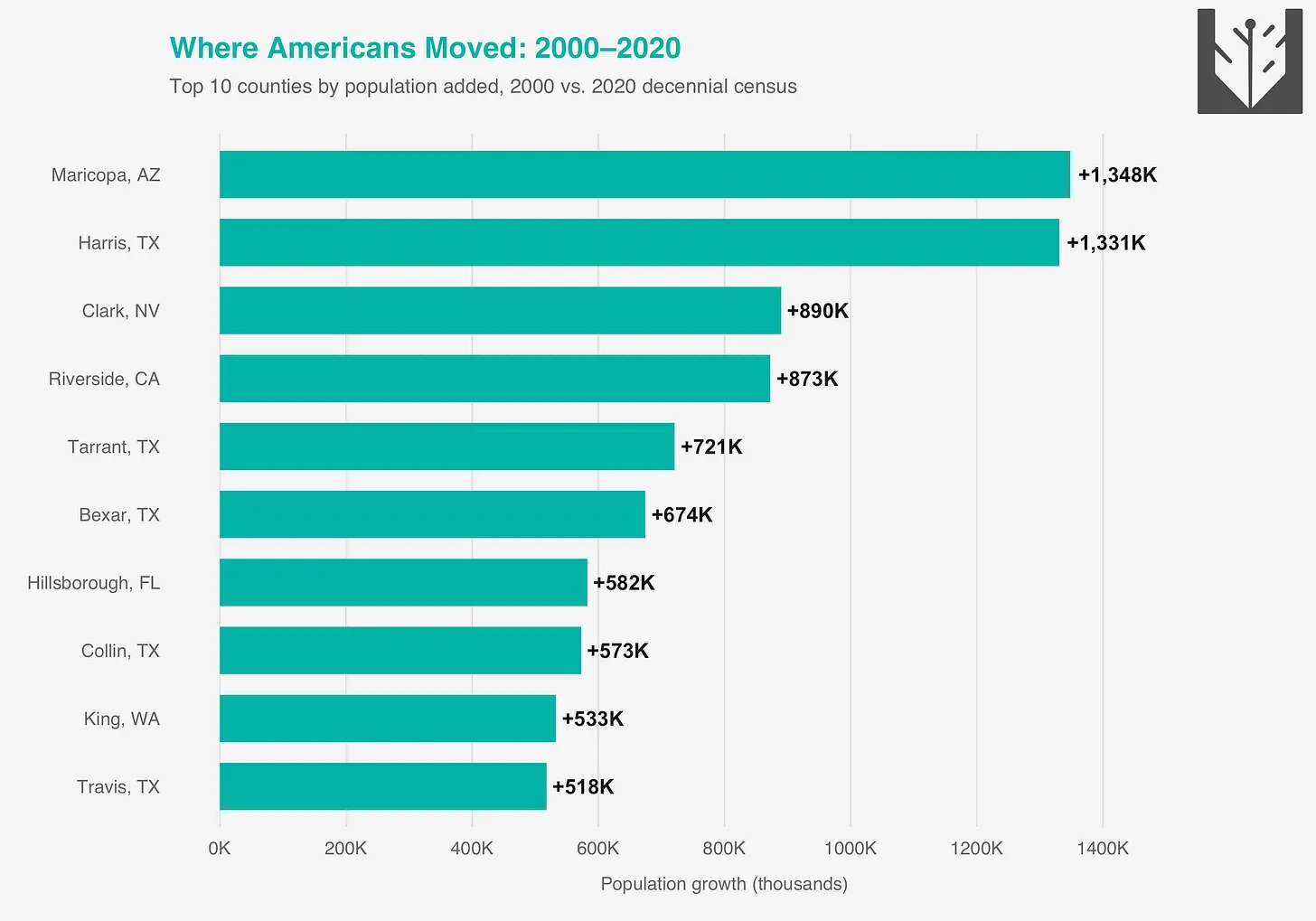
Inland Empire did suffer alot in 2008, but coincidentally around that time the last remaining swathes of undeveloped land within commutable driving range to LA/OC were all but gobbled up that decade. To give you a sense how just how rapidly the IE was growing, in the 2000's, it posted greater percentage growth than metro Phoenix, despite being slightly larger than PHX at the time. The IE would have slowed regardless, and by extension SoCal, but even accounting for slower 2010s growth, Riverside County was the 4th-fastest growing county nationwide this century, adding about as much people as all of Clark County (Las Vegas) between 2000-20.

As for LA county's slow growth in recent years, part of it was the extreme residential overcrowding that took off in the 1990s as immigrants from Latin America came especially to the LA region. But since LA chose to restrict new housing development in its bouts of NIMBYism in the late 80s/early 90s, alot of these newcomers crammed into SFHs; one home could be housing 2-3 families, or 6-8 people in a unit with 3-4 bedrooms. After the kids of these wave of immigrants matured into adulthood, many of them chose to leave the LA region in search of places with more affordable CoL starting in the late 2010s, then exacerbated by COVID, which partly explains the declines in LA/OC populations. You can see this in how more immigrant-heavy suburban communities like Santa Ana have posted severe declines, although surprisingly LA city has held up better than the rest of the region and its peer cities nationally, down only -20K or -0.5% from 2020-24 (NYC for comparison is down -326K or -3.7%, SF is down -46K or -5.3%)

Last edited by kittyhawk28; Mar 18, 2026 at 4:43 PM.
Reply With Quote
     
     
  #38  
Old Posted Mar 18, 2026, 4:42 PM
kittyhawk28 kittyhawk28 is offline
Registered User
 
Join Date: Aug 2021
Posts: 189
Quote:
Originally Posted by xzmattzx View Post
How big is that "Greater Los Angeles" area in square miles? 17 million is a lot, but if it takes 3-4 hours to go from one end to another, then an area the size of New Jersey should be able to hold 17 million people.

By the way, every state has lopsided populations. New Jersey, the densest state, has about 10 million people, and if you compare New Jersey to Greater Los Angeles, it makes sense that GLA has 70% more people because it's all urban, whereas New Jersey has rural places like Sussex County in the northwest, or Salem County in the southwest.
New Jersey is quite a bit larger than the region I highlighted:
Reply With Quote
     
     
  #39  
Old Posted Mar 18, 2026, 7:52 PM
xzmattzx's Avatar
xzmattzx xzmattzx is offline
Registered User
 
Join Date: May 2006
Location: Wilmington, DE
Posts: 6,869
Quote:
Originally Posted by kittyhawk28 View Post
New Jersey is quite a bit larger than the region I highlighted:
Not too much bigger. Turn New Jersey on its side and from the very northernmost point to very southernmost point, it stretches from Ventura to Palm Springs. Or take the southwest corner to the northeast corner, as if you took the NJ Turnpike, and it stretches from Thousand Oaks to the eastern edge of San Bernardino.
Reply With Quote
     
     
  #40  
Old Posted Mar 18, 2026, 7:59 PM
iheartthed iheartthed is offline
Registered User
 
Join Date: Oct 2009
Location: New York
Posts: 11,858
Per Wikipedia, New Jersey is more than twice as dense as the Los Angeles CSA. But the LA MSA is more than twice as dense as New Jersey.
Reply With Quote
     
     
This discussion thread continues

Use the page links to the lower-right to go to the next page for additional posts
 
 
Reply

Go Back   SkyscraperPage Forum > Discussion Forums > City Discussions
Forum Jump


Forum Jump


All times are GMT. The time now is 8:38 AM.

     
SkyscraperPage.com - Privacy Statement - Top

Powered by vBulletin® Version 3.8.7
Copyright ©2000 - 2026, vBulletin Solutions, Inc.