I have done a couple more SketchUp models to illustrate what I think is important in a Haliifax-area stadium. These are just my personal views. However, the ides below are ones that I have seen in other stadiums either in person or through internet images (Ivor Wynne, BMO Bield, Pizza Hut Park, Ralph Wilson Stadium, the new Winnipeg Stadium, Stanford Stadium, Livestrong Sporting Park, and others).
I think the following points are important (but these are just my opinions).
1) a low cost design - this will probably be the biggest factor in the design. In my opinion, a stadium might be more enjoyable by following a simple design as opposed to having all enclosed concourses which will result in an expensive stadium.
2) meets the most basic requuirements (sufficient washrooms, wheelchair accessable, room for portable concession stands, changerooms ...)
3) shelter from the rain but an open-air design
I did the first model with the Pizza Hut Field in mind -
http://en.wikipedia.org/wiki/Pizza_Hut_Park. The Sierra stage 1 report lists the stadium portion of the complex to be $35 million. However, I think a Halifax-area stadium might need more shelter from the rain so I have added a partial roof over most of the seats.
Most of the soccer specific stadiums have sideline seats and end zones seats that are parallel to the field (rectangular shape). This configuration results in the seats being closest to the field while still being able to meet FIFA specifications for foul area allowances. It works quite well for soccer in which players are constantly in motion similar to hockey. The following model shows about 25,000 seats (I didn't show the changeroom tunnels; the changerooms would probably be located under the lower seating bowl on one side - specifications on the FIFA changeroom requirements are in this document -
http://multimidia.brasil.gov.br/bibliote...cal_recommendations_and_requirements.pdf ).

Future club seats and media facilities could be at the top of the 2nd tier under the back of the roof (I showed a couple of short towers that could contain stairs and small elevators to make them wheelchair accessable).

I also did another model (although it looks similar, there are a few differences). In this model, there are 20,000 seats along the sidelines. For football, the action is more focused in one area for longer periods of time than in soccer. For football, and it should work for soccer also, it would be better to have the sideline seats angled so that people have a clearer view down the long Canadian football field. The center-most seats are slightly further from the field but I think it will provide a better viewing experience for spectators (many football stadium are built with some variation of this concept). Spectators won't have to twist their necks for long periods of time when the action is down-field.

This is another field view.

I like the wide open concourse images that I saw of Ivor Wynne Stadium (which I know will be torn down soon).
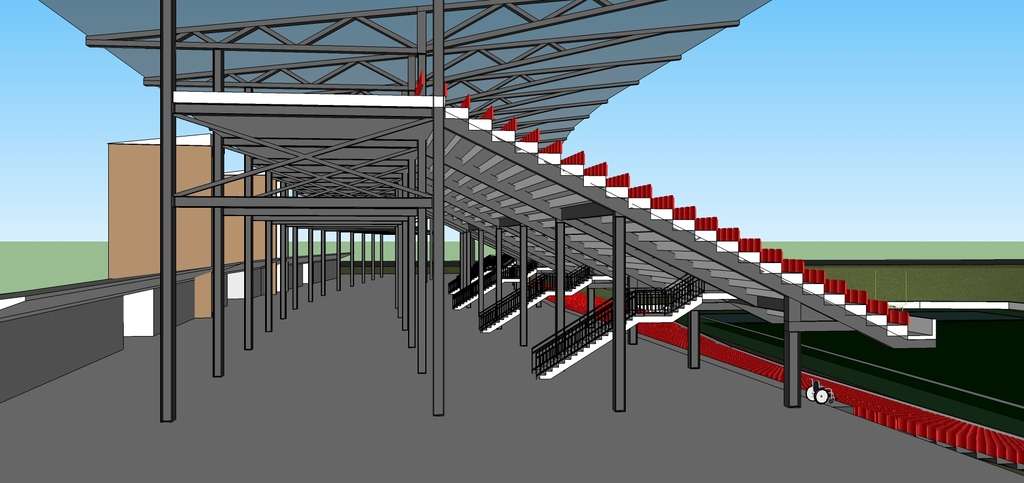
The area under the back of the roof provides support for the roof, leaves more sheltered space in the concourse below, and provides space for media and club seats for possible future expansion. The roof is loosely based on the Livestrong Sporting Park which is in Kansas City. (However, I am not a structural engineer, I studied chemical engineering. So this is just a conceptual image).






 Prev
Prev


 Linear Mode
