HomeDiagramsDatabaseMapsForum About
     

Go Back   SkyscraperPage Forum > Regional Sections > Canada > Ontario > Ottawa-Gatineau > Ottawa Photos


Reply

 
Thread Tools Display Modes
     
     
  #342  
Old Posted Jan 4, 2016, 6:24 PM
rocketphish's Avatar
rocketphish rocketphish is offline
Planet Ottawa and beyond
 
Join Date: Feb 2009
Location: Greater Ottawa
Posts: 14,555
Transforming Ottawa: A look back to Ottawa's future

Bruce Deachman, Ottawa Citizen
Published on: January 3, 2016 | Last Updated: January 3, 2016 8:00 PM EST


One way to look at Alain Miguelez’s new book, Transforming Ottawa, is simply to graze through the hundreds of historical photos and marvel at how much this city has changed.

The palatial waiting room at Union Station, for example, with its impossibly high ceilings and stately columns, the entrance to its underground passage to the Château Laurier across Wellington Street draped with Union Jacks, is forever lost to Ottawa now, except in such photographic memory.

Likewise, a lively street scene viewed from the corner of Bank and Somerset streets, with its criss-cross of hydro and streetcar lines providing an electric canopy under which the industry of banks, drugstores, lunch counters, barber shops and auctioneers bustles, is increasingly only an archival remembrance of how we once lived.

But beyond simply offering photographic evidence of the city’s growth, Transforming Ottawa explains the hows and whys behind the shaping and reshaping of Ottawa, particularly from 1950 to the mid-1980s. Subtitled Canada’s Capital in the eyes of Jacques Gréber, it explains how an urban planner from Paris came to have such an influence on Ottawa’s post-Second World War growth, what he intended and how it was implemented. For, unlike earlier city plans — major ones were undertaken in 1903, 1915 and 1922 — Gréber’s 1950 blueprint is the one today’s capital most resembles: The trains and industrial effluence have largely left the city core for the outskirts, while at the same time the verdancy we now hold so dear as beautifying also separates our neighbourhoods and makes Ottawa difficult to navigate without an automobile.

In other words, the Gréber Report’s implementation changed Ottawa greatly, sometimes for the better, but often not.

The historic photos were commissioned by Gréber, who was hired by then-prime minister Mackenzie King to create a city plan worthy of a national capital, on the sort of scale of a Washington or London. The feeling at the time was that, almost 100 years after becoming Canada’s capital, Ottawa was still very much a provincial town, and a growing sense loomed that it was time to make it more majestic.

Among Gréber’s chief concerns were the numerous railroad tracks running through town and the concentration of heavy industry in Ottawa’s core. His plan saw Union Station closed and a new one built on Tremblay Road, allowing Colonel By Drive to be built along the canal. But, Miguelez notes, the hope that those industries forced out of the downtown core and off the Ottawa River would relocate in the same direction as the station didn’t pan out. Many of them simply chose to relocate or consolidate elsewhere, largely eliminating the city’s blue-collar sector.

“You’d never do that again,” he says. “You don’t touch the economic base of a city and give it a bodycheck of that nature and get away with it. But back then, you look at the grime, the smoke, the noise of trains and industry, and it was easy to say, ‘We need something new. We need something clean and green and safe.’ And greenery — grass, lawns, trees, parks — is something that’s easy to get a buy-in for.”

The Gréber Plan also saw Ottawa’s streetcars eliminated and the establishment of the Greenbelt around the city, intended to slow urban growth. Much of the planning was done with the belief that the region’s population — then 273,000 — would never exceed half a million people, a mark it surpassed in just over 15 years.

The seeds for Miguelez’s book were sown in the late 1990s, when, as an urban planner with the City of Ottawa and a hobby historian, he was conducting research for an earlier book, A Theatre Near You, about Ottawa’s movie houses. Looking through material at Library and Archives Canada one day, he was shown boxes containing hundreds of uncatalogued black-and-white photos of street scenes of post-war Ottawa. It took Miguelez a while, but he soon realized he was looking at photos taken for Gréber’s famous report.

The images stuck with him for years.

“And as an urban planner, I’d known about the Gréber Plan. Even before I saw these, I’d read it, and I’d always thought that something should be written about the Gréber Plan and its outcomes on Ottawa, because it’s still very much regarded as, as I say in the book, the tablets on which the Ten Commandments are written.”

Miguelez found further inspiration in a book he found showing early photos of the Paris that existed before Baron Georges-Eugène Haussmann’s city plan of 1853-70 turned it into the capital we know today.

“Here was a really nice parallel,” recalls Miguelez, “and that just got me going.”

He was motivated, too, by the emotional resonance of many of the photos he found — some of the images are rather static, merely documenting a place in time, but others, such as one scene from Papineau Street in Lowertown, showing a score of young baby boomers playing on the road while a few adults look on from rundown stoops, could serve as illustrative tableaux for Brian Doyle or Norman Levine stories.

“That picture is pure poetry to me,” says Miguelez, “and I wanted to make sure that everyone had access to these pictures. I think everyone SHOULD see them.”

Hoping to produce a finished product with some elegance to accompany the heft, Miguelez chose to crowd-source its funding, and was surprised to find about 250 people willing to offer financial support. “It’s humbling that you’re doing a book on urban planning and so many people are interested.”

The first print run of 500 hardcover editions is almost gone — only a few handfuls remain, he says, at such independent stores as Perfect Books, Books on Beechwood, Octopus Books, The World of Maps and Troubadour Records & Books, as well as online at oldottawa.ca and amazon.com. Miguelez is weighing the possibility of a second edition.

The book also offers a timely sense of Ottawa’s continuity and evolution. One of the final photos on its pages is of the neon sign outside the only recently closed Mellos restaurant on Dalhousie Street, which recently made headlines when it was removed.

Miguelez hopes that readers will take away from the book a realization of what a magnificent city Ottawa is.

“I hope this book helps give this city a better sense of ourselves and our history, and a sense of the urbanity that we had here and that had been developing, and that I think people are still hungry for in how we move forward in the layers of the next urbanization of Ottawa.

“But it’s also just a nostalgic trip to the past. Just to flip through the pages and realize what a city we have and how much character and history there is, and having some pride in it. We’re a modest city in many ways, and while there’s nothing wrong with modesty, there’s also nothing wrong with self-awareness and self-assuredness as we continue to construct our own identity as a city.”


[email protected]

http://ottawacitizen.com/news/local-news/transforming-ottawa-a-look-back-to-ottawas-future
Reply With Quote
     
     
  #343  
Old Posted Jan 4, 2016, 6:49 PM
lrt's friend lrt's friend is online now
Registered User
 
Join Date: Dec 2006
Posts: 12,762
The first photo is amazing as it shows the transformation of downtown Ottawa from its pre-war format to its post-war format. It probably dates from late fall 1938 or early spring 1939 as the city rushed towards the Royal Visit of May 1939 and the official dedication of the War Memorial. Most people don't realize that the Plaza Bridge was widened at that time to allow traffic and the streetcars to move around the new Confederation Square. The new streetcar tracks were smack dab in the middle of the old Russell House Hotel, which had been there until 1928 when it was destroyed by fire and demolished. I find it hard to fathom, but my Dad would have known what old Ottawa looked like before Confederation Square. I wish I had asked him more questions although he and his brothers did point out a few things over the years.
Reply With Quote
     
     
  #344  
Old Posted Jan 4, 2016, 7:07 PM
Aylmer's Avatar
Aylmer Aylmer is offline
Still optimistic
 
Join Date: Nov 2007
Location: Montreal (C-D-N) / Ottawa (Aylmer)
Posts: 5,407
Transforming Ottawa is a marvelous book - a fascinating and sometimes heartbreaking, detailed look at how Ottawa once was. I'm a hopeless romantic and some of the pictures tug at my heartstrings, but when you read it, it really helps you to understand (but not always justify) why the city changed, demolished or built what it did. I think it's a sense of perspective which we desperately need if we're to avoid what future generations will look at as mistakes in today's big projects (the redevelopment of industrial lands like LeBreton, how we grow outside the Greenbelt, how we design our transportation systems...).

A must-read, for sure.
__________________
I've always struggled with reality. And I'm pleased to say that I won.
Reply With Quote
     
     
  #345  
Old Posted Jan 4, 2016, 7:27 PM
Norman Bates Norman Bates is offline
Living With My Mother
 
Join Date: Feb 2009
Posts: 1,026
Does anyone know if the author will be doing any book signings?

EDIT: it's sold out on both Amazon.ca and oldottawa.ca (where it was $45).
Reply With Quote
     
     
  #346  
Old Posted Jan 4, 2016, 7:30 PM
lrt's friend lrt's friend is online now
Registered User
 
Join Date: Dec 2006
Posts: 12,762
What is mostly silent in all of this is thousands of people who were expropriated during the 1940s, 1950s and 1960s and the tremendous heartache that was experienced. I read recently of 200 expropriation notices being sent out in 1947 to clear the east bank of the Rideau River alone. My own greater family had experienced several federal expropriations for various reasons.
Reply With Quote
     
     
  #347  
Old Posted Jan 4, 2016, 7:31 PM
lrt's friend lrt's friend is online now
Registered User
 
Join Date: Dec 2006
Posts: 12,762
Quote:
Originally Posted by Norman Bates View Post
Does anyone know if the author will be doing any book signings?
I believe that occurred the night the book was launched back in November. I heard about it a day or two afterwards.
Reply With Quote
     
     
  #348  
Old Posted Jan 7, 2016, 3:03 AM
MarkR MarkR is offline
Registered User
 
Join Date: Apr 2015
Posts: 149
Quote:
Originally Posted by lrt's friend View Post
The first photo is amazing as it shows the transformation of downtown Ottawa from its pre-war format to its post-war format. It probably dates from late fall 1938 or early spring 1939 as the city rushed towards the Royal Visit of May 1939 and the official dedication of the War Memorial. Most people don't realize that the Plaza Bridge was widened at that time to allow traffic and the streetcars to move around the new Confederation Square. The new streetcar tracks were smack dab in the middle of the old Russell House Hotel, which had been there until 1928 when it was destroyed by fire and demolished. I find it hard to fathom, but my Dad would have known what old Ottawa looked like before Confederation Square. I wish I had asked him more questions although he and his brothers did point out a few things over the years.
That photo, and many others, can be found at http://www.ottawahh.com/ottawahh.pl?x=toc#ap_a_scan
Reply With Quote
     
     
  #349  
Old Posted Jan 7, 2016, 5:24 AM
lrt's friend lrt's friend is online now
Registered User
 
Join Date: Dec 2006
Posts: 12,762
Quote:
Originally Posted by MarkR View Post
That photo, and many others, can be found at http://www.ottawahh.com/ottawahh.pl?x=toc#ap_a_scan
Thanks!
Reply With Quote
     
     
  #350  
Old Posted Jan 22, 2016, 10:18 PM
Urbanarchit Urbanarchit is offline
Registered User
 
Join Date: Jun 2013
Location: Ottawa
Posts: 1,927
Library and Archives lists this photo as being Wellington and Somerset. Unless there is a mistake, this could be a photo of Somerset Square in 1924.

Reply With Quote
     
     
  #351  
Old Posted Jan 25, 2016, 4:52 AM
MarkR MarkR is offline
Registered User
 
Join Date: Apr 2015
Posts: 149
Quote:
Originally Posted by Urbanarchit View Post
Library and Archives lists this photo as being Wellington and Somerset. Unless there is a mistake, this could be a photo of Somerset Square in 1924.

From my various readings of Ottawa history I recall the cannon at Somerset Square, which is the photo. It was placed there after (I think) WW1, but I can't seem to find any online reference to it.
Reply With Quote
     
     
  #352  
Old Posted Jan 25, 2016, 3:42 PM
MoreTrains MoreTrains is offline
Registered User
 
Join Date: Oct 2014
Posts: 858
Quote:
Originally Posted by MarkR View Post
From my various readings of Ottawa history I recall the cannon at Somerset Square, which is the photo. It was placed there after (I think) WW1, but I can't seem to find any online reference to it.
It is definitley WW1 vintage due to the track wheels that prevented it from sinking too far into mud.
Reply With Quote
     
     
  #353  
Old Posted Jan 25, 2016, 6:27 PM
rocketphish's Avatar
rocketphish rocketphish is offline
Planet Ottawa and beyond
 
Join Date: Feb 2009
Location: Greater Ottawa
Posts: 14,555
Ottawa to mark 100 years since Parliament burned down

By Alex Robinson
Ottawa East News, Jan 22, 2016


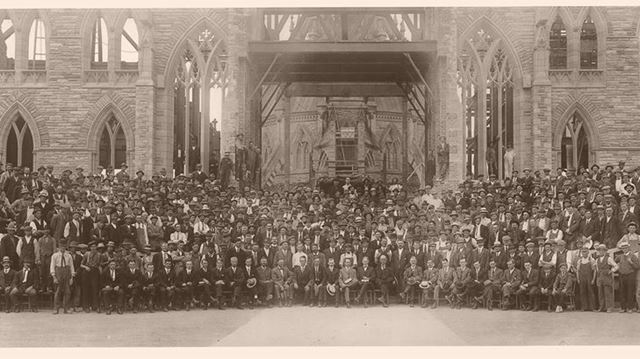
The image is an impressive one: hundreds of men, who rebuilt Parliament after it burned down in 1916, defiantly standing in front of the half-finished new building.

When Paul Couvrette first looked at the photo in the basement of Irene’s Pub in the Glebe, he quickly scanned it in search of a specific face. His great-grandfather was actually standing among the crowd.

An enlarged copy of the picture hangs on the wall below Irene’s Pub, where patrons wandering past on their way to the washroom stop to inspect it.

Through research about his family tree, Couvrette discovered his great-grandfather, Gedeon Couvrette, had worked on both the original construction of Parliament Hill when he was 17 years old, and the rebuilding of Centre Block when he was 72.

Gedeon worked as a labourer in the original construction, and as a teamster – hauling materials with his horses and cart – for the rebuild after retiring as a lumberjack.

Couvrette, who owns one of Centretown’s last photography studios believes his great-grandfather was likely the only person to have worked on both the original construction and rebuilding of Centre Block.

His research led him to this photo.

The landlord of Irene’s Pub and self-described history buff Ron Bujold said he found the photograph in the basement of a house he bought on Morris Street in 1994.

“There was all sorts of junk in this basement and I found this in what was left,” he said.

“I’ve always been fascinated by anything historical like that.”

Bujold and Couvrette were not alone in their historical curiosity. The Bytown Museum recently contacted Bujold to include the photo in an exhibit marking the 100th anniversary of the fire, which ripped through Parliament on Feb. 3, 1916.

The exhibit, called Forged in Fire, will chronicle the history of Parliament Hill, from the time before European settlement up until when the buildings were rebuilt after the fire.

The blaze started in the Commons Reading Room and quickly spread to engulf all of Centre Block except for the library, which was saved by its iron doors.

A cornerstone ceremony was held on Sept. 1, 1916, exactly 56 years after the original cornerstone was laid. Construction was complete on the Peace Tower just 11 years later.

“We no longer have the people who were working the stone and lumber to restore it but their children and grandchildren have mementos of that occasion,” said Grant Vogl, a curator with the Bytown Museum.

“It’s a great way to reintroduce a story that is moving out of memory and into the history books.”

In Bujold’s photograph, Couvrette’s great-grandfather stands among electricians, architects, labourers and even a future prime minister – Arthur Meighen can be seen sitting in the front row.

“I was absolutely stunned by the odds that my great-grandfather would be suddenly appearing before me,” Couvrette said.

“The odds of that happening must be a million to one.”

By complete coincidence, Barry Meabry, Couvrette’s friend who alerted him to the existence of the photo just a couple months ago, found out that his great-grandfather is also in the photo and standing right next to Gedeon in the picture.

The Bytown Museum’s exhibit will open Jan. 29 for Winterlude and will run until the end of October.

Alex Robinson is a reporter with the Ottawa East News. He can be reached at [email protected] .

http://www.ottawacommunitynews.com/news-...-100-years-since-parliament-burned-down/
Reply With Quote
     
     
  #354  
Old Posted Jan 26, 2016, 12:40 PM
rocketphish's Avatar
rocketphish rocketphish is offline
Planet Ottawa and beyond
 
Join Date: Feb 2009
Location: Greater Ottawa
Posts: 14,555
LeBreton Flats revisited: newest visions just latest chapters in storied history
Not the first time former 'slum' has been focus of developers' plans, historian says

CBC News Posted: Jan 25, 2016 3:06 PM ET Last Updated: Jan 25, 2016 3:08 PM ET


The focus this week is on the future of LeBreton Flats, but one Ottawa urban historian is advising us to look to the past for guidance on the redevelopment.

The site, just west of downtown Ottawa, has been opened up for redevelopment by the National Capital Commission, which has chosen two finalists to build on 9.3 hectares of land.

Those two bidders will reveal their full proposals during a public consultation at the Canadian War Museum starting Tuesday at 4 p.m.

Robert Smythe, an urban historian with experience as a planner and political staffer, said in an interview with Radio-Canada the site's development dates back to the turn of the 19th century.

"That's where the settlers first landed, that's where the Rideau Canal was going to open up at first, so really that's the earliest part of Ottawa… that's where the city was born," he said.

The area filled up with stone buildings, mills, hotels and some rail lines by the time a fire completely destroyed the community in 1900.

"It started one April morning in 1900 in Hull and it spread across the [Ottawa River] very quickly, it was quite windy. Because of all the lumber industry and piles of wood and sawdust it spread really within a matter of hours," he said.

"[LeBreton Flats] was pretty well totally wiped out, it was burnt to a cinder … just some melted steel and melted cars. So they had to start over."


Smythe said the community was rebuilt in three years and became much more industrial, with around 2,500 people living in the middle of factories and rail yards.

LeBreton Flats remained a blue-collar, working class neighbourhood until John Diefenbaker's Progressive Conservative government decided it wanted the land for something else.

"It was called 'slum clearance,' that was the way they did it then. They erased everything to start over," Smythe said.

"In the 60s, when we started building freeways, they started looking at that land and thinking we could put a freeway there … it was the Diefenbaker government that did that as a sort of election promise."


Smythe said there was little protest at the time because the decision moved through Parliament in one day, but there was some discontent when houses were left vacant for a long period before being demolished.

"I think it was probably noisy, it was certainly very dirty, it was polluted, a lot of people thought it was a slum … a lot of people were glad to see it go, they felt we were cleaning up the city," he said.

Smythe said the Diefenbaker government wanted to put freeways there along with a "Pentagon of the North" defence headquarters similar to the landmark building in the Washington, D.C. area.

But those plans didn't come to fruition by the time the Diefenbaker government was defeated, and each federal government to follow came up with a new plan for the blank space.

"There were the plans for the short takeoff and landing airport, a plan for a $50-million incinerator, a plan for more office buildings, a plan for public housing, a plan for private housing, then a plan for mixed-use [development] and then large decades where nothing happened at all," Smythe said.

Smyth said he's cautiously optimistic about the new LeBreton Flats redevelopment plans given all the plans that have fallen through.

"I think the speed at which the Zibi Chaudière Islands project has proceeded has probably spurred the government, maybe embarrassed the government into acting," he said.

"There's been a difference in approach, in the past it was all going to be done by the public sector and in the last few years the NCC has used this approach of using the private sector."

Smythe said the planned light rail line with its Pimisi station near LeBreton Flats is another important new factor, as it will help bring people to new businesses and attractions without having to drive.

http://www.cbc.ca/news/canada/ottawa/leb...st-chapters-in-storied-history-1.3418778
Reply With Quote
     
     
  #355  
Old Posted Jan 28, 2016, 8:15 PM
drawarc's Avatar
drawarc drawarc is offline
Registered User
 
Join Date: Jul 2001
Posts: 471
Reply With Quote
     
     
  #356  
Old Posted Jan 30, 2016, 2:12 PM
rocketphish's Avatar
rocketphish rocketphish is offline
Planet Ottawa and beyond
 
Join Date: Feb 2009
Location: Greater Ottawa
Posts: 14,555
Seven deadly decisions: Who died when Parliament burned 100 years ago

Andrew Duffy, Ottawa Citizen
Published on: January 29, 2016 | Last Updated: January 29, 2016 1:54 PM EST


Some ran into danger, others ran to fetch their furs: Andrew Duffy reveals the final moments of seven people killed when Ottawa’s landmark went up in flames.


On the evening of Feb. 3, 1916, as politicians debated the merits of an inquiry into the high price of fish in central Canada, Yarmouth MP Bowman Brown Law stood up and surveyed the empty seats that surrounded him in the House of Commons.

“I have been very sorry to notice during the years I have had the privilege of sitting in this House,” the Liberal groused, “that when our fishing industry is being discussed very few members stay in the chamber.”

Law had spent 14 years on Parliament Hill after a term on Yarmouth’s first town council. He was one of that city’s leading businessmen, heir to a shipping empire founded by his father, William, a former Nova Scotia legislator.

Law had helped expand the business — into auctioneering and marine insurance — while establishing himself as a pillar of the community: He was a member of the Methodist Church, a leader in the local temperance movement, and a devoted father to his only child, Dorothy.

Law was also a strong advocate for his constituents, most of whom worked in the fishing industry; they had returned him to Ottawa three times by ever-widening margins.

On Feb. 3, he asked the House to consider a “bonus” for fisherman in recognition of their dangerous work.

“We are at all times assisting the farmer, doing things for him, which I have no hesitation in saying are quite right,” he argued. “But very little has been done for the hardy, sturdy fisherman.”

It would be the last time that Law addressed the House.

He left his seat sometime after 8:30 p.m., telling his colleague, Inverness County MP Dr. Alexander Chisolm, to “speak good and loud so that I can hear you.”

Law made his way to the long distance phone booths in the basement of the Parliament Buildings, where he put a call through to a friend in Nova Scotia. (Long distance calls were still a novelty: Within weeks, the country would marvel at the first long distance call connecting Montreal with Vancouver.)

When he emerged from the cloistered phone booth, Law stepped into a world that had changed utterly.

The building was in an uproar. Bells were ringing. Messengers, politicians and policemen were hurrying in different directions. Shouts of “Fire! Fire!” sounded through the halls.

Law was about to join an epic drama, a night like no other in the history of Ottawa.

Ultimately, he would become one of seven to die in a fire that would destroy the Parliament Buildings, the seat of government and the cherished emblem of a young country’s ambition.

The dead would come from all walks of life, from disparate social classes, from French and English Canada. Some would die as heroes, others not. All would be victims of decisions cast under pressure when seconds mattered more than more than power, privilege, furs or gold.

The fire started in the House of Commons reading room, where politicians frequently retired to absorb the news. It was wartime and the slaughter at Gallipoli had just ended; the slaughter at Verdun was about to begin.

Conservative MP Frank Glass was standing at the second reading table when he felt a blast of heat on his leg. At first, he thought it was just another belch from the building’s boiler.


“I turned around and almost immediately with my turning, I smelt the burning of paper,” Glass later told the Royal Commission that examined the cause of the blaze.

In its final report, the commission said it had a “strong suspicion” the fire was an act of German sabotage, but they left the matter open for further investigation since there was no conclusive evidence as to what started the inferno. Today, a century later, it is still not clear whether the fire was a tragic accident or mass murder.

What is clear is that the disaster could have been averted in the fire’s first, critical moments.

Just two days earlier, a similar scene had unfolded in the reading room. Two MPs had detected smoke coming from a shelf of newspapers underneath a desk. The two men, Conservative MP William Weichel and a visiting friend, pulled the smouldering papers onto the floor and stamped out the flames.

Curiously, the very same situation faced MP Frank Glass on the evening of Feb. 3.

When he smelled smoke, Glass bent down and saw a few small flames curling inside a shelf of newspapers under the desk behind him. He called for help, but no one came. So Glass ran to the door, where a member of the Dominion Police Force was stationed.


Const. Thomas Moore took one look at the smoke in the room and ran into the hallway to raise a general alarm. He then raced to the nearest extinguisher, which was at the other end of the large room. Meanwhile, a reading room attendant pulled the burning papers onto the floor. The policeman turned the extinguisher on the fire.

But it was too late.

The extinguisher’s hard, narrow stream broke apart the burning paper and spread the flames. They climbed up the newspapers that hung on wooden partitions, and spread to the wood-panelled walls and gallery, where 20,000 books were stored.

The reading room had served as the former library and had accommodated the first sitting of Canada’s Supreme Court. It offered ideal conditions for fire: it was well ventilated, stuffed with paper, and panelled with varnished wood.

Within minutes, flames travelled out the door, and along corridors lined with pine wardrobes.

“The corridor seemed to act like a giant flue with a tremendous draught,” C.R. Stewart, chief doorkeeper of the House of Commons, would later testify.

Said another witness: “The fire ran among the floors like a prairie fire.”

It was Stewart who interrupted proceedings in the House of Commons at 9 p.m. to announce: “There is a big fire in the reading room; everyone get out quickly.”

In 1916, senior government officials both worked and lived in the Parliament Buildings. The House of Commons and Senate speakers, the Sergeant-at-Arms and the Usher of the Black Rod were among those who resided on the Hill when Parliament was in session.

Newly elected House speaker Albert Sévigny was in his office, on the ground floor of his living quarters, when he was warned that a fire had erupted in the reading room.

Sévigny immediately understood that his two children were in mortal peril: Their second-floor nursery was at the far end of the apartment, nearest the fire. They were practically above it.

Moments earlier, in the parlour, the four women had all made fateful choices.

Dussault, Morin and Bray decided to run to their bedrooms down the long hallway to rescue their furs.

Mme. Sévigny tugged at the skirts of her friends in an attempt to bring them with her down the staircase. She begged them to come, but they insisted they had enough time.


He raced upstairs and yelled a warning to his wife and her three guests, Mabel Morin, Florence Bray and Mme. Henri Dussault, who were gathered in the parlour.

Sévigny then went for his children asleep at the other end of the apartment. He escorted his daughters and their nursemaids to safety then attempted to climb back to his apartment, but was met by a wall of smoke and flames.

It was a wickedly cold night, and the women must not have been able to conceive of facing it without their furs. The lost seconds would cost two of them their lives.

After they reached their bedrooms, dense smoke and flame poured into the hallway, cutting off their escape. Dussault climbed out a bedroom window onto a ledge and cried for help.

One of the speaker’s stewards raced to the front of the Parliament Buildings and directed firefighters to the scene. They managed to get a net in place as Dussault dangled from the ledge. She was unconscious when she landed.

“I have never seen a braver woman in my life,” Kingston MP William Nickle, one of those who held the net, told the Ottawa Journal.

Repeated attempts were made to find the two women still inside, but the rescuers were forced back by smoke and heat.

About half an hour after the fire started, Ottawa firefighters pulled Morin and Bray from a second bedroom where they had collapsed on a couch. Their hands were scratched and bleeding from clawing at the window, which led onto a fire escape.

A subsequent inquest found that the window frame had been recently painted. Sévigny had often complained about how difficult it was to open.

Morin, 30, the wife of a lawyer in St. Joseph de Beauce, had intended to leave Ottawa days earlier, but kept postponing the trip because of an illness. She was the mother of five children. Bray, 27, left behind her husband, a Quebec City businessman, and their three-year-old.

A distraught Mme. Sévigny later told the Ottawa Citizen: “Oh, if those two ladies had only followed me when I tugged at their skirts, instead of returning for their furs, they would have been safe.”

There were many narrow escapes, some ready heroes, and much tragedy on the night that Parliament burned.

Agriculture Minister Martin Burrell, whose office adjoined the reading room, had to run for his life through the heart of the fire. He suffered serious burns to his head and hands.

The drama on Parliament Hill unfolded everywhere at once.

In the Library of Parliament, clerk Michael MacCormac ordered closed the heavy iron doors that joined the library to Centre Block as soon as he heard a messenger cry out that the reading room was on fire. He would be made a member of the Order of the British Empire.


In Room 107, steward Walter Hill was reading a newspaper in the deputy speaker’s sitting room when he heard a strange roar. He opened the door to discover the second-floor hallway running with smoke and flame — and a man struggling along one of its walls.

He pulled the man, whom he later identified as assistant Commons clerk René Laplante, into the office and slammed the door. Laplante had a room next door.

They were in desperate trouble. With the heat of the inferno building, Hill pulled down the curtains and tied them together. He anchored them, smashed the window, and tossed the makeshift rope toward the courtyard below.

Hill implored Laplante to join him on the lifeline, but the 60-year-old clerk refused to go, and instead begged, “For God’s sake, send someone back after me.”

Hill later told the Globe: “I explained that it was certain death to remain in the room, while if we left by the window, we took a chance of getting through with probably a broken leg. My efforts were all in vain, and when I could not stand the terrible heat any longer, I had to leave him.

“As I looked at him before I took the leap, he was on his knees praying. It was awful to have to go as I knew in five minutes he would be a dead man.”

Hill injured his back and leg in a long drop to the stone courtyard, but he lived to talk about his daring escape.

The body of Laplante, a married Montrealer who had served 19 years as a Commons clerk, would be found two days later.

The Speaker’s entrance suddenly collapsed

Firefighters and volunteers battled all evening to save the Parliament Buildings and those trapped inside them.

Around midnight, after fighting the blaze for hours, government pipefitter Alphonse Desjardins expressed concern about the safety of a co-worker still in the building’s boiler room — an engineer who had rebuffed earlier entreaties to leave his post. Desjardins enlisted his nephew and a few other men to help save him. If necessary, he said, they’d drag the engineer out.

The men went into the basement and ran a fire hose down the hallway to douse some flames licking out of the Parliamentary barbershop, near the boiler room.

It was then that disaster struck: the west tower of the Speaker’s entrance suddenly collapsed and crashed down onto the rescue party.

Dominion Police officer James Knox grabbed one of the men, Charles George, a waiter in the Parliamentary restaurant, and pulled him to safety. George would later give the officer a gold watch for saving his life.

But three men were buried by debris. Randolph Fanning, a post office employee who had earlier in the night tried to rescue Morin and Bray, was killed. So was the pipefitter Desjardins, 55, a father of three, and his nephew and namesake, Dominion Police Const. Alphonse Desjardins Jr., 27, also a father of three.

On Wellington Street, Desjardins Sr.’s wife, Exilda, and son, Horace, a seminary student, were in the crowd that had gathered to watch events unfold on Parliament Hill. They stayed late into the night. Yet it wasn’t until the next day that they learned — by reading the newspaper — of their loved one’s death.

A year after the fire, Parliament granted a $2,000 “compassionate allowance” to each of the families left behind by the men killed in the rescue effort. The family of clerk René Laplante received $5,000.

Ottawa’s Yolande Desjardins, 86, says her father, Horace, abandoned his religious studies after the tragedy and returned to look after his widowed mother. He later opened a Dalhousie Street pharmacy, married and raised four children.

Desjardins, who sleeps in her grandfather’s carved-oak bed, says her father and grandmother rarely discussed the fire. “It seemed to be something they didn’t want to talk about.”

MP Bowman Law was last seen alive in the messengers’ room in basement of the Parliament Buildings.

Messenger Richard Bailey told the Royal Commission that several MPs were there, including Law’s friend, Dr. Alexander Chisolm, who asked him if he “would take a chance to go up after his coat?”

“I said, ‘No doctor, the smoke would put me back,” Bailey testified.

Bailey then ran into Law, who was worried about something he had left in his coat pocket. “If I had what was in my coat,” Law said, “I would not care for my coat.”

The coat was in Room 213 on the opposite end of the Parliament Buildings. To reach it, Law would have to climb the stairs and cross to the Senate side.

No one saw him go, but it’s believed Law died in pursuit of whatever was in his pocket. His charred remains were the last to be found, buried in the rubble near the reading room.

Law’s only surviving grandchild, Mildred Saunders, says no one in the family ever discovered what was in his coat.

“I have no idea, but it’s a good question,” says Saunders, 85, of Bridgewater, N.S.

The youngest of Law’s six grandchildren, Saunders says the fire was a disaster for her grandmother, Agnes. “The family was never the same,” she says.

Agnes Law “just kind of folded up” and died a few years after her husband, while the couple’s only daughter, Dorothy, was left to manage the sale of the family business. “My mother (Dorothy) was just sort of left alone,” Saunders says. “It was a drastic thing to have happened: I don’t think my mother ever got over it, really.”

http://ottawacitizen.com/news/local-news/the-night-parliament-burned

Reply With Quote
     
     
  #357  
Old Posted Feb 4, 2016, 3:00 AM
rocketphish's Avatar
rocketphish rocketphish is offline
Planet Ottawa and beyond
 
Join Date: Feb 2009
Location: Greater Ottawa
Posts: 14,555
The "noble building" would rise again

Arthur Milnes, Ottawa Citizen
Published on: February 3, 2016 | Last Updated: February 3, 2016 2:14 PM EST


One-hundred-years ago Wednesday evening, Prime Minister Sir Robert Borden was working quietly on his correspondence in the Centre Block on Parliament Hill. At the same time, members of Parliament were debating Canada’s fisheries in the nearby Commons chamber. All seemed normal in political Ottawa on Feb. 3, 1916.

Then disaster struck, shattering a cold winter’s night.

“Shortly after 9 (p.m., a clerk) rushed in and said that there was an awful fire in the corridor,” Borden later wrote in his diary. “We hurried out and in the corridor leading to the reading room there was a great volume of thick, black smoke through which darted long tongues of flame, accompanied by short, sharp sounds like explosions.”

Hansard concludes that day’s report the following way:

“At this time Mr. C. R. Stewart, Chief Doorkeeper of the House of Commons, came hurriedly into the Chamber and called out: ‘There is a big fire in the reading room; everybody get out quickly.’ The sitting was immediately suspended without formality, and members, officials, and visitors in the galleries, fled from the Chamber.

“Some of them were almost overcome by the rapidly-advancing smoke and flames before reaching a place of safety. The fire, which had originated in the reading room, gained momentum with extreme rapidity, and was soon beyond control.

“It continued till the following day, resulting in the almost total destruction of the Parliament buildings, together with the loss of several lives.”

Leading a nation at war, Borden knew he had to immediately assure Canadians that the business of government would continue. Huddling with advisers and ministers at the Chateau Laurier, he made an important decision.

“I called up the (Ottawa) Citizen and told them to announce that the House would meet tomorrow as usual, place to be announced … I took a motor and went again to survey the conflagration. It had worked over to the Senate end and had almost completely enveloped western end. Inquired about library and chauffeur told us it had been destroyed. This surprised me greatly and I afterwards discovered that it was not correct. Reached home about 12:30 … Fire still blazing fiercely when we retired.”

With the ruined Centre Block still smouldering, MPs met hours later, on Feb. 4, at the Victoria Museum, now the Canadian Museum of Nature. Both Borden and Sir Wilfrid Laurier addressed shocked MPs, and through them, the Canadian nation. Seven people, including a sitting MP, had perished.

Prime Minister Borden spoke first.

“The building dates from the very earliest years of Confederation, or even before Confederation. In that Chamber the great policies were debated and worked out which have touched the development of our country and its future destiny,” the Nova Scotian said.

“In that Chamber the great men who founded this Confederation spoke, and did their duty as representatives of the people in Parliament from the inception of Confederation through the active period of their lifetime. The destruction of the building is the loss of a great historic monument.”

Borden then looked to the present and the future.

“I believe it will stand out as a good example of the Canadian spirit of determination if we proceed at once with the public business, and carry on our work without unnecessary delay,” he said. “And so I commend to the consideration of the House our proposal to proceed at once, with firm hearts and renewed resolve, in the discharge of our duties as representatives of the people of Canada in this Parliament.”

The ever-eloquent Laurier, by then an MP for a commanding 42 years, took to his feet. A hush fell over as MPs, Liberal and Tory alike, turned towards the grand old man of Canadian politics. As always, Laurier did not disappoint.

“The old Parliament Building in which we sat yesterday, and which been identified with the life of the Canadian people since Confederation, is a mass of ruins,” he said. “Great though the material loss is to every member of Parliament, to those of the present day and to those of an older generation still living, the loss of life is still more appalling.

“We had become attached to the scene and to everything which appertained to that building. To the people of Ottawa especially it will be a sad loss because it was part of the life of the community, as it was the pride of every Canadian who came to Ottawa to see the British flag floating on the stately tower. The noble building will rise again with no loss of time and we will see it again at no distant date, in its pristine beauty.”

Laurier’s speech was short. Like his American hero, Abraham Lincoln, the great French-Canadian orator knew that brevity was often the vehicle to help calm and reassure an audience and people.

“I have nothing more to say except to endorse what has been said by my right hon. friend the Prime Minister that we should go on at once with the business of the country,” he said.

“When we look at the mass of ruin there on the Hill, and when we know that it is the result of an accident, we are reminded of the ruins of Louvain, and of the ruins of Rheims, caused not by accident, but by the wickedness of a cruel foe. If there is anything which the present calamity should impress upon us, it is the desirability of going on with our work and doing everything to bring those cruel murderers to justice.”

The House adjourned for the weekend so temporary accommodations at the museum could be finalized. By the following week, as the Great War continued, MPs were back at work.

And by 1920 MPs returned to the Hill.

Borden, for example, then became the first prime minister to occupy the Centre Block office used by Prime Minister Justin Trudeau today. In 1927, the Peace Tower was completed.

Just as Laurier had predicted, the “noble building” had risen again. She still stands today, a testament to democracy, resolve and Canada itself.

Arthur Milnes, of Kingston, is a veteran political speechwriter and fellow of the Queen’s School of Policy Studies, is editor of Canada Always: The Speeches of Sir Wilfrid Laurier, to be published later this year by McClelland and Stewart.

http://ottawacitizen.com/opinion/columnists/arthur-milnes-the-noble-building-would-rise-again
Reply With Quote
     
     
  #358  
Old Posted Feb 16, 2016, 8:34 PM
LeadingEdgeBoomer LeadingEdgeBoomer is offline
Registered User
 
Join Date: Mar 2010
Posts: 1,335


uOttawa has published this photo of their brass band in 1898.

I think they should bring it back in time to play at the 150th anniversary of Confederation events. Complete with replica vintage uniforms as in the photo.

uOttawa's School of Music should get on this as a project
Reply With Quote
     
     
  #359  
Old Posted Feb 17, 2016, 2:32 AM
Norman Bates Norman Bates is offline
Living With My Mother
 
Join Date: Feb 2009
Posts: 1,026
Looks like the cover of Pepper.
Reply With Quote
     
     
  #360  
Old Posted Feb 17, 2016, 10:20 PM
Uhuniau Uhuniau is offline
Registered User
 
Join Date: Jan 2010
Posts: 9,019
Canada in general has a shortage of brass bands and marching bands. We oughta do something about that.
Reply With Quote
     
     
This discussion thread continues

Use the page links to the lower-right to go to the next page for additional posts
 
 
Reply

Go Back   SkyscraperPage Forum > Regional Sections > Canada > Ontario > Ottawa-Gatineau > Ottawa Photos
Forum Jump


Forum Jump


All times are GMT. The time now is 8:29 PM.

     
SkyscraperPage.com - Privacy Statement - Top

Powered by vBulletin® Version 3.8.7
Copyright ©2000 - 2026, vBulletin Solutions, Inc.