HomeDiagramsDatabaseMapsForum About
     

Go Back   SkyscraperPage Forum > Regional Sections > Canada > Ontario > Ottawa-Gatineau > Transportation


Reply

 
Thread Tools Display Modes
     
     
  #2841  
Old Posted Nov 28, 2009, 8:55 PM
RTWAP's Avatar
RTWAP RTWAP is offline
Registered User
 
Join Date: Oct 2009
Posts: 528
Quote:
Originally Posted by Richard Eade View Post
Blair:


Although I expect a lot of thought has been put into the design of this station, I think a better station layout could be achieved. This will be a major transfer station with a twin-tracked LRT, two busy BRT Transitways, and local buses all converging here. It will be the western termination of those Transitways while local buses will continue to have access to City Park Drive to the west. A major shopping mall and a business park are connected to this station.

The big problems I have with the presented design are:
- All buses cross twice to have their doors facing the central-island. Buses going to the Lay-by cross the traffic thrice.
- All buses, Transitway and local, will be using the same platforms which will make the stops very crowded, potentially leading to bus jams.
- Virtually all pedestrians will have to cross the LRT/bus platform/island.

I will elaborate a bit on each of these points:

Since buses have their doors on the right side, the buses must cross to a ‘counter-flow’ direction to allow riders access to a central, island platform. After the buses have circled the island, they must then revert to their normal side of the road by crossing again. Thus every bus must cross a traffic lane at least twice. As I mentioned above, if a bus is to wait in the Lay-by area, then it needs to cross the inlet stream a second time to get to the Lay-by area. Worse still would be if the station were modified to permit the local buses to exit the station to the west. This adds a second inlet/outlet stream that needs to be crossed by every bus, at least once. It is not clear in the rendering as to whether buses will have a path to the west.

On my second point, there will be two bus platforms to handle all of the buses using the station. Currently there are two for the Transitway buses and two for local buses for a total of four. The new station will have half the current number, yet it appears that the platforms will be no longer than the current local bus platforms. This will mean that there will be more buses assigned to each stop, which will cause more frustration for the riders, and the likelihood that buses will back up to across other stops.

The third point is perhaps less obvious, but it will increase the crowded nature of the LRT platform. The vast majority of people arriving by bus from Orleans in the morning will want to continue their journey to down town. They will disembark their buses on the south platform and descend to the LRT platform where they will want to move to the north platform to get their train. In the evening, they will arrive by train at the south LRT platform and then move to the north bus platform.

In fact, most people will be continuing in the same direction as the transit vehicle they just got off of so side platforms for both the buses and the LRT would be more suitable. And, since there will continue to be escalators/stairs/elevators from the bridge to the bus platform, these could be extended one more level down to side LRT platforms.

This now brings up the track geometry. In the text, it states that there will be “a crossover and pocket track to the west of the LRT platforms”. If the central platform were built 12 metres wide, there would be room for two pocket tracks between the running tracks, but the text talks in the singular. However, my point is that these are to the west of the station which means that loaded trains will be running over at least two sets of switches, at slow speed. If the switching were done to the east of the station, then the trains travel straight into the station, unload their passengers, then continue onto an eastern tail track to switch sides and then pick up people at the other platform before heading straight out of the station. This removes the mechanics of the trip from the rider’s experience and provides faster, smoother service. It also simplifies the way-finding since there are clearly defined east-bound and west-bound platforms and the west-bound train will always be empty when it arrives at that platform. If the track is switched before the station, the passengers will be trying to exit the train into the crowd trying to board it.

Either side- or central-platform stations will work with the switching after the station. This should be used at both Tunneys Pasture and at Blair stations.

Unfortunately, the renderings presented do not extend beyond the immediate station area so there is no information about how the buses and Transitways will be routed to the station. It needs to be done in a manner that allows the LRT to be extended east in the future without cutting off bus access to the station. Personally, I would like to see more of the ‘big picture’ plan. The following idea allows for future Transitways or LRT routing and compresses the station area to encourage future development and integration of the station into the mall.


Since the ramps from the 174 currently terminate at signal controlled intersections with Blair, I have kept that system, but changed the configuration. These ramps are shown in yellow. The bus routes are in blue. The ones I recommend are in dark blue, and alternative options are in light blue. Using the dark blue route might require pushing the 174 over a bit, but it opens up a second route under Blair.

The Staff station plan could be used, but moved south, directly with the dark blue, or in mirror image (flipped) for the light blue. However, I’d like to see a simplified stacked, side-platform station arrangement.

Local buses could use the existing ramps south of the 174 which I have Xed out. This could also be an access to the Cumberland Transitway.

IIRC, the DC Metro line that runs along I-66 terminates at a centre-platform station and the trains move past the station to switch tracks, much as you suggest.

On the issue of switching tracks and side platforms, is there perhaps an issue that people will go to the 'wrong' platform on purpose because it allows them to board the arriving train and jump the queue of riders waiting patiently at the departure platform?
Reply With Quote
     
     
  #2842  
Old Posted Nov 29, 2009, 5:19 PM
Dado's Avatar
Dado Dado is offline
National Capital Region
 
Join Date: Jul 2007
Location: Ottawa, Canada
Posts: 2,521
Quote:
Originally Posted by Richard Eade View Post
Blair:


Although I expect a lot of thought has been put into the design of this station, I think a better station layout could be achieved. This will be a major transfer station with a twin-tracked LRT, two busy BRT Transitways, and local buses all converging here. It will be the western termination of those Transitways while local buses will continue to have access to City Park Drive to the west. A major shopping mall and a business park are connected to this station.

The big problems I have with the presented design are:
- All buses cross twice to have their doors facing the central-island. Buses going to the Lay-by cross the traffic thrice.
- All buses, Transitway and local, will be using the same platforms which will make the stops very crowded, potentially leading to bus jams.
- Virtually all pedestrians will have to cross the LRT/bus platform/island.

I will elaborate a bit on each of these points:

Since buses have their doors on the right side, the buses must cross to a ‘counter-flow’ direction to allow riders access to a central, island platform. After the buses have circled the island, they must then revert to their normal side of the road by crossing again. Thus every bus must cross a traffic lane at least twice. As I mentioned above, if a bus is to wait in the Lay-by area, then it needs to cross the inlet stream a second time to get to the Lay-by area. Worse still would be if the station were modified to permit the local buses to exit the station to the west. This adds a second inlet/outlet stream that needs to be crossed by every bus, at least once. It is not clear in the rendering as to whether buses will have a path to the west.
How can this be avoided? If LRT uses an island platform, then somewhere or other the pretty much buses have to cross over each others' paths. The crossover could be grade-separated, but that just escalates the cost again.

Without the island platform it could be done, and theoretically even at grade:

If one imagines a standard 4-lane station but built on a cul-de-sac arrangement with a large diameter turning circle at one end (the west, for Blair), buses could drive in, unload, go through to the cul-de-sac and turn around to pick up passengers on the way out. The platforms would have to be rather wide, about 8 m or so, and on the other side of them would be the tracks. This allows for cross-platform transfers (the most efficient) that are optimized for the principal passenger flows at both peak periods. The cul-de-sac at the western end of the station would occupy the space of the platforms beyond the platforms between the tracks. This does place the tracks something like 30 m apart though and just how a train switches from the eastbound track to the westbound one could be a bit of a challenge, especially since it'll have to cross the Transitway and access roads, which may or may not be a big deal (though it is certain to be a big deal in the minds of the powers-that-be). The lay-up area would likely be to the northwest, so a grade crossing of the tracks would be required there (and that also means that the cul-de-sac isn't actually a cul-de-sac any more, either). Given that the trains will not be moving at any speed since they would just be starting up, a grade crossing would be quite workable.

Quote:
On my second point, there will be two bus platforms to handle all of the buses using the station. Currently there are two for the Transitway buses and two for local buses for a total of four. The new station will have half the current number, yet it appears that the platforms will be no longer than the current local bus platforms. This will mean that there will be more buses assigned to each stop, which will cause more frustration for the riders, and the likelihood that buses will back up to across other stops.

The third point is perhaps less obvious, but it will increase the crowded nature of the LRT platform. The vast majority of people arriving by bus from Orleans in the morning will want to continue their journey to down town. They will disembark their buses on the south platform and descend to the LRT platform where they will want to move to the north platform to get their train. In the evening, they will arrive by train at the south LRT platform and then move to the north bus platform.
In Calgary the terminus stations are always island stations because a train just pulls into whichever track is clear. People going downtown just get on the train that's in the station, regardless of what side of the platform it is on. So half of the time the trains switch upon arriving and half of the time upon leaving.

Quote:
In fact, most people will be continuing in the same direction as the transit vehicle they just got off of so side platforms for both the buses and the LRT would be more suitable. And, since there will continue to be escalators/stairs/elevators from the bridge to the bus platform, these could be extended one more level down to side LRT platforms.

This now brings up the track geometry. In the text, it states that there will be “a crossover and pocket track to the west of the LRT platforms”. If the central platform were built 12 metres wide, there would be room for two pocket tracks between the running tracks, but the text talks in the singular. However, my point is that these are to the west of the station which means that loaded trains will be running over at least two sets of switches, at slow speed. If the switching were done to the east of the station, then the trains travel straight into the station, unload their passengers, then continue onto an eastern tail track to switch sides and then pick up people at the other platform before heading straight out of the station. This removes the mechanics of the trip from the rider’s experience and provides faster, smoother service. It also simplifies the way-finding since there are clearly defined east-bound and west-bound platforms and the west-bound train will always be empty when it arrives at that platform. If the track is switched before the station, the passengers will be trying to exit the train into the crowd trying to board it.

Either side- or central-platform stations will work with the switching after the station. This should be used at both Tunneys Pasture and at Blair stations.

Unfortunately, the renderings presented do not extend beyond the immediate station area so there is no information about how the buses and Transitways will be routed to the station. It needs to be done in a manner that allows the LRT to be extended east in the future without cutting off bus access to the station. Personally, I would like to see more of the ‘big picture’ plan. The following idea allows for future Transitways or LRT routing and compresses the station area to encourage future development and integration of the station into the mall.


Since the ramps from the 174 currently terminate at signal controlled intersections with Blair, I have kept that system, but changed the configuration. These ramps are shown in yellow. The bus routes are in blue. The ones I recommend are in dark blue, and alternative options are in light blue. Using the dark blue route might require pushing the 174 over a bit, but it opens up a second route under Blair.

The Staff station plan could be used, but moved south, directly with the dark blue, or in mirror image (flipped) for the light blue. However, I’d like to see a simplified stacked, side-platform station arrangement.

Local buses could use the existing ramps south of the 174 which I have Xed out. This could also be an access to the Cumberland Transitway.

I don't really see what benefits the interchange alteration is bringing, especially on the north side...

I can sort of see the benefit of removing the ramp configuration on the south side and changing that to a half-diamond (and, since it is no longer MTO, we don't have to worry about their Parclo fetish) since it frees up some space for making a bus access (am I to understand that all local buses would go this way?). You've got a lot of extra underpasses that don't seem to have any future post-conversion/extension role (I presume the existing underpasses would be used for LRT?). I noticed that the Transitway underpass of Blair is very wide, wide enough for 4 lanes. That means that in the future the Cumberland Transitway and the LRT could share the underpass. Take a look at this refinement (which assumes the City's plan for Blair itself, which I don't really agree with anyway):


The current southbound-to-westbound ramp could remain as is. The red line is the future LRT. The light blue shows the realigned Cumberland Transitway upon conversion of the East Transitway to LRT (this could be a right turn lane before then as well).
__________________
Ottawa's quasi-official motto: "It can't be done"
Ottawa's quasi-official ethos: "We have a process to follow"
Reply With Quote
     
     
  #2843  
Old Posted Dec 1, 2009, 1:55 PM
Richard Eade Richard Eade is offline
Registered User
 
Join Date: Mar 2008
Location: Nepean
Posts: 2,445
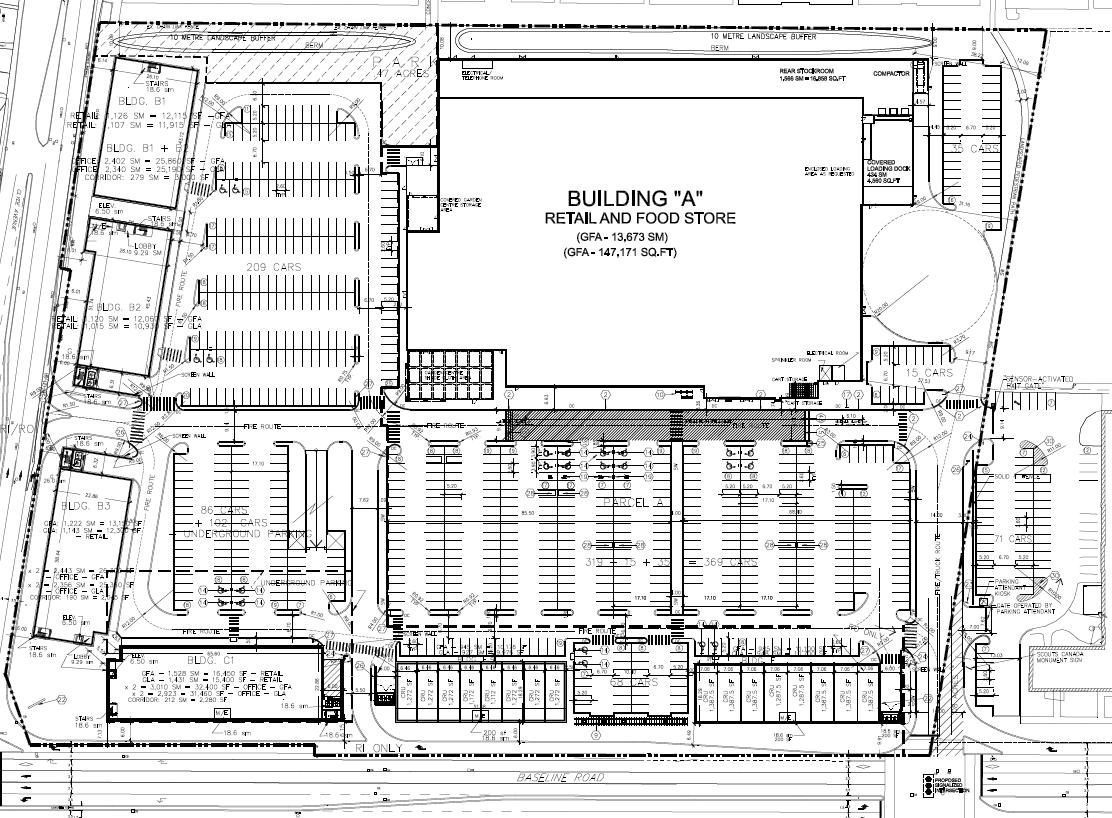
An insite into the type of bus priority that will be added to Baseline can be seen in the Laurentian H.S. development drawing that WaterlooWarrior provided.
Quote:
Originally Posted by waterloowarrior View Post
Notice that there is a complete lane along the north of Baseline marked as Bus Only (marked with 'diamonds', but shared as a right turn lane? I think the 'turn arrows' might be misplaced.). I expect that the bus stop would be in the east end of the Right-In turn lane, allowing pedestrian access between buildings E and F. Personally, I'd nix the 'Right-In' lane since it could interfere with buses.

I notice that the median is still shown, also, so it looks like the roadway will be widened by two lanes at least from Prince of Wales to Navaho.
Reply With Quote
     
     
  #2844  
Old Posted Dec 1, 2009, 6:00 PM
lrt's friend lrt's friend is offline
Registered User
 
Join Date: Dec 2006
Posts: 12,600
So OC Transpo has now opened the Riverview Park n Ride lot at Riverside South which can eventually handle 1,000 cars. This illustrates the stupidity of our rapid transit plan that calls for LRT to travel to Riverside South but not quite to this lot. Is anybody thinking at City Hall?
Reply With Quote
     
     
  #2845  
Old Posted Dec 1, 2009, 6:12 PM
eternallyme eternallyme is offline
Registered User
 
Join Date: Mar 2009
Posts: 5,243
Quote:
Originally Posted by lrt's friend View Post
So OC Transpo has now opened the Riverview Park n Ride lot at Riverside South which can eventually handle 1,000 cars. This illustrates the stupidity of our rapid transit plan that calls for LRT to travel to Riverside South but not quite to this lot. Is anybody thinking at City Hall?
Obviously not. The terminus of Bowesville is highly illogical.

IMO, the north-south line (via the Southeast Transitway, not the current O-Train) should be phased so that:

Phase 1 - Hurdman to Greenboro + extension of current O-Train to the airport (requires double tracking at Greenboro Station plus 2 more LRT vehicles). Remains a BRT or local/BRT combination service from Greenboro to Riverside South. Greenboro Station would have 4 tracks at the time, one of which could become a storage track in the ultimate configuration.

Phase 2 - Twinning/electrification of extended O-Train line to Lester Road, electrification to the airport and extension from Lester Road to Riverview

Ultimately:

The current O-Train line would be virtually unchanged, with a temporary extension to the airport until the north-south line is extended beyond Greenboro.

The north-south LRT would operate from downtown to Riverview via the current Southeast Transitway. At Lester Road, it would branch out - half of trips would run to the airport (terminating there), and half of trips would continue to Riverview. Transfers to the current O-Train line could be made at Greenboro or Bayview.
Reply With Quote
     
     
  #2846  
Old Posted Dec 11, 2009, 1:43 AM
waterloowarrior's Avatar
waterloowarrior waterloowarrior is offline
National Capital Region
 
Join Date: Nov 2005
Location: Eastern Ontario
Posts: 9,252
Staff report:
DOWNTOWN OTTAWA TRANSIT TUNNEL (DOTT) PLANNING AND ENVIRONMENTAL ASSESSMENT STUDY - RECOMMENDED PLAN


REPORT RECOMMENDATIONS

That the Transit Committee recommend that Council:

1. Approve the functional design for the Light Rail Transit (LRT) corridor from Tunney's Pasture to Blair Station and the Maintenance and Storage Facility as described in this report and detailed in Document 1.

2. Direct staff to initiate a formal, expedited Environmental Assessment (EA) process based on the approved functional design, and file the Environmental Project Report with the Ministry of the Environment in accordance with Ontario EA Regulation 231/08 for transit projects.

3. Direct staff to begin the property acquisition process as described in this report for subsequent consideration by Committee and Council, subject to funding approval in the 2010 Budget.

4. Direct staff to initiate the preliminary engineering and the procurement management process as described in Document 3, subject to funding approval in the 2010 Budget.

5. Direct staff to undertake an urban design study and a transportation study for the downtown that takes into account pedestrian, cycling facilities and residual transit service for post-DOTT implementation.
Reply With Quote
     
     
  #2847  
Old Posted Dec 11, 2009, 1:43 AM
waterloowarrior's Avatar
waterloowarrior waterloowarrior is offline
National Capital Region
 
Join Date: Nov 2005
Location: Eastern Ontario
Posts: 9,252

Last edited by waterloowarrior; Dec 11, 2009 at 2:18 AM.
Reply With Quote
     
     
  #2848  
Old Posted Dec 11, 2009, 1:49 AM
waterloowarrior's Avatar
waterloowarrior waterloowarrior is offline
National Capital Region
 
Join Date: Nov 2005
Location: Eastern Ontario
Posts: 9,252
And finally, a functional design of the recommended plan! (warning 142 megs!)


Not just plans in the pdf, there is information and descriptions of the route/station/components as well

DOTT Operation
A detailed operating plan for the DOTT will be
developed prior to opening of the line for revenue
service and adjusted as ridership patterns develop and
establish themselves. Operating plans will address LRT
operations under a variety of different scenarios (normal,
emergency, special events).
Based on current ridership forecasts, it is expected that 3
or 4-car LRT trains will be required to operate on the
line at the following headways:
• Early Morning – 10 minute service (opening day
and 2031)
• Shoulder – morning peak – 5-minute service
(opening day and 2031)
• Morning peak – 3-minute service opening day, 2-
minute service in 2031
• Midday – 5-minute service (opening day and 2031)
• Afternoon peak – 3-minute service opening day, 2-
minute service in 2031
• Early Evening – 5-minute service (opening day and
2031)
• Late Evening – 10-mimute service (opening day
and 2031)
The provision of a pocket track at Hurdman Station will
allow operational flexibility to provide more frequent
service through the downtown transit tunnel to match
demand on what will likely be the busiest segment of
the line. Once future LRT extensions (e.g. N-S LRT) are
in operation, refinements to LRT operation will need to
be undertaken to accommodate interlining and/or
overlapping of services.

Last edited by waterloowarrior; Dec 11, 2009 at 2:25 AM.
Reply With Quote
     
     
  #2849  
Old Posted Dec 11, 2009, 2:51 AM
MalcolmTucker MalcolmTucker is offline
Registered User
 
Join Date: May 2007
Posts: 11,556


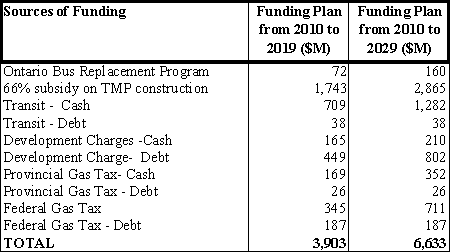
I am not 100% sure, but I think they made an error here. In similar projections for projects in other cities, the 66% subsidy for construction was inclusive of federal and provincial gas tax, not exclusive. Ie: the civic 1/3rd would not include money from federal or provincial sources.
Reply With Quote
     
     
  #2850  
Old Posted Dec 11, 2009, 3:22 AM
eternallyme eternallyme is offline
Registered User
 
Join Date: Mar 2009
Posts: 5,243
I sent a 26-page submission with graphics of what I think should have been the DOTT plan (most of the graphics I have shown already here), and it seems the bus route plan is very similar to what I suggested, except that the Southeast Transitway would still be able to connect to downtown at least in the initial stage as the LRT would be detached from the Transitway from Hurdman to LeBreton. The Orleans route network seems to be identical to my submission in that all express and local routes would be combined (on the current express network) and running to Blair, leaving only 1 or 2 intra-Orleans routes for local service (Route 130 at least). However, no part of Place d'Orleans Station should be removed, since it would be a major hub again if the LRT extends to Orleans.

I would have deferred major reorganization of the Barrhaven and Kanata routes until the LRT is extended to Baseline and they are within reasonable distance of Lincoln Fields and Baseline for local routes to be extended.

It was mentioned that if the Southeast Transitway was to be converted to rail (which it should be instead of the existing O-Train line), it would require a second platform and most likely a transfer to continue downtown, as it would be a tight entrance required to make the curve due to the land required under NCC ownership (a standard wye would use up a lot of land, especially considering that there would have to be two LRT platforms, a smaller local bus terminal and walking paths to connect both lines).
Reply With Quote
     
     
  #2851  
Old Posted Dec 11, 2009, 5:54 AM
Ottawan Ottawan is offline
Citizen-at-large
 
Join Date: Aug 2009
Location: Expat (in Toronto)
Posts: 738
Quote:
Originally Posted by waterloowarrior View Post
Overall, in reading the memo, the routing seems very well planned out.

One thing that really needs to come out of the Interprovincial Transit Study (and I've suggested this to them as the lesser but acceptable alternative to a rail transit loop) is to relocate the STO buses to the current transitway (i.e. Albert and Slater / Mackenzie King Bridge) once the DOTT is done. I have nothing against STO buses over OC Transpo buses - it is just a disgrace to have that volume of buses on what should be one of our most important commercial streets (Rideau) and our National Capital's most significant street (Wellington).
Reply With Quote
     
     
  #2852  
Old Posted Dec 11, 2009, 4:16 PM
eternallyme eternallyme is offline
Registered User
 
Join Date: Mar 2009
Posts: 5,243
For each of the main non-Transitway routes, here is what I would do through downtown (assuming the currently approved plan stands):

One thing I would construct is a large new bus terminal using the lower level of the Rideau Centre potential expansion area cornered by the edge of the mall, Besserer, Rideau and Nicholas (currently a parking lot). The Rideau Centre expansion should take place above it, so shopping is directly above the bus terminal. The building that sits in the lot should remain, perhaps as part of the expansion as well. Buses would enter via Nicholas and Besserer, with a possible right-in, right-out access on Rideau Street. A large layover facility would also be in place. That way, routes could easily terminate at the Rideau Centre.

Routes 1, 2, 3, 4, 5, 7, 14, 15, 85: Operates via Albert, Slater, Waller and Besserer, serving the Mackenzie King Bridge and the Rideau Centre bus terminal before terminating. Route 85 would terminate downtown rather than continue to Hurdman. (Route 15 is not the current route)

Routes 6, 9, 10, 11, 12, 16, 17, 19, 81: Operates into the Rideau Centre bus terminal via Rideau and Nicholas. Some of these routes would interline with routes going westbound to avoid a transfer. (Route 6 is not the current route and Route 81 is the current Route 15)

Routes 8 and 86: Would be the only through-downtown routes at all time periods (although some of those routes above could be interlined but with different numbers across downtown). Route would follow the westbound routing, then along Nicholas, 417 and Riverside. Requires a walking transfer to Hurdman or Train from Riverside Drive to connect to the LRT east of downtown.

Route 18: Operates the same as the other eastbound routes, then operates onto the westbound routing to Tunney's Pasture during rush hours and midday on weekdays to preserve an additional direct link during business hours. On evenings and weekends, it would terminate at the Rideau Centre terminal.

Route 87: Would operate through to downtown along the same routing as 8 and 86 from the Southeast Transitway to the Rideau Centre only during rush hours. At other times, it would terminate at Hurdman.

Routes 305 (current Route 6), 306 and 316: No changes. Due to the fact that they are heavily used by seniors that would be unlikely to transfer to the LRT, they should run to the front door of the Rideau Centre.

STO service: Would continue along Rideau Street to the Rideau Centre, the exiting via Besserer and Dalhousie. (Ultimately, the LRT should extend to Gatineau, removing most of the STO buses from downtown Ottawa)

Routes that would be split or changed:

Route 1 - Route 1 south (1 SOUTH KEYS), Route 11 north (11 OTTAWA-ROCKCLIFFE)
Route 5 - Route 5 south (5 BILLINGS BRIDGE), Route 6 east (6 ST. LAURENT)
Route 6 - Route 305 (305 TUNNEY'S PASTURE)
Route 7 - Route 7 south (7 CARLETON), Route 17 east (17 ST. LAURENT)
Route 14 - Route 14 west (14 CARLINGTON), Route 19 east (19 ST. LAURENT)
Route 15 - Route 81 (81 BLAIR VIA LA CITE COLLEGIALE)
Route 16 - Route 15 west (15 BRITANNIA), Route 16 east (16 ALTA VISTA)
Reply With Quote
     
     
  #2853  
Old Posted Dec 11, 2009, 4:40 PM
lrt's friend lrt's friend is offline
Registered User
 
Join Date: Dec 2006
Posts: 12,600
First of all, I have enjoyed the latest sound bites coming from Alex Cullen. He is now encouraging extensive use of construction workers at premium rates during night and weekend shifts because he is finally recognizing the tremendous disruption that Transitway conversion will inflict on transit riders. He is recognizing that loss of ridership during this conversion period is a possibility. What is most interesting about this is that it is preparing us for further cost increases for Phase 1 of the LRT plan to cover those premium labour rates.

On the route plan, the only winners will be residents of Orleans who will have local service extended to Blair Station. That might be a double-edged sword as service to Place d'Orleans will be reduced and that is a natural meeting place in Orleans. Just like my discussion on Route 149 in the other transit thread, this change may favour commuters to the detriment of off-peak users wanting to go shopping at the local mall.

I also note that LRT downtown is going to facilitate the split up of more bus routes as was the case with Routes 3/9 and 2/12. From comments elsewhere, it appears that this has not been an entire success and has not resolved the schedule issue, and now we see a desire to reduce service on those routes. I find it troubling to see the main terminus for a number of downtown routes being at Laurier and Waller mid-way between 2 subway stations and that a number of routes will no longer cross downtown anymore. For example, the Route on Elgin and St. Patrick. It seems all we care about is efficiency and not whether we are addressing the wishes of transit riders. What happened to customer satisfaction and the customer coming first? Furthermore, OC Transpo will no longer connect downtown Ottawa with downtown Hull with direct service of any kind. Instead, we run the only service to Hull via Preston Street. Lucky people on Preston. You lost your downtown connection. Wait for ridership to fall there too and guess what, we need to reduce service there as well. Why would you make people living so close to downtown transfer to a train?

My other comment is concerning service from the suburbs. All along, I have been warning of a double transfer system being implemented during off-peak hours in order to reach downtown. Now we see it in the proposal. You will have to transfer at Eagleson or Fallowfield and then again at Tunney's Pasture, or from the south at South Keys and again at Hurdman. In the case of Riverside South, let's add a third transfer for good measure within the community to make sure nobody will use transit if you are not within walking distance of Route 99.

Will this really boost ridership? This is a grand transit experiment with many risks. We are depending on the public's willingness to expect to transfer much more often in order to use transit in Ottawa. Studies have indicated that transfers are ridership killers. Good Luck!
Reply With Quote
     
     
  #2854  
Old Posted Dec 11, 2009, 4:49 PM
eternallyme eternallyme is offline
Registered User
 
Join Date: Mar 2009
Posts: 5,243
Quote:
Originally Posted by lrt's friend View Post
First of all, I have enjoyed the latest sound bites coming from Alex Cullen. He is now encouraging extensive use of construction workers at premium rates during night and weekend shifts because he is finally recognizing the tremendous disruption that Transitway conversion will inflict on transit riders. He is recognizing that loss of ridership during this conversion period is a possibility. What is most interesting about this is that it is preparing us for further cost increases for Phase 1 of the LRT plan to cover those premium labour rates.

On the route plan, the only winners will be residents of Orleans who will have local service extended to Blair Station. That might be a double-edged sword as service to Place d'Orleans will be reduced and that is a natural meeting place in Orleans. Just like my discussion on Route 149 in the other transit thread, this change may favour commuters to the detriment of off-peak users wanting to go shopping at the local mall.

I also note that LRT downtown is going to facilitate the split up of more bus routes as was the case with Routes 3/9 and 2/12. From comments elsewhere, it appears that this has not been an entire success and has not resolved the schedule issue, and now we see a desire to reduce service on those routes. I find it troubling to see the main terminus for a number of downtown routes being at Laurier and Waller mid-way between 2 subway stations and that a number of routes will no longer cross downtown anymore. For example, the Route on Elgin and St. Patrick. It seems all we care about is efficiency and not whether we are addressing the wishes of transit riders. What happened to customer satisfaction and the customer coming first? Furthermore, OC Transpo will no longer connect downtown Ottawa with downtown Hull with direct service of any kind. Instead, we run the only service to Hull via Preston Street. Lucky people on Preston. You lost your downtown connection. Wait for ridership to fall there too and guess what, we need to reduce service there as well. Why would you make people living so close to downtown transfer to a train?

My other comment is concerning service from the suburbs. All along, I have been warning of a double transfer system being implemented during off-peak hours in order to reach downtown. Now we see it in the proposal. You will have to transfer at Eagleson or Fallowfield and then again at Tunney's Pasture, or from the south at South Keys and again at Hurdman. In the case of Riverside South, let's add a third transfer for good measure within the community to make sure nobody will use transit if you are not within walking distance of Route 99.

Will this really boost ridership? This is a grand transit experiment with many risks. We are depending on the public's willingness to expect to transfer much more often in order to use transit in Ottawa. Studies have indicated that transfers are ridership killers. Good Luck!
My recommendation for handling the transfer situation from the suburbs was as follows:

From Orleans: As recommended, due to the short distance from Blair to Orleans.

From Kanata and Barrhaven: Routes 95 and 96 would continue downtown and on to Hurdman (it could be shortened to downtown with the Transitway not available). However, to prevent them from competing with the LRT, it would be off-only beyond Westboro eastbound and on-only until Westboro westbound. Once the LRT is extended westward to Baseline, Lincoln Fields (for Kanata routes) and Baseline (for Barrhaven routes) would serve the function Blair would for Orleans routes, replacing the 95 and 96.

From the south: My submission kept the Transitway in place, at least initially, there. But with that not an option, Routes 97, 98 and 99 could continue downtown via Nicholas and 417, but it is off-only from Hurdman onward northbound and on-only until Lycee Claudel southbound.

That would reduce transfers by one.

As for the Preston Street situation, I would reject the changes to Route 3 and 8, and basically leave them alone. The 108 and 109 (I have them as 103 and 104) would not be necessary if buses continue to downtown from the west end - they would still have the options of 8 and 105. The 27 and 40 would no longer go to Gatineau though, since the 27 would be an Orleans local route and the 40 would be detached at Hurdman (the 8 remains an option from Hurdman).
Reply With Quote
     
     
  #2855  
Old Posted Dec 11, 2009, 4:51 PM
lrt's friend lrt's friend is offline
Registered User
 
Join Date: Dec 2006
Posts: 12,600
I would hate to spend millions more on a downtown bus terminal after spending hundreds of millions on a tunnel. For what purpose? To split all downtown bus routes into two? I don't see what we are really gaining. All this does is make you have to transfer to reach the west part of downtown from the east. I am sure that downtown office workers will be very pleased to have to transfer at the Rideau Centre to reach an office building at Slater and Lyon and what about the new proposed library in the west part of downtown?
Reply With Quote
     
     
  #2856  
Old Posted Dec 11, 2009, 5:08 PM
eternallyme eternallyme is offline
Registered User
 
Join Date: Mar 2009
Posts: 5,243
Quote:
Originally Posted by lrt's friend View Post
I would hate to spend millions more on a downtown bus terminal after spending hundreds of millions on a tunnel. For what purpose? To split all downtown bus routes into two? I don't see what we are really gaining. All this does is make you have to transfer to reach the west part of downtown from the east. I am sure that downtown office workers will be very pleased to have to transfer at the Rideau Centre to reach an office building at Slater and Lyon and what about the new proposed library in the west part of downtown?
Interlining of routes would prevent the need for transfers for many of them though. Another option would be to do a "partial split" of routes - have the routes from the east continue to LeBreton or Bayview and terminate there at least at some times of day, serving all of downtown.

The terminal would remove buses from laying over on downtown streets more than anything, and make it easier to reach buses from the Rideau Centre, since the buses would be directly below the shopping centre.

With the possible exception of Route 87 - although the option does exist to continue running it downtown if ridership warrants, all non-rapid, non-express routes (those being the current Routes 1, 2, 3, 4, 5, 6, 7, 8, 9, 12, 14, 15, 16, 18, 85, 86, 87, 306 and 316) serving downtown now should continue to serve downtown at all times of day. None of them should be cut back to the LRT outside downtown, and they should continue to serve downtown even when the LRT is extended to the suburbs.

Transfers within downtown are nothing new - routes like 5 and 14 have never served all of downtown though, and the 14 is one of the best performing non-rapid routes in the network.

Last edited by eternallyme; Dec 11, 2009 at 5:24 PM.
Reply With Quote
     
     
  #2857  
Old Posted Dec 11, 2009, 5:26 PM
lrt's friend lrt's friend is offline
Registered User
 
Join Date: Dec 2006
Posts: 12,600
Quote:
Originally Posted by eternallyme View Post
Interlining of routes would prevent the need for transfers for many of them though. Another option would be to do a "partial split" of routes - have the routes from the east continue to LeBreton or Bayview and terminate there at least at some times of day, serving all of downtown.

The terminal would remove buses from laying over on downtown streets more than anything, and make it easier to reach buses from the Rideau Centre, since the buses would be directly below the shopping centre.

With the possible exception of Route 87 - although the option does exist to continue running it downtown if ridership warrants, all non-rapid, non-express routes (those being the current Routes 1, 2, 3, 4, 5, 6, 7, 8, 9, 12, 14, 15, 16, 18, 85, 86, 87, 306 and 316) serving downtown now should continue to serve downtown at all times of day. None of them should be cut back to the LRT outside downtown, and they should continue to serve downtown even when the LRT is extended to the suburbs.
The proposal indicates that this will not be the case. A number of those bus routes will terminate outside of downtown including at least Routes 3, 8, 86 and 87. It appears that Route 6 will be cancelled outright.
Reply With Quote
     
     
  #2858  
Old Posted Dec 11, 2009, 5:35 PM
eternallyme eternallyme is offline
Registered User
 
Join Date: Mar 2009
Posts: 5,243
Quote:
Originally Posted by lrt's friend View Post
The proposal indicates that this will not be the case. A number of those bus routes will terminate outside of downtown including at least Routes 3, 8, 86 and 87. It appears that Route 6 will be cancelled outright.
Those should be changed back in my opinion. The 3/8 switch should not take place (they should be basically left alone except for detouring) and Route 86 has good ridership through and should be detoured. As for Route 87, ridership numbers need further analysis since it definitely performs best south of Hurdman, but if there is enough ridership, it could continue downtown at least at some times of day.

Route 6 might be in the next analysis, since it is a local route that functions similar to the 306 and 316 (and there is no reason to worry about the LRT on those routes, since I don't think too many people riding them would be transferring to the LRT). I recommend it be renumbered as 305, to make clear it is a local community route, and target the seniors complexes in the Glebe and vicinity and their gathering places, re-routing if necessary to provide service near their doors. The 153 - which I would renumber as 314 (being close to the 14), since that number 153 could be valuable in realigning the bus network in the urban west end - would also have such a function in the southern part of downtown. The entire sections of those routes are within reasonable walking distance to other (mostly high frequency) routes for most people, but that is not the case for seniors and disabled people and there are enough of them in the core area to warrant special routes - even if only hourly and during the daytime.
Reply With Quote
     
     
  #2859  
Old Posted Dec 11, 2009, 8:03 PM
Ottawan Ottawan is offline
Citizen-at-large
 
Join Date: Aug 2009
Location: Expat (in Toronto)
Posts: 738
Quote:
Originally Posted by eternallyme View Post
One thing I would construct is a large new bus terminal using the lower level of the Rideau Centre potential expansion area cornered by the edge of the mall, Besserer, Rideau and Nicholas (currently a parking lot). The Rideau Centre expansion should take place above it, so shopping is directly above the bus terminal. The building that sits in the lot should remain, perhaps as part of the expansion as well. Buses would enter via Nicholas and Besserer
I quite like the idea of constructing a bus terminal here, but not for transit buses: it should be the new Intercity Bus Terminal. Having OC Transpo and STO buses use Mackenzie-King seems a good use of existing infrastructure. However, for intercity buses, the ability to come right from the Queensway via Nicholas to a central, hopefully state-of-the-art terminal right on mass transit and near all our tourist attractions/hotels would be amazing!
Reply With Quote
     
     
  #2860  
Old Posted Dec 11, 2009, 10:51 PM
RTWAP's Avatar
RTWAP RTWAP is offline
Registered User
 
Join Date: Oct 2009
Posts: 528
I know there has been some discussion of the wisdom of building stations long enough to support 6 cars. Given they are suggesting starting service with 3 or 4 car trains, one obvious question would be how long would we have to wait before we actually need 6 car trains.

But maybe that's not exactly what they're planning. If they are anticipating having multiple rail routes converge on the downtown tunnel (main east-west, O-Train and perhaps Interprovincial) then it might be more a question of headways and capacity. If service from those other lines alternates with the mainline service then you'd get something like EW / OT / EW / IP / EW / OT / EW / IP (repeating). The interspersed trains from the south and north may not be 6 car trains (or maybe they would be) but any mapping of system capacity with respect to EW ridership would need to reflect the fact that only half the capacity is available (every second train).

Also, headways may need to increase if they're switching between trains to accommodate these alternate routes. That would further separate effective capacity from the maximum theoretical capacity.

One interesting thought would be what to do with any such alternate routes. Would they just stop at Hurdman? Continue east? I don't think continuing east makes much sense. I would expect the system to be somewhat balanced in terms of the capacity provided to the eastern and western portions of the main line.

Maybe they're anticipating additional routes? A route along Rideau/Montreal Road would be interesting, branching from the main line east of Rideau. A look at the tunnel route suggests that such a configuration may have been anticipated in the routing east of Rideau station as the turn to the south does not occur until a few hundred meters east of the station.

An interprovincial route that branches from the Rideau street line shortly before or after that line surfaces would allow for the creation of an Interprovincial Loop, at least on the Ottawa side. I'm not sure what the routing would look like on the Gatineau side, given current land use, route availability, transit demand and such.

Then again, maybe they're just planning on keeping the O-train/Interprovincial line separate with a single transfer station at Bayview. They might still have 174/Montreal Road endpoints in the east and Woodroffe/417 endpoints in the west, with the two lines sharing the core of the network.
Reply With Quote
     
     
This discussion thread continues

Use the page links to the lower-right to go to the next page for additional posts
 
 
Reply

Go Back   SkyscraperPage Forum > Regional Sections > Canada > Ontario > Ottawa-Gatineau > Transportation
Forum Jump


Forum Jump


All times are GMT. The time now is 2:11 PM.

     
SkyscraperPage.com - Privacy Statement - Top

Powered by vBulletin® Version 3.8.7
Copyright ©2000 - 2026, vBulletin Solutions, Inc.