Thank you Changing City for sharing that

.
I do have some questions as it pertains to the data collection though and I kindly invite someone with insight to help understand:
1. What, in Portugal, defines itself as a legal or illegal drug? For example if cocaine was decriminalized then is there a certain amount of the drug that a user can carry before carrying an "illegal" amount of drugs?
2. Is there a certain amount of a given drug that is considered criminal to have in your system under Portuguese law? This would be tedious to prove all the time with anyone you suspect but you would need to prove that they are using a criminal amount before charging them. Perhaps there is no criminal amount to have in your system?
3. Which leads me to my next question: how much usage constitutes itself as a prevalent usage to make the statistic in the link?
4. How does the Portuguese government keep up with the decriminalization of new drugs entering the black market? A drug, in NA standard AFAIK, is defined by its chemical composition. All you need to do is change the chemical composition to comply or avoid the law (technically..). I'm thinking that the Portuguese government has some sort of a way to keep up otherwise they would have entered into a bit of an administrative nightmare.
5. I am open to misunderstanding the Portuguese government's program as I have never been there before but with the decriminalization of drugs, does that mean pharmacies can carry and sell narcotics without prescriptions? I know that their pharmacies work drastically different from ours but I think that Canada would want a way to regulate usage some how via prescriptions...
6. Why was data from people older than 34 years omitted from the data provided? I know that this statement is going to get me in hot water but I have witnessed first hand a lot of older people still using drugs. Therefore I'm wondering if the stats benefitted one generation and not the other?
I don't see how it could but this is an innocent question!
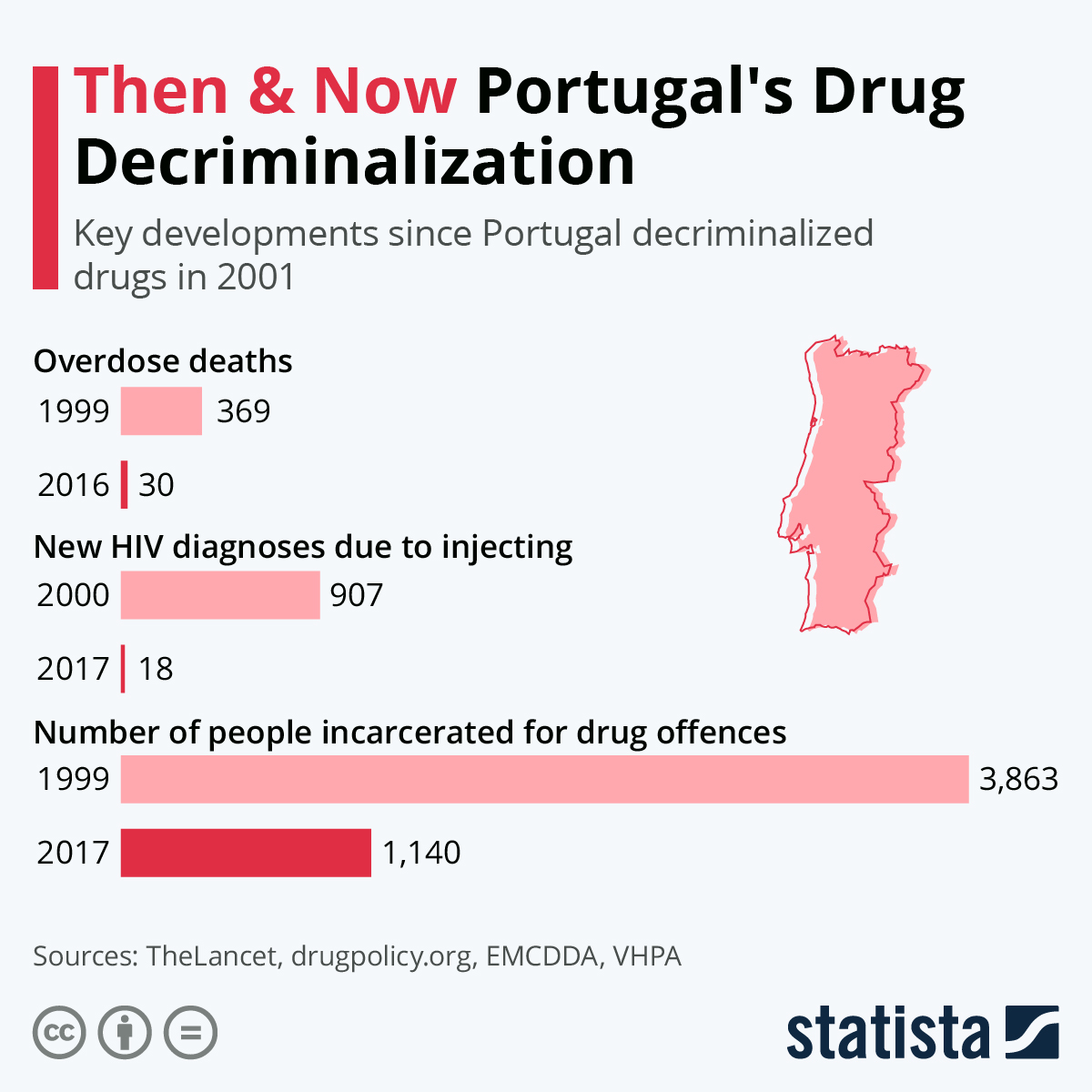
Anyways my point with posing these questions is that we have to really analyze the reasons why these statistics are reading super positively. To me this looks like it could be a way to clean your books of criminal statistics linked to drug usage to look good from an administrative standpoint.
Perhaps I just need to get out of the house more but I don't see travelers in Portugal or Portuguese people singing praises of their country eradicating drug problems with the magic wand of decriminalization left and right. You can decriminalize something and on paper it will look great (via an admin-wash) but in reality it could be very different. You could still have a drug problem in your city even though you aren't recording it. I doubt that this is Portugal's game as other countries would adopt this method of cleaning their books of criminal activity but with the way things are going on in the world, we owe it to ourselves to question how stats were gathered. Stats are constantly used to influence public opinion whether for better or for worse.
I just think that we owe it to the tax payers and to the addicts to ask the harder questions and to analyze the Portuguese system with a fine-tooth comb before throwing billions blindly thinking it's a solution.





 Prev
Prev










 Linear Mode
