HomeDiagramsDatabaseMapsForum About
     

Go Back   SkyscraperPage Forum > Regional Sections > Canada > Ontario > Hamilton > Downtown & City of Hamilton


Reply

 
Thread Tools Display Modes
     
     
  #21  
Old Posted Mar 3, 2023, 2:58 PM
Innsertnamehere's Avatar
Innsertnamehere Innsertnamehere is online now
Registered User
 
Join Date: Jan 2010
Location: Hamilton
Posts: 12,733
https://www.thepublicrecord.ca/2023/...n-street-east/

Apparently this is going to the DRP in a few days - we should see the larger presentation package shortly.

Reply With Quote
     
     
  #22  
Old Posted Mar 3, 2023, 3:05 PM
Hawrylyshyn's Avatar
Hawrylyshyn Hawrylyshyn is offline
Registered User
 
Join Date: Mar 2015
Location: Ontario
Posts: 2,261
From that article above: "The proposed 39-storey building will be 126.47 metres tall, including the mechanical penthouse"

SO close to a new tallest building downtown
Reply With Quote
     
     
  #23  
Old Posted Mar 3, 2023, 3:46 PM
Innsertnamehere's Avatar
Innsertnamehere Innsertnamehere is online now
Registered User
 
Join Date: Jan 2010
Location: Hamilton
Posts: 12,733
It's almost like they purposefully kept it under Landmark Place's height.. Same as the tower proposed at the waterfront, which has been purposefully designed not to exceed the geodetic height of Landmark Place.
Reply With Quote
     
     
  #24  
Old Posted Mar 3, 2023, 4:03 PM
TheHonestMaple's Avatar
TheHonestMaple TheHonestMaple is offline
Registered User
 
Join Date: Aug 2016
Posts: 1,833
Sometimes I think this height limit is really holding this city back. I totally understand the arguments for lower developments and midrises. TheRitsman has made a strong case for that. Lower builds definitely make more livable cities. But developers want height because it generally makes the development more profitable for them (they've made this argument many many times before). So why would a developer build in Hamilton, when they can simply build in Mississauga or Toronto and make more money? They wouldn't. This city needs to stop scaring off developers.
Reply With Quote
     
     
  #25  
Old Posted Mar 3, 2023, 4:10 PM
mikevbar1 mikevbar1 is offline
Registered User
 
Join Date: Dec 2017
Posts: 216
If the city somehow doesn’t approve this, at least we know the OLT almost certainly will.

This would be a preliminary rendering by any standard for the GTA, but this looks fairly run of the mill for a project ready to start construction here. That design could only be passable if they used good materials- there is something very off about it, and it’s more than just being cheap. It looks suburban, specifically like something you would see in Markham or Richmond Hill.

Slightly unrelated, does anyone know if the height limit negatively affects margins for development? Ie, if you can only build to 30 floors, certain projects don’t pencil, like this. I’m trying to understand if the notion that the height limit will distribute development across the city actually holds water, because “excessive” height like this seems to just be a reflection of a sites value and needed ROI.
__________________
Steeltowner & Urban Planning Undergrad.
Reply With Quote
     
     
  #26  
Old Posted Mar 3, 2023, 4:15 PM
TheHonestMaple's Avatar
TheHonestMaple TheHonestMaple is offline
Registered User
 
Join Date: Aug 2016
Posts: 1,833
Quote:
Originally Posted by mikevbar1 View Post

Slightly unrelated, does anyone know if the height limit negatively affects margins for development? Ie, if you can only build to 30 floors, certain projects don’t pencil, like this. I’m trying to understand if the notion that the height limit will distribute development across the city actually holds water, because “excessive” height like this seems to just be a reflection of a sites value and needed ROI.
It absolutely affects margins. The taller a building is the more profitable it is. Simple as that. That's why these developers are always trying to go for the max height they can. I've heard the argument in the forum before that a taller building in some scenarios actually cost more to build per square foot than a shorter one, it's not true.
Reply With Quote
     
     
  #27  
Old Posted Mar 3, 2023, 4:16 PM
mikevbar1 mikevbar1 is offline
Registered User
 
Join Date: Dec 2017
Posts: 216
Quote:
Originally Posted by TheHonestMaple View Post
Sometimes I think this height limit is really holding this city back. I totally understand the arguments for lower developments and midrises. TheRitsman has made a strong case for that. Lower builds definitely make more livable cities. But developers want height because it generally makes the development more profitable for them (they've made this argument many many times before). So why would a developer build in Hamilton, when they can simply build in Mississauga or Toronto and make more money? They wouldn't. This city needs to stop scaring off developers.
You partially answered my question above… thanks. For developers it’s a question of margins of course. However I do think there’s an element of the developers mantra, “location, location, location”. If demand exists in Hamilton, even if it’s regionally-oriented (for GTA expats) then developers will move to fill it with supply. Our policies just make things a bit more complicated, setting back but not really inhibiting projects in the long run. Landowners are perhaps more inclined to hold rather than build because of the limit, rather than build elsewhere or adhere to the limit.

I’m sure there are many landowners waiting for a watershed moment where a project proposes a ludicrous height (50 floors, the horror) and the OLT approves it and establishes a precedent.
__________________
Steeltowner & Urban Planning Undergrad.
Reply With Quote
     
     
  #28  
Old Posted Mar 3, 2023, 4:17 PM
mikevbar1 mikevbar1 is offline
Registered User
 
Join Date: Dec 2017
Posts: 216
Quote:
Originally Posted by TheHonestMaple View Post
It absolutely affects margins. The taller a building is the more profitable it is. Simple as that. That's why these developers are always trying to go for the max height they can. I've heard the argument in the forum before that a taller building in some scenarios actually cost more to build per square foot than a shorter one, it's not true.
My assumption was that the cost to build a structure that’s 20-50 floors is about the same per floor, so taller is better until that point. Around 50-60 floors I assume it gets more complicated.
__________________
Steeltowner & Urban Planning Undergrad.
Reply With Quote
     
     
  #29  
Old Posted Mar 3, 2023, 4:31 PM
TheHonestMaple's Avatar
TheHonestMaple TheHonestMaple is offline
Registered User
 
Join Date: Aug 2016
Posts: 1,833
Quote:
Originally Posted by mikevbar1 View Post
My assumption was that the cost to build a structure that’s 20-50 floors is about the same per floor, so taller is better until that point. Around 50-60 floors I assume it gets more complicated.
I agree with that. There's probably specific challenges once you get into the "very tall" or supertall range. But for Hamilton, the difference between 20 floors and 40 floors would be clear, and it's probably why we constantly see developers pushing back on this 30 floor limit. They want a bit taller, and I wish the city would just let the market decide.

This particular development proposal would be a perfect one to go above the limit, since the view is already obstructed.
Reply With Quote
     
     
  #30  
Old Posted Mar 3, 2023, 5:04 PM
Innsertnamehere's Avatar
Innsertnamehere Innsertnamehere is online now
Registered User
 
Join Date: Jan 2010
Location: Hamilton
Posts: 12,733
Generally the more height you allow, the more sites there are which are "feasible" for development.

Lower height limits means you need large sites which allow for low construction costs and a large enough building footprint to get enough units to spread costs around. You won't see a 14-storey building built on a site like 213 King St W as it's simply too small for it to pencil.

The height limit isn't really limiting development downtown right now as the downtown is full of big parking lots which can easily be developed at a reasonable enough cost at 30 storeys.

Once all the "easy" sites disappear though, it will be more limiting as the profit margins won't be enough.

Eliminating parking requirements would also go a long way to improving building financial feasibility, especially in Hamilton where there are often tight urban sites where it is difficult to provide parking. Luckily Hamilton already has the lowest parking requirements in the 905 for it's downtown, so projects still pencil, but the less parking that is needed the easier it is to build on small sites.

Sites like this which are large and allow for efficient parking garage layouts work fine. Buildings this size here would be printing money for the developer as these buildings can go up very affordably, much like how LiUNA's current towers are.

Vranich's 213 King site is significantly tighter, and likely wouldn't of penciled if he had to provide parking on-site and not in The Marquee's garage next door.
Reply With Quote
     
     
  #31  
Old Posted Mar 3, 2023, 5:08 PM
TheRitsman TheRitsman is offline
Registered User
 
Join Date: Sep 2017
Location: Hamilton
Posts: 3,055
Quote:
Originally Posted by TheHonestMaple View Post
Sometimes I think this height limit is really holding this city back. I totally understand the arguments for lower developments and midrises. TheRitsman has made a strong case for that. Lower builds definitely make more livable cities. But developers want height because it generally makes the development more profitable for them (they've made this argument many many times before). So why would a developer build in Hamilton, when they can simply build in Mississauga or Toronto and make more money? They wouldn't. This city needs to stop scaring off developers.
My issue mostly surrounds the fairness. Why do downtown neighbourhoods (which are often already the most dense in the country) saddled with all the density while suburban areas have none, like literally none, fighting even duplexes, lot splits, rooming houses, and anything over 2 storeys?

If we are to remove the height limit, it should be city-wide. Which will accomplish two things:

1) By increasing height and density in suburban areas, it will put less pressure on the downtown to take all the density and height, leading to lower height buildings happening naturally rather than being forced to be midrise by law

2) Actually improve the housing situation, as the massive wealth of suburban homeowners is used to increase density in various areas of the city, improving transit demand, commercial demand, and property tax sustainability. This is how it is in cities that have avoided the housing crisis we are straddled with today.

Back on topic of this development to ensure I don't get in trouble with the 15 active users of this forum, I'm supportive of this development. While I'd appreciate less parking being 200 mètres from a future LRT stop, I really like the retail, and this is a perfect spot for this kind of density.

I support density where it makes sense in terms of livability, infrastructure usage, and when it makes smart decisions like less parking and inclusion of commercial space.
__________________
Hamilton Downtown. Huge tabletop skyline fan. Typically viewing the city from the street, not a helicopter. Cycling, transit and active transportation advocate 🚲🚍🚋

Follow me on Twitter: https://x.com/ham_bicycleguy?t=T_fx3...SIZNGfD4A&s=09
Reply With Quote
     
     
  #32  
Old Posted Mar 3, 2023, 7:21 PM
ScreamingViking's Avatar
ScreamingViking ScreamingViking is offline
Ham-burgher
 
Join Date: Jun 2013
Location: Hamilton
Posts: 7,397
Quote:
Originally Posted by TheHonestMaple View Post
It absolutely affects margins. The taller a building is the more profitable it is. Simple as that. That's why these developers are always trying to go for the max height they can. I've heard the argument in the forum before that a taller building in some scenarios actually cost more to build per square foot than a shorter one, it's not true.
I have made the point about the "cost" of building taller in the past.

I don't know where the inflection point is in terms of building height vs. design considerations that add to cost and reduce profitability. And I don't think it's a universal standard -- it probably differs for buildings with large floor plates vs. point towers. But it's not "simple as that" in my opinion.

That said, I don't agree that the city is justified in dicking around with developers over whether they should be allowed to have an additional 3, 5 or 8 floors. If they want to build that, and the location is reasonable for the building size, cutting height on principle is not a hill to die on.
Reply With Quote
     
     
  #33  
Old Posted Mar 3, 2023, 7:28 PM
Innsertnamehere's Avatar
Innsertnamehere Innsertnamehere is online now
Registered User
 
Join Date: Jan 2010
Location: Hamilton
Posts: 12,733
Quote:
Originally Posted by TheRitsman View Post
My issue mostly surrounds the fairness. Why do downtown neighbourhoods (which are often already the most dense in the country) saddled with all the density while suburban areas have none, like literally none, fighting even duplexes, lot splits, rooming houses, and anything over 2 storeys?

If we are to remove the height limit, it should be city-wide. Which will accomplish two things:

1) By increasing height and density in suburban areas, it will put less pressure on the downtown to take all the density and height, leading to lower height buildings happening naturally rather than being forced to be midrise by law

2) Actually improve the housing situation, as the massive wealth of suburban homeowners is used to increase density in various areas of the city, improving transit demand, commercial demand, and property tax sustainability. This is how it is in cities that have avoided the housing crisis we are straddled with today.

Back on topic of this development to ensure I don't get in trouble with the 15 active users of this forum, I'm supportive of this development. While I'd appreciate less parking being 200 mètres from a future LRT stop, I really like the retail, and this is a perfect spot for this kind of density.

I support density where it makes sense in terms of livability, infrastructure usage, and when it makes smart decisions like less parking and inclusion of commercial space.
The province already removed the proposed city-wide height limit - which means you are now technically able to build over 30 storeys outside of the Downtown, but not within it

Hamilton has 4 buildings proposed right now taller than Landmark Place - all 4 are outside of downtown!
Reply With Quote
     
     
  #34  
Old Posted Mar 3, 2023, 8:02 PM
lachlanholmes's Avatar
lachlanholmes lachlanholmes is offline
Forever forward.
 
Join Date: Jun 2017
Location: Hamilton
Posts: 878
Developers deal in floor area, not storeys. If they need 30,000 square metres of saleable area, divided into 500 units, whether that is in a 30 storey tower (with 1,000 square metre floorplates) or a 40 storey tower (with 750 square metre floorplates), is mostly immaterial, as long as they can design the unit floorplans in an appropriate, saleable/leasable manner.

(Admittedly, this is an oversimplification, construction costs do change depending on height, built form, economies of scale (repetition in floorplates), etc, but generally, the amount of saleable area is the key metric.)


So, the issue with the height limit is not really about project viability. Developers have shown they can make projects work despite the height limit. The question is: do the implications that the height limit has on the built form of new development make for better buildings? I have always argued no.

Take the above hypothetical. Instead of a thin point tower (750 m2) that rises 40 storeys, like one would see in Toronto or Vancouver, developers have to build towers with floorplates of 1000 m2 or more. From the public perspective, this causes: larger shadows that have less "movement", generally worse appearing width-to-height proportions, and increased blocking of sky views. From a livability perspective, this causes: worse floorplans that are more "bowling alley" style than a 750 m2 tower, more bedrooms that don't actually have a window, and so on.

Can these effects be considered positive? Can they be considered better than the alternative 10 extra storeys with a slimmer floorplate? I really don't see how you can argue that.

It doesn't stop at larger floorplates, either. We also see towers being built closer together, and sited directly facing each other. A 25 metre tower separation is generally the standard in Toronto, but in Hamilton, we continually see towers that are significantly closer to each other than that. Ideally, as well, we would position towers kitty corner to each other so you're not directly facing out towards another one. But this is much more difficult to achieve when you are forced to build larger floorplates and you have to build to less than ideal tower separation distances. From a public perspective, this again causes: larger shadows that "blend" together into one mass effectively negating that benefit of limiting tower floorplate size, and reduced sky views between towers, again, making it appear more like one massive structure. From a livability perspective: the amount of daylight that can enter a unit is reduced, and your privacy is reduced as you're closer to the condo tower next door.

Again, are these positive effects? Are they better than the alternative?

They are not serving the general public interest. They are not serving the interest of the individuals who will inhabit these buildings.

That, to me, makes the height limit indefensible policy. It is not spreading development around as some have argued, it is simply shaping the development that will occur in our downtown for the worse. The other practical argument that I've seen given in defense of the height limit, that it eliminated land speculation and will make development more affordable, is really disingenuous, because the so-called land speculation was replaced by significantly raising the land value in one fell swoop. (and let's be clear, there is still speculation ongoing — properties within the DTSP boundaries that don't allow the maximum 30 storeys spark questions of "what's the chance we can get that land increased to the 30 storeys that's permitted on the other side of the street?")


And, on a final note, by all means, increase permissions everywhere, and get rid of parking minimums — I am 110% on board, and believe those are necessary, overdue, valuable changes. Advocating that we should be okay with keeping a bad policy because there are other bad policies or because other areas are not pulling their weight is letting the perfect be the enemy of the good. We can, and need to, do better — and do all of the above.
Reply With Quote
     
     
  #35  
Old Posted Mar 3, 2023, 10:46 PM
ScreamingViking's Avatar
ScreamingViking ScreamingViking is offline
Ham-burgher
 
Join Date: Jun 2013
Location: Hamilton
Posts: 7,397
Thanks for the very thoughtful and informative post, lachlanholmes
Reply With Quote
     
     
  #36  
Old Posted Mar 4, 2023, 3:49 AM
TheHonestMaple's Avatar
TheHonestMaple TheHonestMaple is offline
Registered User
 
Join Date: Aug 2016
Posts: 1,833
I wonder if Landmark Place will ever get new cladding, at least on the podium? You'd think the owners of that building might start to feel the need to update once the competition heats up with newer developments downtown.
Reply With Quote
     
     
  #37  
Old Posted Mar 4, 2023, 4:02 PM
mikevbar1 mikevbar1 is offline
Registered User
 
Join Date: Dec 2017
Posts: 216
Quote:
Originally Posted by lachlanholmes View Post
Developers deal in floor area, not storeys. If they need 30,000 square metres of saleable area, divided into 500 units, whether that is in a 30 storey tower (with 1,000 square metre floorplates) or a 40 storey tower (with 750 square metre floorplates), is mostly immaterial, as long as they can design the unit floorplans in an appropriate, saleable/leasable manner.

(Admittedly, this is an oversimplification, construction costs do change depending on height, built form, economies of scale (repetition in floorplates), etc, but generally, the amount of saleable area is the key metric.)


So, the issue with the height limit is not really about project viability. Developers have shown they can make projects work despite the height limit. The question is: do the implications that the height limit has on the built form of new development make for better buildings? I have always argued no.

Take the above hypothetical. Instead of a thin point tower (750 m2) that rises 40 storeys, like one would see in Toronto or Vancouver, developers have to build towers with floorplates of 1000 m2 or more. From the public perspective, this causes: larger shadows that have less "movement", generally worse appearing width-to-height proportions, and increased blocking of sky views. From a livability perspective, this causes: worse floorplans that are more "bowling alley" style than a 750 m2 tower, more bedrooms that don't actually have a window, and so on.

Can these effects be considered positive? Can they be considered better than the alternative 10 extra storeys with a slimmer floorplate? I really don't see how you can argue that.

It doesn't stop at larger floorplates, either. We also see towers being built closer together, and sited directly facing each other. A 25 metre tower separation is generally the standard in Toronto, but in Hamilton, we continually see towers that are significantly closer to each other than that. Ideally, as well, we would position towers kitty corner to each other so you're not directly facing out towards another one. But this is much more difficult to achieve when you are forced to build larger floorplates and you have to build to less than ideal tower separation distances. From a public perspective, this again causes: larger shadows that "blend" together into one mass effectively negating that benefit of limiting tower floorplate size, and reduced sky views between towers, again, making it appear more like one massive structure. From a livability perspective: the amount of daylight that can enter a unit is reduced, and your privacy is reduced as you're closer to the condo tower next door.

Again, are these positive effects? Are they better than the alternative?

They are not serving the general public interest. They are not serving the interest of the individuals who will inhabit these buildings.

That, to me, makes the height limit indefensible policy. It is not spreading development around as some have argued, it is simply shaping the development that will occur in our downtown for the worse. The other practical argument that I've seen given in defense of the height limit, that it eliminated land speculation and will make development more affordable, is really disingenuous, because the so-called land speculation was replaced by significantly raising the land value in one fell swoop. (and let's be clear, there is still speculation ongoing — properties within the DTSP boundaries that don't allow the maximum 30 storeys spark questions of "what's the chance we can get that land increased to the 30 storeys that's permitted on the other side of the street?")


And, on a final note, by all means, increase permissions everywhere, and get rid of parking minimums — I am 110% on board, and believe those are necessary, overdue, valuable changes. Advocating that we should be okay with keeping a bad policy because there are other bad policies or because other areas are not pulling their weight is letting the perfect be the enemy of the good. We can, and need to, do better — and do all of the above.
This is a great insight, thank you.
__________________
Steeltowner & Urban Planning Undergrad.
Reply With Quote
     
     
  #38  
Old Posted Mar 8, 2023, 5:59 PM
spaghettisam spaghettisam is offline
Registered User
 
Join Date: Sep 2022
Location: Hamilton
Posts: 54


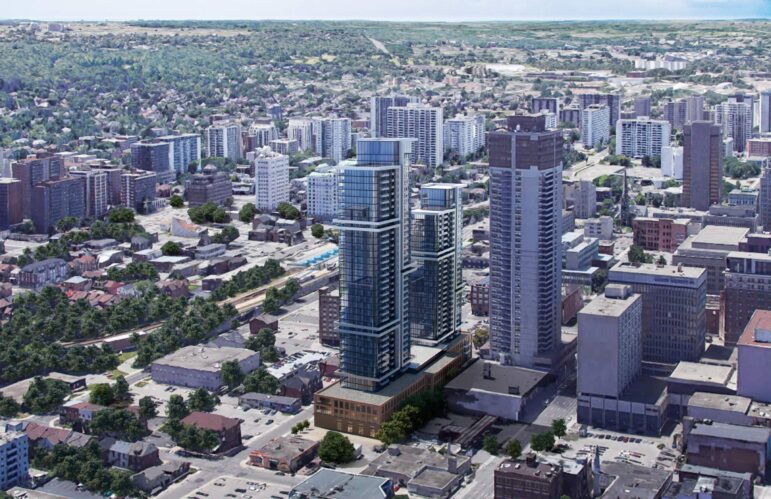
From this image it looks as if this build is slightly taller than landmark
Reply With Quote
     
     
  #39  
Old Posted Mar 8, 2023, 6:46 PM
TheRitsman TheRitsman is offline
Registered User
 
Join Date: Sep 2017
Location: Hamilton
Posts: 3,055
I also noticed there was a significant reduction in commercial space on the ground floor according to the more recent documents.
__________________
Hamilton Downtown. Huge tabletop skyline fan. Typically viewing the city from the street, not a helicopter. Cycling, transit and active transportation advocate 🚲🚍🚋

Follow me on Twitter: https://x.com/ham_bicycleguy?t=T_fx3...SIZNGfD4A&s=09
Reply With Quote
     
     
  #40  
Old Posted Mar 8, 2023, 7:42 PM
Innsertnamehere's Avatar
Innsertnamehere Innsertnamehere is online now
Registered User
 
Join Date: Jan 2010
Location: Hamilton
Posts: 12,733
Revised ground floor plan for reference - retail is now only along Catharine St.

Honestly I'm not surprised by this, Jackson isn't exactly a main retail street.

Reply With Quote
     
     
This discussion thread continues

Use the page links to the lower-right to go to the next page for additional posts
 
 
Reply

Go Back   SkyscraperPage Forum > Regional Sections > Canada > Ontario > Hamilton > Downtown & City of Hamilton
Forum Jump


Thread Tools
Display Modes

Forum Jump


All times are GMT. The time now is 7:09 PM.

     
SkyscraperPage.com - Privacy Statement - Top

Powered by vBulletin® Version 3.8.7
Copyright ©2000 - 2026, vBulletin Solutions, Inc.