HomeDiagramsDatabaseMapsForum About
     

Go Back   SkyscraperPage Forum > Regional Sections > United States > Midwest


Reply

 
Thread Tools Display Modes


  #1  
Old Posted Aug 16, 2021, 3:01 PM
marothisu marothisu is offline
Registered User
 
Join Date: Dec 2012
Location: Chicago
Posts: 6,930
Quote:
Originally Posted by the urban politician View Post
Lots of neat stuff in here, good job!

First of all, Bridgeport is now about 42% Asian? Damn. It's changing quite rapidly. At this rate, by the next census it could become majority Asian.
The largest percentage by group in 2020 IS Asian already. I believe in 2010 it was about equivalent with the White non-Hispanic group but it's now overtaken it. It shouldn't be a surprise really. I've talked about it in posts for a few years here and there's been articles on it in Sun Times even. There's more Chinese people in Bridgeport for the last handful of years than Chinatown and it's only increased.

In 2020 for Bridgeport:

Asian: 42.11%
White: 30.68%
Hispanic: 21.95%
Black: 2.67%
Other: 2.60%

One to keep an eye on over the next few decades will be McKinley Park:

Hispanic: 55.94%
Asian: 26.97%
White: 13.65%
Other: 1.84%
Black: 1.6%


Quote:
The Loop, Near West, and Near South are now about 1/5 Asian. Not sure about the Near North Side, though. But that's pretty impressive.
Near North Side had less Asian growth than estimated, but Near South Side had more than estimated. I'm not surprised though - I was stalking some of the real estate purchase records for a bit and South Loop had a lot of Chinese names on the records (as well as some Indian). South Loop is now pretty similar in makeup to my neighborhood in NYC for the last few years I think although South Loop is a little less white.

Quote:
Also, if the white population of Lincoln Park and Lakeview are decreasing, who are they being replaced with?
Here are the percentage point changes for each.. not percentage change but percentage point change..

Lincoln Park
Other (i.e. mixed race): +2.31 percentage points
Asian: +2.19 percentage points
Hispanic: +1.42 percentage points
Black: -0.19 percentage points
White: -5.74 percentage points

Lake View
Other: +2.65 percentage points
Asian: +1.5 percentage points
Hispanic: +1.44 percentage points
Black: -0.07 percentage points
White: -5.52 percentage points

Quote:
I see the black population of West Ridge inching up, and I'm betting that these are almost all African immigrants. I was just on Devon Ave in the past weekend and saw what I've been observing for years, more and more of what I guess to be Nigerians. There were Nigerians showing up in nice cars, finely dressed, for what appeared to be some sort of reception (wedding?) last weekend.
I'm not surprised. Those areas on the north side are a big port of entry for all sorts of immigrants especially from Middle East, South Asia, and Africa. I think parts of the south side are getting some of it too but not like this.
__________________
Chicago Maps:
* New Construction https://www.google.com/maps/d/viewer...B0&usp=sharing
Reply With Quote
     
     
  #2  
Old Posted Aug 20, 2021, 7:45 PM
the urban politician the urban politician is online now
The City
 
Join Date: Jul 2004
Location: Chicago region
Posts: 21,373
Has anybody seen this yet? I wish I could see a larger version:


Got it from Crains:

Quote:
Fascinating development on South Side lakefront
Census figures suggest Bronzeville and other mostly Black areas are starting to follow in the path of affluent North Side neighborhoods like Lincoln Park and Lakeview.

GREG HINZ

Is the South Side lakefront headed toward the same type of revival that has lifted the North Side in recent decades and made neighborhoods such as Lincoln Park, Lake View, Roscoe Village and North Center among the most desirable in the city?

The answer may well be yes, suggests some very solid new data emerging from the 2020 Census.

The phenomenon is in its early stages and is coming from a small base. But it appears real and is backed up by other data. If it continues, it suggests that despite all of Chicago’s other problems, a portion of the city that is heavily Black is making major strides to move up the economic scale.

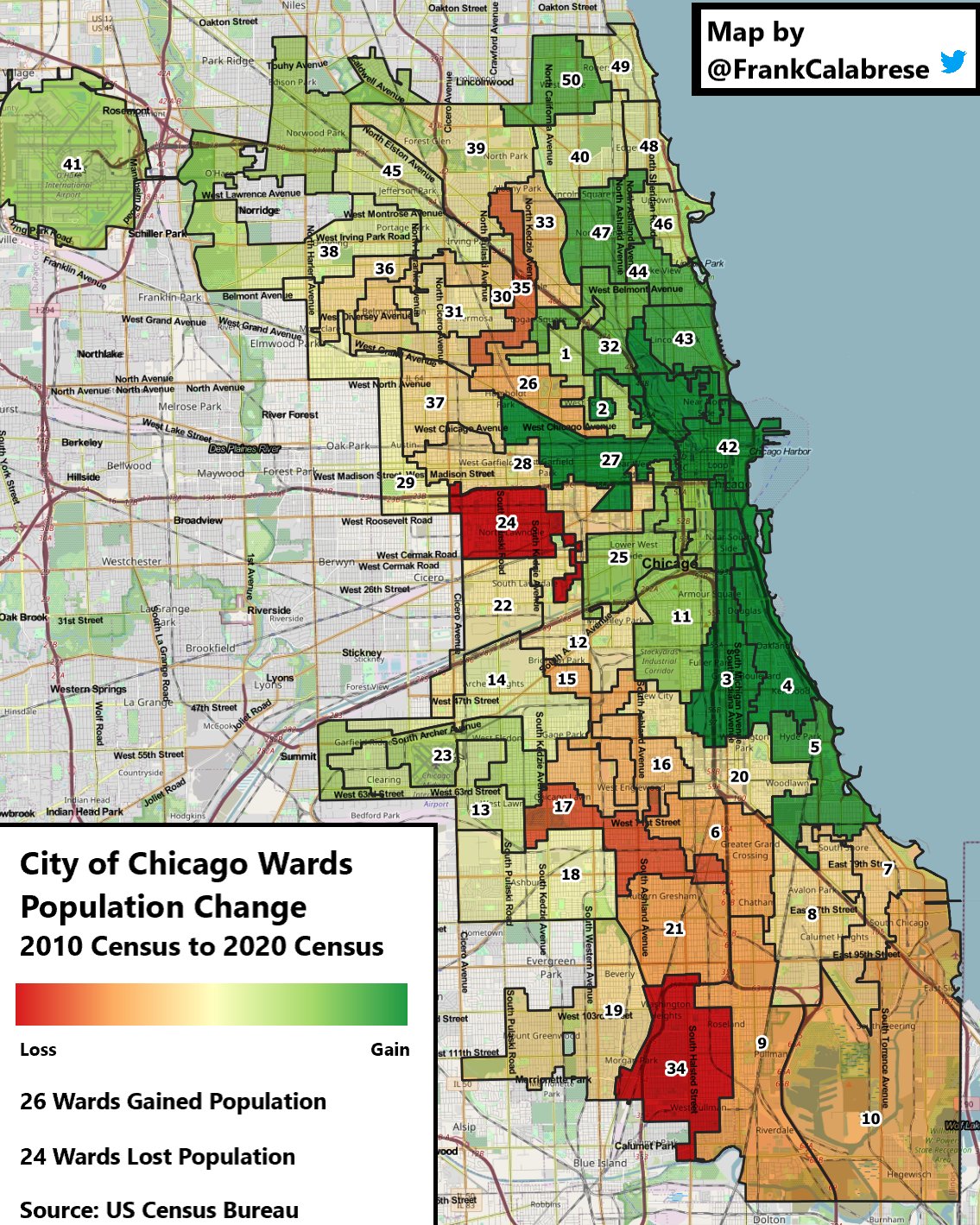
The data is the first actual population count by community area in the city. It comes from demographer and consultant Frank Calabrese, who developed it while working on upcoming ward reapportionment for the City Council’s Latino Caucus.

As expected, the data shows that population plummeted in the past decade in some, mostly outlying heavily Black portions of the South and West Side, while population in mostly white areas from the Loop north and west grew solidly.

What was really eye-catching, though, are gains on South Side neighborhoods along or close to the lakefront. All the way from the Loop down to Woodlawn, their population grew a lot, in some cases more than 10 percent.

Who are these people? According to Chicago demographer Ed Zotti, who first tipped me several years ago that interesting things were starting to happen on the South Shore, it’s mostly affluent, middle-class Black people with college degrees, many of them working in in the same kind of high-end service jobs downtown that power North Side neighborhoods.

“Chicago is on the leading edge of a trend toward a new Black middle class, consisting of college-educated professionals living in big-city neighborhoods with good access to downtown and to recreational and cultural amenities,” Zotti says.

His initial conclusions were based on American Community Survey data, another U.S. Census Bureau product that is less extensive than the census. But now that the census is out, we know population definitely is up in those South Side lakefront areas. And we’ll soon quite likely have data confirming the racial, educational and economic trends first seen in ACS data.

Real estate sources are fully aware of what’s going on. They’re busy making a lot money from the return of the Black middle class to Bronzeville and nearby areas.

My colleague Dennis Rodkin reported in May that 67 homes homes in Bronzeville sold for more than $500,000 in the past 12 months, up from 40 in the prior year and 36 in the year before that. Another 53 units worth that much were proposed or under construction. “Everything gets snapped up,” one developer told Rodkin.

That’s an utterly different story than in other Black neighborhoods miles farther South and West that are hemorrhaging people, neighborhoods that appear to be still be dependent on factory jobs that no longer exist.


Lots more research needs to be done. But as Mayor Lori Lightfoot tries to do her best to spark development in some of those other neighborhoods with her Invest South/West program, the new data suggests she ought to keep an eye on the South Side lakefront, because it’s a lot easier to keep build on an existing trend than start a new one.

The census figures indicate something really good and noticeable is occurring. The job now is to keep it going on.
https://www.chicagobusiness.com/greg...side-lakefront
__________________
Supercar Adventures is my YouTube channel:

https://www.youtube.com/channel/UC4W...lUKB1w8ED5bV2Q
Reply With Quote
     
     
  #3  
Old Posted Aug 20, 2021, 9:39 PM
marothisu marothisu is offline
Registered User
 
Join Date: Dec 2012
Location: Chicago
Posts: 6,930
Quote:
Originally Posted by the urban politician View Post
Has anybody seen this yet? I wish I could see a larger version:


Got it from Crains:


https://www.chicagobusiness.com/greg...side-lakefront
Yeah. Let's say some of my findings made it here but I'm not mentioned (usually I keep it like that).

There's no 2020 data yet other than population by race and basic housing stats, but basically from South Shore to the Loop added over 5000 black people from 2010 to 2020. Not big by percentage but good to see. All other groups out gained it though by a bit so Black % went down. Black college graduates according to the 2019 ACS in this area went up by 2X the amount of those 25+ in the group went up by.

South Shore to Douglas increased in population by over 8%.
__________________
Chicago Maps:
* New Construction https://www.google.com/maps/d/viewer...B0&usp=sharing
Reply With Quote
     
     
  #4  
Old Posted Aug 21, 2021, 1:44 AM
Brentsters Brentsters is offline
Registered User
 
Join Date: Mar 2006
Location: chicago
Posts: 249
Quote:
Originally Posted by the urban politician View Post
Has anybody seen this yet? I wish I could see a larger version:


https://twitter.com/GregHinz/status/...777413/photo/1
Reply With Quote
     
     
  #5  
Old Posted Aug 16, 2021, 3:06 AM
pip's Avatar
pip pip is offline
Registered User
 
Join Date: Mar 2003
Location: Chicago
Posts: 4,531
^I love your number crunching. Keep it coming.
Reply With Quote
     
     
  #6  
Old Posted Aug 16, 2021, 6:06 AM
Randomguy34's Avatar
Randomguy34 Randomguy34 is offline
Registered User
 
Join Date: Apr 2013
Location: Chicago & Philly
Posts: 2,695
Quote:
Originally Posted by sentinel View Post
As sprawl continues west and south in Chicagoland, I can foresee the greater Rockford MSA being engulfed as part of the greater Chicago MSA. There's 330,000 people in that area, that's enough to put Chicagoland over 10 Million. Right now, the eastern part of Rockford/Belvidere is only 30 minutes/35 miles from Huntley, and even 10 minutes/10 miles less to Marengo.
As of March, IDOT is still deciding if rail service to Rockford should be Metra or Amtrak. If it ends up being Metra, that could very well be the momentum to bring in the Rockford MSA. Also, double track upgrades on the SSL will speed the commute from South Bend to Chicago to only 90 minutes. That's the same amount of time as to Aurora, Elgin, and Joliet, despite South Bend being much farther. With Buttigieg as head of DOT, I can imagine earmarked funds to bring the SSL to downtown South Bend.

If Chicagoland is able to eventually stretch that far out, that's an additional 650,000 residents to the metro area for little work
Reply With Quote
     
     
  #7  
Old Posted Aug 17, 2021, 5:39 PM
the urban politician the urban politician is online now
The City
 
Join Date: Jul 2004
Location: Chicago region
Posts: 21,373
^ Every day we are hearing about small buildings, townhomes, 2-6 flats, etc getting permitted in these areas.

It's not a tidal wave of development, but slowly and surely they are getting new residents.
__________________
Supercar Adventures is my YouTube channel:

https://www.youtube.com/channel/UC4W...lUKB1w8ED5bV2Q
Reply With Quote
     
     
  #8  
Old Posted Aug 17, 2021, 6:35 PM
marothisu marothisu is offline
Registered User
 
Join Date: Dec 2012
Location: Chicago
Posts: 6,930
Quote:
Originally Posted by the urban politician View Post
^ Every day we are hearing about small buildings, townhomes, 2-6 flats, etc getting permitted in these areas.

It's not a tidal wave of development, but slowly and surely they are getting new residents.
Right. The good news is that this area has seen its fair share of multi unit development. A bunch of SFH too but it's fairly balanced unlike some other areas. That's good news. So many lots available for a fraction of the price. Will be interesting to see what this area does in the next 20 years. It would be good if there could be a resurgence culturally of what it once was. So much culture lost. Some new businesses have sprung up lately I see which is great but what could be in general... so much was lost it's at least 50% a blank slate now.

From a location perspective and even public transit, it's just as good as parts of Lakeview, Uptown, Lincoln Square, North Center, etc.
__________________
Chicago Maps:
* New Construction https://www.google.com/maps/d/viewer...B0&usp=sharing
Reply With Quote
     
     
  #9  
Old Posted Aug 17, 2021, 11:40 PM
UPChicago's Avatar
UPChicago UPChicago is offline
Vote for me for Mayor!
 
Join Date: Apr 2013
Location: Chicago
Posts: 801
Quote:
Originally Posted by marothisu View Post
Right. The good news is that this area has seen its fair share of multi unit development. A bunch of SFH too but it's fairly balanced unlike some other areas. That's good news. So many lots available for a fraction of the price. Will be interesting to see what this area does in the next 20 years. It would be good if there could be a resurgence culturally of what it once was. So much culture lost. Some new businesses have sprung up lately I see which is great but what could be in general... so much was lost it's at least 50% a blank slate now.

From a location perspective and even public transit, it's just as good as parts of Lakeview, Uptown, Lincoln Square, North Center, etc.
Bronzeville is closer to the loop and is a quicker commute by transit in my experience. Looking forward to the area’s continued growth.
Reply With Quote
     
     
  #10  
Old Posted Aug 21, 2021, 2:49 AM
the urban politician the urban politician is online now
The City
 
Join Date: Jul 2004
Location: Chicago region
Posts: 21,373
^ Seriously, look at the shape of the second ward. That’s just pure corruption
__________________
Supercar Adventures is my YouTube channel:

https://www.youtube.com/channel/UC4W...lUKB1w8ED5bV2Q
Reply With Quote
     
     
  #11  
Old Posted Aug 21, 2021, 2:53 AM
tjp tjp is offline
Registered User
 
Join Date: Apr 2013
Posts: 431
I'm honestly surprised to hear that South Shore gained population... The narrative I had been hearing is that it was a formerly black middle / working class neighborhood that has become more violent and less desirable in recent years?
Reply With Quote
     
     
  #12  
Old Posted Aug 22, 2021, 1:23 AM
marothisu marothisu is offline
Registered User
 
Join Date: Dec 2012
Location: Chicago
Posts: 6,930
Quote:
Originally Posted by tjp View Post
I'm honestly surprised to hear that South Shore gained population... The narrative I had been hearing is that it was a formerly black middle / working class neighborhood that has become more violent and less desirable in recent years?
From a real estate perspective, South Shore had been selling well for awhile now from all the reports and data I saw.

From a crime perspective, I can't speak for it since I'm not there but statistically 2020 for many types wasn't really any or much higher than 2010 there. Some rates like Robbery and Burglary were way lower in 2019 and 2020 than 2010. No different than some other places in the city. Crimes like Assault may be down technically but shootings and homicides are up.

These have been adjusted via population - for 2019 I used the 2020 census number.

Assault (of any kind)
2020: 1547.13 per 100K
2019: 1476.64 per 100K
2010: 1530.47 per 100K

Not a world of difference

Robbery
2020: 487.3 per 100K
2019: 563.35 per 100K
2010: 963.28 per 100K

2020 was half of what 2010 was. 2019 was way lower than 2010.

Battery
2020: 4669.17 per 100K
2019: 3955.01 per 100K
2010: 3697.37 per 100K

2020 is a bit higher than 2010.

Burglary
2020: 791.17 per 100K
2019: 984.43 per 100K
2010: 2345.7 per 100K

2019 and 2020 were way lower than 2010.

Theft
2020: 2117.8 per 100K
2019: 2812.92 per 100K
2018: 3672.37 per 100K

2020 and 2019 were a lot lower than 2010.


Now as far as the differences in racial makeup of South Shore?
Other: +781 people
Black: +473 people
Hispanic: +459 people
White: +224 people
Asian: +24 people

The Hispanic population is expanding quite a bit in parts of the south side. West Englewood went from 2% to nearly 20% in a decade. Auburn Gresham went from under 1% in 2010 to fast approaching 4%. It'll be interesting to see what happens there and how much it goes into places like Chatham, South Shore, etc over the next decade or two.
__________________
Chicago Maps:
* New Construction https://www.google.com/maps/d/viewer...B0&usp=sharing
Reply With Quote
     
     
  #13  
Old Posted Aug 22, 2021, 2:37 PM
Steely Dan's Avatar
Steely Dan Steely Dan is online now
devout Pizzatarian
 
Join Date: Jul 2001
Location: Lincoln Square, Chicago
Posts: 29,964
Quote:
Originally Posted by marothisu View Post

The Hispanic population is expanding quite a bit in parts of the south side. West Englewood went from 2% to nearly 20% in a decade.
Wow, that's a pretty big demo change for one decade.

I had heard people here report that shift was starting to happen in west Englewood, but it's still interesting to see that reflected in the real data
__________________
"Missing middle" housing can be a marvelous middle ground for many middle class families.
Reply With Quote
     
     
  #14  
Old Posted Aug 22, 2021, 3:06 AM
galleyfox galleyfox is offline
Registered User
 
Join Date: Dec 2018
Posts: 1,149
Quote:
Originally Posted by tjp View Post
I'm honestly surprised to hear that South Shore gained population... The narrative I had been hearing is that it was a formerly black middle / working class neighborhood that has become more violent and less desirable in recent years?
I recently moved to South Chicago by Eckersall Park. The reality that I can see on the ground right now is that investors are rapidly trying to upgrade every single vacant or rundown property they can get their hands on in South Shore.

On just my 15 min walk to the Metra, I see 5 properties getting the gut rehab treatment. Though the 79th commercial street has a ways to go.

My impression is that there’s been definite decline compared to the 1970-1980s which is the narrative comes from. The neighborhood hit rock bottom amid the 2009 financial crisis when all the foreclosures happened.

But the market has now turned around so that the foreclosure properties are coming back on the market with new renovations.
Reply With Quote
     
     
  #15  
Old Posted Aug 22, 2021, 3:05 PM
the urban politician the urban politician is online now
The City
 
Join Date: Jul 2004
Location: Chicago region
Posts: 21,373
All of the investment and rehab of properties in historically low income areas for apartments, at least, will eventually come to a screeching halt if the eviction moratorium keeps dragging on, though.

Housing providers of all racial backgrounds have a major hand tied behind their back if they can’t rely on the justice of being able to remove a nonpaying tenant. That threatens the stability of their investment and ultimately can slow investment down.

The funding streams going into these rehabs are probably from before, and also under the assumption that this is a temporary state of affairs, but as long as politicians keep extending the eviction moratorium further and further into the future it creates a sort of existential crisis for building owners—“Is this even my property any more? What happens if my tenant just decides to stop paying? I have zero recourse against him/her”. This has got to be in the mind of millions of owners and their lenders, which is why I’m guessing you are not seeing many banks seize rental properties in default right now because banks don’t want to be stuck with this lousy situation.

I mention this here because this threatens to derail investment in lower income areas of the city for all but for sale housing. I would hate to see our current progress stall.
__________________
Supercar Adventures is my YouTube channel:

https://www.youtube.com/channel/UC4W...lUKB1w8ED5bV2Q
Reply With Quote
     
     
  #16  
Old Posted Aug 22, 2021, 4:22 PM
marothisu marothisu is offline
Registered User
 
Join Date: Dec 2012
Location: Chicago
Posts: 6,930
I finally got around to finishing the analysis for 2020 by community area and also versus 2010. Here are some of the changes by percentage points. Not percentage change, but percentage points. In other words, if a community area went from 14% Asian to 16%, then that is 2 percentage points.


Increases
Top Increases in White Non-Hispanic Population
1. Logan Square: +11.71 percentage points
2. Avondale: +8.22
3. Lower West Side: +6.46
4. West Town: +4.51
5. Humboldt Park: +4.37
6. East Garfield Park: +1.78
7. Hermosa: +1.25
8. North Lawndale: +1.03
9. Irving Park: +1.01
10T. Albany Park: +0.98
10T. Fuller Park: +0.98
12. Near West Side: +0.95
13. Grand Boulevard: +0.79
14. Rogers Park: +0.76
15. Woodlawn: +0.72

Top Increases in Hispanic Population
1. West Englewood: +17.49 percentage points
2. Garfield Ridge: +14.72
3. Clearing: +13.82
4. Chicago Lawn: +13.72
5. Fuller Park: +11.32
6. Dunning: +11.02
7. Austin: +10.4
8. New City: +10.17
9. Ashburn: +9.78
10. Hegewisch: +8.14
11. Montclare: +7.41
12. West Lawn: +7.31
13. Archer Heights: +6.14
14. North Lawndale: +5.66
15. Englewood: +5.53
16. West Elsdon: +5.47
17. Humboldt Park: +5.24
18. Jefferson Park: +4.77
19. West Garfield Park: +4.7
20. Portage Park: +4.65
21. Norwood Park: +4.3
22. East Garfield Park: +4.19
23. South Lawndale: +3.91
24. East Side: +3.65
25. Mount Greenwood: +3.47

Many more above +1

Top Increases in Non-Hispanic Black Population
1. Hegewisch: +4.89 percentage points
2. West Ridge: +2.45
3. Montclare: +1.66
4. Lower West Side: +1.48
5. Dunning: +1.16
6. Clearing: +1.06
7. North Park: +1.04
8. Portage Park: +0.85
9. East Side: +0.81
10. Jefferson Park: +0.6
11. Bridgeport: +0.56
12. Armour Square: +0.55
13. Avondale: +0.52
14. Norwood Park: +0.5
15. Irving Park: +0.49

Top Increases in Non-Hispanic Asian Population
1. McKinley Park: +11.31 percentage points
2. Bridgeport: +7.53
3. O'Hare: +6.3
4. Brighton Park: +5.9
5. The Loop: +4.78
6. Near South Side: +4.62
7. Near West Side: +4.16
8. Hyde Park: +3.88
9. Archer Heights: +3.27
10. West Ridge: +2.32
11. Lincoln Park: +2.19
12. West Town: +2
13. Forest Glen: +1.89
14. Lower West Side: +1.87
15. Logan Square: +1.82
16. Kenwood: +1.68
17. North Center: +1.61
18. Near North Side: +1.56
19. Jefferson Park: +1.55
20. Lake View: +1.5
21T. Avondale: +1.42
21T. West Elsdon: +1.42
23. Edgewater: +1.35
24. North Park: +1.31
25. Norwood Park: +1.21

Top Increases in Other (i.e. mixed race, Hawaiian/Native American) Population
1. North Center: +3.08 percentage points
2. Near South Side: +2.69
3. Lake View: +2.65
4. Logan Square: +2.5
5. West Town: +2.37
6. Lincoln Park: +2.31
7. Edison Park: +2.1
8. Forest Glen: +2.09
9. Hyde Park: +2.04
10. Rogers Park: +2.03
11T. The Loop: +2.02
11T. Uptown: +2.02
13. Lincoln Square: +2
14. Fuller Park: +1.99
15. Edgewater: +1.97
16. Avondale: +1.96
17. Woodlawn: +1.88
18. Near North Side: +1.83
19. Beverly: +1.79
20. Near West Side: +1.78
21. Norwood Park: +1.77
22. Mount Greenwood: +1.76
23. Burnside: +1.73
24. Morgan Park: +1.7
25. Irving Park: +1.68
26. Jefferson Park: +1.61
27. Lower West Side: +1.6
28. Kenwood: +1.57
29. Douglas: +1.54
30. Grand Boulevard: +1.47


Decreases
Top Decreases in White Non-Hispanic Population
1. Clearing: -15.71 percentage points
2. Garfield Ridge: -14.83
3. Dunning: -14.5
4. Hegewisch: -13.8
5. Montclare: -10.58
6. Archer Heights: -9.75
7. O'Hare: -8.81
8. Jefferson Park: -8.53
9. Portage Park: -8.31
10. Norwood Park: -7.8
11. West Elsdon: -7.41
12. Ashburn: -6.43
13. Forest Glen: -6.32
14. West Lawn: -6.29
15. West Ridge: -6.1
16. Hyde Park: -5.88
17T. Lincoln Park: -5.74
17T. The Loop: -5.74
19. Edison Park: -5.6
20. Lake View: -5.52
21. East Side: -5.14
22. Bridgeport: -4.48
23. Mount Greenwood: -4.07
24. North Park: -3.93
25. Belmont Cragin: -3.84
26. North Center: -3.83
27. Near South Side: -3.68
28. Beverly: -3.57
29. McKinley Park: -3.44
30. Brighton Park: -2.62

Top Decreases in Hispanic Population
1. Logan Square: -14.97 percentage points
2. Avondale: -12.11
3. Lower West Side: -11.4
4. McKinley Park: -8.82
5. West Town: -7.49
6. Bridgeport: -5.07
7. Irving Park: -4.27
8. Brighton Park: -3.7
9. Albany Park: -2.57
10. Hermosa: -2.42
11. Rogers Park: -1.8
12. Lincoln Square: -1.69
13. Edgewater: -1.45
14. Uptown: -0.94
15. North Center: -0.76

Top Decreases in Non-Hispanic Black Population
1. West Englewood: -18.98 percentage points
2. Fuller Park: -14.58
3. Chicago Lawn: -12.71
4. Humboldt Park: -11.08
5. New City: -10.84
6. Austin: -10.52
7. North Lawndale: -7.77
8. East Garfield Park: -7.46
9. Near West Side: -7.43
10. Englewood: -7.33
11. West Garfield Park: -6.68
12. Near South Side: -5.3
13. Woodlawn: -5.23
14. Avalon Park: -4.79
15. South Lawndale: -4.37
16. Auburn Gresham: -4.06
17. Kenwood: -4.04
18. Ashburn: -3.76
19. Oakland: -3.63
20. Grand Boulevard: -3.61
21. Burnside: -3.32
22. Washington Park: -3.2
23. Roseland: -3.02
24. Near North Side: -2.72
25. South Shore: -2.57
26. West Pullman: -2.53
27. The Loop: -2.47
28. Riverdale: -2.39
29. Douglas: -2.34
30. Morgan Park: -2.28

Top Decreases in Non-Hispanic Asian Population
1. Uptown: -0.57 percentage points
2. Austin: -0.2
3. Douglas: -0.17
4. Ashburn: -0.16
5. West Lawn: -0.12

Top Decreases in Other (i.e. mixed race, Hawaiian/Native American) Population
NONE - every area had increases in percentage share.
__________________
Chicago Maps:
* New Construction https://www.google.com/maps/d/viewer...B0&usp=sharing
Reply With Quote
     
     
  #17  
Old Posted Aug 22, 2021, 5:21 PM
the urban politician the urban politician is online now
The City
 
Join Date: Jul 2004
Location: Chicago region
Posts: 21,373
^ Great info. I will be looking at this for days

O’Hare is becoming less white and more Asian
Midway is becoming less white and more Hispanic
Logan Square/Avondale and the lower west side becoming less Hispanic and more white
Some historically black areas like Austin, W Englewood, N Lanwdale, E. Garfield Park turning Hispanic rather quickly

Nothing here surprising, but it’s nice to have actual data quantifying it all.
__________________
Supercar Adventures is my YouTube channel:

https://www.youtube.com/channel/UC4W...lUKB1w8ED5bV2Q
Reply With Quote
     
     
  #18  
Old Posted Aug 22, 2021, 5:28 PM
Steely Dan's Avatar
Steely Dan Steely Dan is online now
devout Pizzatarian
 
Join Date: Jul 2001
Location: Lincoln Square, Chicago
Posts: 29,964
marothisu, thank you for compiling all that info!

Taking a 30,000' view, the main over-arching demo trend within the city, other than continued black flight out of the city altogether, seems to be Hispanics being pushed/pulled from inner neighborhoods to outer neighborhoods.
__________________
"Missing middle" housing can be a marvelous middle ground for many middle class families.

Last edited by Steely Dan; Aug 22, 2021 at 5:45 PM.
Reply With Quote
     
     
  #19  
Old Posted Aug 22, 2021, 5:53 PM
marothisu marothisu is offline
Registered User
 
Join Date: Dec 2012
Location: Chicago
Posts: 6,930
Quote:
Originally Posted by Steely Dan View Post
marothisu, thank you for compiling all that info!

Taking a 30,000' view, the main over-arching demo trend within the city, other than continued black flight out of the city altogether, seems to be Hispanics being pushed from inner neighborhoods to outer neighborhoods.
These are only percentages, so it's hard to get an accurate reading of the raw numbers, which I'll post later. This is true in a few areas, but largely the population in most areas is increasing. Of the 77 community areas, 19 of them had a reduction in Hispanic population.

It's a little more nuanced than that though.

Near North, South, West, The Loop, Lakeview, Lincoln Park, Douglas, Hyde Park, Kenwood, Woodlawn, South Shore, Grand Boulevard, Washington Park, Greater Grand Crossing, Washington Park, Fuller Park, Armour Square, Oakland, and North Center had an increase of 12,087 Hispanic people from 2010 to 2020. On the other hand, Lincoln Square, Edgewater, Rogers Park, Uptown, Albany Park, West Ridge and Irving Park lost a collective 7670 Hispanic people in the same time period. West Ridge actually gained.

So you could say that the Hispanic population from the Far North and part of the NW side actually "migrated" to the greater downtown area and south lakefront area. The Hispanic population in the center of the city went up, not down.

__________________
Chicago Maps:
* New Construction https://www.google.com/maps/d/viewer...B0&usp=sharing
Reply With Quote
     
     
  #20  
Old Posted Aug 22, 2021, 6:52 PM
the urban politician the urban politician is online now
The City
 
Join Date: Jul 2004
Location: Chicago region
Posts: 21,373
More great information from Yuriandrade in another thread. Using his metric, the central area of a Chicago grew by over 57,000 people from 2010-2020

Quote:
Originally Posted by yuriandrade View Post
Here you are:

---------------------- 2020 ------ 2010 ------ 2000 ------ 1990

Near North Side ------ 105,481 ----- 80,484 ---- 72,811 ---- 62,842 ----- 31.1% ----- 10.5% ----- 15.9% ------ 6.8 km²

Loop -------------------- 42,298 ----- 29,283 ---- 16,388 ---- 11,954 ----- 44.4% ----- 78.7% ----- 37.1% ------ 3.9 km²

Near South Side ------- 28,795 ----- 21,390 ----- 9,509 ----- 6,828 ----- 34.6% ---- 124.9% ----- 39.3% ------ 4.6 km²

Near West Side -------- 48,719 ----- 36,789 ---- 21,689 ---- 17,978 ----- 32.4% ----- 69.6% ----- 20.6% ------ 7.4 km²

Central Chicago ---- 225,293 --- 167,946 --- 120,397 ---- 99,602 ----- 34.1% ----- 39.5% ----- 20.9% ------ 22.8 km²

Chicago MSA ----- 9,618,502 - 9,461,105 - 9,098,314 - 8,182,076 ------ 1.7% ------ 4.0% ----- 11.2% -- 18,634 km²


For Near West Side, as it's way too big, I considered only the eastern half of it, using 10 censos tracts.

As it happens in Near North Side, it's the census tracts near Loop the ones booming, in both NSS an NWS. In fact, the southernmost census tract in NSS, majority Black, is actually collapsing. In 1990, it made up 40% of NSS population. Today, it represents mere 4%.

Another thing: Chicago city proper minus Central Chicago declined by 7,000 people.
.
__________________
Supercar Adventures is my YouTube channel:

https://www.youtube.com/channel/UC4W...lUKB1w8ED5bV2Q
Reply With Quote
     
     
This discussion thread continues

Use the page links to the lower-right to go to the next page for additional posts
 
 
Reply

Go Back   SkyscraperPage Forum > Regional Sections > United States > Midwest
Forum Jump


Thread Tools
Display Modes

Forum Jump


All times are GMT. The time now is 5:16 PM.

     
SkyscraperPage.com - Privacy Statement - Top

Powered by vBulletin® Version 3.8.7
Copyright ©2000 - 2026, vBulletin Solutions, Inc.